Why wholesale boosts food brand growth and reach

TL;DR:Wholesale offers extensive market reach and operational relief for growing food brands.Transitioning to wholesale is strategic, often surpassing direct sales in profit as brands scale.Choosing the right wholesale partner requires assessing reach, reputation, terms, and logistics capability.
Many food brand owners assume that selling direct to retailers always means higher profits. Cut out the middleman, keep the margin, stay in control. It sounds logical. But for brands moving beyond their first 50 or 100 accounts, this thinking often leads to burnout, bottlenecks, and stalled growth. The UK wholesale food sector generates around £30 billion in annual turnover and supports over 400,000 businesses. That scale exists for a reason. This guide breaks down how wholesale distribution actually works, what it costs you in margin versus what it gives you in reach, and how to decide when the wholesale route is the right move for your brand.
Table of Contents
- How wholesale distribution works for food brands
- Direct sales versus wholesale: Key differences and trade-offs
- Key benefits of partnering with wholesalers
- How to choose the right wholesale partner
- Why the best food brands succeed with wholesale – our perspective
- Grow your brand with wholesale opportunities
- Frequently asked questions
Key Takeaways
| Point | Details |
|---|---|
| Wholesale simplifies growth | Wholesalers handle logistics and distribution, allowing brands to focus on making and marketing their products. |
| Lower margins, wider reach | Brands trade some margin for access to hundreds of new retail accounts and faster scaling. |
| Resilience in uncertain markets | Wholesale partners help brands stay stable and reach customers reliably during market fluctuations. |
| Choose strategically | Selecting the right wholesale partner is essential for long-term brand success and efficient growth. |
How wholesale distribution works for food brands
A wholesaler sits between your brand and the retailers or foodservice businesses you want to supply. Rather than you managing dozens of individual deliveries, invoices, and stock queries, the wholesaler absorbs that operational load. They buy from you in volume, store your products in their warehouse, and handle last-mile delivery to their network of customers.
For food brands, this model removes a significant layer of complexity. You are no longer coordinating refrigerated vans, chasing late payments from independent shops, or fielding calls about damaged stock. The wholesaler owns that relationship with the end buyer, and you focus on making and marketing your product.
The core activities a good wholesale partner handles include:
- Bulk purchasing and inventory management
- Warehousing and cold chain storage where required
- Order fulfilment and delivery logistics
- Credit management with retail customers
- Merchandising support and ranging advice
The scale of this infrastructure in the UK is substantial. Wholesalers streamline distribution by buying in bulk from manufacturers, warehousing products, and delivering to independent retailers, restaurants, and other businesses, significantly reducing the logistics burden on brands. The industry employs around 60,000 people and supplies over 400,000 outlets across the country.
The UK food wholesale sector turns over approximately £30 billion annually, supplying more than 400,000 businesses. For growing food brands, tapping into this network means instant access to a distribution infrastructure that would take years and millions to build independently.
Understanding UK food logistics for wholesalers is essential before committing to any distribution route. The variety of food distribution channels available means there is rarely a one-size-fits-all answer, but wholesale consistently offers the most scalable foundation for brands targeting independent retail.
Direct sales versus wholesale: Key differences and trade-offs
Direct sales have genuine advantages, especially early on. You keep more margin per unit, you control the customer relationship, and you get unfiltered feedback from buyers. For a brand with 20 or 30 accounts, this works well.
The problems start when you grow. At 75 to 100 accounts, the admin load becomes unsustainable for most small teams. You are managing route planning, invoicing, credit control, returns, and stock rotation across dozens of relationships simultaneously. The gross margin looks healthy on paper, but the true cost in time and resource often erodes it.
Wholesale margins typically sit at 10 to 25%, lower than direct, but brands trade that margin for reach and operational simplicity when scaling beyond 75 to 100 accounts. The maths often favours wholesale once you account for the full cost of running direct distribution at scale.
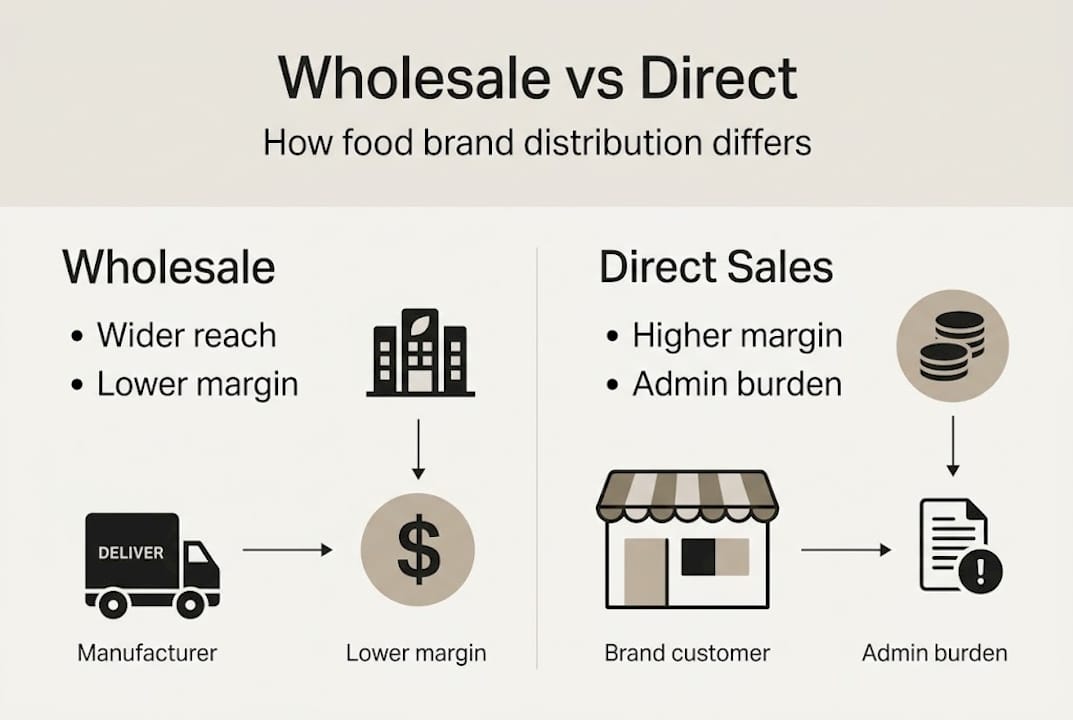
Research into distribution models also shows that direct sales are more common among smaller operations, with larger producers shifting to wholesale and processing channels as they grow. Infrastructure gaps consistently hinder short supply chains at scale.
Here is a straightforward comparison to help you think through the decision:
| Factor | Direct sales | Wholesale |
|---|---|---|
| Margin per unit | Higher (30-50%+) | Lower (10-25%) |
| Market reach | Limited by your capacity | Hundreds of outlets via network |
| Admin burden | High | Low |
| Cash flow | Variable | More predictable |
| Speed to scale | Slow | Fast |
| Brand control | Full | Shared |
The steps to assess which model fits your stage:
- Count your current active accounts and project growth over 12 months
- Calculate the true cost of your current direct distribution (time, fuel, admin, credit risk)
- Identify the margin you would give up through wholesale versus the volume you would gain
- Assess whether your team can absorb a doubling of accounts without additional hires
- Speak to brands at a similar stage who have made the transition
Pro Tip: Calculate your break-even point where the cost of managing direct accounts exceeds the extra margin you earn. For most brands, this lands somewhere between 60 and 90 active accounts. Once you cross that threshold, wholesale almost always delivers better net profit.
A strong food brand strategy accounts for this transition point in advance. Understanding brand acceleration in food means knowing when to hand off logistics and focus your energy on product and positioning.
Key benefits of partnering with wholesalers
The most obvious benefit is reach. A well-connected wholesaler already serves hundreds or thousands of retailers. Getting your product into their catalogue means instant visibility across accounts you could never service efficiently on your own.

Financial resilience is another underrated advantage. The BAKO co-operative model is a compelling example. BAKO grew from £90 million turnover to £242 million by building a co-operative structure where baker shareholders deepened loyalty and increased collective buying power. The model created stability that purely transactional relationships rarely achieve.
Wholesale partnerships also proved their value during industry shocks. Wholesale enabled resilience during Covid in ways that direct-only brands struggled to match. Brands with established wholesale relationships had predictable order flows even when individual retail footfall collapsed.
Here is a quick-reference summary of the key benefits:
| Benefit | Description | Example |
|---|---|---|
| Wider reach | Access to 400,000+ outlets via existing networks | New brand listed across 200 independents in weeks |
| Operational relief | Wholesaler handles logistics, storage, and delivery | Brand team focuses on NPD and marketing |
| Financial stability | Predictable bulk orders smooth cash flow | Fewer bad debts from individual retailers |
| Crisis resilience | Established channels hold during market shocks | Maintained revenue during Covid disruptions |
| Growth leverage | Volume growth without proportional cost increase | Margin improves as production scales |
Key advantages for food brands working with wholesalers:
- Reduced time spent on route planning and delivery coordination
- Access to buyer relationships built over years by the wholesaler
- Shared marketing and promotional support in many cases
- Faster new product launches across multiple accounts simultaneously
Pro Tip: If your wholesaler offers a loyalty or co-operative scheme, engage with it actively. Brands that participate in these programmes often secure better payment terms, priority ranging, and co-funded promotional activity.
For strategic food brands looking to build lasting retail presence, wholesale is frequently the most direct route. It also positions you to respond quickly when adapting to food trends becomes a competitive priority.
How to choose the right wholesale partner
Not all wholesalers are equal. Choosing the wrong partner can mean your product sits in a warehouse with no active selling, poor retailer fit, and slow payment terms that damage your cash flow.
Start by assessing these factors before committing:
- Market reach: How many accounts do they serve, and do those accounts match your target retail profile?
- Product fit: Does their existing range complement your brand, or will you be lost among competitors?
- Reputation: Speak to other brands they distribute. Ask about communication, payment reliability, and support.
- Commercial terms: Understand minimum order quantities, payment timings, return policies, and any listing fees.
- Logistics capability: Can they handle your specific requirements, whether that is chilled, ambient, or specialist storage?
Must-ask questions when evaluating a wholesaler:
- What is the minimum order quantity and how often do you reorder?
- What are your standard payment terms and do you offer early payment incentives?
- How do you handle damaged or short-dated stock?
- What marketing or promotional support do you provide to listed brands?
- How do you communicate sell-through data and retailer feedback?
Red flags to watch for include vague answers about payment timelines, reluctance to provide references from current brand partners, and overpromising on distribution reach without evidence. Positive signals include transparent reporting, a clear onboarding process, and genuine enthusiasm for your product category.
Wholesalers reduce the logistics burden significantly, but only when the partnership is well-structured from the start. Spend time on the contract and relationship before you commit stock.
Useful food logistics tips can help you prepare for these conversations. Running a trend analysis for food brands before approaching wholesalers also strengthens your pitch by showing you understand where the market is heading.
Why the best food brands succeed with wholesale – our perspective
Here is something most distribution guides will not tell you: the brands that struggle most with wholesale are the ones who treated it as a last resort rather than a strategic choice.
We see it regularly. A brand builds a loyal direct customer base, hits a growth ceiling, and only then considers wholesale out of desperation. By that point, they are often exhausted, undercapitalised, and negotiating from weakness. The brands that thrive are the ones who plan the wholesale transition deliberately, usually before they feel the operational pressure.
There is also a persistent myth that high gross margins mean higher profitability. When you factor in the true overhead of direct distribution, including driver time, vehicle costs, credit risk, and admin hours, many brands discover their net margin on direct accounts is lower than they thought. Wholesale, at the right volume, often delivers better net returns.
The smartest brands we work with view wholesalers as growth partners, not just order-takers. They share market intelligence, collaborate on promotions, and use the wholesaler’s retailer relationships to test new products quickly. Understanding the full range of food distribution approaches available helps brands make this shift with confidence rather than reluctance.
Sustainable brand growth in the UK almost always involves a blend of direct and wholesale at the right stage. The key is knowing when to make the shift.
Grow your brand with wholesale opportunities
At Woodford, we work with food brands at every stage of growth, from ambitious independents launching into retail for the first time to established names looking to deepen their presence across the UK. Our platform connects brands with hundreds of independent retailers through a curated, trend-led approach that goes well beyond simple logistics. You can explore our food brands to see the calibre of producers we represent, and browse current promotions to understand how we actively support sell-through for our brand partners. If you are ready to scale without the operational headache, we would love to talk.
Frequently asked questions
What is a food wholesaler and how do they support brands?
A food wholesaler buys in bulk from brands, stores products, and delivers to retailers, making distribution far more efficient for both parties. They essentially absorb the logistics complexity so brands can focus on growth.
How does wholesale help food brands grow?
Wholesale connects your brand to a network of 400,000+ businesses across the UK, giving you reach that would take years to build through direct sales alone. It allows you to scale volume without scaling your operational headcount.
Is wholesale or direct sales better for food brands?
Direct sales suit early-stage brands with manageable account numbers and a need for high margins, but larger producers shift to wholesale as they grow because direct infrastructure gaps make short supply chains unsustainable at scale.
What margin do food brands get from wholesale?
Brands typically earn 10 to 25% margins through wholesale, which is lower than direct, but the volume uplift and reduced operational costs often result in stronger net profitability overall.
Recommended
- What is brand acceleration in food: a guide for UK retailers - WOODFORD - Bringing quality foods your way
- WOODFORD - Bringing quality foods your way
- Strategic food brands for UK independent retailers - WOODFORD - Bringing quality foods your way
- Food brand strategy drives UK retail success in 2026 - WOODFORD - Bringing quality foods your way