Compliance as a competitive edge in UK food wholesale

TL;DR:Over 95% of UK food businesses are broadly compliant, but even minor non-compliance risks costly recalls and reputational damage. Effective compliance requires active management through proven methodologies like HACCP, supplier monitoring, and digital record-keeping, especially in high-risk categories such as allergens and imports. Investing in technology and embedding compliance into daily operations significantly enhances trust, reduces risks, and strengthens market position.
Over 95% of inspected UK food businesses achieve broad compliance, yet that headline figure masks a harder truth: even a small margin of non-compliance can trigger costly product recalls, enforcement action, or permanent reputational damage. For food compliance managers and decision-makers working in wholesale distribution, the gap between “broadly compliant” and “genuinely protected” is precisely where the real risk lives. This article walks through the legal foundations, operational methodologies, high-risk scenarios, and digital tools that define world-class compliance, giving you a clear, practical framework to protect your business and strengthen your position in the supply chain.
Table of Contents
- Understanding compliance in UK food wholesale
- Core compliance methodologies: Setting the gold standard
- Managing special risks: Approval, allergens and evolving threats
- Powering compliance through technology and continuous improvement
- Beyond the checklist: Why genuine compliance is your greatest asset
- Take your compliance and supply chain further with Woodford
- Frequently asked questions
Key Takeaways
| Point | Details |
|---|---|
| Compliance safeguards safety | Compliance ensures food safety, legality, and trust across the UK wholesale chain. |
| Proactive systems prevent failure | Ongoing audits, supplier approval, and digital traceability guard against costly non-compliance. |
| Allergens are a critical risk | Undeclared allergens remain the main cause of recalls, making rigorous controls a must for wholesalers. |
| Continuous improvement is key | Treating compliance as an asset enables competitive advantage and future-proofs business operations. |
Understanding compliance in UK food wholesale
Compliance in food wholesale is not simply about passing an inspection. It is the active, documented management of every process that keeps food safe, legal, and traceable from supplier intake to retailer delivery. The Food Safety Act 1990 established due diligence as the central defence for all food business operators, including wholesalers, requiring them to demonstrate that every reasonable precaution was taken to avoid an offence.
The legal framework rests on three pillars. First, the Food Safety Act 1990 sets overarching duties on safety and fitness for purpose. Second, General Food Law (EC Regulation 178/2002, retained in UK law post-Brexit) places traceability obligations on every link in the supply chain. Third, the Food Hygiene Regulations 2006 govern the operational hygiene standards applicable to premises, transport, and temperature control.
What this means in practice is that wholesalers carry a distinct and serious responsibility. You are not merely passing products along; you are actively verifying that your suppliers are compliant, that your own operations meet legal standards, and that the retailers you supply can trust the integrity of every SKU you distribute. Solid food logistics compliance is the backbone of that trust.
“Due diligence is not a one-time exercise. It is a living system of checks, documentation, and verification that must be maintained consistently across every supplier relationship and every product line.”
For independent retailers, the implications are direct. When their wholesale partner maintains rigorous compliance, they benefit from reduced risk of recalls, stronger product confidence, and more straightforward conversations with their own environmental health officers. Well-executed logistics tips for retailers consistently point back to the importance of choosing wholesale partners whose compliance infrastructure is genuinely robust.
Core compliance methodologies: Setting the gold standard
Understanding the legal obligation is one thing. Building the operational systems that deliver consistent compliance every day is another challenge entirely. The gold standard in wholesale food compliance is built on five interlocking methodologies, each reinforcing the others.
- HACCP-based risk management requires wholesalers to identify critical control points across all product handling activities, from goods-in through cold storage to despatch. Under General Food Law, HACCP is mandatory for food business operators, and its principles must be documented, validated, and reviewed regularly.
- Supplier approval and monitoring involves structured vetting before any new supplier is onboarded, including review of certifications, site audits where warranted, and product specifications. Ongoing monitoring ensures that approval is not a one-off gate but a continuous relationship.
- Traceability and record-keeping must satisfy Article 18 obligations to maintain records of suppliers, products, quantities, and customer distributions. This is the paper trail that makes recalls fast and targeted rather than wide and catastrophic.
- Allergen management demands ingredient-level verification, robust labelling checks, and cross-contamination controls throughout the warehouse and distribution network.
- Regular internal and third-party audits provide independent verification that controls are working as intended and that documentation reflects operational reality.
| Methodology | Primary regulation | Key output |
|---|---|---|
| HACCP | Food Hygiene Regulations 2006 | Hazard analysis and CCP monitoring records |
| Supplier approval | General Food Law | Approved supplier register and audit logs |
| Traceability records | General Food Law (Article 18) | Batch traceability from intake to delivery |
| Allergen management | Food Information Regulations 2014 | Verified ingredient declarations and controls |
| Internal audits | BRCGS / BRC Food Standard | Non-conformance reports and corrective actions |
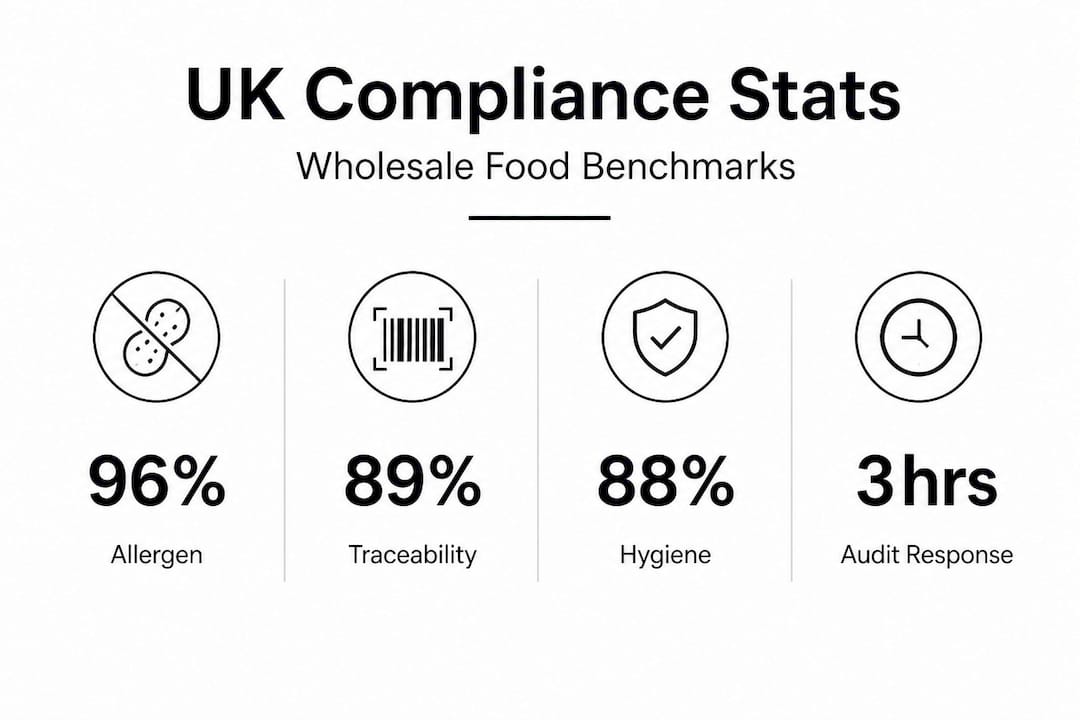
How the UK currently performs against these benchmarks matters. Allergen compliance sits at 96% across retail surveillance samples, while food authenticity sits at 94%. Those figures sound reassuring, but they also tell you that roughly one in seventeen product samples has an authenticity issue. At wholesale volume, that ratio represents a significant and tangible risk.
Pro Tip: Build your supplier approval process around a tiered risk model. High-risk categories such as ready-to-eat products, allergen-containing lines, and imported goods warrant annual audits, whilst lower-risk ambient lines might be reviewed every two years. This keeps your compliance resource focused where it matters most.
Choosing the right distribution channel strategies also affects compliance load. Direct-to-retailer distribution with fewer intermediaries typically reduces the number of compliance touchpoints you need to manage, simplifying your traceability obligations and reducing the risk of documentation gaps.
Managing special risks: Approval, allergens and evolving threats
Not every compliance challenge is equal. Certain product categories and operational scenarios carry substantially higher risk, and managing them requires controls that go well beyond standard HACCP documentation.
Product approval versus registration is a distinction many operators underestimate. Wholesalers handling meat, dairy, or fish require formal approval from their local authority competent authority, not merely registration. Approval involves verification of compliance before the business can operate, and it can be withheld or revoked where non-compliance endangers health. Misunderstanding this requirement has left businesses operating unlawfully without realising it.
Allergen management represents the most immediate public health risk in wholesale operations. Undeclared allergens account for 4% of retail samples in surveillance data, and allergen incidents have been rising year-on-year. The consequences are not abstract: anaphylaxis, hospitalisation, and death have all resulted from failures that originated in the supply chain. At wholesale level, the critical controls are:
- Robust ingredient specification verification at goods-in
- Segregated storage for allergen-containing products
- Documented allergen risk assessments for any repackaging or picking activity
- Clear labelling audits before despatch to retail customers
- Traceability systems that can isolate affected batches within hours
Post-Brexit import controls have added a new layer of complexity. Increased documentation requirements, phased border controls, and the need to verify compliance with UK-specific standards (rather than relying on EU equivalents) have substantially increased the verification load on wholesalers importing from European suppliers. Post-Brexit delays also increase the window during which temperature-sensitive products may be at risk, making your cold chain monitoring even more critical.
“Conditional approvals can be denied if non-compliance presents a health risk. The burden of proof lies with the operator, not the regulator.”
Pro Tip: Develop a post-Brexit supplier questionnaire that specifically addresses the regulatory standards applicable to UK imports. Ask for documentary evidence of conformance with UK retained food law, not just EU certification, and record this in your approved supplier register.
For wholesalers managing complex logistics across multiple sites or using cross-docking facilities, understanding food logistics edge cases is particularly relevant. Temperature excursions, documentation handoffs between sites, and product co-mingling all introduce compliance risks that need specific procedural controls.
Powering compliance through technology and continuous improvement
The compliance landscape is shifting. Regulatory expectations are rising, product ranges are growing more complex, and the volume of documentation required to satisfy modern audit standards is substantial. The wholesalers who manage this most effectively are those investing in digital infrastructure to do the heavy lifting.
Automated monitoring tools are increasingly central to this picture. Continuous temperature monitoring with real-time alerts removes the reliance on manual checks and creates an audit trail that is both more reliable and faster to retrieve. Digital supplier portals allow specification updates and certification renewals to be tracked centrally, reducing the risk of lapsed approvals going unnoticed.

The business case for technology investment goes beyond pure efficiency. Where wholesalers can demonstrate BRCGS certification and a documented due diligence defence supported by digital records, their position in commercial negotiations strengthens considerably. Retailers and foodservice buyers increasingly require evidence of compliance maturity before agreeing terms, particularly for premium or specialist product ranges.
Key benefits of a technology-led compliance approach include:
- Faster recall response: Digital batch traceability can reduce recall identification from days to hours.
- Reduced audit preparation time: Automated record generation means audit packs are always current rather than assembled under pressure.
- Proactive non-conformance management: Dashboard visibility of supplier performance data flags issues before they become regulatory problems.
- Staff training records: Digital systems can track training completion and competency assessments, supporting your due diligence defence.
- Regulatory horizon scanning: Compliance platforms increasingly include regulatory update feeds, helping teams anticipate change rather than react to it.
Continuous improvement is not a philosophy; it is a practical discipline. Each internal audit should produce a corrective action log with owners and deadlines. Each supplier review should feed back into your approval risk ratings. Each incident, however minor, should trigger a root cause analysis that updates your HACCP. This cycle of review and refinement is what separates businesses that remain compliant from those that gradually drift.
Retail success for the brands you distribute is directly linked to the quality of the compliance infrastructure behind them. Independent retailers choosing wholesale partners consistently cite product safety confidence and supply reliability as the top factors in supplier retention.
Pro Tip: Use audit findings as a forward-looking intelligence tool. Patterns in non-conformances often reveal systemic issues in supplier performance or internal processes before they escalate into incidents. Tracking these trends quarterly gives compliance managers early warning signals that a simple pass-or-fail audit view misses entirely.
Beyond the checklist: Why genuine compliance is your greatest asset
Here is the uncomfortable reality that the compliance industry rarely states plainly: most businesses that suffer significant regulatory incidents were technically compliant on paper at the time. Their documentation was in order. Their HACCP was signed off. Their suppliers were on the approved list. The problem was that the systems were maintained as a performance rather than a practice.
Checkbox compliance is a liability dressed up as a safeguard. It satisfies an inspection but does nothing to prevent the production error, the mislabelled ingredient, or the temperature excursion that happens the week after the auditor leaves. The BRC Food Standard frames this tension directly: certification provides evidence of a system, but only constant maintenance delivers the protection that certification promises.
At Woodford, we see the distinction between these two approaches every day. Wholesalers who treat compliance as a minimum entry cost tend to structure their operations around inspection readiness. Wholesalers who treat it as a genuine operational commitment build cultures where every team member understands why the controls exist, not just what the controls are. The difference in outcomes is stark.
The commercial argument for the latter approach is equally strong. Wholesale logistics executed to a genuinely high compliance standard opens doors that checklist operators cannot access: preferred supplier listings with major retailers, access to premium and regulated product categories, and the confidence to take on complex distribution contracts without operational anxiety.
Our view is that the highest-performing wholesalers will increasingly differentiate not on price or range alone, but on the integrity and maturity of their compliance infrastructure. As regulatory scrutiny increases, as consumer expectations rise, and as independent retailers become more sophisticated buyers, the question will not be whether you are compliant. It will be how deeply compliance is embedded in everything you do.
Take your compliance and supply chain further with Woodford
If this article has prompted you to review your compliance architecture or assess new distribution partnerships, Woodford is built to support exactly that kind of ambition. As the UK’s leading strategic food wholesaler, we work with brands and retailers who take compliance as seriously as we do, selecting only partners whose operations meet the standards that protect consumers and build long-term commercial trust.
Explore our brands to see the calibre of suppliers we work with, or review our dedicated solutions for brand owners to understand how we integrate compliance-led logistics with commercial distribution strategy. Whether you are seeking stronger supply chain integrity, better retailer access, or a wholesale partner who genuinely understands regulatory risk, Woodford food wholesale provides the infrastructure and expertise to move forward with confidence.
Frequently asked questions
What is the legal basis for compliance in UK food wholesale?
Compliance is required under the Food Safety Act 1990, General Food Law, and the Food Hygiene Regulations 2006, with due diligence and full supply chain traceability mandatory for all wholesale operators.
How do wholesalers demonstrate due diligence to regulators?
They provide documented evidence of supplier verification, including specifications, audit records, and current certifications, alongside traceability records and corrective action logs from internal audit programmes.
What are the main penalties for non-compliance in food wholesale?
Non-compliance can result in product recalls, improvement notices, substantial fines, and in serious cases where public health is at risk, business closure and criminal prosecution.
Why is allergen management a priority for wholesalers?
Undeclared allergens remain a leading driver of food recalls in the UK and can cause life-threatening reactions, making rigorous ingredient verification, labelling checks, and cross-contamination controls non-negotiable at wholesale level.
How can technology help with compliance in food wholesale?
Digital monitoring tools automate temperature logging and record-keeping, making audit preparation faster and more accurate whilst providing the continuous evidence trail needed to support a robust due diligence defence.
Recommended
- Navigating UK food logistics for wholesalers in 2026 - WOODFORD - Bringing quality foods your way
- Food logistics tips for UK independent retailers in 2026 - WOODFORD - Bringing quality foods your way
- Food brand strategy drives UK retail success in 2026 - WOODFORD - Bringing quality foods your way
- Strategic food brands for UK independent retailers - WOODFORD - Bringing quality foods your way
- Why financial compliance matters for UK SMEs: 2026 guide
- London commercial pest control compliance guide 2026