
Why choose bespoke distribution for UK food brands

Bespoke distribution is defined as a fully customised logistics model built around a brand’s specific products, retail requirements, and operational workflows rather than a one-size-fits-all system. For UK wholesalers and food brand owners, why choose bespoke distribution is a question with a clear answer: standard models create friction, hide costs, and treat every SKU identically regardless of its commercial value. Woodford works with food brands that have outgrown generic logistics and need a partner whose processes fit their business precisely. The difference between bespoke and standard distribution is not cosmetic. It is operational, financial, and measurable.
Why choose bespoke distribution over standard models?
Bespoke distribution, also referred to in the industry as customised third-party logistics (3PL), delivers operational fit that standard models cannot replicate. 80% of shippers cite cost variability as the primary driver for choosing tailored distribution models. That figure tells you the market has already moved: brands are choosing bespoke because generic pricing structures erode margins in ways that are difficult to track until the damage is done.
Standard distribution contracts frequently contain hidden promotional accruals and chargeback clauses. These charges surface only after a retailer deducts them from payment, leaving brand owners chasing reconciliations rather than growing sales. Bespoke models expose these margin leaks through transparent data access and direct customer insight loops. Knowing exactly where money is going is not a luxury. It is a prerequisite for profitable growth.
The operational fit argument is equally compelling. Forcing a food brand with complex cold-chain requirements or short shelf-life products into a standard workflow creates what logistics professionals call operational drag. Every workaround, manual correction, and exception process costs time and money. Bespoke distribution removes those workarounds by building the exception into the standard process from day one.
- Cost transparency: Custom contracts expose hidden charges before they become deductions.
- Workflow alignment: Processes are built around your product type, not adapted from a generic template.
- Retailer compliance: Custom standard operating procedures (SOPs) match each retailer’s specific requirements.
- Reduced manual handling: Fewer exceptions mean fewer errors and lower labour costs.
Pro Tip: Before signing any distribution agreement, request a full breakdown of all potential deductions including promotional accruals, chargebacks, and compliance penalties. A bespoke partner will provide this without hesitation. A standard distributor may not.
How does bespoke distribution improve inventory and route planning?
Inventory management is where the benefits of custom distribution become most visible at store level. 20% of SKUs generate 80% of sales, yet generic distribution treats every product identically. That mismatch causes your best-selling lines to run out of stock while slower products occupy warehouse space and delivery capacity.

Bespoke distribution corrects this by building stock allocation rules around actual sales velocity. Your top-performing SKUs receive priority in picking, packing, and routing. Slower lines are managed separately with appropriate reorder triggers. The result is fewer out-of-stocks on high-value products and less capital tied up in low-velocity inventory. For food brands selling into independent retailers, this distinction directly affects shelf presence and repeat orders.
Route planning follows the same logic. A tailored logistics model maps delivery schedules around your retail accounts, not around a national carrier’s existing network. Independent retailers in particular benefit from consistent delivery windows that fit their staffing patterns. Consistency builds trust, and trust builds the kind of retailer relationship that leads to better shelf positioning.
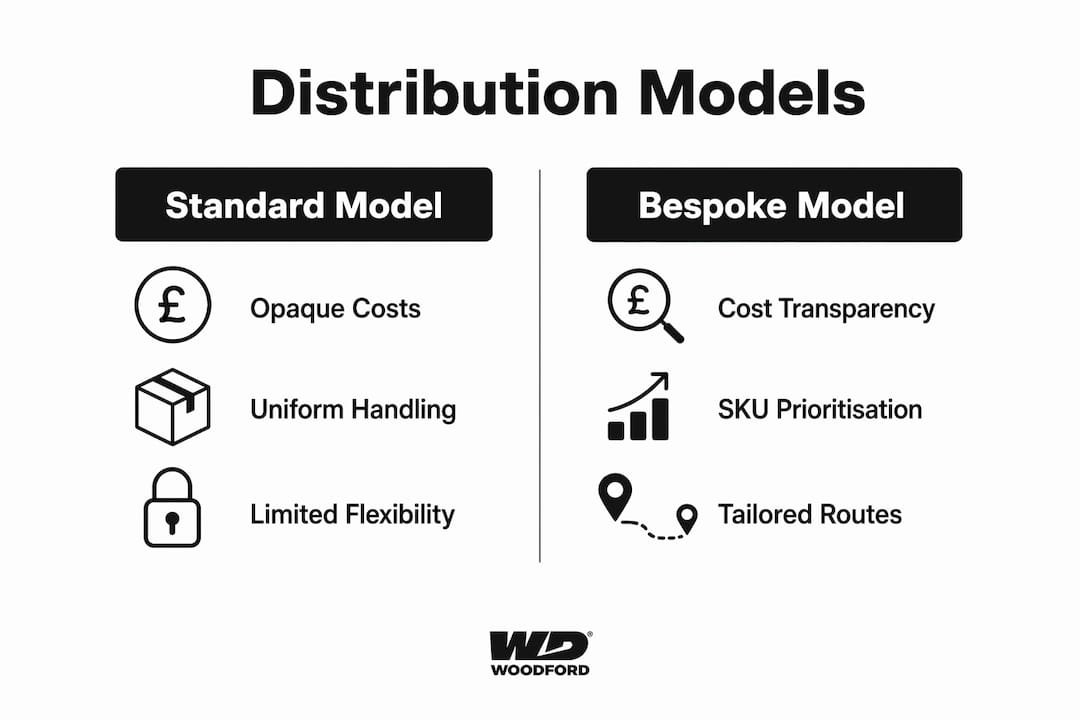
Custom ERP workflows reduce order processing times by up to 50% in documented case studies. That is not a marginal improvement. Halving the time between order receipt and despatch means faster replenishment, fewer gaps on shelf, and a measurable reduction in lost sales.
Key operational gains from tailored logistics
| Area | Standard model | Bespoke model |
|---|---|---|
| SKU prioritisation | Equal treatment for all products | Allocation based on sales velocity |
| Order processing | Manual exceptions for non-standard orders | Automated rules embedded in ERP |
| Route planning | Fixed national carrier network | Schedules built around your retail accounts |
| Stock visibility | Periodic batch reporting | Real-time tracking per SKU |
Pro Tip: Ask any prospective distribution partner to show you how their ERP handles your top five SKUs specifically. If they cannot demonstrate SKU-level configuration, their system is not truly bespoke.
Embedding business rules into ERP automates order classification and reduces both shipping errors and manual labour costs. For food brands managing multiple pack sizes, promotional variants, and retailer-specific labelling, this automation is the difference between a scalable operation and a team buried in spreadsheets.
How does bespoke distribution help with retail compliance?
Retail compliance is one of the most underestimated costs in food distribution. Major UK grocery retailers and buying groups impose strict requirements on labelling, advanced shipping notices (ASNs), pallet configurations, and delivery windows. Missing any one of these triggers a chargeback or a refused delivery. Both outcomes damage the retailer relationship and reduce your brand’s credibility on the buying team’s scorecard.
Bespoke distribution partners retain institutional knowledge through stable account management teams with lower staff turnover than national 3PLs. That stability matters enormously in compliance-heavy environments. When the person managing your account has handled your retailer’s ASN requirements for two years, they do not make the same mistakes a new team member would. Knowledge retention is a direct financial benefit, not a soft advantage.
Custom retail compliance workflows reduce operational friction and chargeback penalties by building retailer-specific SOPs into the distribution process. Each retailer’s requirements are documented, version-controlled, and applied automatically at the point of order processing. There is no reliance on individual memory or manual checklists.
- ASN accuracy: Bespoke systems generate retailer-specific ASNs automatically, reducing rejection rates.
- Labelling compliance: Custom workflows apply the correct label format per retailer at the point of packing.
- Delivery window adherence: Route plans are built around retailer booking systems, not carrier convenience.
- Chargeback tracking: Transparent reporting flags potential deductions before they appear on a remittance.
Strong food brands align distribution decisions with operational readiness to balance fast shelf placement against internal capacity for retailer communications. Bespoke distribution provides that capacity externally, so your internal team can focus on product development and sales rather than compliance administration. Woodford’s approach to compliance in UK food wholesale treats retailer requirements as a competitive edge rather than an administrative burden.
What are the strategic business impacts of bespoke distribution?
The strategic case for tailored distribution goes beyond operational efficiency. Customised supply chains are now a competitive advantage that enables companies to outperform competitors in service quality and reliability. That claim is backed by market behaviour: brands with bespoke logistics consistently achieve better on-shelf availability and faster response to demand shifts than those using standard models.
Agility is the most commercially valuable outcome. Bespoke distribution builds resilience against fuel price fluctuations and labour shortages by giving brands direct visibility into their supply chain costs and the flexibility to adjust quickly. A standard model absorbs those cost increases and passes them on through opaque surcharges. A bespoke model shows you exactly what is driving cost changes and gives you options to respond. Understanding supply chain disruptions and how to adapt to them is a core capability that bespoke logistics builds directly into your operation.
79% of businesses outsource logistics to avoid capital investment, and 77% cite the ability to focus on core competencies as a primary reason. Bespoke distribution delivers both outcomes simultaneously. You avoid the capital cost of building a proprietary logistics operation, and you free your team to focus on brand building, product innovation, and retail relationships. That combination is why the market is moving decisively towards customised models.
Bespoke vs standard distribution: strategic comparison
| Factor | Standard distribution | Bespoke distribution |
|---|---|---|
| Cost visibility | Opaque, bundled pricing | Transparent, line-item reporting |
| Market agility | Fixed processes, slow to adapt | Adjustable workflows per market condition |
| Retailer relationships | Generic account management | Dedicated, retailer-specific SOPs |
| Competitive position | Parity with all other brands on the network | Differentiated service quality |
The food distribution cycle for UK retailers rewards brands that can guarantee availability, compliance, and consistent service. Bespoke distribution is the mechanism that makes those guarantees credible. Brands that invest in tailored logistics build a reputation with buyers that generic distribution simply cannot support.
Woodford’s approach to bespoke food distribution
Woodford works exclusively with food brands that are serious about independent retail in the UK. The focus is on brands that need more than a carrier. They need a distribution partner who understands retailer compliance, manages stock with commercial intelligence, and provides the kind of account management that retains knowledge rather than cycling through new contacts.
Woodford’s model is built around the specific requirements of each brand in its portfolio. That means custom workflows, retailer-specific compliance management, and transparent reporting on every aspect of the distribution relationship. Food brand owners who want to see what that looks like in practice can explore Woodford’s brand portfolio and the distribution model behind it. The portfolio reflects a deliberate approach to managing food inventory for better profit at every stage of the supply chain.
Key takeaways
Bespoke distribution delivers measurable advantages over standard models by aligning logistics workflows, compliance processes, and inventory management directly with a brand’s commercial requirements.
| Point | Details |
|---|---|
| Cost transparency | Bespoke contracts expose hidden charges like chargebacks before they erode your margins. |
| SKU prioritisation | Tailored stock allocation puts your best-selling lines first, reducing out-of-stocks. |
| Compliance management | Custom SOPs and stable account teams reduce chargeback penalties and retailer friction. |
| Operational efficiency | Custom ERP workflows cut order processing times significantly, improving shelf replenishment. |
| Strategic agility | Bespoke models give brands direct visibility into cost drivers and the flexibility to adapt quickly. |
FAQ
What is bespoke distribution?
Bespoke distribution is a customised logistics model built around a brand’s specific products, retail accounts, and compliance requirements. Unlike standard distribution, it applies tailored workflows, SKU-level stock management, and retailer-specific processes rather than a generic template.
Why do food brands choose bespoke distribution over standard 3PLs?
Standard 3PLs apply uniform processes that create operational drag and hidden costs for brands with complex products or strict retailer requirements. Bespoke distribution removes those inefficiencies by building the brand’s specific needs into every stage of the logistics process.
How does bespoke distribution reduce retail compliance costs?
Bespoke partners build retailer-specific SOPs directly into their order processing systems, automating ASN generation, labelling, and delivery scheduling. Stable account teams retain the institutional knowledge needed to avoid costly compliance errors and chargebacks.
Can bespoke distribution improve inventory performance?
Yes. By allocating stock based on actual sales velocity rather than treating all SKUs equally, bespoke distribution reduces out-of-stocks on high-value lines and cuts capital tied up in slow-moving inventory.
Is bespoke distribution suitable for smaller food brands?
Bespoke distribution is particularly well suited to brands with complex handling requirements, multiple retailer accounts, or compliance-heavy products, regardless of size. Operational fit matters more than volume when selecting a distribution model.


