
Food stock replenishment guide for UK independents
Food stock replenishment is the process of restoring inventory to optimal levels before demand outpaces supply. For independent food retailers and wholesalers across the UK, getting this process right separates profitable operations from those haemorrhaging margin through stockouts and spoilage. The industry term is inventory replenishment, and it covers everything from calculating reorder points to choosing the right purchasing cadence. This guide covers the core methods, tools, and common pitfalls so you can build a replenishment system that works for your business, not against it.
What are the key methods for food stock replenishment?
Segmenting stock by demand and applying different replenishment methods balances availability with cash flow. The mistake most independent retailers make is treating all stock the same. A tin of chickpeas and a batch of fresh salmon need entirely different replenishment approaches.
The four main methods used in food retail are:
- Reorder point with safety stock. You set a minimum quantity that triggers a new order. Best for high-velocity, predictable lines like bread, milk, and canned goods.
- Min-max replenishment. Stock is ordered when it drops to a minimum level, and the order brings it back to a defined maximum. Works well for ambient products with stable demand.
- Periodic review. You check stock at fixed intervals, such as every Monday, and order whatever is needed. Suits smaller operations with limited storage.
- Just-in-time (JIT). Orders arrive exactly when needed, minimising storage costs. Viable only when your supplier lead times are short and reliable.
The right method depends on two factors: how predictable demand is, and how long your supplier takes to deliver. Perishables with short shelf lives suit periodic review or JIT. Shelf-stable lines with consistent sales suit reorder point systems.
Pro Tip: Classify your stock into A, B, and C categories. A items are your top sellers by revenue, B items are mid-range, and C items are slow movers. Apply your tightest replenishment controls to A items first.

| Method | Best for | Key risk |
|---|---|---|
| Reorder point | High-volume, stable lines | Inaccurate lead time data |
| Min-max | Ambient, predictable stock | Overstocking at the maximum |
| Periodic review | Small stores, limited storage | Stockouts between review dates |
| Just-in-time | Fresh, short-shelf-life items | Supplier delay exposure |
How to set reorder points and safety stock levels
A reorder point (ROP) is the stock level at which you place a new order to avoid running out before the next delivery arrives. Setting it correctly is the single most impactful step in any grocery restocking guide.
The calculation is straightforward:
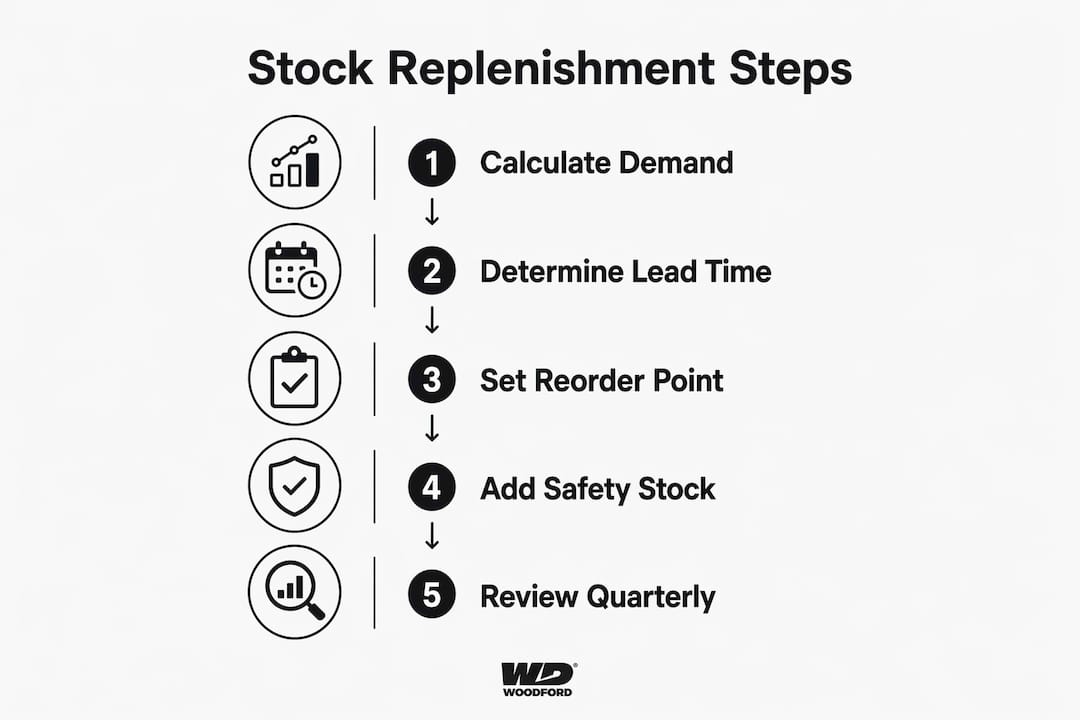
- Measure your average daily sales for each product over the past four weeks. Use actual sales data from your point-of-sale (POS) system, not estimates.
- Record your actual supplier lead time. Track real delivery times over at least 30 days. Supplier-quoted lead times are often optimistic and lead to chronic stockouts when you rely on them.
- Calculate your ROP. Multiply average daily sales by your measured lead time in days. If you sell 20 units per day and your supplier takes five days to deliver, your ROP is 100 units.
- Add safety stock. Safety stock is a buffer that covers demand spikes and delivery delays. Segment safety stock by item type: stable lines carry 10–20% buffer stock, while high-impact or seasonal items carry 30–50%.
- Set your final ROP. Add safety stock to your base ROP. This is the number that triggers your next order.
Reorder points should be reviewed every 90 days by comparing actual consumption against your original calculations. Demand shifts seasonally, and supplier performance changes. A ROP set in january will be wrong by april if you do not revisit it.
Pro Tip: Build a simple spreadsheet with columns for average daily sales, lead time, base ROP, safety stock percentage, and final ROP. Update it quarterly and share it with whoever places your orders.
| Item type | Safety stock range | Review frequency |
|---|---|---|
| Stable ambient goods | 10–20% of average stock | Every 90 days |
| Seasonal or promotional | 30–50% of average stock | Monthly during peak |
| Fresh and perishable | Minimal buffer, high frequency | Weekly or daily |
What tools support efficient food stock replenishment?
Purchasing decisions without usage-based data are essentially guesses. Moving from habit-based ordering to POS-triggered replenishment protects your retail margins. The good news is that the tools to do this are accessible even for small independents.
- POS systems with inventory tracking. Systems like Lightspeed, Square for Retail, and Epos Now integrate sales data with stock levels in real time. When a product sells, your inventory count updates automatically. This removes the guesswork from knowing what you have on the shelf.
- Inventory management software. Platforms such as Unleashed and Cin7 are used by UK food retailers to manage stock across multiple locations, set reorder alerts, and generate purchase orders automatically. They connect directly with supplier catalogues and accounting tools like Xero.
- Barcode scanning. A handheld scanner used during deliveries and cycle counts dramatically reduces data entry errors. Inaccurate stock records are one of the leading causes of phantom stockouts, where the system shows stock available but the shelf is empty.
- Automated reorder alerts. Set par levels in your inventory software for each SKU. When stock drops below the par level, the system flags it or generates a draft purchase order. This removes the reliance on memory or manual checks.
Understanding your supplier options and lead times is equally important. Different wholesaler types carry different minimum order quantities, delivery frequencies, and product ranges, all of which affect how you structure your replenishment cycles.
What are common food stock replenishment challenges?
Stockouts and excess inventory share a common root cause: decisions made without accurate data. Identifying the warning signs early saves you from margin loss and customer attrition.
- Inaccurate lead times. If you set your ROP using a supplier’s quoted three-day lead time but actual deliveries take five days, you will run out of stock regularly. Measure real lead times over 30 days and use those figures.
- Spoilage from poor rotation. FIFO (first in, first out) and FEFO (first expired, first out) are the two rotation methods that prevent perishable waste. FIFO moves older stock to the front. FEFO prioritises items closest to their expiry date, regardless of when they arrived. Both methods are critical for managing perishables and protecting your margins.
- Phantom stock. Your system shows 30 units available, but the shelf is empty. This happens when deliveries are not scanned in correctly or when theft and damage go unrecorded. Cycle counts, where you count a subset of products each week rather than doing a full stocktake, catch these discrepancies early.
- Overstocking slow movers. Buying too much of a C-category item ties up cash and storage space. Apply min-max replenishment to slow movers and set conservative maximum levels.
Bidirectional traceability, linking supplier batch numbers to the customer outlets you supply, is a legal requirement for many food categories in the UK. It also protects you during product recalls. Build batch tracking into your receiving process from day one.
Good food logistics management sits underneath all of this. Timely deliveries, accurate manifests, and reliable supplier relationships reduce the number of variables you need to manage in your replenishment system.
How does bulk purchasing work alongside replenishment planning?
Bulk purchasing and replenishment planning are not in conflict. They work best when you treat them as two separate but coordinated buying channels. A two-store purchasing approach combines bulk non-perishable purchases from a wholesale supplier with more frequent local or direct buys for fresh lines. This approach can save retailers £80–£140 monthly within 60 days of implementation. That saving comes from reducing impulse top-up purchases at higher unit prices.
The practical steps for combining both approaches are:
- Separate your SKUs by purchase channel. Ambient, shelf-stable lines suit bulk purchasing. Fresh, short-life products suit frequent small orders.
- Align bulk order volumes with your replenishment cycle. If your ROP for a product is 200 units and your bulk order minimum is 500 units, check that your storage capacity and cash flow can absorb the difference before the next replenishment cycle.
- Avoid overstocking to hit a discount threshold. Bulk discounts are only profitable if you sell the stock before it expires or ties up cash you need elsewhere. Calculate the true cost of storage and capital before committing to a large order.
- Review your bulk buying strategy quarterly. Demand patterns shift. A product that justified a bulk order in january may be a slow mover by march.
Woodford works with independent UK retailers to source quality food brands in volumes that suit their actual replenishment cycles, not just the minimum order quantities that suit the supplier. Understanding how bulk buying maximises profit for independents is a practical starting point for aligning your purchasing with your stock management.
Woodford’s role in your replenishment planning
Woodford is the UK’s leading food wholesaler for independent retailers seeking consistent stock availability and access to trend-led brands. Woodford provides exclusive distribution, curated product ranges, and reliable logistics that fit the replenishment cycles of independent businesses rather than forcing retailers to adapt to supplier convenience. If you are building or refining your food inventory management approach, Woodford’s team can help you identify the right product mix, order volumes, and delivery cadence for your store. Visit woodford.food to browse the range and speak with the team about supply arrangements that match your replenishment needs.
Key takeaways
Effective food stock replenishment requires matching your replenishment method to each product type, setting data-driven reorder points, and reviewing both quarterly to stay aligned with actual demand.
| Point | Details |
|---|---|
| Match method to product type | Use reorder point systems for stable lines and periodic review for fresh or perishable stock. |
| Use real lead time data | Measure actual supplier delivery times over 30 days before setting any reorder point. |
| Segment safety stock | Apply 10–20% buffer for stable items and 30–50% for seasonal or high-impact SKUs. |
| Rotate stock with FIFO or FEFO | Date-code rotation prevents spoilage and protects margins on perishable lines. |
| Review reorder points quarterly | Compare actual consumption against your calculations every 90 days and adjust for demand shifts. |
FAQ
What is food stock replenishment?
Food stock replenishment is the process of restoring inventory to optimal levels before stock runs out. It uses reorder points, safety stock buffers, and demand data to keep shelves full without overstocking.
How do I calculate a reorder point for food products?
Multiply your average daily sales by your measured supplier lead time in days, then add your safety stock buffer. Review this figure every 90 days to account for demand and supplier changes.
What is the difference between FIFO and FEFO?
FIFO (first in, first out) moves the oldest stock first. FEFO (first expired, first out) prioritises items closest to their expiry date. FEFO is the safer method for mixed-date perishable deliveries.
How often should I review my replenishment system?
Reorder points should be reviewed every 90 days as a minimum. Review more frequently during seasonal peaks or when a key supplier changes their delivery schedule.
Can bulk buying reduce my replenishment costs?
Yes. Combining bulk purchases of ambient lines with frequent small orders for fresh stock can save independent retailers meaningful sums each month, provided storage capacity and cash flow support the approach.


