
Food retail partnership guide for UK brands in 2026
A food retail partnership is a structured commercial collaboration between a food brand owner and a retailer to expand distribution, grow sales, and share market intelligence. In the UK, these alliances are governed by the Groceries Code Adjudicator (GCA) and shaped by IGD compliance frameworks, which means getting the foundations right is not optional. This food retail partnership guide covers every stage, from regulatory groundwork and partner selection through to pilot programmes and co-marketing, so you can build alliances that last and scale.
What does a food retail partnership guide actually cover?
A food retail partnership, known in the industry as a supplier-retailer trading alliance, requires both parties to align on values, customer demographics, and operational capacity before any contract is signed. The GCA uses an annual YouGov survey to assess retailer compliance with the Groceries Supply Code of Practice. That survey directly informs enforcement priorities, so any brand entering a major retail relationship in 2026 must understand what compliant behaviour looks like from day one.
The IGD’s 2026 guidance adds a further layer. Parties may cooperate on distribution and wastage reduction, but pricing decisions must remain independent and no agreement should affect third-party products. This is not a technicality. It is a competition-law boundary that shapes how you structure every joint project.
Before approaching any retailer, you need three things in place. First, a clear sell sheet that communicates your product’s margin, shelf life, and minimum order quantity. Second, a basic sales forecast covering at least 12 weeks. Third, a contract template that reflects GCA-compliant terms. Woodford’s guide on UK distributor relationships explains how these documents function within the broader trading framework.

Pro Tip: Review the GCA’s most recent annual supplier survey results before your first retailer meeting. The findings reveal which compliance issues retailers are currently under scrutiny for, giving you a sharper negotiating position.
How do you identify the right retail partners in the UK?
Partner selection is the decision that determines whether your food industry collaboration succeeds or stalls. The UK retail market divides broadly into three tiers: independent retailers, regional chains, and national multiples. Each tier carries different margin expectations, ranging from 20–30% for grocery distributors delivering to store shelves, to tighter direct-supply arrangements with larger chains. That margin range is a core budgeting input, not an afterthought.
Wholesale buying groups offer a faster route to scale than approaching retailers individually. Sugro UK has over 90 members supplying 21,000 retailers, while Unitas Wholesale claims 124 members with 285 distribution points reaching 180,000 outlets. Those figures are significant, but they require validation against your specific category and depot coverage before you treat them as guaranteed reach.
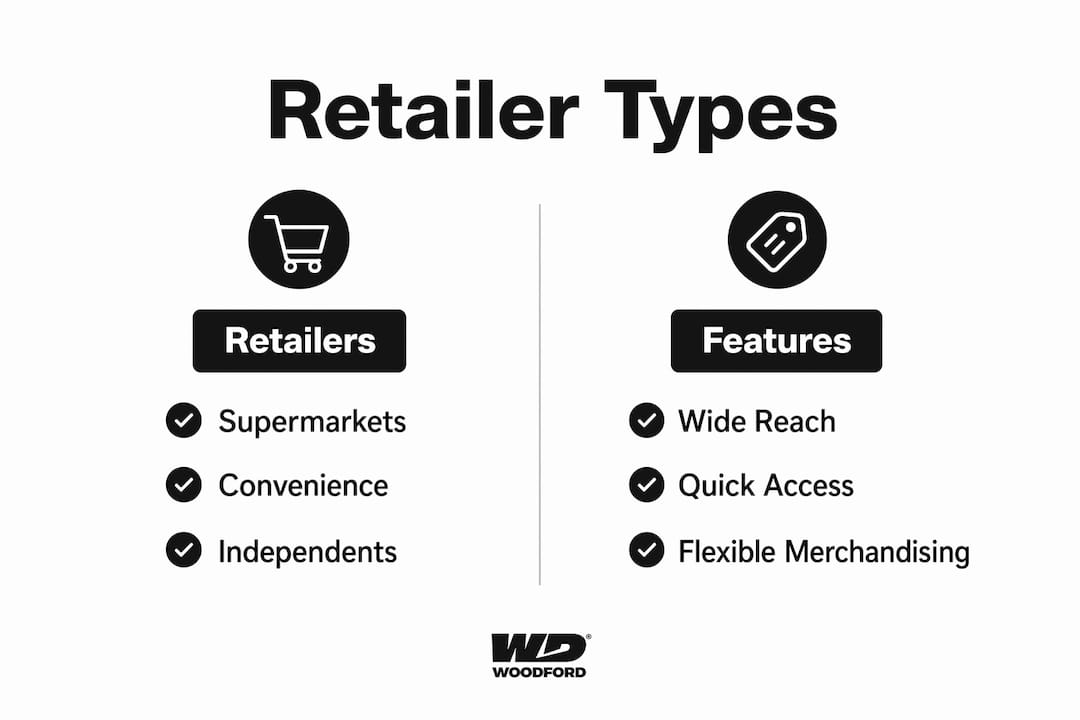
Retailer types compared
| Retailer Type | Typical Margin | Speed to List | Best For |
|---|---|---|---|
| Independent retailer | 35–45% | Fast (2–4 weeks) | Niche and premium products |
| Regional chain | 30–40% | Medium (4–8 weeks) | Established brands with volume |
| National multiple | 25–35% | Slow (3–6 months) | High-volume, proven SKUs |
| Wholesale buying group | 20–30% | Medium (4–6 weeks) | Broad reach with lower complexity |
When matching your product to a retailer’s customer base, look at three factors in order of priority. First, does the retailer’s shopper demographic match your buyer profile? Second, does the retailer’s average basket size support your price point? Third, does the retailer have the chilled, ambient, or frozen infrastructure your product needs?
- Map your product’s positioning against the retailer’s existing range using their current shelf catalogue.
- Request footfall or basket data where available, particularly from independent buying groups.
- Assess whether the retailer participates in a buying group such as Sugro or Unitas, as group membership affects your route to listing and promotional support.
- Check depot coverage against your own logistics capability before committing to a distribution model.
Woodford’s article on strategic food brands for independent retailers provides a useful framework for matching brand positioning to the independent channel specifically.
What are the best practices for pilot partnership programmes?
Starting with a time-bounded pilot programme is the fastest way to build evidence for scaling a retail partnership. A 3–6 month pilot with a limited number of SKUs and locations lets you test logistics, measure sell-through, and gather customer feedback before committing to a full rollout. This approach protects both parties and produces the data retailers need to justify a permanent listing.
A well-structured pilot has four stages.
- Define scope clearly. Agree on the number of SKUs (typically 2–4), the number of locations (3–10 stores), and the pilot duration (12–24 weeks). Put these parameters in writing before any stock moves.
- Set measurable KPIs. Sell-through rate, average units per transaction, and customer return rate are the three metrics that matter most in a food retail pilot. Agree on the minimum thresholds that would trigger a full rollout.
- Assign operational ownership. Decide in advance who handles replenishment, who manages point-of-sale materials, and who owns the forecasting process. Ambiguity here is the most common reason pilots fail.
- Schedule a formal review. Book a mid-pilot review at week 6–8 and a final review at the end of the pilot period. Use these sessions to share data, not just impressions.
Pro Tip: Use the pilot period to test at least two different shelf positions or display formats. The data on which placement drives higher sell-through is worth more than any focus group result.
Operational pilot tests are the fastest route to evidence-based retail scaling. Retailers respond to numbers, not promises. A pilot that shows a 65% sell-through rate in week four carries more weight in a range review than a year of sales presentations.
How do you sustain collaboration and compliance over time?
Long-term food retail alliances depend on translating your brand intelligence into plans the retailer can actually execute. Around 90% of retailers want stronger collaboration with CPG brands, but most brands fail to deliver retailer-specific plans that address planogram fit, assortment logic, and retail media. That gap is where partnerships stall after the initial listing.
Co-marketing is the most underused lever in food distribution collaboration. Co-op marketing budgets should be allocated to in-store events, product launch moments, and digital campaigns timed to delivery windows. A new product arrival is a marketing event. Treating it as a logistics transaction wastes the opportunity entirely.
Compliance remains non-negotiable throughout the relationship. IGD’s guidance is explicit: supply-side cooperation must stay within operational goals and must never extend to coordinating pricing or influencing decisions about third-party products. Structure every joint project with a written scope that excludes these areas by default.
On the commercial side, slotting fees require careful budgeting. Published estimates for chain authorisations run into tens of thousands of dollars per SKU in the US market. UK figures vary widely by retailer tier and category, so build a contingency of at least 15–20% into your partnership budget for listing and promotional costs.
The following practices define partnerships that grow rather than plateau:
- Share category data with your retail partner on a quarterly basis, not just at range review time.
- Align promotional calendars at least 8 weeks in advance to give the retailer time to plan in-store execution.
- Conduct joint business planning sessions twice a year, covering the next two trading periods.
- Use wholesale pricing frameworks to model margin scenarios before entering fee negotiations.
- Document every agreed change to terms in writing, referencing the original contract to maintain GCA compliance.
| Collaboration Activity | Frequency | Owner |
|---|---|---|
| Category data sharing | Quarterly | Brand owner |
| Promotional calendar alignment | Every 8 weeks | Joint |
| Joint business planning | Twice yearly | Joint |
| Compliance review | Annually | Both parties |
| Pilot performance review | Mid-pilot and end of pilot | Joint |
Key takeaways
Successful food retail partnerships in the UK require compliance-aware foundations, evidence-based pilot testing, and sustained joint planning to convert listings into long-term growth.
| Point | Details |
|---|---|
| Compliance comes first | Align with GCA and IGD frameworks before approaching any retail partner. |
| Pilot before scaling | Run a 3–6 month pilot with defined KPIs to validate logistics and sell-through. |
| Match partner to product | Evaluate retailer demographics, infrastructure, and buying group membership before committing. |
| Co-market from day one | Allocate co-op budget to in-store events and digital campaigns tied to product arrivals. |
| Document everything | Record all agreed terms in writing to maintain GCA-compliant trading relationships. |
How Woodford supports your retail partnership strategy
Building retail partnerships in the UK requires more than a good product. It requires distribution infrastructure, category knowledge, and a network of independent retailers ready to take on new brands. Woodford operates as the UK’s leading strategic food wholesaler, connecting ambitious food brands with independent retailers through exclusive distribution and trend-led curation. Whether you are entering the independent channel for the first time or looking to extend an existing range into new regions, Woodford’s food distribution services provide the operational and commercial support to make it work. Explore how Woodford can accelerate your route to shelf and help you build retail alliances that deliver measurable results.
FAQ
What is a food retail partnership?
A food retail partnership is a formal commercial arrangement between a food brand owner and a retailer to distribute, promote, and sell products through the retailer’s outlets. In the UK, these relationships are governed by the Groceries Code Adjudicator and IGD compliance frameworks.
How long should a retail partnership pilot last?
A pilot programme should run for 3–6 months, covering a limited number of SKUs and store locations. This duration is sufficient to measure sell-through rates, assess logistics performance, and gather customer feedback before a full rollout.
What compliance rules apply to UK food retail partnerships?
The GCA monitors retailer compliance through an annual YouGov supplier survey, and IGD guidance requires that supply-side collaborations keep pricing decisions independent. Any joint project must exclude coordination on pricing or decisions affecting third-party products.
How do wholesale buying groups help food brands reach more retailers?
Groups such as Sugro UK and Unitas Wholesale aggregate hundreds of member retailers and distribution points, giving brands access to tens of thousands of outlets through a single commercial relationship. Brands should validate depot coverage and category fit before treating headline reach figures as guaranteed distribution.
What are slotting fees and should UK brands budget for them?
Slotting fees are charges retailers levy to list a new product on their shelves. UK fee levels vary by retailer tier and category, so brands should build a contingency of at least 15–20% into their partnership budget to cover listing and promotional costs across the first trading period.


