
How to launch new food products: a 2026 guide
Launching a new food product is a defined sequence of stages, from concept validation through to post-launch optimisation, and each stage carries real commercial consequences if skipped. The food product development process typically spans 7 to 8 core stages, covering market research, prototyping, regulatory compliance, and performance monitoring. Founders who treat this as a linear checklist rather than an iterative process tend to hit the same avoidable walls: failed retailer pitches, compliance rejections, and products that sell once but never repeat. This guide breaks down how to launch new food products with the rigour and practicality the process demands.
What are the essential steps to launch food products successfully?
A successful food product launch follows a structured sequence. Skipping stages does not save time. It creates expensive rework later.
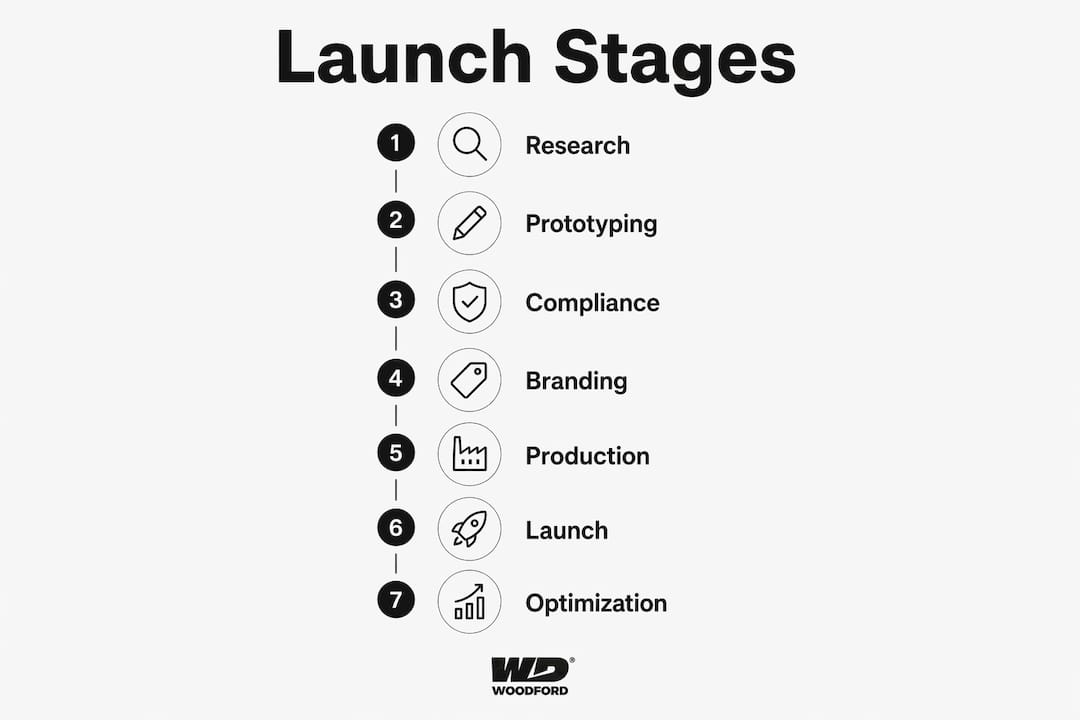
The core launch stages are:
- Market research — Identify gaps, consumer demand, and competitive positioning before committing to a concept.
- Idea selection — Filter concepts against commercial viability, production feasibility, and brand fit.
- Prototyping — Develop initial recipes or formulations and test them with target consumers.
- Testing and validation — Run structured consumer panels, shelf simulations, and stability assessments.
- Industrialisation — Transition from kitchen or pilot batch to scalable manufacturing.
- Packaging and compliance — Finalise labels, barcodes, and regulatory documentation.
- Launch — Execute your go-to-market plan across chosen distribution channels.
- Post-launch optimisation — Monitor performance data and iterate quickly.
The table below summarises each stage, its primary task, and the most common failure point at that step.
| Stage | Primary task | Common pitfall |
|---|---|---|
| Market research | Validate demand and competitive gaps | Relying on assumptions rather than data |
| Prototyping | Develop and refine formulation | Skipping consumer taste panels |
| Testing | Stability, shelf-life, and consumer feedback | Underestimating allergen complexity |
| Industrialisation | Scale production with a co-manufacturer | Incompatible equipment or minimum order quantities |
| Packaging and compliance | Labels, barcodes, and legal review | Printing before legal sign-off |
| Launch | Distribution and marketing activation | Launching in too many channels at once |
| Post-launch | Track KPIs and iterate | Treating launch as a one-time event |
Pro Tip: Validate your concept with real consumers before investing in packaging design or manufacturing quotes. A simple tasting session or online survey can eliminate a costly wrong turn at the earliest possible stage.
What compliance and packaging requirements must you meet before launch?
Regulatory compliance is not the final step before launch. It runs in parallel with product development from the start.
Here are the non-negotiable requirements every food entrepreneur must address:
- Facility registration. All food manufacturing facilities producing goods for the UK or US markets must meet mandatory registration requirements. In the United States, FDA facility registration is compulsory and must be renewed biennially on even years. Missing this blocks market entry entirely.
- GS1-issued UPC barcodes. Every unique SKU requires a GS1-issued barcode to be retail compliant. Non-GS1 barcodes are routinely rejected by major retailers. GS1 UK is the authorised source for UK-compliant barcodes.
- Professional nutrition analysis. Estimated database values are not sufficient. Professional nutrition labs produce accurate nutrition labels and allergen disclosures, which now cover nine major allergens as of 2026. Getting this wrong risks both regulatory failure and consumer harm.
- Specification sheets. Detailed spec sheets covering product, packaging, logistics, and compliance details are essential for buyer pitches and operational planning. Retailers and distributors will ask for these before listing your product.
- Legal review of packaging. Packaging design is a regulatory document as much as a marketing asset. Legal review before printing is standard practice to avoid recalls and costly reprints caused by labelling errors.
Pro Tip: Commission your nutrition lab analysis and legal packaging review at the same time. Running them in parallel rather than sequentially can cut several weeks from your compliance timeline.
How do you build a branding and distribution strategy for a new food product?
Most food entrepreneurs spend too long on the product and too little time on how they will sell it. A product without a clear go-to-market plan is just inventory.

Insight-led positioning tested against competitive retail shelves outperforms general demographic targeting. This means understanding not just who your consumer is, but what they see when they stand in front of a shelf and why they reach for one product over another. Simulating that shelf environment during development gives you a significant advantage before you spend a penny on marketing.
Your new food product marketing strategy should address four areas:
- Brand story and positioning. Define what your product stands for and why it exists. A clear brand narrative makes retailer conversations easier and consumer recall stronger. Woodford works with food brands that have a defined identity, because ambiguous positioning rarely survives a buyer meeting.
- Channel selection. Choose your distribution channels based on where your target consumer shops, not where it is easiest to list. Independent retailers, food shows such as Speciality and Fine Food Fair, and direct-to-consumer e-commerce each serve different purposes at different stages of a launch.
- Marketing activation. Integrate your launch activities across social media, in-store sampling, PR, and trade press. A single channel rarely generates enough momentum. Sampling at food shows, for example, generates immediate feedback and press coverage simultaneously.
- Sales support tools. Prepare sell-in materials including product one-pagers, trade pricing sheets, and sample packs before approaching any retailer or distributor. Buyers make fast decisions. Arriving unprepared wastes the meeting.
For a deeper look at how food brand strategy drives UK retail success, the principles of positioning and channel fit are worth studying before you finalise your go-to-market plan.
What challenges arise when scaling from prototype to industrial production?
The transition from a kitchen prototype to a factory run is where most food product launches stall. What works at five litres rarely works at five hundred without significant reformulation.
Equipment compatibility and minimum order quantities are the two most common blockers. A co-manufacturer’s mixing equipment may not replicate the texture your kitchen mixer produces. Their minimum batch size may be ten times what you need at launch. Vetting co-manufacturers early, before you have finalised your recipe, saves significant time and money.
Common scaling pitfalls and how to address them:
- Ingredient sourcing at volume. A supplier who sells you 5 kg of a specialist ingredient may not be able to supply 500 kg consistently. Qualify your ingredient suppliers for volume before you commit to a co-manufacturer.
- Shelf-life and stability testing. A product that tastes excellent fresh may degrade within weeks under retail storage conditions. Accelerated shelf-life testing should happen before, not after, you approach retailers.
- Quality assurance protocols. Define your quality standards in writing before production begins. Co-manufacturers need clear specifications to maintain consistency across batches.
- Logistics and supply chain setup. Understand your cold chain requirements, pallet configurations, and lead times before your first retail order arrives. Woodford’s experience in UK food wholesaling shows that logistics gaps are among the most common reasons new products fail to reorder.
The goal at this stage is not perfection. It is a production process that is repeatable, cost-effective, and consistent enough to meet retailer expectations from day one.
How do you monitor and optimise your food product after launch?
The first 90 days after launch are not a celebration period. They are a hypothesis-testing phase, and the data you collect during this window shapes everything that follows.
Track these metrics from week one:
- Sales volume by channel. Identify which retailers or platforms are performing and which are not. Underperforming channels may need more support or may simply be the wrong fit.
- Repeat purchase rate. This is the single most predictive indicator of product longevity. A high trial rate with a low repeat purchase rate signals that your brand promise is not matching consumer reality.
- Consumer feedback. Collect reviews, social media comments, and direct feedback systematically. Patterns in negative feedback often point to fixable issues in packaging, flavour, or portion size.
- Shelf performance. Visit your retail stockists regularly. Check placement, facings, and stock levels. A product buried on the bottom shelf with one facing will not sell regardless of its quality.
Be prepared to make changes quickly. Adjusting pack size, price point, or on-pack messaging within the first 90 days is not a sign of failure. It is the standard operating procedure for a successful food product launch. The brands that scale are the ones that treat launch as the beginning of an improvement cycle, not the end of a development project.
Key takeaways
A successful food product launch requires a structured, stage-by-stage process covering compliance, branding, manufacturing, and continuous post-launch iteration.
| Point | Details |
|---|---|
| Follow the 7–8 stage process | Move through market research, prototyping, compliance, launch, and optimisation in sequence. |
| Complete compliance before printing | Obtain GS1 barcodes, professional nutrition analysis, and legal packaging review before any print run. |
| Validate positioning on the shelf | Test your product against competitive retail shelves, not just demographic profiles. |
| Vet co-manufacturers early | Confirm equipment compatibility and minimum order quantities before finalising your recipe. |
| Treat the first 90 days as a test | Track repeat purchase rate and shelf performance, then iterate on pricing, messaging, or pack size fast. |
How Woodford supports food entrepreneurs launching new products
Woodford works with food brands at every stage of the launch journey, from first retail introduction through to scaled distribution across independent retailers in the UK. As the UK’s leading strategic food wholesaler, Woodford provides exclusive distribution, trend-led curation, and logistics support that removes the operational burden from founders focused on product and brand. Whether you are preparing your first buyer pitch or looking to expand your retail footprint, Woodford’s network and expertise give your product the best possible route to shelf. Explore Woodford’s food sourcing solutions to find out how we can support your next launch.
FAQ
How many stages does a food product launch involve?
A structured food product launch typically follows 7 to 8 core stages, from market research and prototyping through to post-launch optimisation. Skipping any stage increases the risk of compliance failure or poor retail performance.
Do I need a GS1 barcode to sell in UK retailers?
Yes. Every unique SKU requires a GS1-issued UPC barcode to be accepted by most major and independent retailers. Non-GS1 barcodes are routinely rejected at the point of listing.
When should I start compliance work for a new food product?
Compliance work should run in parallel with product development, not after it. Professional nutrition analysis and legal packaging review should both be commissioned before you finalise your packaging design.
What is the most important metric to track after launch?
Repeat purchase rate is the strongest predictor of long-term product success. A high trial rate paired with a low repeat purchase rate indicates a gap between your brand promise and the consumer experience.
How do I find the right co-manufacturer for my food product?
Vet co-manufacturers for equipment compatibility, minimum order quantities, and quality assurance protocols before committing. The transition from prototype to factory is a critical failure point, and early vetting prevents costly reformulation later.


