
How to streamline logistics in food supply chains
Logistics optimisation is defined as the integrated management of workflows, technology, and data to reduce waste, lower costs, and improve delivery performance across a supply chain. For food industry businesses, getting this right is not optional. Supply chain cost reductions of 5–30% are achievable through structured optimisation, with inventory reductions of up to 30% from digital solutions alone. That scale of saving changes margin structures entirely. This article covers the foundational tools, phased automation methods, route planning strategies, and common pitfalls you need to know to make your logistics operation genuinely more efficient in 2026.
How to streamline logistics: what you need before you start
The most common reason logistics improvement projects fail is that businesses skip the prerequisites. You cannot automate what you have not mapped, and you cannot measure what you have not defined.
Map your existing technology stack
Start by auditing every system currently touching your logistics operation. That means your Transport Management System (TMS), Warehouse Management System (WMS), Enterprise Resource Planning (ERP) platform, and any carrier portals you use. The goal is to understand what data each system holds, how they currently communicate, and where the gaps are. A unified control tower integrating TMS, WMS, and ERP provides real-time visibility and KPI monitoring that prevents operational bottlenecks. Without this integration layer, you are managing logistics through disconnected snapshots rather than a live picture.

Define your KPI framework first
Before deploying any new technology, establish the metrics you will use to judge success. The three most useful KPIs for food logistics are cost per shipment, on-time delivery rate, and exception rate (the percentage of shipments requiring manual intervention). Defining these upfront means you have a baseline to measure against. Many businesses deploy technology first and ask questions later, which makes it impossible to prove ROI.
The table below compares the most common logistics tools by function and integration potential:
| Tool | Primary Function | Integration Potential |
|---|---|---|
| TMS (e.g. Oracle TMS) | Freight planning and carrier management | High: connects to ERP, WMS, carrier APIs |
| WMS (e.g. Manhattan Associates) | Warehouse operations and inventory tracking | High: syncs with TMS and ERP |
| ERP (e.g. SAP S/4HANA) | Business-wide data and financials | High: central hub for all logistics data |
| Route optimisation software (e.g. Routemaster) | Delivery scheduling and route planning | Medium: often standalone with API options |
| Carrier portals | Booking, tracking, and invoicing | Low to medium: varies by carrier |
Pro Tip: Before purchasing any new logistics software, run a sandbox test using 90 days of historical shipment data. This reveals integration gaps and data quality issues before they become live problems.
Clean historical data is non-negotiable. Data ingestion compressed from weeks to days is now achievable with modern integration tools, but only when the underlying data is structured and consistent. If your order data, carrier records, and warehouse logs are held in incompatible formats, fix that first.
What are the key steps to automate logistics operations?
A phased approach to automation produces better results than attempting a full transformation at once. The logic is straightforward: simple automations build the data foundation that advanced AI tools require to function reliably.
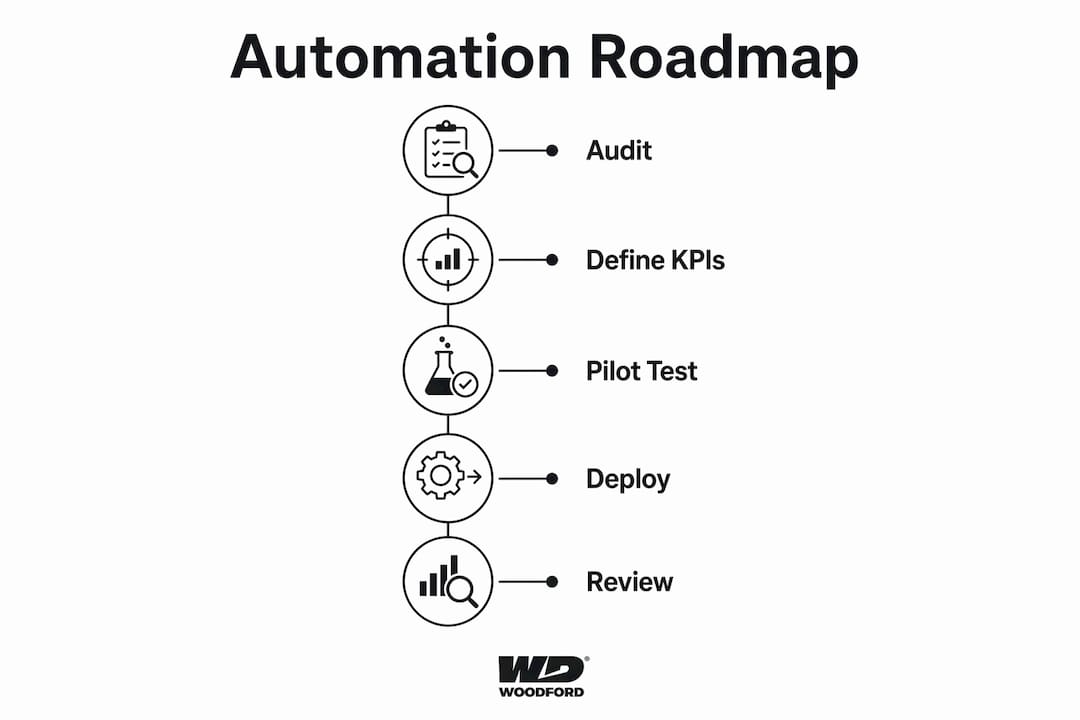
The 12-month automation roadmap
A phased 12-month roadmap starting with carrier notifications and progressing to predictive analytics is the most effective structure for maximising return on investment. Here is how that breaks down in practice:
- Months 1–3: Customer and carrier communications. Automate shipment status updates sent to customers and internal teams. This single step reduces inbound status inquiry calls significantly. Mid-market logistics firms that automated shipment communications cut inbound status calls by 58%, freeing dispatchers for higher-value work.
- Months 4–6: Invoice and document automation. Automate freight invoice matching against purchase orders and proof-of-delivery documents. Manual invoice processing is one of the highest-cost administrative tasks in food logistics and one of the easiest to automate with existing TMS capabilities.
- Months 7–9: Exception alerts and carrier performance scoring. Build automated alerts for late shipments, temperature excursions (critical in food logistics), and carrier SLA breaches. Score carriers monthly using automated data pulls. This removes the manual effort of performance reviews and creates an objective record for contract negotiations.
- Months 10–12: Predictive analytics and AI-driven demand signals. Once your data foundation is clean and your integrations are stable, introduce AI tools that forecast demand, predict delivery delays, and suggest proactive rerouting. AI systems are now evolving from passive record-keeping to agentic AI that proactively reroutes freight and rebalances inventory, reducing disruption impact before it reaches the customer.
Pro Tip: Pilot every automation with test data before going live. Thorough pilot testing with test data reduces post-launch issues by 60%. Without this step, AI predictions remain unreliable because the model trains on flawed inputs.
The biggest mistake at this stage is rushing to month ten without completing months one through six properly. Advanced AI tools are only as good as the data feeding them. Skipping the foundational steps produces expensive tools that deliver poor results. For a deeper look at phased automation in the food sector specifically, Woodford’s guide on UK food logistics covers the tactical steps in detail.
How does route optimisation reduce logistics costs?
Route optimisation is the process of selecting the most cost-effective combination of carriers, lanes, modes, and schedules to move goods from origin to destination. It sits above day-to-day dispatching and requires a strategic view of your entire distribution network.
Route guides and lane strategies
A route guide is a ranked list of preferred carriers for each lane you operate, with pricing, service levels, and backup options defined in advance. Without one, mode decisions become reactive. Transportation costs surge when mode decisions are reactive and consolidation is inconsistent. A clear lane strategy prevents this by locking in preferred rates and ensuring freight consolidation happens by design rather than by accident.
Freight consolidation deserves particular attention in food distribution. Consolidating smaller orders into full truckloads on shared lanes reduces cost per unit significantly and lowers your carbon footprint. For independent food retailers, this is one of the fastest ways to reduce logistics costs without changing suppliers or service levels.
The table below compares route optimisation techniques by effectiveness and implementation complexity:
| Technique | Cost Reduction Potential | Implementation Complexity |
|---|---|---|
| Static route guide with preferred carriers | Medium | Low |
| Freight consolidation by lane | High | Medium |
| AI-driven dynamic routing | Very High | High |
| Cross-docking to reduce storage time | High | Medium to High |
| Multi-stop delivery scheduling | Medium to High | Medium |
Understanding total cost to serve
The most important concept in logistics network design is total cost to serve. This means accounting for every cost associated with getting a product to a customer: warehousing, inventory holding, returns processing, labour, and freight. Logistics optimisation requires managing total cost to serve rather than focusing solely on freight rate negotiation. Businesses that focus only on freight rates often shift costs into warehousing or customer service without realising it.
Distribution centre sizing and location directly affect total cost to serve. Correctly sized distribution centres save 10–20% in operational costs compared to oversized or poorly located facilities. For food wholesalers serving independent retailers across the UK, this means regularly reviewing whether your current network design still matches your customer geography. Woodford’s overview of food distribution channels explains how channel choice affects total cost to serve in practical terms.
What are the most common logistics mistakes to avoid?
Even well-resourced businesses make predictable errors when improving their logistics operations. Knowing these pitfalls in advance saves significant time and money.
- Mistaking cost-cutting for true optimisation. Most companies mistake cost-cutting for streamlining. Cutting a carrier rate by 5% while absorbing higher exception handling costs is not an improvement. True logistics management encompasses all supply chain cost centres, not just the most visible line items.
- Over-promising delivery speeds. Realistic delivery promises supported by accurate inventory positioning reduce costly customer support inquiries, returns, and lost loyalty. Over-promising creates hidden costs that cancel out any efficiency gains made elsewhere in the operation.
- Ignoring warehouse slotting. Effective warehouse slotting using ABC analysis places high-velocity items in ergonomic gold zones to increase throughput and reduce travel time. Failing to update slotting quarterly erodes warehouse capacity silently. For food businesses with seasonal SKU velocity changes, this is a recurring task, not a one-off project.
- Deploying technology without KPIs. Technology without measurement is expensive guesswork. Establish your cost per shipment, on-time delivery rate, and exception rate baselines before any system goes live. Without these, you cannot demonstrate ROI to stakeholders or identify where the next improvement should come from.
- Treating logistics as a fixed cost. The businesses that achieve the greatest long-term savings treat logistics as a strategic lever, not a fixed overhead. This means reviewing carrier contracts annually, reassessing network design when customer geography shifts, and continuously updating slotting and route guides as product ranges evolve.
“Treating logistics as a strategic lever leads to sustainable savings rather than cost shifting.” — Alphazerologistics, Logistics Cost Reduction Strategies
Pro Tip: Schedule a quarterly logistics review covering KPI performance, carrier scorecards, and warehouse slotting. Businesses that review regularly catch cost creep before it compounds.
How Woodford supports food logistics efficiency
Woodford is the UK’s leading strategic food wholesaler, working with independent retailers and food brands to make distribution genuinely efficient. If the strategies in this article feel like a significant undertaking, Woodford’s logistics infrastructure and industry expertise remove much of the complexity. From inventory management to distribution network design, Woodford provides the operational backbone that lets food businesses focus on growth rather than freight. Explore how Woodford approaches food inventory management for practical guidance on reducing holding costs and improving stock accuracy. To learn more about how Woodford can support your supply chain, visit Woodford’s homepage.
Key takeaways
Effective logistics management in food supply chains requires integrated technology, phased automation, and a total cost to serve mindset rather than isolated cost-cutting measures.
| Point | Details |
|---|---|
| Map systems before automating | Audit your TMS, WMS, and ERP integrations before deploying any new technology. |
| Use a phased automation roadmap | Start with communications automation and build toward AI analytics over 12 months. |
| Optimise total cost to serve | Account for warehousing, labour, and returns, not just freight rates. |
| Define KPIs before going live | Set cost per shipment, on-time delivery, and exception rate baselines first. |
| Review slotting and routes quarterly | Seasonal SKU changes and shifting customer geography require regular network updates. |
FAQ
What does it mean to streamline logistics?
Streamlining logistics means integrating technology, data, and workflows to reduce waste, lower costs, and improve delivery performance across a supply chain. The industry term for this is logistics optimisation, which encompasses everything from route planning to warehouse slotting.
How much can logistics optimisation reduce costs?
Supply chain optimisation reduces total costs by 5–30% depending on the starting point and the scope of changes made. Digital inventory solutions alone can reduce inventory holding costs by up to 30%.
Where should a business start with logistics automation?
Start with customer and carrier communications automation, which delivers fast ROI and builds the clean data foundation required for advanced AI tools. A phased 12-month roadmap is the most reliable structure for food logistics businesses.
What is total cost to serve in logistics?
Total cost to serve is the full cost of delivering a product to a customer, including freight, warehousing, inventory holding, labour, and returns. Focusing only on freight rates without considering these other factors leads to cost shifting rather than genuine savings.
How does warehouse slotting affect logistics efficiency?
ABC analysis slotting places high-velocity SKUs in ergonomic, accessible zones, reducing picker travel time and increasing throughput. Businesses that update slotting quarterly maintain efficiency as product ranges and seasonal demand patterns change.


