What is food market segmentation: a practical guide

TL;DR:Food market segmentation involves dividing consumers into groups based on shared characteristics to enable precise targeting and better brand resonance. Combining behavioral, psychographic, and needs-based data offers the most effective insights for product positioning and retail success. Regularly updating segmentation models and considering emerging lifestyle micro-communities help brands stay aligned with shifting consumer motivations and behaviors.
Food market segmentation is the practice of dividing your consumer base into distinct groups based on shared characteristics, so you can target each group with precision rather than broadcasting a single message into the void. For marketing professionals and food industry analysts, understanding what is food market segmentation is not an academic exercise. It is the difference between a brand that resonates and one that gets lost on the shelf. Done well, segmentation tells you who is buying, why they are buying, and what product positioning will convert interest into loyalty.
Table of Contents
- Key takeaways
- What is food market segmentation and why it matters
- Market segmentation examples from the food industry
- Advanced segmentation: beyond the basics
- How to implement food market segmentation
- My perspective on food market segmentation
- How Woodford can support your segmentation strategy
- FAQ
Key takeaways
| Point | Details |
|---|---|
| Segmentation goes beyond demographics | Behavioural and needs-based segmentation predicts future purchases far more accurately than age or location alone. |
| Combine two to three types | No single segmentation method is sufficient; pairing behavioural with psychographic data yields the sharpest targeting. |
| Consumer motivations matter most | Understanding why a consumer buys, not just who they are, produces stronger product positioning and messaging. |
| Real industry data validates segments | Food-away-from-home and plant-based meat data show how concrete segment profiles guide distribution and product strategy. |
| Segmentation shapes retail success | Aligning segment insights with retailer priorities, such as velocity and shelf-life, turns brand strategy into sales. |
What is food market segmentation and why it matters
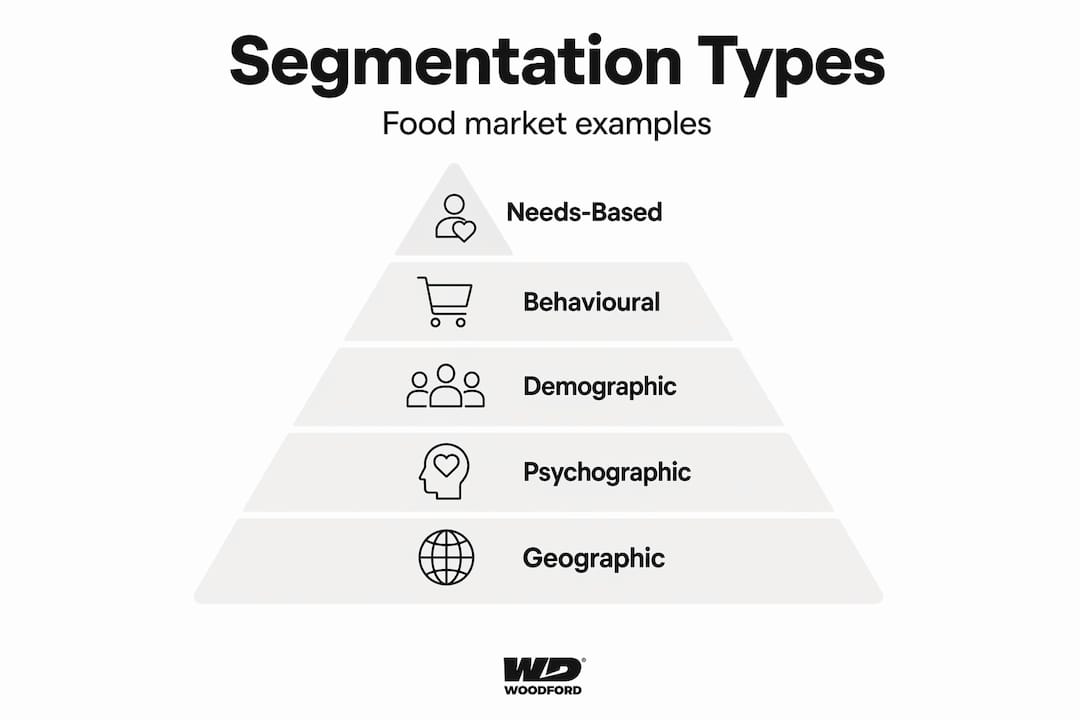
Food market segmentation is the structured process of identifying and grouping consumers according to attributes that predict how they will behave in the marketplace. The five core types used in food marketing are demographic, geographic, behavioural, psychographic, and needs-based segmentation.
- Demographic segmentation groups consumers by age, income, household size, or life stage. A baby food brand targeting new parents, or a premium meal kit aiming at dual-income households, is applying demographic logic.
- Geographic segmentation focuses on location: regional tastes, urban versus rural access, and even climate-driven eating patterns. A snack brand performing well in convenience-led Northern cities may require a completely different channel strategy in rural markets.
- Behavioural segmentation groups consumers by their actual purchase patterns, usage frequency, brand loyalty, and response to promotions. Behavioural segmentation predicts future actions more reliably than demographic or geographic data alone, making it the most operationally useful type for food marketers.
- Psychographic segmentation categorises consumers by values, lifestyle, and attitudes. A consumer who identifies strongly with environmental sustainability will respond differently to a product claim than one primarily motivated by convenience.
- Needs-based segmentation groups consumers by the specific problem they need solved, often described as the “jobs-to-be-done” framework. This is where segmentation becomes genuinely powerful for product development.
Effective strategies rarely rely on a single type. Combining two to three segmentation types consistently produces better targeting outcomes than any single approach. A functional snack brand, for example, might combine psychographic data (health-conscious values) with behavioural data (frequency of gym visits) and demographic data (age 25 to 40) to build a sharply defined segment profile.
Pro Tip: Start with behavioural data when building a segmentation model. Purchase history, basket analysis, and repeat-buy rates give you a factual foundation before you layer on attitudinal or lifestyle data.
Market segmentation examples from the food industry
The food industry offers some of the clearest segmentation examples of any sector, precisely because the market is so fragmented and consumer motivations so varied.
Food service: the commercial segmentation model
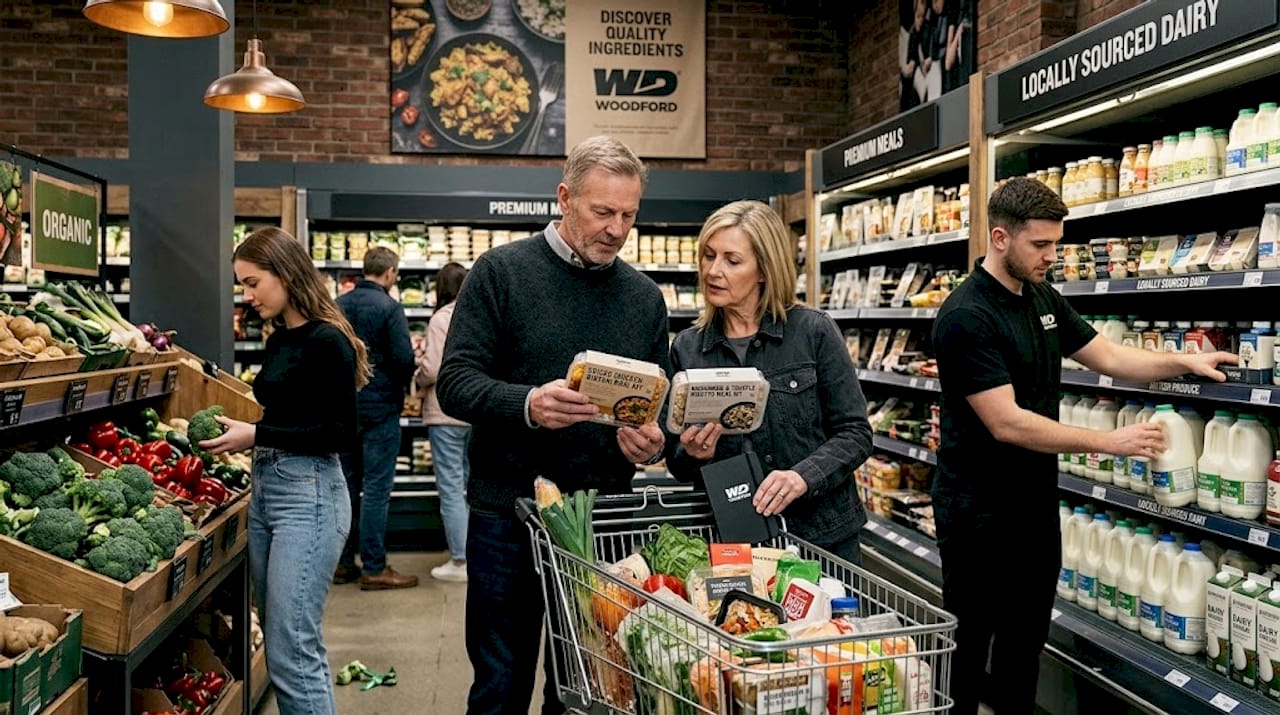
The food-away-from-home market illustrates commercial segmentation at scale. Limited-service and full-service restaurants combined account for 72.6% of food-away-from-home spending, with the remaining 27.4% spread across retail food-service, vending, and institutional outlets. For a food brand seeking wholesale or food-service distribution, this split tells you where volume lives and what operator profile to prioritise.
Category segmentation: the ‘Just Foods’ model
Within packaged food categories, segmentation by product type reveals where growth is concentrated. Meal kits account for 35 to 40% of the ‘Just Foods’ category, functional snacks and bars represent 25 to 30%, and better-for-you beverages hold 15 to 20%. Each sub-segment is driven by distinct consumer triggers: hybrid working patterns, gym culture, and diagnosed food allergies, respectively. A brand that simply launches into “healthy food” without identifying which sub-segment it serves will spread its marketing budget too thin to make a meaningful impression.
Consumer motivation segmentation: plant-based meat
Plant-based meat offers a textbook case of motivation-led segmentation. Research from the Good Food Institute found that 57% of the addressable plant-based meat market sits within just four high-engagement consumer segments, which collectively represent over 80% of current buyers. These segments are differentiated not by age or income but by motivation: environmental ethics, health outcomes, curiosity, and flexitarian identity. Targeting all four with the same message is a waste of budget. Targeting the flexitarian segment with convenience-focused messaging, or the ethics segment with supply chain transparency claims, produces a materially different result.
| Segment type | Food industry example | Key driver |
|---|---|---|
| Demographic | Baby food, premium meal kits | Age, income, household size |
| Behavioural | Repeat snack buyers, loyalty programme members | Purchase frequency, brand switching |
| Psychographic | Sustainability-led consumers | Values, lifestyle identity |
| Needs-based | Allergy-specific products, post-workout nutrition | Functional problem to solve |
| Geographic | Regional flavour preferences, urban convenience | Location, access, climate |
Pro Tip: When building segment profiles for a food brand, add a “purchase trigger” column to your data model. Knowing what prompts the first purchase is as valuable as knowing who makes it.
Advanced segmentation: beyond the basics
The terminology trap
One confusion worth addressing directly: food market segmentation as a business discipline is entirely separate from AI food image segmentation, which is a computer vision technique used in nutrition tracking apps. Confusing the two can lead to misaligned R&D investment, particularly in food-tech businesses where data science teams and marketing teams use the term differently. If your brand is exploring AI applications, clarify upfront which problem you are solving.
Micro-communities and lifestyle narratives
The US food and beverage market is evolving towards micro-communities aligned with lifestyle narratives rather than traditional product categories. Consumers increasingly define their food choices through personal identity, whether that is biohacking, religious practice, ancestral eating, or climate activism. This shift makes psychographic and needs-based segmentation considerably more valuable than a basic demographic cut.
Aligning brand messaging with lifestyle micro-communities is not simply a trend. It is becoming the primary mechanism through which independent food brands build loyal customer bases without the media budgets of category giants.
“Segmenting by ‘who someone is’ tells you where to find them. Segmenting by ‘what they are trying to achieve’ tells you what to say when you get there.”
The barbell strategy in commercial segmentation
For brands operating in retail, a barbell strategy targeting both value-conscious and premium health-focused consumers simultaneously has shown strong results. This is not the same as having no positioning. It means developing genuinely distinct product lines or pack formats for each end of the market, with separate messaging, pricing, and channel strategies. When pitching to retailers, commercial segmentation by velocity and shelf-life becomes equally important as consumer-facing data. A buyer at an independent retailer cares about turns per week as much as they care about which lifestyle segment the product serves.
The jobs-to-be-done approach to needs-based segmentation is particularly powerful here, because it moves strategic planning away from who the consumer is towards what they are actually trying to accomplish. That shift, applied to niche food categories, often reveals underserved segments that larger brands have overlooked entirely.
How to implement food market segmentation
Segmentation only creates value when it is applied. Here is a practical framework for moving from data to strategy.
- Gather primary and secondary data. Combine sales data, customer surveys, retail scanner data, and third-party category reports. Do not rely on a single source. RFM metrics (recency, frequency, monetary value), as used by major e-commerce segmentation models, are directly applicable to food brand analysis.
- Identify your segmentation variables. Choose two or three variables that are most predictive for your specific category. For a functional food brand, that might be health motivation, purchase frequency, and income band. For a regional artisan producer, it might be geography, lifestyle values, and retail channel preference.
- Build segment profiles. Give each segment a working name and write a one-paragraph profile that captures their motivation, purchase trigger, channel preference, and price sensitivity. The profile should be specific enough that a product developer and a sales manager would both make the same decisions after reading it.
- Test messaging before committing budget. Run small-scale A/B tests across two or three segments before rolling out a full campaign. Segmentation hypotheses are not facts until consumer behaviour confirms them.
- Align with retail and distribution strategy. Your segments should directly inform which retail channels you target, which food brand strategy you pursue, and how you position each SKU within a category. A segment profile that stops at marketing and does not reach the sales and ranging conversation is only half the job.
- Review and revise quarterly. Food consumer behaviour shifts quickly, particularly in response to economic pressure, health trends, and cultural moments. A segmentation model built in 2024 will need updating for 2026 conditions.
My perspective on food market segmentation
I have worked with enough food brands to know that the biggest segmentation mistake is not using the wrong model. It is using any model too rigidly. I have seen brands build elaborate demographic profiles, convince themselves they know their consumer precisely, and then fail to notice when that consumer’s motivations shifted completely.
The brands that win, in my experience, are the ones that treat segmentation as a living document rather than a quarterly deliverable. They watch for early signals in consumer behaviour: shifts in basket composition, changes in social content engagement, new purchase triggers emerging in a category. Those signals often arrive before the category data catches up.
My honest view is that the emerging lifestyle micro-community model will make traditional demographic segmentation less useful over the next three to five years. Consumers are increasingly tribal about food in ways that cut across age, income, and geography. A 58-year-old managing type 2 diabetes and a 26-year-old training for an ultramarathon may sit in completely different demographic segments but share identical purchasing behaviour in the functional nutrition aisle. Demographic logic would send them different messages. Motivational logic would send them the same one.
Segmentation is most valuable when it makes you uncomfortable. If your segment profiles confirm everything you already believed about your consumer, they are probably not granular enough.
— Nadim
How Woodford can support your segmentation strategy
Woodford works directly with food brands and independent retailers to turn category intelligence into commercial results. Our team understands the segmentation dynamics that drive shelf performance, from identifying the right consumer profile to recommending the most suitable retail channels for each product type. Whether you are refining your brand positioning or exploring new category opportunities, our knowledge of the UK independent retail market gives your segmentation strategy a direct route to the shelf.
Explore how Woodford’s strategic food distribution platform connects brand insight with retail execution. For deeper reading, our guide to UK food retail trends in 2026 covers the evolving consumer landscape your segmentation model needs to account for.
FAQ
What is food market segmentation?
Food market segmentation is the process of dividing food consumers into distinct groups based on shared characteristics such as behaviour, lifestyle, needs, or demographics. It allows brands to target specific groups with relevant products and messaging rather than applying a one-size-fits-all approach.
Which type of segmentation works best for food brands?
No single type is universally superior, but behavioural segmentation is the most operationally useful because it predicts future purchasing behaviour. Combining behavioural with psychographic and needs-based segmentation consistently produces the most accurate consumer profiles.
Why is segmentation important in the food industry?
Segmentation is the foundation of effective targeting. Without it, food brands risk investing in channels, messaging, and product formats that do not match actual consumer motivations. The plant-based meat market, where just four consumer segments account for over 80% of buyers, shows how precisely defined segments can focus brand investment and improve conversion.
How do I start segmenting a food market?
Begin by collecting sales data, customer survey responses, and retail scanner data. Identify two or three variables most predictive for your category, build detailed segment profiles, and test messaging with real consumers before committing to a full campaign strategy.
What is the difference between demographic and needs-based segmentation?
Demographic segmentation groups consumers by observable characteristics such as age, income, or location. Needs-based segmentation groups them by the problem they are trying to solve, often called the “jobs-to-be-done” framework. Needs-based approaches move beyond who the consumer is to why they are buying, which produces stronger product positioning and more targeted messaging.
Recommended
- Discover niche food categories to set your shop apart - WOODFORD - Bringing quality foods your way
- How to identify food trends: a guide for UK retailers - WOODFORD - Bringing quality foods your way
- Ambient food explained: a retailer’s guide to new opportunities - WOODFORD - Bringing quality foods your way
- Innovation in UK food retail: A practical guide for independents - WOODFORD - Bringing quality foods your way