Logistics process for retailers: your complete guide
TL;DR:Effective food retail logistics involve strict compliance, accurate forecasting, and strong supplier partnerships to prevent stockouts and waste. Implementing real-time monitoring and leveraging technology like 3PLs help independent retailers enhance efficiency and ensure cold chain integrity. Strategic collaborations and integrated systems are essential for maintaining profitability and high customer satisfaction.
Running a food retail shop is hard enough without your supply chain working against you. The logistics process for retailers sits at the heart of whether your shelves stay stocked, your cold chain stays compliant, and your margins stay intact. Get it wrong and you lose sales to empty shelves, throw money at waste, and frustrate customers who walk out the door. This guide walks you through the entire process, from foundational compliance and demand planning through to execution, monitoring, and the technology decisions that actually move the needle for independent food retailers across the UK.
Table of Contents
- Understanding the logistics process and requirements
- Preparing your supply chain: forecasting, inventory, and supplier collaboration
- Executing logistics operations: receiving, storage, picking, and shipping
- Monitoring, managing, and verifying your logistics performance
- Why embracing integrated technology and partnerships transforms retail logistics
- Optimise your retail logistics with Woodford’s expert support
- Frequently asked questions
Key Takeaways
| Point | Details |
|---|---|
| Understand logistics basics | Mastering inbound costs and cold chain rules is vital for compliant retail operations. |
| Prepare supply chains strategically | Use forecasting and supplier collaboration to ensure smooth stock flow and reduced waste. |
| Execute operations carefully | Follow best practices for receiving, storage, and picking to maintain product quality and accuracy. |
| Monitor logistics continuously | Track temperatures and delivery notices closely to comply with regulations and avoid costly errors. |
| Leverage technology and partnerships | Integrating planning software and 3PL services transforms efficiency and responsiveness for independents. |
Understanding the logistics process and requirements
Before you can fix anything, you need to understand what you are working with. For independent food retailers, the logistics process covers every movement of goods, from the moment a supplier confirms an order to the moment a product lands on your shelf. And in food retail, that process carries legal weight.
Inbound logistics costs for UK retailers typically represent 2 to 7% of sales. For a small independent with thin margins, that figure is not background noise. It is the difference between a profitable quarter and a loss. Knowing where those costs live, delivery fees, handling, waste from poor temperature management, gives you specific places to act.
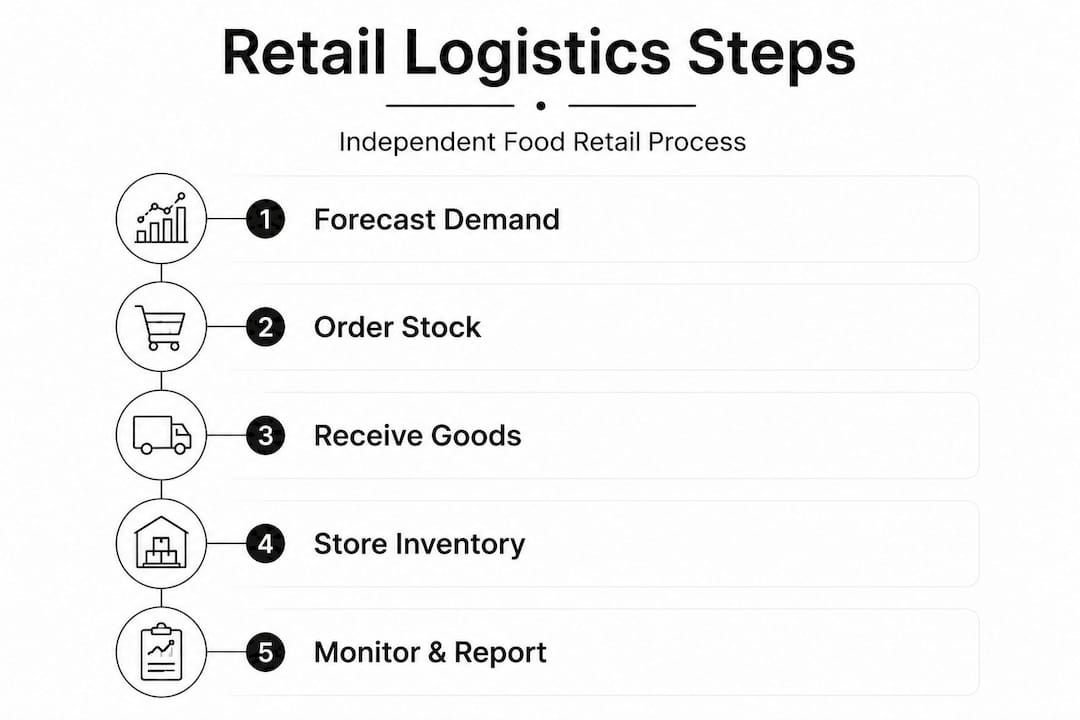
Food safety compliance is non-negotiable. FSA regulations require chilled food to be kept at or below 8°C and frozen food at -18°C or colder throughout the entire supply chain. Not just in your store. Throughout. That means your suppliers, any intermediate handlers, and your own receiving dock all need to meet those standards consistently.
Key compliance obligations for UK independent food retailers include:
- Maintaining temperature records at every handover point
- Ensuring vehicles used for delivery carry valid temperature monitoring equipment
- Keeping Food Business Operator (FBO) registration current with your local authority
- Documenting any temperature deviations and the corrective action taken
- Following FSA and local Environmental Health Officer (EHO) guidelines on storage labelling
For a detailed breakdown of what UK food regulations demand from your supply chain, UK food logistics requirements covers the current landscape clearly.
| Compliance area | Regulatory body | Requirement |
|---|---|---|
| Chilled food temperature | FSA | At or below 8°C |
| Frozen food temperature | FSA | -18°C or colder |
| Food business registration | Local Authority | Mandatory before trading |
| Temperature records | EHO / FSA | Must be retained and available |
| Vehicle temperature monitoring | HMRC / EHO | Required for temperature-controlled transport |
Pro Tip: When you receive a chilled delivery, use a calibrated probe thermometer to spot-check the core temperature of products, not just the air temperature of the vehicle. Air temp readings can be misleading if the vehicle door has been open for several minutes during unloading.
Preparing your supply chain: forecasting, inventory, and supplier collaboration
Knowing your compliance obligations is the starting point. The next layer is getting your supply chain ready to actually deliver on them without constant firefighting.
Demand forecasting, inventory management, and replenishment planning must handle millions of SKU and store combinations in grocery retail. Even at small-independent scale, the principle holds: ordering without forecasting is guesswork, and guesswork in food retail means either waste or stockouts.
For independent retailers, a practical forecasting approach does not require enterprise software. Start with your sales data from the past 12 months, segment by season, and identify your top 20% of products by volume. Those items deserve tight replenishment cycles. The rest can be managed on longer lead times without the same intensity.
How to build a workable demand forecast:
- Pull weekly sales data by product for the past 52 weeks
- Identify seasonal peaks and troughs for each category
- Cross-reference with your supplier lead times to set reorder points
- Build a minimum stock level for your top 20 products that accounts for the longest realistic lead time
- Review and adjust monthly, not quarterly
Inventory positioning matters as much as the numbers themselves. Placing fast-moving chilled products nearest the delivery entrance reduces the time they spend outside controlled temperature. That single change lowers both compliance risk and product loss.
Supplier collaboration is underrated. Most independent retailers treat supplier relationships as purely transactional. Retailers who share their sales velocity data with key suppliers get better fill rates, earlier warnings of supply issues, and sometimes priority allocation during shortages. It costs nothing to share a monthly sell-through report.
Partnering with 3PL providers enhances efficiency and flexibility for retailers who lack direct supplier relationships or the volume to negotiate favourable delivery terms. For independents, a 3PL can consolidate deliveries from multiple suppliers into a single drop, cutting your inbound delivery frequency and giving you more control over receiving windows.
For more on practical food inventory management techniques and how 3PL benefits for food retailers work at independent scale, both guides are worth your time.
Pro Tip: Even a basic shared spreadsheet with your top five suppliers, updated weekly with your current stock levels and upcoming promotional activity, can dramatically reduce surprise stockouts. Most suppliers will act on that data proactively if you give them the chance.
Executing logistics operations: receiving, storage, picking, and shipping
Preparation creates the conditions for good execution. This is where your logistics process either earns its keep or quietly bleeds money.
Retail order fulfilment involves receiving inventory, storage, picking, packing, and shipping, and accuracy at each stage compounds across the chain. One miscount at receiving becomes a phantom stock problem two weeks later.
Steps for accurate goods-in receiving:
- Compare the physical delivery against the Purchase Order before signing anything
- Check temperatures of chilled and frozen goods before accepting
- Count units per SKU and record any discrepancies on the delivery note
- Log the batch numbers and best-before dates for each product line
- Move temperature-sensitive goods to the correct storage zone within 15 minutes of acceptance
- File the signed delivery note and any variance records for your compliance audit trail
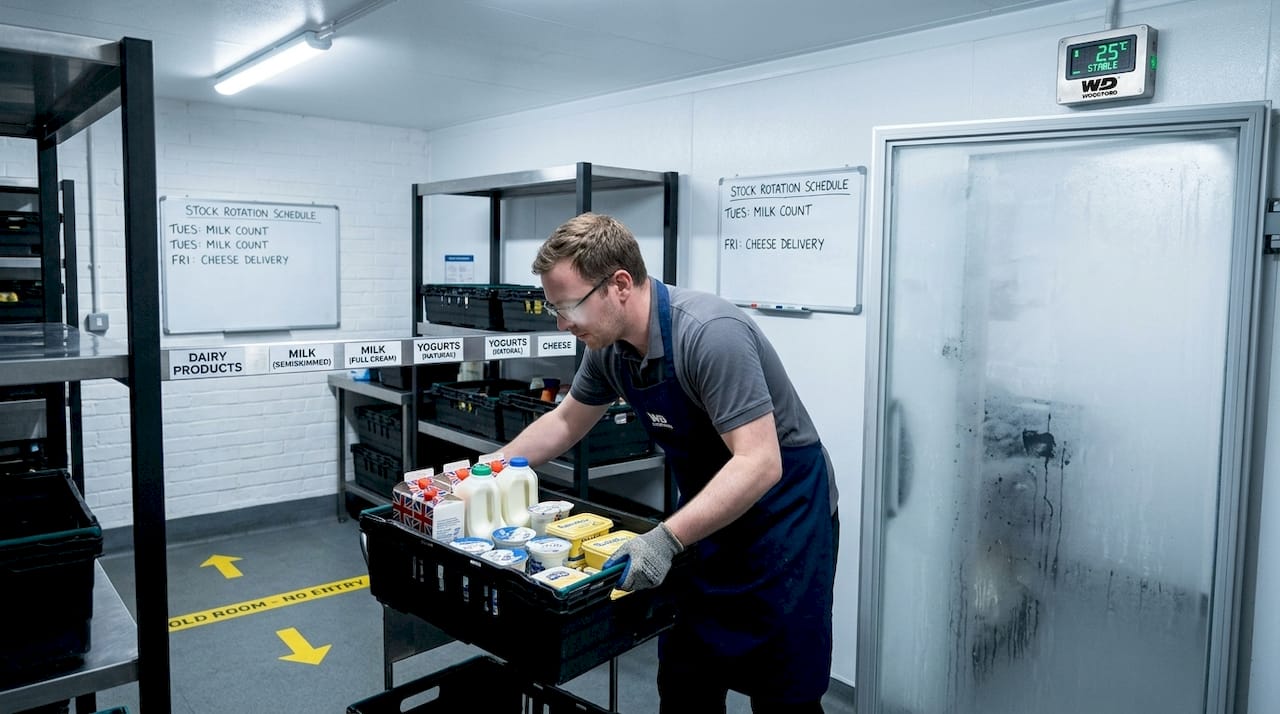
Storage discipline keeps your cold chain intact and your stock rotation honest. FIFO (first in, first out) is the standard, but many independent retailers apply it inconsistently under the pressure of busy delivery days. A simple shelf label system showing the week of receipt costs almost nothing and removes the guesswork entirely.
Picking accuracy directly affects your customers when you fulfil click-and-collect or wholesale orders from your store. Batch picking (grouping multiple orders and picking in a single pass through the store) cuts travel time considerably for small operations.
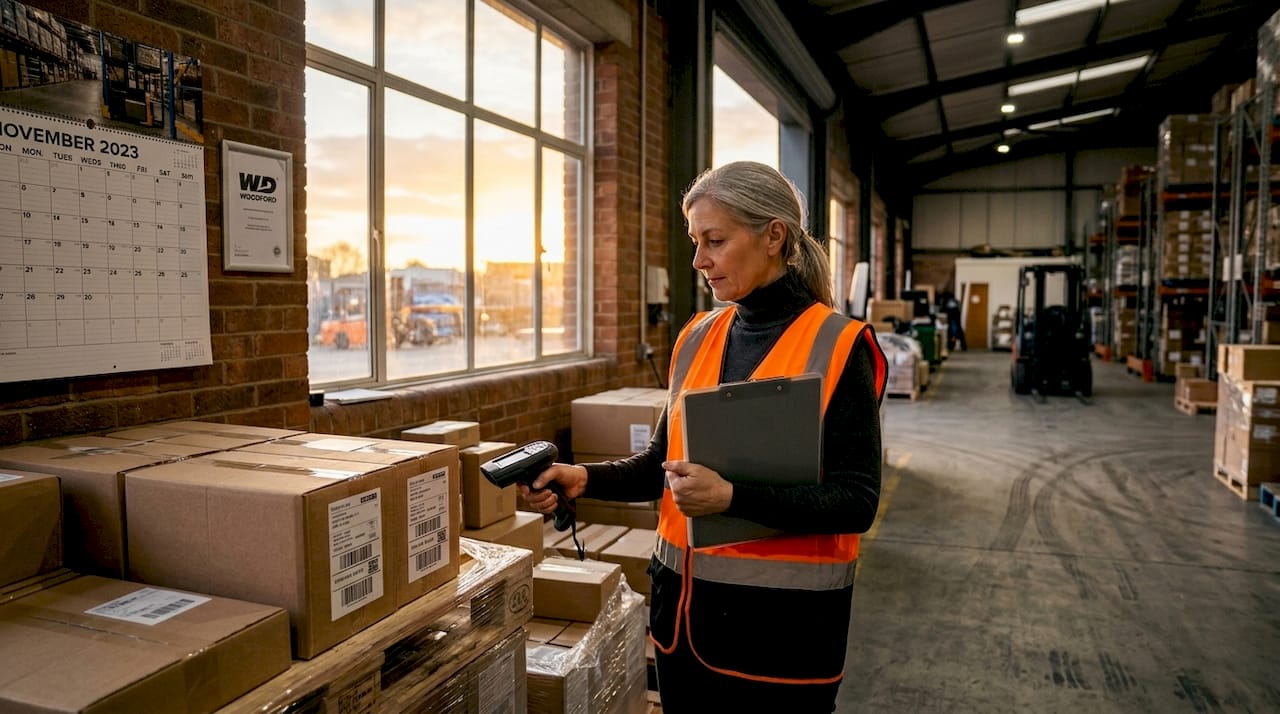
On the supplier side, GS1 UK standards require GS1-128 labels with SSCC-18 codes on pallets for automated receiving. If your suppliers use these correctly, you can scan pallets directly into your stock system rather than counting manually. This cuts receiving time and reduces entry errors significantly.
| Operation | Common failure point | Practical fix |
|---|---|---|
| Goods-in receiving | Signing off without checking temperatures | Train staff to probe-check before signing |
| Cold storage | Incorrect zone placement under time pressure | Colour-coded storage zone signage |
| Stock rotation | FIFO inconsistency during busy periods | Date-labelled shelf markers |
| Order picking | Picking errors on multi-SKU orders | Printed pick lists with barcode verification |
| Dispatch | Missing or incorrect delivery documentation | Checklist before any vehicle leaves |
To understand how cross-docking fits into your food logistics execution steps and which distribution channels for food retailers suit different product types, both resources add useful context.
Pro Tip: If a supplier delivery arrives with an incorrect pallet label or no SSCC code, do not let it pass without a written note to the supplier. One correction request is ignored. Three is a pattern. Consistent feedback is how you get better service over time.
Monitoring, managing, and verifying your logistics performance
You cannot manage what you do not measure. In food logistics, that is not a motivational saying. It is a legal and commercial reality.
Continuous temperature monitoring sits at the foundation of UK food safety compliance. But monitoring alone is not enough. You need documented procedures for what happens when a reading falls outside the acceptable range. Without that paper trail, a single EHO visit can become a very expensive afternoon.
Short temperature excursions may be acceptable if they are risk-assessed and documented. Real-time monitoring is recommended to avoid penalties. In practice, this means having a written deviation procedure that your staff actually follow, not just one that lives in a folder.
Key monitoring practices for independent food retailers:
- Install digital temperature data loggers in all chilled and frozen storage areas
- Set automated alerts for any reading outside your target range
- Record corrective actions taken and the name of the staff member responsible
- Retain temperature logs for a minimum of 12 months
- Conduct weekly reviews of your monitoring data to spot drift before it becomes a breach
On the logistics side, Advance Ship Notices (ASN) are increasingly required. Major UK retailers mandate ASN in advance of delivery. Deliveries without one are rejected outright. If you are supplying other businesses as well as running your own retail operation, this is not optional compliance. It is the price of doing business.
The independent retailers who manage logistics well share one habit: they treat monitoring data as a weekly management tool, not a box-ticking exercise for audits. Spotting a temperature sensor drift in week one costs nothing to fix. Discovering it during an EHO inspection costs considerably more.
For logistics performance monitoring tips specific to UK independent food retailers, including which metrics actually matter at small-to-medium scale, the linked guide goes into practical detail.
Why embracing integrated technology and partnerships transforms retail logistics
Here is what most logistics guides will not tell you: the biggest source of waste in independent food retail is not poor execution. It is the gap between planning and execution. You order based on last week’s data while your shelves reflect this week’s reality. That disconnect, often just a 48-hour information lag, drives more stockouts and more write-offs than any operational failing.
Grocery supply chains fail when plans do not align with execution. Unified planning software keeps forecasts and replenishment synchronised in real-time. The technology to close that gap used to be enterprise-only. It no longer is. Affordable cloud-based stock and replenishment tools now connect point-of-sale data directly to reorder triggers. The independent retailer who uses them competes on a different level to one still working from a weekly spreadsheet.
The second underappreciated factor is the quality of your logistics partnerships. Many independents treat their wholesaler or distributor as a commodity supplier, chosen on price alone. The retailers who consistently outperform on availability do something different. They treat their supply partners as extensions of their own operation, sharing sales data, flagging upcoming events, and building the kind of relationship where a phone call on a Tuesday afternoon can unlock an emergency pallet.
Partnering with 3PL providers significantly enhances efficiency and flexibility for retailers operating without large infrastructure. For an independent with one or two sites, a well-chosen 3PL partner effectively gives you the logistics muscle of a much larger operation, without the capital cost.
The retailers who will thrive over the next five years are not necessarily the ones with the biggest budgets. They are the ones who close the loop between what they plan to sell, what they actually stock, and what their suppliers are shipping. Technology and partnerships are the mechanisms that make that possible.
For a practical view of leveraging 3PL and technology in the UK independent food sector, the linked resource covers specific tools and partnership models worth considering.
Optimise your retail logistics with Woodford’s expert support
At Woodford, we work specifically with independent food retailers across the UK who want to raise the standard of their logistics without the overhead of building it all from scratch. As the UK’s leading strategic food wholesaler, we provide exclusive distribution, trend-led product curation, and logistics support that takes the pressure off your supply chain so you can focus on your customers. Whether you are tackling cold chain compliance, supplier consolidation, or getting your inventory management to a professional standard, we have the experience and the network to help. Visit Woodford to explore how we support independent retailers at every stage of the logistics process.
Frequently asked questions
What temperature must chilled food be kept at during distribution?
Chilled food must be kept at or below 8°C throughout the supply chain, with best practice targeting 1 to 5°C to maintain a meaningful safety margin.
Why is Advance Ship Notice (ASN) important for deliveries?
ASN must be sent before a delivery arrives. Major UK retailers, including Tesco, will refuse to accept deliveries that arrive without a valid ASN, resulting in a returned load and a missed sale.
How can small independent retailers improve logistics efficiency without owning distribution centres?
Small UK retailers can work with 3PL providers and consolidation centres to access professional logistics infrastructure without the capital cost of owning their own facility.
What is the role of forecasting in retail supply chain logistics?
Accurate demand forecasting drives correct inventory positioning and replenishment timing, directly reducing both stockouts and the waste that comes from over-ordering.
Recommended
- Wholesale logistics explained: A guide for UK food retailers - WOODFORD - Bringing quality foods your way
- Understanding the food distribution cycle for UK retailers - WOODFORD - Bringing quality foods your way
- Food logistics tips for UK independent retailers in 2026 - WOODFORD - Bringing quality foods your way
- What is cross-docking in food logistics: a guide - WOODFORD - Bringing quality foods your way