Guide to food product curation for retailers

TL;DR:Poor food product curation causes shopper confusion, dead stock, and weakens brand identity in retail.Effective curation begins with understanding customer preferences, current trends, and setting clear selection criteria.Continuous review, strategic presentation, and sensory evaluation are essential for building a strong, relevant food range.
Stocking a retail shelf or building an online food offering sounds straightforward until you are faced with thousands of products, each one promising to be the next big thing. Poor curation is one of the most quietly damaging decisions a food retailer can make. It leads to confused shoppers, dead stock, and a brand identity that never quite lands. This guide to food product curation gives you a practical, step-by-step framework to select, organise, and continuously improve your product range so that every item on your shelves earns its place.
Table of Contents
- Key takeaways
- Starting your guide to food product curation right
- How to curate food products step by step
- Organising and presenting your curated range
- Maintaining and optimising your assortment over time
- My honest view on what makes curation work
- Discover Woodford’s curated brand portfolio
- FAQ
Key takeaways
| Point | Details |
|---|---|
| Know your customer first | Define your customer’s dietary needs and preferences before selecting a single product. |
| Sensory evaluation is non-negotiable | Taste and texture testing must precede any buying decision; labels alone are not sufficient. |
| Limit variety deliberately | Smaller, intentional ranges reduce shopper overwhelm and signal premium quality. |
| Presentation shapes perceived value | How you group and describe products directly affects willingness to pay. |
| Curation requires ongoing review | Sales data and customer feedback should drive regular assortment updates to stay relevant. |
Starting your guide to food product curation right
Before you select a single product, you need to build a foundation. The retailers who struggle most with curation are the ones who start with the products rather than the customer. Flip that order and most of the hard decisions become much easier.
Understanding your customer and current trends
Start by mapping your core customer. What dietary preferences do they hold? Are they shopping for convenience, health, indulgence, or all three at different points in the week? Independent retailers often have a genuine advantage here because they know their regulars personally. Use that knowledge deliberately.
Trend awareness matters just as much as knowing your existing customers. Right now, gut health is one of the most powerful forces reshaping food retail. Eight per cent of reviewed food products make gut health claims, with 65% of soda submissions alone including prebiotic or probiotic claims. If gut health does not feature somewhere in your range, you are already behind where your customers are heading. Woodford’s roundup of 2026’s top food trends is a practical starting point for spotting these shifts early.
Setting your selection criteria
Written selection criteria sound bureaucratic but they save you an enormous amount of time and money. Before you speak to a single supplier, agree internally on what qualifies a product for your range. Useful criteria include:
- Quality and freshness standards: minimum acceptable shelf life, ingredient quality benchmarks, and any provenance requirements
- Dietary and allergen fit: whether you are catering to vegan, gluten-free, or allergen-conscious shoppers
- Pricing band: the price range that aligns with what your customers actually spend
- Supplier reliability: track record of consistent supply, clear labelling, and responsive account management
Tools and systems to set up early
Product tagging using standardised taxonomy is one of the most underused levers in food retail. Tagging by type, ingredient, dietary fit, allergens, sourcing, and use case makes filtering and recommendation far more effective, whether you are managing a physical stockroom or an e-commerce catalogue. Pair this with inventory management software that flags slow movers before they become a write-off.
Pro Tip: Before approaching any new supplier, build a one-page product brief that lists your selection criteria and target customer profile. It focuses conversations quickly and filters out products that will not work before they take up your time.
How to curate food products step by step
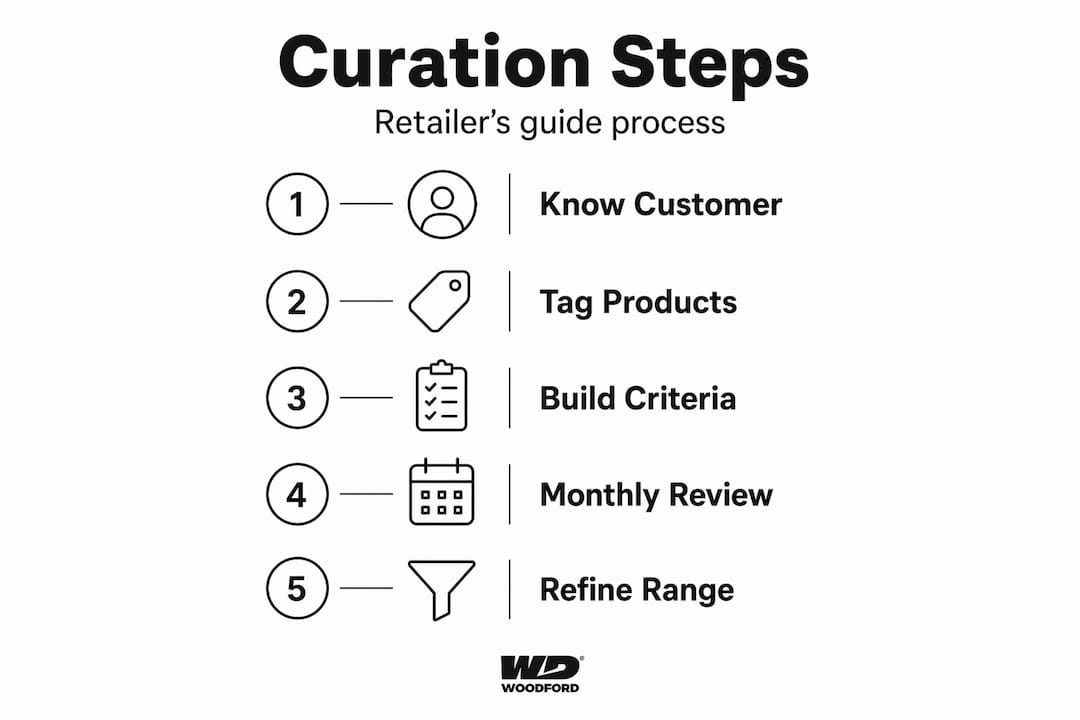
A repeatable process is what separates retailers who build strong ranges from those who restock on gut feel. Here is a clear sequence to follow every time you are building or refreshing your assortment.
- Define your core assortment first. Identify the ten to twenty products that make up the backbone of your range. These are the items your regulars expect to find every time. Build everything else around this anchor selection.
- Audit market gaps. Look at what your customers ask for that you do not stock, and at what your competitors are not offering. Woodford’s guidance on niche food categories is worth reading here. Gaps in the market are often where the highest-margin products live.
- Conduct sensory evaluation. This is the step most buyers skip and the one that matters most. Sensory evaluation requires physically experiencing product taste and texture. Labels, nutritional panels, and brand decks are useful context, but they cannot tell you whether a product is actually good. Taste everything before you list it.
- Balance staples with trend-led products. Approximately 70 to 80 percent of your range should be reliable, familiar products. The remaining 20 to 30 percent is where you introduce trending or niche items that signal to customers that your range is alive and considered.
- Apply structured product tagging. Before any new product goes live in your system, tag it correctly across all relevant attributes. This makes ranging decisions and stock reports far more useful when you come to review performance.
- Limit similar options. Smaller, curated product lists actively prevent the confusion caused by the paradox of choice, improving both sales and customer satisfaction. Three well-chosen pasta sauces will outsell eight indistinguishable ones.
- Use data to validate decisions. After any new product has been on sale for four to six weeks, review its scan data, return rate, and any customer comments. Let the numbers confirm or challenge your initial instinct.
Pro Tip: Run a monthly “one in, one out” review. Every time a new product joins the range, identify the weakest performer it will replace. This keeps your range tight and prevents the slow creep of clutter.
Organising and presenting your curated range
Getting the selection right is only half the job. How you group and present your products shapes how customers perceive their quality and value. This is where good food product curation strategies translate directly into revenue.
Grouping by use case rather than category
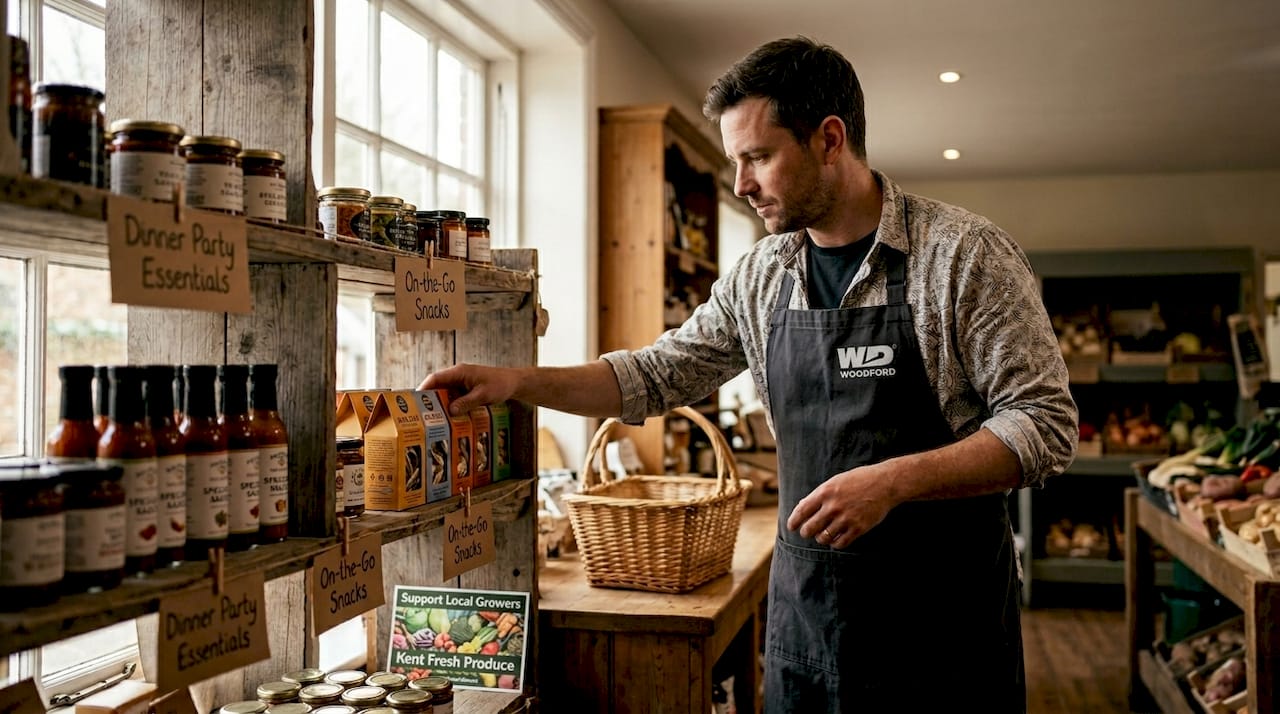
Most retailers organise shelves by conventional category: sauces here, snacks there. Consider organising by occasion or consumer goal instead. A “weekend breakfast” section that brings together granola, specialty preserves, and a standout coffee feels intentional and inspires basket-building in a way that a generic “breakfast” bay rarely does.
This approach works online too. Collections built around a theme, such as “high protein lunches” or “low-sugar snacking”, perform better because they do the thinking for the customer.
The role of presentation and storytelling
Artfully presented products are perceived as better tasting and higher value than identical products presented without care. In practice, this means shelf positioning, facing, and the quality of signage all affect whether a product sells at full margin or sits and ages.
Storytelling grounded in verifiable detail outperforms vague marketing claims consistently. A shelf label that reads “Cold-pressed in Shropshire using heritage apples, harvested September” does more for sales than “artisan quality.” Origin, process, and ingredient transparency are what build genuine trust.
| Presentation approach | Effect on customer behaviour |
|---|---|
| Themed use-case groupings | Encourages basket building and longer browsing time |
| Story-driven shelf labels | Increases perceived value and reduces price sensitivity |
| Cluttered, undifferentiated shelving | Leads to decision fatigue and lower conversion rates |
| Seasonal or limited-time displays | Creates urgency and repeat visits to discover what’s new |
Clear packaging messaging combined with product integrity is what drives long-term repeat purchase. Read Woodford’s food merchandising tips for practical guidance on translating these principles into your physical retail space.
Maintaining and optimising your assortment over time
The best food product selection guide is not one you follow once and file away. Effective curation is a recurring discipline, not a one-off project.
Sales data and customer feedback should be the primary inputs to any ranging review. Look at weekly velocity, margin contribution, and whether slower movers are pulling their weight in terms of basket attachment or customer loyalty. Products that perform poorly on all three measures should exit the range without sentiment.
Keep the following practices in your regular rhythm:
- Monthly velocity reviews: compare sales rank against the previous four weeks to catch slow movers before they become dead stock
- Quarterly trend checks: use trade publications, wholesale data, and customer surveys to assess whether your range still reflects where tastes are heading; spotting trends early is a genuine competitive edge
- Seasonal rotations: plan limited-time offerings around key calendar moments (Christmas, summer BBQ season, Veganuary) at least eight weeks in advance so you have time to source and merchandise properly
- Supplier coordination: maintain open dialogue with your best suppliers about what is coming next; good relationships give you early access to new products and priority during supply shortages
Pro Tip: Create a simple traffic-light scoring system for your range. Green means the product is performing well and stays. Amber means it needs attention, possibly better positioning or a price review. Red means it is on notice for delisting. Review it every quarter.
Taste drives repeat business more reliably than competitive pricing alone. When you are deciding whether to keep or delist a product, always factor in customer feedback on quality, not just the sales numbers.
My honest view on what makes curation work
I have watched a lot of retailers approach curation as a buying exercise. They compare supplier price lists, check certifications, and make decisions from a spreadsheet. The ranges they build are technically fine and commercially mediocre.
The retailers whose ranges I genuinely respect all share one habit: they taste everything. Not just once at a trade show, but repeatedly, in context, alongside the customer journey they are trying to create. Sensory evaluation is where the real knowledge lives, and most buyers treat it as optional.
The second thing I see underestimated constantly is the power of restraint. Over-diversification is one of the most common curation mistakes I encounter. Buyers feel pressure to cover every possible preference and end up with a range so broad it says nothing about who they are. The best independent retailers I know could describe their range philosophy in two sentences. That clarity is not a limitation. It is what earns loyalty.
Pricing is the third area where I think conventional wisdom misleads people. The instinct is to compete on price, but the retailers who build long-term customer value almost always lead with quality and let price follow. When you curate products that taste genuinely better, you stop having a pricing conversation entirely.
Curation is ultimately a reflection of taste, values, and knowledge. The more honestly you invest in those three things, the less work the rest of it takes.
— Nadim
Discover Woodford’s curated brand portfolio
If you are building or refreshing your food range, the sourcing challenge is often where good intentions stall. Woodford works exclusively with independent retailers and food entrepreneurs to provide access to quality, trend-led food brands that would otherwise be difficult to discover and source reliably. Browse Woodford’s curated brand portfolio to explore the quality food brands already available to you. For guidance on how to source exclusive products for your shop, Woodford’s advice on sourcing exclusive food brands is a practical next step.
FAQ
What is food product curation?
Food product curation is the deliberate process of selecting, organising, and presenting a specific set of food products based on customer needs, quality standards, and commercial goals. It goes beyond standard buying by treating the range as a considered whole rather than a collection of individual items.
How many products should a curated food range include?
There is no universal number, but smaller, intentional ranges consistently outperform bloated ones. Limiting similar options prevents the paradox of choice and increases the perception of premium quality among shoppers.
How often should I review my curated food assortment?
Monthly velocity reviews catch slow movers early, while quarterly trend and feedback reviews are sufficient for broader ranging decisions. Seasonal rotations should be planned at least eight weeks in advance.
Why does sensory evaluation matter in food product curation?
Taste and texture cannot be assessed accurately from labels or brand materials alone. Research confirms that taste secures repeat purchases more reliably than price, making direct product experience a critical part of any curation process.
What tools do I need to manage a curated food range effectively?
Standardised product tagging by type, dietary fit, allergens, and use case is the most practical starting point. Pair this with inventory software that tracks sales velocity and flags underperformers before they become a stock problem.
Recommended
- Discover niche food categories to set your shop apart - WOODFORD - Bringing quality foods your way
- How to identify food trends: a guide for UK retailers - WOODFORD - Bringing quality foods your way
- Ambient food explained: a retailer’s guide to new opportunities - WOODFORD - Bringing quality foods your way
- Innovation in UK food retail: A practical guide for independents - WOODFORD - Bringing quality foods your way