UK food compliance: essential laws and best practices

TL;DR:UK food compliance requires ongoing adherence to laws covering safety, hygiene, labelling, and traceability.Implementing a HACCP-based system with prerequisite programmes is essential for day-to-day safety management.Strong food safety culture, real-time records, and third-party certification are key to pass inspections and build trust.
UK food compliance: essential laws and best practices
Over 95% of UK food businesses are broadly compliant with food safety law, yet formal enforcement actions have risen sharply, up 23% for hygiene breaches and 44% for labelling standards compared to pre-COVID levels. Roughly 300 prosecutions occur each year, with fines ranging from £1,000 to over £30,000 per case. When you factor in lost revenue, reputational damage, and operational disruption, a single incident can cost a business between £30,000 and £100,000. This guide cuts through the complexity to clarify exactly what UK food compliance requires, from legal foundations to daily operational habits, so you can protect your business and your customers with confidence.
Table of Contents
- What is food compliance in the UK?
- Core food safety management: HACCP and prerequisite programmes
- Post-Brexit changes and advanced compliance challenges
- Best practices for efficient and defensible food compliance
- A fresh perspective: what most compliance guides leave out
- Take your next step in food compliance
- Frequently asked questions
Key Takeaways
| Point | Details |
|---|---|
| Legal framework | UK food compliance relies on retained EU and national laws to ensure safety, hygiene, and accurate labelling. |
| HACCP is essential | All businesses must use HACCP principles, but simplified approaches exist for smaller operations. |
| Post-Brexit shifts | Legal updates, food culture, and fraud prevention are now as important as hygiene and process rules. |
| Best practice matters | Digital tools, regular reviews, and staff training make compliance stronger and more defensible. |
| Real compliance shows | Inspectors look for verifiable behaviours and records, not just paperwork or certificates. |
What is food compliance in the UK?
Food compliance in the UK means meeting every legal obligation that governs how food is produced, handled, stored, labelled, and sold. It is not a single rule or a one-time audit. It is an ongoing commitment across your entire operation, from supplier onboarding to shelf placement.
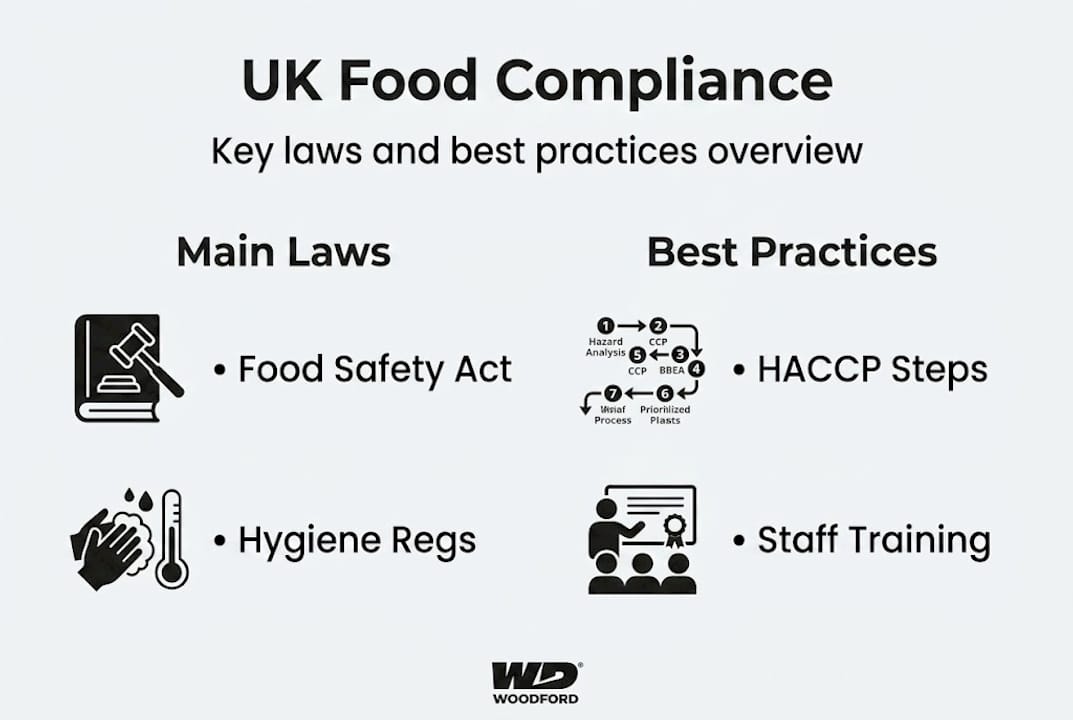
The legal framework for food compliance in the UK is built on retained EU regulations adapted post-Brexit, most importantly Regulation (EC) No 178/2002 (General Food Law) and Regulation (EC) No 852/2004 (food hygiene), alongside the Food Safety Act 1990 and the Food Hygiene (England) Regulations 2006 and their devolved equivalents in Scotland, Wales, and Northern Ireland.
The core obligations these laws create fall into five broad categories:
- Food safety: Food must not be injurious to health or unfit for consumption
- Hygiene: Businesses must implement hygiene controls throughout the supply chain
- Labelling: Products must be accurately and clearly labelled, including allergen information
- Traceability: You must be able to trace food one step back and one step forward in the supply chain at all times
- Non-deception: Food must not mislead the consumer about its nature, substance, or quality
“Food compliance is not a department. It is the daily operating standard of every person who touches food in your business.”
Enforcement sits primarily with local authority Environmental Health Officers (EHOs) and Trading Standards officers, supported at national level by the Food Standards Agency (FSA) in England, Wales, and Northern Ireland, and Food Standards Scotland (FSS) in Scotland. The FSA also maintains the Food Hygiene Rating Scheme (FHRS), which rates businesses from 0 (urgent improvement necessary) to 5 (very good). Currently, 75% of rated businesses hold a rating of 5, while only 3% score 2 or below.
For food businesses involved in distribution and wholesale, understanding food logistics regulations is equally critical, as compliance obligations extend beyond the factory or kitchen and follow the product throughout its journey to retail. Those operating across multiple channels should also consider navigating food logistics as a strategic competency, not just an operational one.
Compliance matters because failure is not merely a regulatory problem. It is a public health issue. Foodborne illness affects roughly 2.4 million people in the UK each year. Non-compliance also undermines consumer trust, and in an environment where independent retailers increasingly scrutinise their suppliers, a weak food brand compliance strategy can cost you listings and partnerships as quickly as it costs you a hygiene rating.
Core food safety management: HACCP and prerequisite programmes
Once you understand the legal landscape, the next question is practical: how do you actually implement food compliance in day-to-day operations? The answer, for almost every food business in the UK, is a HACCP-based food safety management system.
HACCP stands for Hazard Analysis and Critical Control Points. It is a systematic, science-based approach to identifying and controlling food safety risks before they cause harm. The seven HACCP principles are:
- Conduct a hazard analysis: Identify all biological, chemical, and physical hazards at each stage of your process
- Determine Critical Control Points (CCPs): Pinpoint the steps where control is essential to prevent or eliminate a hazard
- Establish critical limits: Define the boundaries for safe operation, such as cooking to a core temperature of 75°C or chilling to below 5°C
- Establish monitoring procedures: Set out who checks what, when, and how often
- Establish corrective actions: Define what must happen if a critical limit is breached
- Establish verification procedures: Confirm that your HACCP system is working, through testing, audits, and review
- Establish documentation: Keep accurate, contemporaneous records of all of the above
Before HACCP can work effectively, businesses must have prerequisite programmes (PRPs) in place. These are the foundational hygiene controls that create a safe operating environment:

| Prerequisite programme | Examples |
|---|---|
| Cleaning and disinfection | Scheduled deep cleans, chemical controls, verification swabs |
| Pest control | Contracted pest management, proofing surveys, monitoring maps |
| Supplier assurance | Approved supplier lists, specification agreements, audit records |
| Personal hygiene | Hand-washing protocols, illness reporting, protective clothing |
| Maintenance | Planned preventive maintenance, equipment calibration schedules |
| Temperature control | Fridge/freezer monitoring, delivery temperature checks |
Pro Tip: Never treat PRPs as tick-box admin. EHOs look for evidence that you actually follow your cleaning schedules, not just that you have written them. Verification swabs and photographic records are far more defensible than a clean-looking logbook.
For smaller food businesses, a full bespoke HACCP system can feel overwhelming. The FSA’s Safer Food Better Business (SFBB) packs offer a structured, simplified approach that meets legal requirements for many small operators. SFBB packs cover core hazards, cleaning routines, and diary records in a format that a sole trader or small team can realistically manage.
Critically, your HACCP system is not a static document. It must be reviewed at least annually, and also whenever your processes change, a new product is introduced, a food safety incident occurs, or relevant legislation is updated. An outdated HACCP plan that no longer reflects your actual operation is a compliance failure, even if the paperwork looks tidy.
For those considering implementing HACCP as part of a wider brand growth strategy, or exploring food compliance for small businesses, the key is starting with what you actually do, then building the documentation around reality, not the other way around.
Post-Brexit changes and advanced compliance challenges
The UK’s departure from the EU introduced a layer of complexity that many businesses are still working through. The headline change is that retained EU food law now operates as UK domestic law, modified by UK-specific statutory instruments. In practice, this means the rules look familiar but diverge in important ways depending on where you operate.
The most significant practical split is between Great Britain (England, Scotland, and Wales) and Northern Ireland. Under the Windsor Framework, Northern Ireland remains aligned with EU food law in several respects, particularly for products of animal origin. This creates real UK food law trends that distribution businesses need to monitor closely, as products compliant in GB may face different requirements moving into Northern Ireland or the Republic of Ireland.
| Area | Great Britain | Northern Ireland |
|---|---|---|
| Food labelling standards | UK-specific retained law | EU-aligned under Windsor Framework |
| Animal origin products | GB-specific certification | EU SPS rules apply |
| Regulatory updates | FSA/FSS-led | Dual UK and EU monitoring required |
Beyond the Brexit dimension, regulatory attention has expanded to cover several areas that were previously less scrutinised:
- Food fraud (VACCP and TACCP): Vulnerability Assessment and Critical Control Points (VACCP) and Threat Assessment and Critical Control Points (TACCP) are now expected components of food safety management in higher-risk businesses. These systematic approaches address the risk of economically motivated adulteration and deliberate contamination.
- Food safety culture: Regulators and standards bodies now assess whether food safety is genuinely embedded in organisational behaviour, not just documented in a manual. BRCGS Global Standard clause 1.1.2 specifically addresses food safety culture and is one of the most commonly cited non-conformities.
- Natasha’s Law: In force since October 2021, Natasha’s Law requires full ingredient and allergen labelling on all foods prepacked for direct sale (PPDS). Businesses without a documented allergen matrix are highly exposed.
The most common non-conformities identified in modern audits paint a revealing picture of where businesses struggle:
- Back-filled records completed retrospectively rather than in real time
- Uncalibrated temperature probes that cannot be trusted for CCP monitoring
- Documented procedures that do not match actual practice on the floor
- Missing or incomplete allergen matrices
- Pest ingress through damaged doors, broken vents, or unsealed pipework
In BRCGS audits specifically, equipment design and cleaning (Clause 4.6.1) generates 454 non-conformities annually, while hygiene (Clause 4.11.1) accounts for 430. These are not obscure technicalities. They are the fundamentals that inspectors check on every visit.
Best practices for efficient and defensible food compliance
Knowing the risks is only useful if you act on them. The most inspection-ready businesses share a consistent set of habits and tools that make compliance visible, verifiable, and sustainable.
Digital compliance platforms are now arguably the single most important operational investment a food business can make. Paper-based logs are vulnerable to back-filling, illegibility, and physical loss. Digital HACCP systems provide real-time monitoring, automatic time-stamping, and audit trails that are far more credible to an EHO than a handwritten logbook. They also flag anomalies automatically, reducing the likelihood that a missed temperature check slips through unnoticed.
Training remains foundational, but the level matters enormously. Level 2 food hygiene certificates meet the basic legal requirement for food handlers, but compliance managers and supervisors should hold Level 3 qualifications as a minimum. For manufacturing environments seeking BRCGS or ISO 22000 certification, Level 4 training for key personnel is strongly advisable. Critically, training alone does not demonstrate compliance. Compliance is evidenced through records and observed practice, and EHOs are highly experienced at spotting the difference between a business that trains and one that applies.
Root cause analysis transforms reactive non-conformance management into a proactive tool. When something goes wrong, whether it is a temperature exceedance, a contamination incident, or an audit finding, the Five Whys technique or a Fishbone (Ishikawa) diagram helps identify the genuine systemic cause rather than simply logging the symptom. This approach generates meaningful corrective actions that actually prevent recurrence.
Pro Tip: When documenting corrective actions, always record the root cause, the corrective action taken, and who verified it was effective. A corrective action with no verification record is a red flag in any audit.
Third-party certification provides independent credibility that internal checks alone cannot. GFSI-recognised schemes such as BRCGS Global Standard for Food Safety and ISO 22000 are increasingly required by major retailers and food service buyers. For independent food brands and their wholesale partners, certification signals seriousness and opens doors.
FHRS display in England remains voluntary for food businesses, unlike in Wales and Scotland where display is mandatory. Voluntarily displaying a 5-star rating is a low-cost, high-impact signal of confidence to consumers and trade buyers alike.
“The businesses that perform best in unannounced inspections are the ones that run every day as if an inspector is already in the building.”
A fresh perspective: what most compliance guides leave out
Most compliance guides tell you what to document. Very few tell you what enforcement officers actually look for when they walk through your door.
Here is the honest reality: paperwork is the floor, not the ceiling. An EHO conducting an unannounced inspection will glance at your records, but they will spend far more time observing behaviour. Are staff washing hands at the right moments without being prompted? Is the cold store actually at the right temperature, or does it struggle after a busy delivery? Does the team supervisor look confident or nervous when asked how they handle allergen queries?
Food safety culture is now a formal assessment criterion in major audit standards, and it should be. Culture is the gap between what your HACCP plan says and what actually happens on a Tuesday afternoon when the manager is off-site. Businesses that invest in visible leadership, open reporting of near misses, and genuine team engagement with food safety consistently outperform those that treat compliance as a paperwork exercise.
Going beyond the minimum also makes commercial sense. Retailers and foodservice buyers increasingly apply their own supplier audits on top of regulatory requirements. A business that can demonstrate proactive compliance, genuine food safety culture, and third-party certification is simply a better commercial partner. That competitive edge is entirely within reach, and it starts with shifting the question from “are we compliant?” to “are we genuinely safe?”
Take your next step in food compliance
At Woodford, we work exclusively with food brands and independent retailers who take compliance seriously. As the UK’s leading strategic food wholesaler, we understand that meeting regulatory standards is not a constraint on growth; it is the foundation of it. Every brand in our portfolio is selected with quality, traceability, and compliance in mind, because our retail partners depend on it. Whether you are looking to explore our brands, take advantage of our current promotions, or simply understand how Woodford’s compliance solutions can support your business, we are ready to help you build a food operation that is as resilient as it is ambitious.
Frequently asked questions
What are the main laws governing food compliance in the UK?
UK food compliance is primarily governed by retained EU regulations including Regulation (EC) No 178/2002 and No 852/2004, alongside the Food Safety Act 1990 and the Food Hygiene Regulations. These set the legal baseline for safety, hygiene, labelling, and traceability across all food businesses.
Do small food businesses need a full HACCP system?
Small businesses can use simplified tools such as Safer Food Better Business packs, which are designed to meet HACCP obligations without requiring a full bespoke system, provided all seven core principles are addressed in practice.
How often should food compliance systems be reviewed?
At minimum, food safety management systems should be reviewed annually, and also whenever processes, products, personnel, or applicable regulations change significantly.
What are the penalties for non-compliance with UK food law?
Fines range from £1,000 to over £30,000 per case, and when lost revenue, legal costs, and reputational damage are included, the total cost of a single incident can exceed £100,000.
How can food compliance be demonstrated to inspectors?
Compliance is demonstrated through accurate, real-time records and observable practice on the floor. Training certificates support compliance but do not replace it; EHOs are skilled at identifying documentation that does not reflect actual operations.
Recommended
- Food logistics tips for UK independent retailers in 2026 - WOODFORD - Bringing quality foods your way
- Navigating UK food logistics for wholesalers in 2026 - WOODFORD - Bringing quality foods your way
- Food brand strategy drives UK retail success in 2026 - WOODFORD - Bringing quality foods your way
- Strategic food brands for UK independent retailers - WOODFORD - Bringing quality foods your way