Food sector compliance: What every UK brand must know

TL;DR:One in four UK food products failed compliance standards in 2024/25, mainly due to labelling and composition errors.UK authorities conduct routine and targeted inspections to ensure products meet legal and safety requirements.Businesses can prevent failures through regular label reviews, supplier vetting, staff training, and maintaining accurate documentation.
One in four UK food products sampled in 2024/25 failed to meet full compliance standards, with labelling errors and composition failures appearing most frequently across retail surveillance results. For food brand owners and independent retailers, that figure is a wake-up call. Compliance is not simply a box-ticking exercise — it is the difference between shelf space and a product recall, between consumer trust and a Trading Standards investigation. This guide walks you through what food sector compliance means in practice, where the data shows businesses falling short, how enforcement actually works, and the steps you can take to protect your brand and your retail operation right now.
Table of Contents
- What does food sector compliance mean?
- Compliance statistics and common pitfalls in the UK
- Types of compliance checks and the enforcement process
- Practical steps for ensuring compliance in your food business
- A fresh perspective: Why food sector compliance is a competitive advantage
- How Woodford supports your compliance journey
- Frequently asked questions
Key Takeaways
| Point | Details |
|---|---|
| Compliance is critical | Following food sector rules protects your reputation and market access. |
| Know the pitfalls | Labelling and composition errors drive most non-compliance in the UK. |
| Be proactive | Regular reviews and staff training reduce your risk of enforcement actions. |
| Compliance offers advantage | Brands who lead in compliance can win customer trust and stand out. |
What does food sector compliance mean?
Food sector compliance, at its core, means meeting all legal and regulatory requirements that govern how food is produced, labelled, stored, distributed, and sold in the UK. It sounds straightforward, but the reality is considerably more layered, particularly for brands supplying independent retailers or launching new products into a competitive market.
In the UK, compliance is overseen by several bodies. The Food Standards Agency (FSA) sets the policy framework and coordinates national surveillance programmes. Trading Standards officers operate at local authority level and carry out inspections, sampling, and enforcement actions. Environmental Health Officers are involved where food safety and hygiene are concerned. Together, these agencies form a multi-tiered regulatory net, meaning that non-compliance rarely goes unnoticed for long.
So, what exactly do these bodies check? UK food sector compliance covers four primary areas:
- Labelling accuracy: Ingredient lists, nutritional information, country of origin, and allergen declarations must all be present, legible, and correct.
- Allergen management: The 14 major allergens regulated under UK law must be clearly and accurately declared on every product.
- Product composition: The actual contents of a product must match what is stated, including protein levels, meat content, and ingredient proportions.
- Authenticity: Products must be what they claim to be, whether that is a particular origin, species, or variety.
Why does this matter beyond avoiding fines? Because compliance underpins everything from your ability to secure retail listings to your brand’s reputation in a market where consumers are more informed and more scrutinising than ever before. A labelling error might seem minor, but it can trigger a product withdrawal, generate negative press, and permanently damage a retailer’s confidence in stocking your line.
In the 2024/25 retail surveillance sampling programme, 94% of products passed authenticity checks and 96% met allergen compliance standards — but overall compliance still sat at just 75%, with labelling and composition pulling the figures down significantly.
Those headline allergen and authenticity figures are genuinely encouraging, but they mask the scale of the problem in other areas. If your product falls into that 25% that fails on any measure, the business consequences are real and immediate.
Compliance statistics and common pitfalls in the UK
With the basics in place, let’s examine real-world compliance data and where most issues arise. The 2024/25 retail surveillance programme offers the clearest picture yet of where UK food brands and retailers are genuinely struggling.
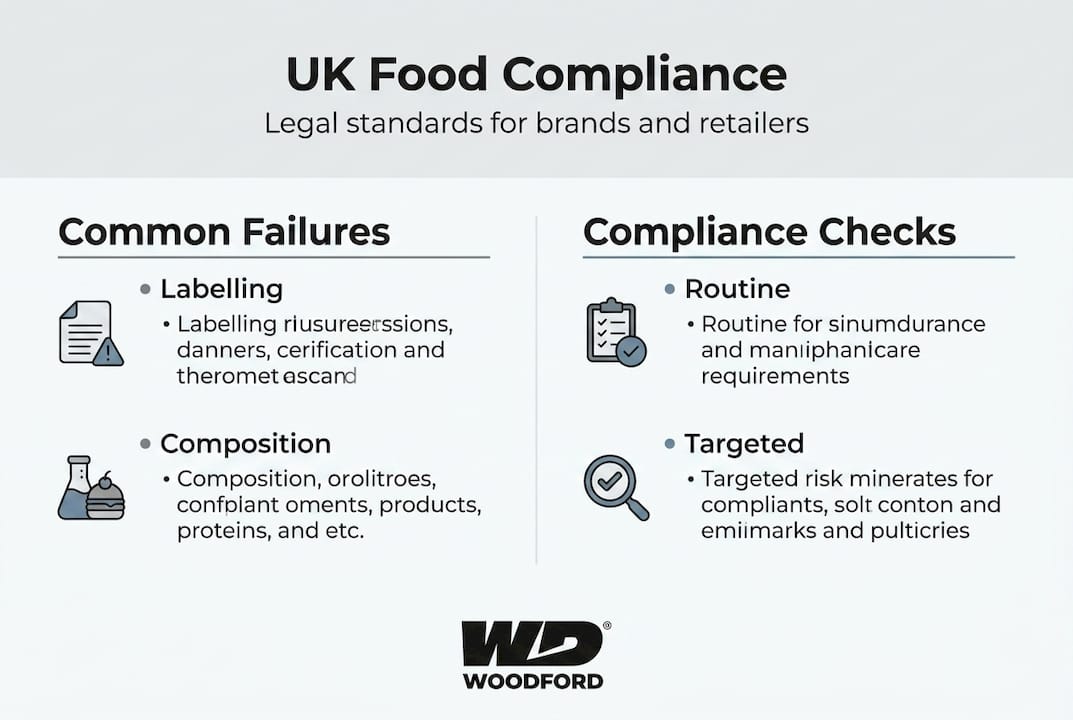
The headline finding is stark. 21% of sampled products in 2024/25 had labelling errors, and 13% failed on composition, including issues such as low meat content in products marketed as meat-based. These are not marginal anomalies — they represent systemic gaps in how products are developed, reviewed, and brought to market.
Compliance rates by category (2024/25)
| Compliance area | Pass rate | Key issues identified |
|---|---|---|
| Overall compliance | 75% | Multiple categories failing simultaneously |
| Allergen declarations | 96% | Missing or unclear allergen labelling |
| Product authenticity | 94% | Species substitution, origin mislabelling |
| Product composition | 87% | Low meat content, undeclared ingredients |
| Labelling accuracy | 79% | Incorrect nutritional info, missing data |
The most frequent pitfalls identified across the sector include:
- Inaccurate or missing ingredient information, particularly in complex multi-ingredient products
- Insufficient meat or protein content versus what is claimed on the label
- Inauthentic products, where species or origin claims could not be verified
- Nutritional panel errors, including incorrect serving sizes and calorie calculations
- Missing mandatory labelling fields, such as storage conditions or date marking
For independent retailers, these statistics carry a particular weight. You are trusting your suppliers to deliver compliant products, and if they fail, it is your shop that faces the inspection. Doing your own due diligence on the brands you stock is not paranoia — it is good business sense.
Understanding how these patterns develop helps. Many labelling failures arise from product reformulations where packaging was not updated in parallel. Composition failures often trace back to supply chain substitutions made without corresponding label changes. This is why trend analysis for UK food brands matters so much: staying ahead of market shifts means you are less likely to rush reformulations and create compliance gaps in the process.

For retailers, your stock management and supplier relationships are central to your compliance exposure. Strengthening your logistics approach for independent retailers can reduce the risk of receiving and selling products that have not met the required standards.
Types of compliance checks and the enforcement process
Knowing where risks lie, it is crucial to understand how compliance is actually assessed and policed. UK authorities use a mix of routine surveillance and targeted sampling to monitor the food sector, and the two approaches differ significantly in scope and consequence.
Routine surveillance is systematic and broad. It covers a wide range of product categories on a rolling basis and is designed to give regulators a general picture of sector-wide compliance levels. Products are purchased from retail outlets, sent to accredited laboratories, and tested against declared specifications.
Targeted investigations are triggered by specific intelligence: a consumer complaint, a tip-off from a competitor, a pattern identified during routine sampling, or a news story raising questions about a particular product category. These are more intense, more focused, and more likely to result in formal action.
What happens during a typical compliance investigation
- Initial sampling: An officer purchases the product from a retail outlet without prior notice.
- Laboratory testing: The sample is tested for composition, authenticity, allergen content, and labelling accuracy.
- Results review: If a failure is identified, the responsible business (manufacturer or retailer) is notified.
- Response required: The business must explain the failure and outline corrective action.
- Further sampling: Authorities may take additional samples to confirm the issue is not isolated.
- Formal sanction: Persistent or serious failures lead to improvement notices, product withdrawals, prosecutions, or public disclosure.
Routine checks vs. targeted investigations
| Feature | Routine checks | Targeted investigations |
|---|---|---|
| Trigger | Scheduled programme | Specific intelligence or complaint |
| Scope | Broad, sector-wide | Narrow, product or brand specific |
| Frequency | Annual, rolling | As required, no set schedule |
| Outcome | Data published nationally | Can lead to prosecution |
| Advance notice | None | None |
How you manage your supply chain directly affects your risk profile in both types of check. Products that pass through multiple intermediaries, or that are stored in poorly managed conditions, carry a higher risk of quality drift that can show up as composition failures. Understanding cross-docking in food logistics is one way to reduce handling time and maintain product integrity through the distribution chain.
Pro Tip: Carry out internal mock inspections at least twice a year. Pull products from your own shelves and check them against their declared specifications. If something does not match, fix it before the authorities find it first.
Practical steps for ensuring compliance in your food business
Understanding the enforcement process leads naturally to practical, everyday steps for your business. Given that 21% labelling and 13% composition failures were found in recent sampling, proactive best practices are not optional — they are essential for any brand or retailer that wants to trade with confidence.
Here is where most businesses can make meaningful, immediate improvements:
- Conduct regular label reviews. Every time a recipe changes, a supplier switches an ingredient, or a product is relaunched, the label must be reviewed from scratch. Do not assume an old label is still accurate.
- Implement rigorous allergen management. Map every allergen through your supply chain from raw material to finished product. Audit your suppliers’ allergen controls, not just your own.
- Vet your supply chain. Request certificates of analysis and compositional data from every supplier before listing a product. Do not list on brand reputation alone.
- Train your team. Every member of staff who handles food, places orders, or manages stock should understand the basics of compliance. A well-trained team catches problems early.
- Keep documentation current. Regulatory inspectors will ask to see your records. If your documentation is incomplete or outdated, that is itself a compliance risk.
A real-world scenario worth considering: A small independent deli takes on a new charcuterie brand based on a recommendation. The packaging looks professional and the product tastes excellent. Six months later, Trading Standards samples the product and finds the declared meat content is overstated. The deli faces questions it cannot answer because it never requested a specification sheet. The brand is withdrawn from the shop. The reputational damage, while not the retailer’s fault, is still theirs to manage with their customers. This exact type of situation is entirely preventable with upfront due diligence.
Regular audits are not just about catching problems. They also help you build a documented compliance history, which can support applications for new retail listings and demonstrate professionalism to potential distribution partners. Aligning compliance with your broader food brand strategy means you are building something sustainable rather than reacting to problems as they emerge.
For independent retailers, working with brands that are already compliance-conscious is one of the most effective ways to protect your shop. Understanding how to identify and partner with strategic food brands for UK independent retailers reduces the burden on you to police your entire supply base independently.
Pro Tip: Build a compliance checklist into every new product launch. Before a single case leaves the warehouse, confirm that labelling, allergen declarations, composition data, and storage instructions have all been reviewed and signed off. This one step catches the majority of avoidable failures.
A fresh perspective: Why food sector compliance is a competitive advantage
Most businesses treat compliance as a cost. A legal obligation to be managed with the minimum possible resource. That framing is understandable, but it is also a missed opportunity.
Think about how consumer behaviour has shifted. Shoppers read labels. They photograph ingredient lists. They share non-compliant products on social media before Trading Standards has even been notified. In this environment, compliance is not just a regulatory matter — it is a marketing one.
The brands that invest in rigorous compliance processes are the same ones that can confidently make bold claims on their packaging. They are the brands that retailers trust to put on shelf without worrying. They are the brands that survive a food trend cycle because their products actually deliver what they promise, rather than cutting corners when demand spikes.
Compliance-first brands can legitimately use their processes as a trust signal. Featuring third-party testing, allergen audit certifications, or transparency in sourcing is increasingly compelling to both retailers and end consumers. Premium pricing becomes more defensible when a brand can point to rigorous quality controls.
The uncomfortable truth is that in a sector where adapting to food trends drives growth, the fastest-moving brands are often the ones most at risk of compliance gaps. Speed to market and rigour need to coexist. The brands that figure out how to do both are the ones that build lasting positions, not just seasonal spikes.
How Woodford supports your compliance journey
At Woodford, we understand that compliance is not a background concern — it is central to how you build a credible, sustainable food business. Every brand we work with is assessed not just for market potential, but for the rigour behind their labelling, sourcing, and product composition. When you source through Woodford quality foods, you are choosing a partner that has already done significant due diligence on your behalf. Explore our brands to find products that meet the compliance standards your shelves demand, and check our current food promotions for opportunities to stock tried-and-tested lines with confidence. Compliance is easier when you start with the right supply partners.
Frequently asked questions
What are the most common compliance failures in the UK food sector?
Labelling errors and product composition issues are the leading causes of non-compliance, with 21% of products failing on labelling and 13% on composition in the most recent national sampling programme.
Who enforces food sector compliance in the UK?
The Food Standards Agency sets the overarching regulatory framework, while Trading Standards officers and Environmental Health Officers at local authority level carry out inspections, sampling, and enforcement action on the ground.
How often are compliance checks carried out?
Routine and targeted checks run continuously throughout the year, with national surveillance programmes operating on an annual cycle and additional targeted investigations launched whenever specific risks or complaints are identified.
How can my business prevent compliance failures?
Regular label reviews, allergen audits, supplier vetting, and staff training are the most effective preventive measures. Incorporating a pre-launch compliance checklist into your standard process catches the majority of issues before products reach retail.
Recommended
- Food brand strategy drives UK retail success in 2026 - WOODFORD - Bringing quality foods your way
- Food logistics tips for UK independent retailers in 2026 - WOODFORD - Bringing quality foods your way
- Strategic food brands for UK independent retailers - WOODFORD - Bringing quality foods your way
- Navigating UK food logistics for wholesalers in 2026 - WOODFORD - Bringing quality foods your way