
Streamline UK food wholesaling workflow: boost efficiency
TL;DR:UK food wholesalers face thin margins and productivity challenges due to outdated workflows.Digital tools like inventory management and automated order processing can significantly improve efficiency and margins.Balancing process discipline with flexibility is essential for resilience and long-term success.
Somewhere in a busy distribution unit right now, someone is manually re-keying an order that arrived by email, chasing a delivery that left three hours late, and wondering why the margin on this week’s run looks even thinner than last month. It is a familiar scene for UK food brand owners and independent retailers. With profit sitting at roughly 29p on a £20.24 basket, there is precious little room for wasted steps. This guide walks you through the practical preparation, tools, step-by-step process changes, and verification habits that will help you reclaim both time and margin from an outdated wholesaling workflow.
Table of Contents
- Understanding the UK food wholesaling landscape
- Essential tools and prerequisites for a streamlined workflow
- Step-by-step: how to optimise your UK food wholesaling workflow
- Monitoring results and adjusting for continuous improvement
- Why chasing perfect efficiency isn’t always the winning strategy
- How Woodford helps you achieve wholesaling workflow excellence
- Frequently asked questions
Key Takeaways
| Point | Details |
|---|---|
| Boost efficiency with tech | Digital order and inventory management are essential to streamlining the UK food wholesaling workflow. |
| Monitor and adapt | Continually tracking results and market shifts ensures your workflow stays effective amid changing conditions. |
| Balance automation with service | Combining automation with attentive customer care improves margins without sacrificing relationships. |
| Small gains, big impact | Even modest efficiency improvements can significantly raise profit in a thin-margin sector. |
Understanding the UK food wholesaling landscape
Before diving into steps, let us establish why an efficient approach is no longer optional for UK wholesalers.
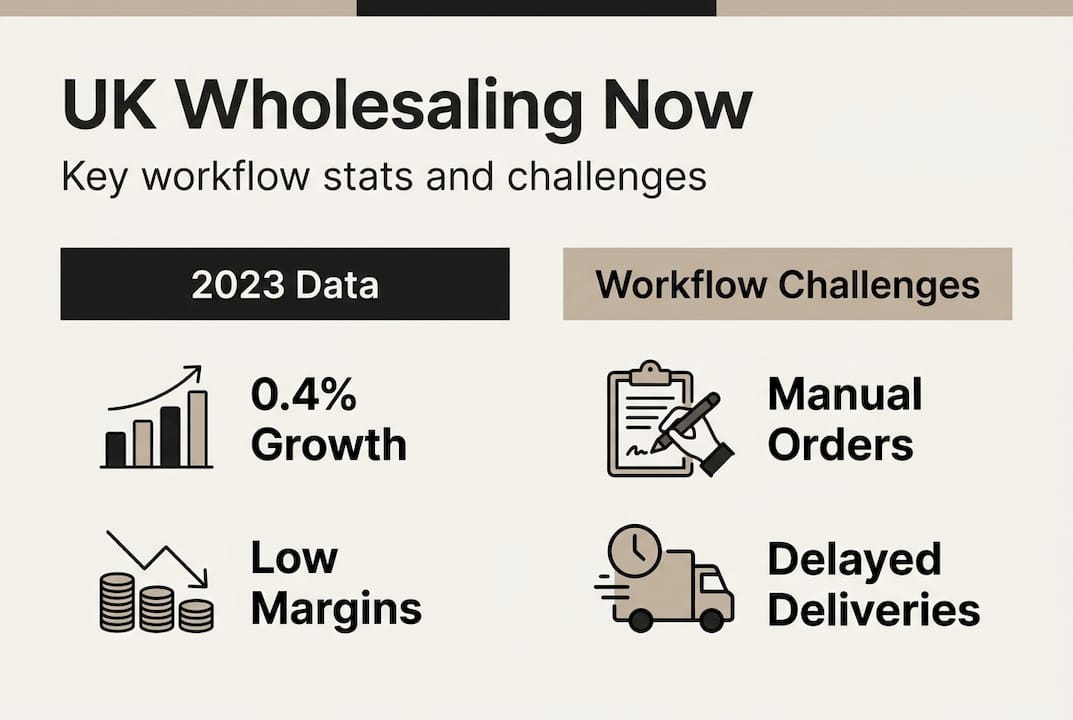
The economics are blunt. UK food wholesaling productivity increased just 0.4% in 2023, while industry profit sits at a mere 29p on a £20.24 basket. That is not a comfortable cushion. It means a single inefficient process, a missed delivery window, or a picking error can wipe out the margin on an entire order run before anyone notices.
UK wholesalers also trail Western European benchmarks on productivity. Countries such as Germany and the Netherlands have invested earlier in automation and digital supply chain tools, leaving UK operators playing catch-up. The gap is closeable, but it requires deliberate action rather than incremental tinkering.
The main workflow challenges facing UK food wholesalers today include:
- Excess handling: Products moving through too many touchpoints before reaching the retailer
- Slow delivery cycles: Scheduled bulk runs that no longer match the pace of independent retail demand
- Complex paperwork: Manual invoicing, compliance documentation, and returns processing
- Food waste: Inefficient stock rotation and poor demand forecasting leading to spoilage
- Inflation pressure: Rising fuel, labour, and packaging costs squeezing an already thin margin
The shift from traditional to modern wholesaling is stark. Traditional models relied on large, infrequent deliveries with long lead times. Modern independent retailers expect faster replenishment, better product visibility, and fewer administrative headaches. Understanding the range of supply chain models available helps you position your operation correctly.
| Workflow challenge | Traditional impact | Modern solution |
|---|---|---|
| Order input | Manual, error-prone | Digital order management |
| Stock visibility | Periodic counts | Real-time inventory systems |
| Delivery scheduling | Fixed bulk runs | Flexible, demand-led despatch |
| Returns handling | Paper-based, slow | Automated returns processing |
| Performance tracking | Monthly reports | Live KPI dashboards |
For a deeper look at how logistics complexity affects UK food brands, the UK wholesaler logistics landscape in 2026 is worth exploring in full. The core takeaway is simple: even a 1% improvement in process efficiency can translate into a meaningful uplift in net margin when you are operating at these levels.
Essential tools and prerequisites for a streamlined workflow
With the big picture in mind, here are the practical tools and requirements you will need before transforming your workflow.
Efficiency benchmarks for UK wholesaling growth consistently point to automation and waste reduction as the two highest-impact levers. Getting there requires the right foundation.
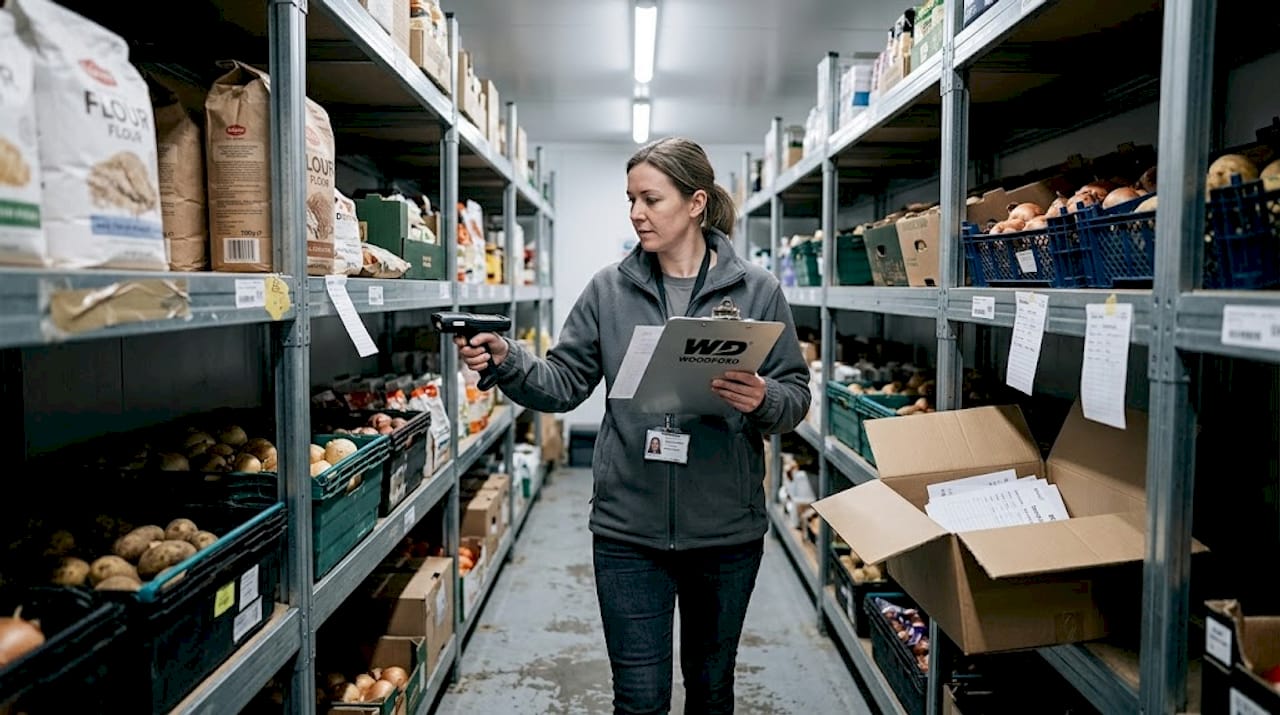
Inventory management systems are non-negotiable. You need a platform that tracks stock in real time, flags low levels automatically, and integrates with your order management and accounting tools. Standalone spreadsheets will not cut it at any meaningful scale.
Order management tools should replace manual email or phone-based ordering wherever possible. Digital order capture reduces input errors, speeds up processing, and creates an auditable trail for every transaction.
Beyond technology, you need reliable data flowing in both directions across your supply chain. Upstream, that means accurate lead times and stock availability from your suppliers. Downstream, it means clear demand signals from your retail partners. Without both, even the best software will produce unreliable outputs.
Staff training and genuine buy-in are prerequisites that operators frequently underestimate. A new inventory system introduced without proper onboarding will be bypassed or misused within weeks. Budget time for training before you go live, not after problems emerge.
| Feature | Basic toolkit | Advanced toolkit |
|---|---|---|
| Inventory tracking | Manual counts, spreadsheets | Real-time automated system |
| Order management | Email/phone intake | Integrated digital platform |
| Delivery planning | Fixed schedule | Dynamic route optimisation |
| Reporting | Monthly manual reports | Live dashboards with alerts |
| Returns processing | Paper forms | Automated workflow |
Choosing the right distribution channel options for your product range also shapes which tools you actually need. A brand selling ambient goods to fifty independent retailers has different requirements from one distributing chilled products across a wider network.
Pro Tip: Before investing in new software, map your current workflow on paper first. Identify the three steps that cause the most delays or errors. Fix those specifically rather than replacing everything at once.
Step-by-step: how to optimise your UK food wholesaling workflow
Once your toolkit is ready, follow these practical steps for a demonstrably smoother workflow.
- Digitise order receipt. Move all incoming orders onto a single digital platform. Whether that is an integrated portal or a structured order form, the goal is zero manual re-keying. Every re-keying step introduces error and adds time.
- Automate picking cues. Use your inventory system to generate pick lists automatically once an order is confirmed. Colour-coded or location-sequenced lists reduce warehouse walking time and picking errors significantly.
- Batch and prioritise despatch. Group orders by delivery route and urgency. Time-sensitive chilled products leave first. Ambient orders can be batched more flexibly. This single step often reduces vehicle usage and fuel costs.
- Evaluate your delivery model honestly. Traditional bulk and rapid delivery models each have trade-offs in supply chain control and cost. Rapid, integrated delivery suits high-frequency independent retailers. Bulk runs suit larger, less frequent orders. Many operators benefit from running both in parallel.
- Standardise returns and verification. Create a clear, documented process for handling returns. Every returned item should be logged, inspected, and either restocked or written off within 24 hours. Delays here create phantom stock and distort your inventory data.
- Close the feedback loop. After each delivery run, review what went wrong and why. A ten-minute debrief with your despatch team surfaces problems faster than any software dashboard.
“The most expensive part of any wholesaling operation is not the delivery vehicle or the warehouse. It is the time spent correcting avoidable mistakes.”
For practical logistics tips for UK retailers on the receiving end, sharing process expectations with your retail partners reduces friction at the point of delivery. And if you are a food brand looking to understand how workflow efficiency connects to growth, the concept of brand acceleration in food is directly relevant to how distribution speed affects market penetration.
Pro Tip: Assign a single person to own each workflow stage. Shared responsibility for a process step usually means no one takes responsibility when it fails.
Monitoring results and adjusting for continuous improvement
After your process overhaul, maintaining momentum is critical. Here is how to keep your workflow on the right track and react quickly to market changes.
Industry profit margins have narrowed since 2020, which means ongoing adjustment is not optional. The wholesalers gaining ground are those treating their workflow as a living system rather than a fixed process.
Track these KPIs consistently:
- Order accuracy rate: Percentage of orders fulfilled without errors or substitutions
- On-time delivery rate: Orders delivered within the agreed window
- Waste as a percentage of throughput: Spoilage and write-offs relative to total stock moved
- Customer return rate: Volume of returns as a proportion of total orders despatched
- Order processing time: Average time from order receipt to despatch confirmation
Adapting to inflation requires more than cost-cutting. It means reviewing supplier terms regularly, renegotiating delivery contracts when fuel costs shift, and being willing to adjust minimum order quantities to protect margin without losing retail partners.
“A workflow that worked in 2022 may be quietly costing you money in 2026. The market has changed. Your processes need to change with it.”
Common pitfalls include rigid processes that cannot flex when a key supplier is delayed, and ignoring qualitative feedback from retail partners in favour of numbers alone. A retailer who stops ordering without explanation is a data point your KPI dashboard will not capture.
For food brands specifically, staying ahead of demand shifts requires structured trend analysis for food brands as part of your regular planning cycle. Workflow efficiency and market awareness are not separate disciplines. They feed each other.
Why chasing perfect efficiency isn’t always the winning strategy
Having covered technical improvement, here is an important word of caution for anyone leading workflow change.
Efficiency is a means, not an end. We have seen operators invest heavily in automation, hit impressive throughput numbers, and then quietly lose their best independent retail accounts because the relationship became transactional and impersonal. A retailer who feels like a reference number rather than a partner will find another supplier.
Rigid automation can also miss the nuances that matter in food. A specialist deli owner may need a short-run product delivered outside your standard schedule. A rigid system says no. A flexible operator finds a way. That flexibility is often what builds the kind of loyalty that survives a competitor undercutting your price.
The most resilient wholesaling operations we observe balance strong process discipline with genuine responsiveness. They review both their numbers and their relationships on a regular cycle. Understanding which strategic brands for retailers create the most mutual value is as important as knowing your order accuracy rate.
Efficiency should make you faster and more reliable. It should not make you inflexible.
How Woodford helps you achieve wholesaling workflow excellence
If you are ready to take the next step or need specialised help in streamlining your workflow, here is how Woodford provides solutions tailored for you.
At Woodford, we work with food brand owners and independent retailers across the UK to remove the friction from wholesaling. Our approach combines exclusive distribution, trend-led product curation, and logistics support built around how modern independent retail actually works. You do not need to rebuild your workflow from scratch on your own. Explore our trusted brands to see the range of products we distribute and the kind of retail partnerships we support. Whether you are a brand seeking better reach or a retailer looking for a more reliable supply partner, we make the process straightforward.
Frequently asked questions
What is the average profit margin for UK food wholesalers in 2026?
Net margins for UK food wholesalers are around 1 to 2%, with 29p profit per £20.24 basket. This makes every process improvement directly visible on the bottom line.
Which workflow improvements help UK wholesalers most?
Digital inventory, automation, and optimised delivery processes offer the biggest gains, as efficiency benchmarks for UK wholesaling consistently highlight automation and waste reduction as the highest-impact levers.
How can UK wholesalers adapt to inflation and fast-changing logistics?
Regularly reviewing KPIs and workflow data lets you adapt quickly. Ongoing adjustments are necessary because margin pressures and cost inputs shift frequently in the current environment.
What is the difference between traditional and integrated wholesaling?
Traditional wholesaling delivers in bulk on scheduled runs, while integrated rapid models provide faster, more controlled supply that better suits the needs of modern independent retailers.
Recommended
- Navigating UK food logistics for wholesalers in 2026 - WOODFORD - Bringing quality foods your way
- Food logistics tips for UK independent retailers in 2026 - WOODFORD - Bringing quality foods your way
- What is brand acceleration in food: a guide for UK retailers - WOODFORD - Bringing quality foods your way
- Strategic food brands for UK independent retailers - WOODFORD - Bringing quality foods your way