Optimising your food supply chain: A guide for UK retailers
TL;DR:UK independent food retailers operate on very thin margins making supply chain efficiency crucial.Diversifying suppliers and adopting technology can significantly improve stock control and profitability.Local knowledge and tailored logistics are vital for optimizing supply chains in diverse and rural areas.
Running an independent food retail business in the UK means operating on some of the thinnest margins in any industry. Net margins of 1-2% leave almost no room for supply chain inefficiencies, late deliveries, or poor purchasing decisions. Yet most independents are still relying on legacy supplier relationships and gut instinct to manage stock. The good news is that smarter systems and the right wholesale partnerships can genuinely shift the dial. This guide walks you through every stage of supply chain improvement, from identifying your current weaknesses to building a continuous improvement cycle that keeps your margins moving in the right direction.
Table of Contents
- Understanding your current supply chain challenges
- Preparing for change: Tools and partners for supply chain success
- Step-by-step: Building a resilient supply chain
- Monitoring and improving your new supply chain
- What most guides get wrong about food supply chain optimisation
- Partner with the right food brands and wholesalers
- Frequently asked questions
Key Takeaways
| Point | Details |
|---|---|
| Know your pain points | Identifying current supply chain problems is the first step to improvement. |
| Choose smart partners | Collaborate with wholesalers and brands that offer flexible technology and support your needs. |
| Build resilience | Diversifying suppliers and embracing innovation makes your supply chain more adaptable. |
| Track and review | Regularly monitoring supply chain metrics ensures ongoing efficiency and profit growth. |
Understanding your current supply chain challenges
Supply chain struggles hit independents harder than they hit the multiples. Large supermarkets negotiate from a position of enormous volume, locking in favourable terms, priority delivery slots, and bespoke logistics arrangements. As an independent, you’re often working with whatever terms a supplier is willing to offer. That power gap is well documented: thin margins and cost pressures dominate UK agri-food chains, with smaller buyers consistently absorbing a disproportionate share of supply chain risk.
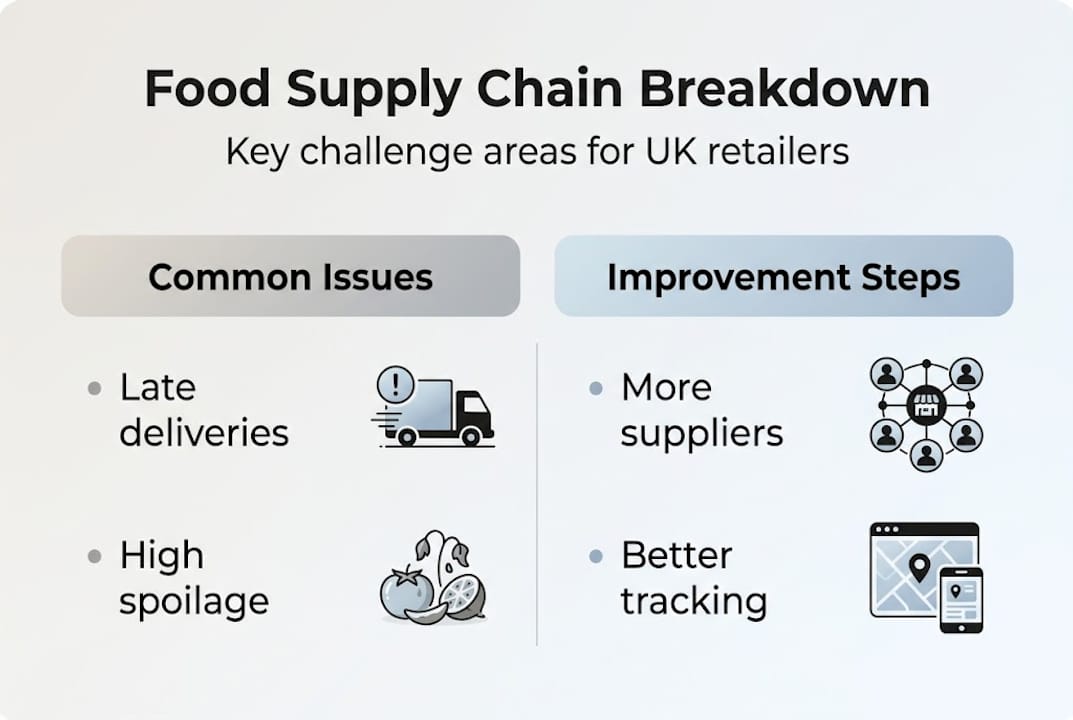
Understanding where your own chain is weakest is the essential first step. Consider this sample breakdown of how a typical independent’s supply chain might look right now:
| Metric | Typical independent | Best-in-class independent |
|---|---|---|
| Delivery frequency | 2x per week | 4-5x per week |
| Average product margin | 18-22% | 28-35% |
| Number of key suppliers | 3-5 | 8-15 |
| Out-of-stock rate | 8-12% | 2-4% |
| Spoilage rate | 5-8% | 1-3% |
The gap between typical and best-in-class is not about luck. It reflects deliberate choices around supplier diversity, ordering systems, and partnership quality. For practical guidance on managing deliveries more effectively, food logistics tips can help you identify quick wins.
“For independent food retailers, every percentage point of margin matters. A supply chain that loses even 2% to spoilage or inefficiency can wipe out the entire profit on a product line.”
Here are the clearest warning signs that your supply chain needs attention:
- Frequent out-of-stocks on your best-selling lines
- Rising spoilage or short shelf-life deliveries
- Delivery windows that disrupt your trading hours
- Minimum order quantities that force you to overbuy
- No visibility of UK food margin statistics or your own per-product profitability
- Losing sales to larger competitors who always seem to have stock
If three or more of these apply to you, your supply chain is costing you money every single week.
Preparing for change: Tools and partners for supply chain success
With the challenges clear, let’s set you up with the right tools and allies. The technology landscape for food supply chains has changed rapidly, and the good news is that solutions once reserved for large retailers are now accessible to independents.
| Technology | What it does | Benefit for independents |
|---|---|---|
| AI forecasting | Predicts demand based on sales history and trends | Reduces overstock and out-of-stocks |
| IoT sensors | Monitors temperature and stock levels in real time | Cuts spoilage and compliance risk |
| Blockchain traceability | Creates transparent product journey records | Builds customer trust and simplifies recalls |
| Supplier portals | Centralises ordering and communication | Saves time and reduces errors |
| Sales analytics platforms | Tracks margin by product and category | Identifies your most and least profitable lines |
The evidence for investing in these tools is compelling. The Wholesale Group’s use of AI through their DASHAi platform produced a 76% increase in supplier engagement, demonstrating how technology reshapes commercial relationships at every level of the supply chain.
Before you invest in new platforms, audit what you already have. Follow these steps:
- List every tool you currently use for ordering, stock management, and sales tracking
- Identify where data gaps exist, particularly around margin visibility and delivery performance
- Map your current supplier relationships and note which ones offer digital ordering or integration
- Research supply chain tech options suited to your size and budget
- Shortlist wholesalers and brands that support flexible ordering, digital communication, and sustainable pricing
When evaluating wholesale partners, look beyond price lists. A brand strategy for retailers that prioritises margin health and category growth will serve you far better than chasing the lowest unit cost. Seek out strategic brands that understand the independent retail model and are willing to work with your ordering patterns.
Pro Tip: Prioritise platforms that integrate both sales forecasting and supplier communications in one place. Switching between disconnected systems costs time and creates errors that erode your margins silently.
Step-by-step: Building a resilient supply chain
You now have your tools. Here’s how to apply them systematically to build a supply chain that can absorb shocks and keep your shelves full.
- Map your entire supply chain from producer to shelf. Identify every handoff point, every cost, and every delay risk. Most independents have never done this formally, and the exercise alone reveals surprising inefficiencies.
- Set minimum and maximum stock levels for every key line. This prevents both overbuying and running out. Use your sales data, not instinct, to set these thresholds.
- Diversify your supplier base. Relying on one or two wholesalers creates fragility. Adding regional or specialist suppliers gives you flexibility when a primary source fails or imposes unfavourable terms.
- Negotiate delivery terms explicitly. Ask for morning deliveries, consolidated drops, and written commitments on lead times. Many suppliers will accommodate requests that are never formally made.
- Review your distribution channel types to understand whether direct-from-producer routes or cross-docking benefits could reduce your handling costs.
- Build relationships with regional wholesalers. They often offer lower minimum orders, faster response times, and a genuine understanding of local demand patterns.
The importance of diversification is backed by real experience. Rural independent stores frequently face punishing delivery charges and minimum order thresholds from major wholesalers like Booker, making supply chain diversification not just a strategy but a survival necessity.
On the compliance side, supplier code compliance has improved to 93% across the industry, yet 30% of suppliers still report issues. That tells you two things: the system is improving, but you still need to protect yourself with clear contractual terms and documented agreements.

Pro Tip: Build at least one direct link to a local or regional producer. Even a single farm-to-shelf relationship reduces your dependence on large wholesalers and gives you a genuinely differentiated product story to tell customers.
Monitoring and improving your new supply chain
Once your plan is in motion, tracking results keeps you sharp and competitive. Improvement without measurement is just hope. You need a clear set of metrics that tell you whether your changes are working.
Key metrics every independent should track:
- Margin uplift per category: Are your new supplier terms actually improving profitability?
- On-time delivery rate: What percentage of orders arrive on time and in full?
- Inventory turnover: How quickly are you selling through stock before it ages?
- Out-of-stock frequency: Are gaps on your shelves decreasing?
- Supplier engagement score: How responsive and proactive are your key partners?
Set a quarterly review calendar. Each quarter, pull your data, compare it to the previous period, and identify the two or three changes that had the biggest impact. Respond to seasonal trends by adjusting order volumes six to eight weeks ahead of peak periods, not reactively when shelves are already running low. For guidance on adapting to trends and using trend analysis techniques, both resources offer practical frameworks for independents.
| Indicator | Before optimisation | After optimisation |
|---|---|---|
| Out-of-stock rate | 10% | 3% |
| Spoilage rate | 7% | 2% |
| Average product margin | 20% | 30% |
| On-time delivery | 72% | 91% |
| Supplier engagement | Low | High |
The results are achievable. Platforms that use AI-driven insights have recorded a 76% supplier engagement increase and 30% foodservice sales growth, showing what consistent monitoring and the right technology can deliver. Build feedback loops with your suppliers too. Share your sales data with them where possible. Suppliers who understand your demand patterns can serve you better, and that mutual transparency creates partnerships rather than transactions.
What most guides get wrong about food supply chain optimisation
Most supply chain guides tell you to adopt technology, diversify suppliers, and negotiate harder. That advice is not wrong, but it is incomplete. It assumes every independent retailer operates in the same conditions, with the same access to infrastructure, the same proximity to distribution hubs, and the same negotiating leverage.
The reality is more complicated. Power asymmetry in agri-food chains means that smaller buyers often cannot negotiate on equal terms, regardless of how well-prepared they are. Rural stores face a particularly stark version of this problem, where minimum order requirements and delivery surcharges from major wholesalers make the standard playbook unworkable.
True optimisation requires local knowledge. It means understanding which regional suppliers will actually deliver to your postcode, which community relationships can substitute for formal logistics networks, and when bending a rule (such as accepting a slightly higher unit cost from a local supplier) is actually the smarter financial decision. The best supply chains for independents are not copies of supermarket systems. They are built around the specific geography, community, and product mix of each individual store. For a grounded view of wholesaler logistics reality, the picture is more nuanced than most guides acknowledge.
Partner with the right food brands and wholesalers
If you’re ready to strengthen your supply chain, here’s where to start. At Woodford, we work exclusively with independent retailers across the UK, connecting you with food brands and wholesale solutions that are built around your needs, not the needs of a supermarket buyer. Our curated network means you access trend-led products with sustainable margins, flexible ordering, and logistics that actually work for your business model. Whether you’re looking to diversify your supplier base, discover new categories, or simply reduce the friction in your current supply arrangements, we can help. Explore our food brands to see what’s available, or partner with Woodford to start a conversation about your specific supply chain goals.
Frequently asked questions
What is the average net margin for UK food retailers?
UK food retailers typically operate on net margins of 1-2%, which means a £20.24 shopping basket generates just 29p in profit. Every supply chain inefficiency directly erodes that already thin return.
How can independent retailers reduce supply chain costs?
Diversifying your supplier base, building relationships with regional wholesalers, and adopting smarter ordering systems are the most effective routes. Rural independents in particular benefit from moving away from sole reliance on major wholesalers who impose high minimum orders and delivery charges.
What role does technology play in food supply chain optimisation?
AI, IoT, and supplier engagement platforms can transform how you forecast demand and manage relationships. DASHAi-driven results show a 76% increase in supplier engagement and 30% foodservice sales growth as evidence of what the right tools can deliver.
How often should retailers review supply chain performance?
A quarterly review cycle is the minimum recommended cadence, allowing you to respond to seasonal shifts and supplier changes before they cause stock problems or margin erosion.
Recommended
- Food logistics tips for UK independent retailers in 2026 - WOODFORD - Bringing quality foods your way
- Navigating UK food logistics for wholesalers in 2026 - WOODFORD - Bringing quality foods your way
- Strategic food brands for UK independent retailers - WOODFORD - Bringing quality foods your way
- Food brand strategy drives UK retail success in 2026 - WOODFORD - Bringing quality foods your way