Food wholesale explained: A guide for UK independents
Food wholesale is widely misunderstood. Many independent retailers assume it simply means buying large quantities at a discount, but the reality is far richer and more strategic than that. The UK food wholesaling industry generates between £30 billion and £49 billion in annual turnover and employs up to 77,000 people. That scale tells you something important: this is not a passive middleman sector. It is a sophisticated infrastructure that, when used well, gives independent food retailers a genuine competitive edge. This guide walks you through how it all works and how you can make it work for you.
Table of Contents
- Defining food wholesale: The backbone of UK food supply
- Understanding wholesale models: Cash-and-carry versus delivery
- Key benefits for UK independent food retailers
- Industry challenges and strategic considerations
- Applying food wholesale strategies: Success tips for UK independents
- Discover quality wholesale solutions for your business
- Frequently asked questions
Key Takeaways
| Point | Details |
|---|---|
| Wholesale models matter | Choosing the right approach—cash-and-carry or delivery—can optimise your sourcing and cash flow. |
| Lower costs and flexible credit | Wholesalers typically offer better pricing and payment terms for UK independents. |
| Compliance and traceability | Batch tracking and cold chain logistics from wholesalers help you meet safety standards efficiently. |
| Monitor market challenges | Keep a close eye on supply volatility and rising costs for resilient inventory management. |
Defining food wholesale: The backbone of UK food supply
Let’s clear up the most common misconception first. Wholesalers are not simply resellers who mark up products and pass them along. They are active participants in the supply chain who take on significant operational responsibility.
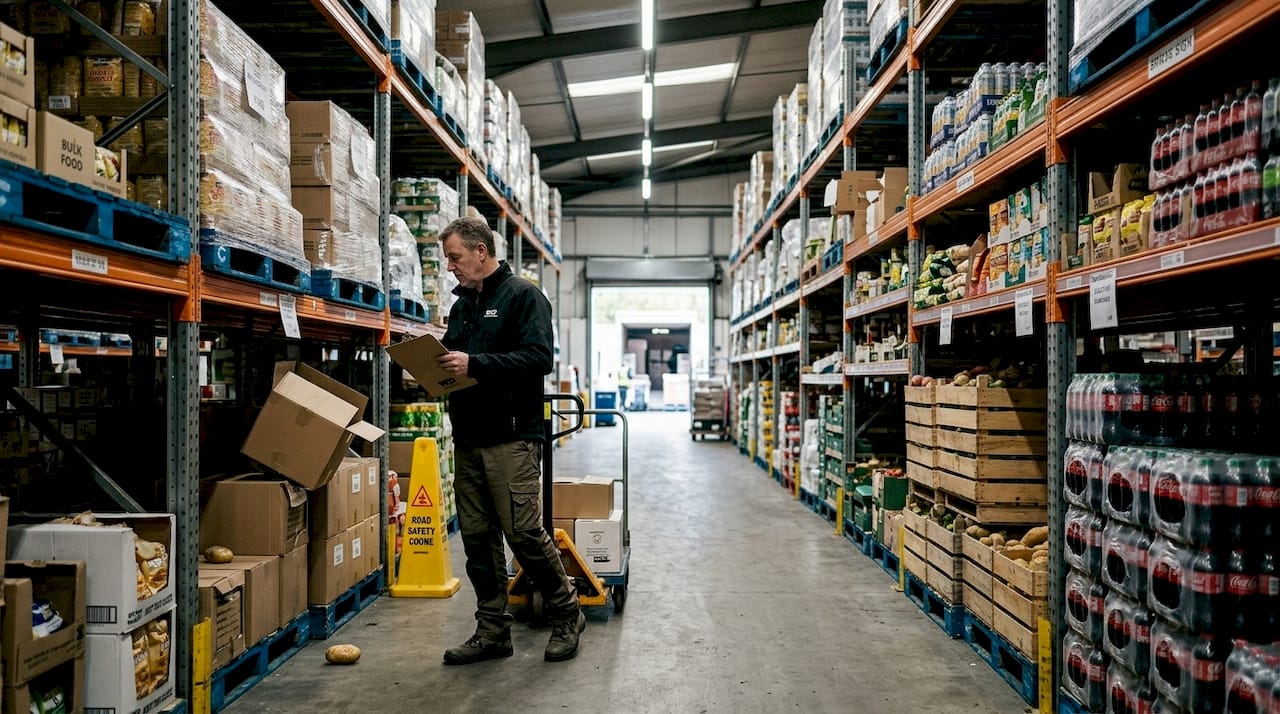
Food wholesale involves distributors acting as intermediaries who buy in bulk from producers and manufacturers, warehouse the products, and then sell and deliver usable quantities to retailers, restaurants, and other businesses. That warehousing function alone involves temperature control, stock rotation, compliance documentation, and batch tracking. None of that is simple.
Here is what a food wholesaler typically manages on your behalf:
- Bulk purchasing from farms, factories, and food producers
- Warehousing and cold chain management to maintain product integrity
- Regulatory compliance including traceability and food safety documentation
- Order fulfilment in quantities that suit your business, not just pallet loads
- Logistics coordination from supplier to your shop floor
Over 400,000 UK businesses rely on wholesalers, and a significant proportion of those are independent retailers just like yours. Understanding the food distribution channels available to you is the first step towards smarter sourcing.
“Wholesalers do not just move product. They absorb complexity so that retailers can focus on selling.”
This distinction matters because it changes how you evaluate a wholesale partner. You are not just looking for the lowest price. You are looking for reliability, compliance support, and a relationship that scales with your business.
Understanding wholesale models: Cash-and-carry versus delivery
Now that we know the basics, let’s examine the operational models independents can tap into. There are two primary structures, and each suits different buying behaviours.
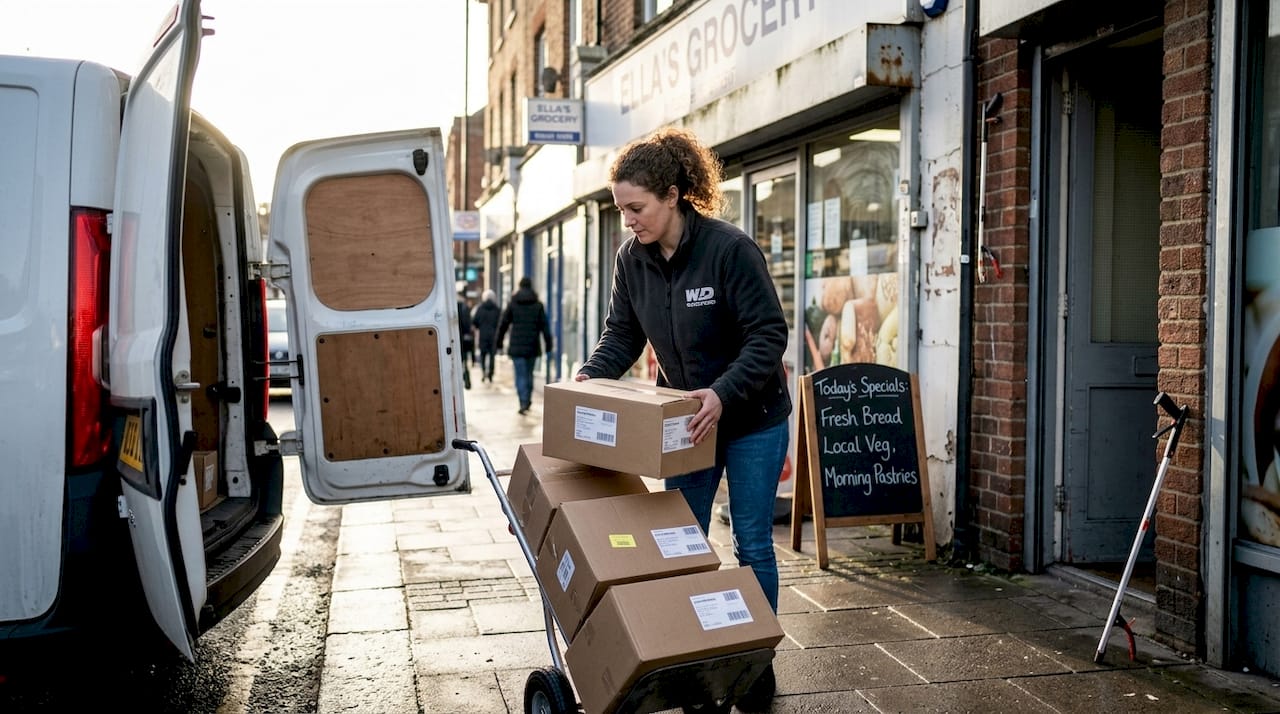
Primary wholesale models are cash-and-carry, where businesses collect goods immediately after payment, and delivery services, where products are shipped directly to your premises. Both have genuine merit depending on your situation.
| Feature | Cash-and-carry | Delivery service |
|---|---|---|
| Speed | Immediate | Scheduled |
| Order size | Smaller, flexible | Larger, planned |
| Cost | Lower per unit | May include delivery fee |
| Control | You select stock in person | Relies on accurate ordering |
| Best for | Top-ups, urgent needs | Regular, high-volume orders |
Here is how to decide which model fits your operation:
- Assess your order frequency. If you restock weekly in small batches, cash-and-carry gives you flexibility without over-committing.
- Calculate your storage capacity. Delivery models work best when you have space to receive and store larger volumes.
- Review your cash flow cycle. Delivery accounts often come with credit terms; cash-and-carry requires immediate payment.
- Consider your product mix. Chilled and frozen lines may be better handled through a specialist delivery partner with cold chain capability. Explore the distribution channel types that suit your product range.
- Factor in your time. Travelling to a cash-and-carry takes staff hours. Delivery frees that time for customer-facing work.
For retailers managing seasonal peaks, understanding cross-docking in food logistics can also help you move product faster without holding excess stock.
Pro Tip: Use cash-and-carry for opportunistic buys and short-shelf-life products, and lean on delivery accounts for your core range. Combining both models gives you flexibility without sacrificing cost efficiency.
Key benefits for UK independent food retailers
With an understanding of wholesale models, here is why independents benefit directly from building strong wholesale relationships.
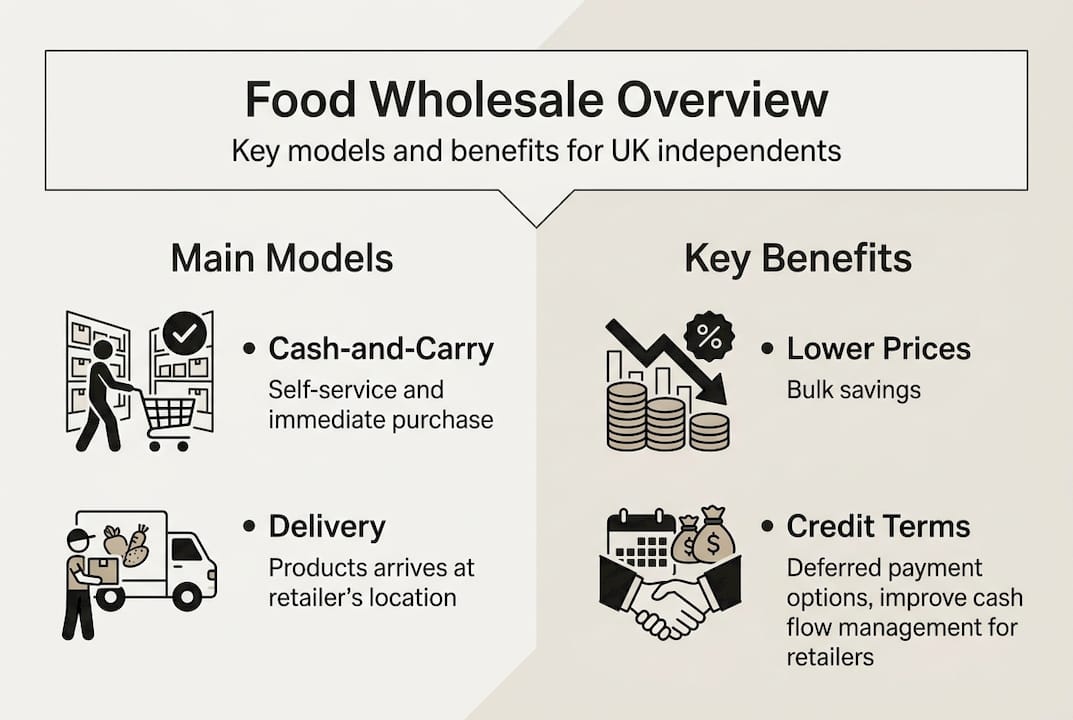
The price advantage is real and significant. Wholesale markets such as Birmingham offer prices 30 to 40% lower than retail chains, with flexible credit terms of up to 12 weeks for independent businesses. That credit window is not a minor perk. It is a cash flow tool that lets you stock shelves before revenue comes in.
Beyond pricing, the structural support available through buying groups is often overlooked. Buying groups like Food and Drink Wholesale UK and The Wholesale Group support independent wholesalers with collective buying power worth £4.5 billion, own-brand product ranges, and shared marketing resources. Joining or working with a wholesaler connected to these groups gives you access to negotiating leverage you simply cannot achieve alone.
Here is a summary of the core benefits:
| Benefit | What it means for you |
|---|---|
| Lower prices | 30 to 40% below retail chain costs |
| Credit terms | Up to 12 weeks to pay, supporting cash flow |
| Buying group access | Collective power, own-brands, marketing support |
| Compliance infrastructure | Batch tracking and traceability built in |
| Range breadth | Access to products not available in retail |
Compliance is another area where wholesalers add genuine value. Batch tracking and traceability are legal requirements under UK food safety law, and managing them independently is time-consuming. A good wholesale partner handles much of this infrastructure for you.
Pro Tip: When evaluating a new wholesale partner, ask specifically about their traceability systems and compliance documentation. A wholesaler with strong infrastructure here protects your business as much as it protects theirs. Explore strategic brands for independents to see how the right product mix supports growth for independent retailers.
Industry challenges and strategic considerations
While wholesale offers clear advantages, retailers should understand the risks and how to manage them. The food wholesale sector operates on thin margins, and small disruptions can have an outsized impact on your bottom line.
Supply volatility is the most unpredictable challenge. Bad weather can wipe out a soft fruit harvest overnight. Post-Brexit border friction has added lead times and paperwork to imported lines. These are not hypothetical risks; they are recurring realities that affect availability and pricing across the sector.
The key challenges in food wholesale include supply volatility from weather and Brexit, persistently low margins, and rising costs in energy and labour. In a low-margin sector, even a modest increase in energy bills can tip a profitable line into a loss.
Here is how to build resilience into your sourcing strategy:
- Diversify your supplier base. Relying on a single wholesaler for a core product is a single point of failure.
- Monitor pricing monthly. Wholesale prices shift with seasons and supply conditions. Staying informed lets you act before margins erode.
- Use batch tracking actively. Do not treat it as a compliance box-tick. It helps you identify slow-moving stock before it becomes waste.
- Partner with cold chain specialists. For chilled and frozen lines, the right logistics partner reduces spoilage risk significantly.
“In food wholesale, the margin is thin enough that operational discipline is not optional. It is the business model.”
Understanding these pressures also helps you have better conversations with your wholesale partners. When you know what they are managing, you can negotiate more effectively and build relationships based on mutual benefit rather than just price.
Applying food wholesale strategies: Success tips for UK independents
With challenges and benefits explored, here is how you can put food wholesale strategies into practice. A clear sourcing strategy is not a luxury for larger retailers. It is essential for any independent that wants to compete.
Follow these steps to build a robust wholesale sourcing approach:
- Map your product categories. Identify which lines are core (always in stock), seasonal, and opportunistic. Each category may suit a different wholesale model or partner.
- Audit your compliance processes. Ensure your wholesale partners provide batch tracking and traceability documentation. Cold chain integrity is non-negotiable for chilled and frozen products.
- Introduce price-marked packs. PMPs build consumer trust and boost impulse sales for independents supplied via wholesale. Shoppers feel confident they are getting fair value, which increases basket size.
- Review your wholesale accounts quarterly. Compare pricing, credit terms, and product availability across your partners. Loyalty is valuable, but complacency is costly.
- Stay current on logistics options. Read up on logistics tips for independent retailers to ensure your supply chain keeps pace with your growth.
Key statistic: Retailers using PMPs supplied through wholesale report stronger impulse purchase rates, particularly in confectionery, soft drinks, and snacking categories. These are exactly the lines where independents can outperform supermarkets on convenience and range.
Pro Tip: Set a monthly calendar reminder to review wholesale market changes, new product launches, and pricing shifts. Thirty minutes of proactive monitoring each month can save you from reactive, costly decisions later.
The retailers who get the most from wholesale are not necessarily the ones spending the most. They are the ones who treat their wholesale relationships as strategic partnerships rather than transactional purchases.
Discover quality wholesale solutions for your business
At Woodford, we work specifically with UK independent retailers who want more than a catalogue and a price list. We understand that your business needs trend-led product curation, reliable logistics, and wholesale partners who are invested in your success. If you are ready to strengthen your sourcing strategy, explore quality food wholesale solutions built around the needs of independents. Browse our brands to discover the product ranges we distribute exclusively, and visit our showcase to see what we are bringing to market. We bridge the gap between ambitious independent retailers and the food brands that deserve a place on your shelves.
Frequently asked questions
How can I choose the best food wholesaler for my independent business?
Look for wholesalers offering flexible credit terms, robust traceability systems, and connections to buying groups like Food and Drink Wholesale UK that are tailored to support independents. Strong compliance infrastructure is as important as competitive pricing.
Are cash-and-carry models better than delivery services?
Cash-and-carry suits quick top-ups and smaller orders, while delivery services work best for planned, higher-volume purchasing. Using both models flexibly often gives independents the best of both worlds.
What are the main challenges for independent retailers in food wholesale?
Supply volatility, slim margins, and rising energy and labour costs are the primary pressures. Monitoring stock levels, diversifying suppliers, and tracking costs monthly are the most effective ways to stay resilient.
How do price-marked packs (PMPs) help my business?
PMPs reassure shoppers they are getting fair value, which drives impulse purchases and builds loyalty, particularly in high-frequency categories like snacks and soft drinks supplied through wholesale.
Recommended
- Food logistics tips for UK independent retailers in 2026 - WOODFORD - Bringing quality foods your way
- Navigating UK food logistics for wholesalers in 2026 - WOODFORD - Bringing quality foods your way
- Strategic food brands for UK independent retailers - WOODFORD - Bringing quality foods your way
- What is brand acceleration in food: a guide for UK retailers - WOODFORD - Bringing quality foods your way