Food merchandising tips to boost your UK retail sales
TL;DR:Effective food merchandising involves strategic product placement and clear displays to maximize visibility and sales.UK independents benefit from disciplined category structuring, prime positioning, and regular review to stay competitive.
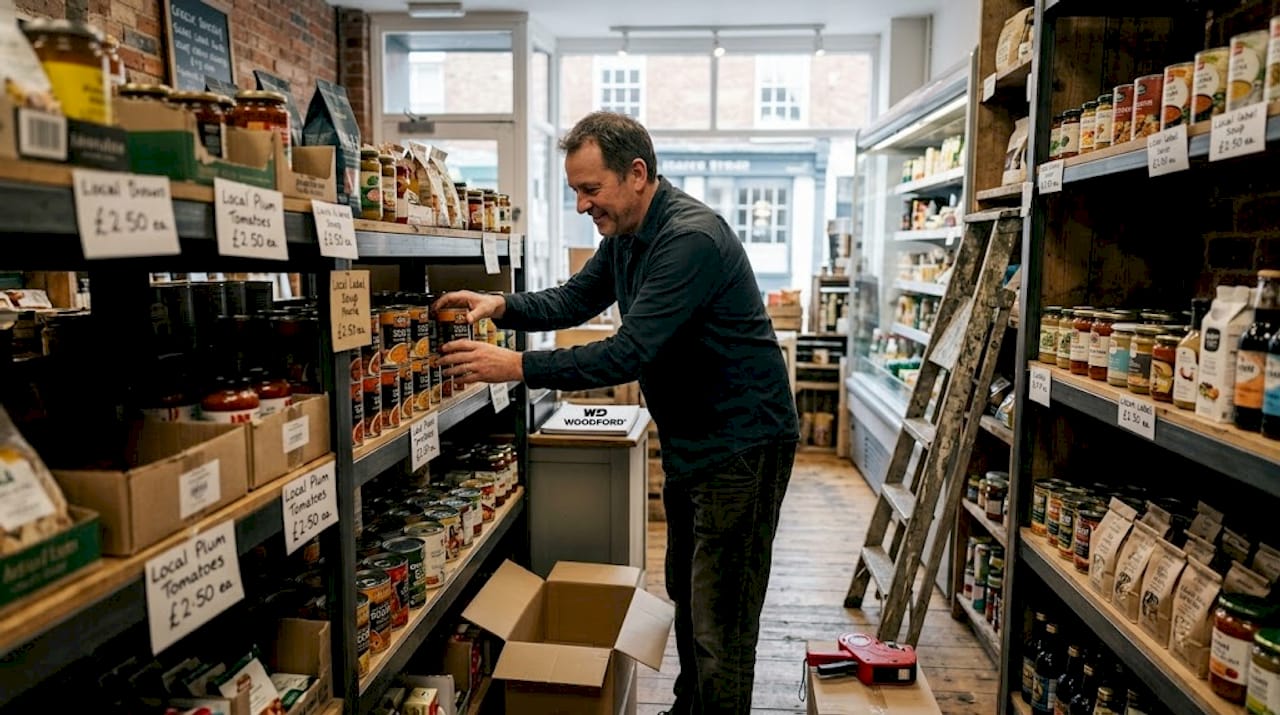
Walk into any thriving independent food shop and something clicks before you’ve consciously registered it. The layout feels logical, the right products catch your eye at exactly the right moment, and you leave spending more than you planned. That experience is not accidental. Food merchandising is the planned on-shelf and display arrangement of products to maximise visibility, comprehension, availability, and purchasing decisions. Many retailers assume it simply means keeping shelves neat. In reality, it is the single most controllable lever you have for increasing basket size, reducing dead stock, and shaping the shopper journey from the moment someone steps through your door.
Table of Contents
- What is food merchandising and why does it matter?
- Core merchandising principles: Building your shop’s sales foundation
- Going beyond shelves: Secondary displays, cross-merchandising, and store flow
- Operational excellence: Execution, auditing, and ongoing refinement
- Support systems: Leveraging symbol groups, partners, and external expertise
- A fresh perspective: Rethinking merchandising for modern independents
- Connect with food merchandising solutions from Woodford
- Frequently asked questions
Key Takeaways
| Point | Details |
|---|---|
| Merchandising shapes sales | Strategic product placement impacts what shoppers see, buy, and how they navigate your store. |
| Planograms boost consistency | Using data-led shelf plans ensures prime space is always optimised for the top-selling products. |
| Maintain, review, and refresh | Regular auditing and removing underperforming lines keeps the store relevant and sales-focused. |
| Innovate with care | Extra displays and cross-merchandising can uplift sales but must not create aisle confusion or crowding. |
| External support is valuable | Harnessing symbol group blueprints and merchandising advice simplifies and standardises store success. |
What is food merchandising and why does it matter?
Tidying shelves is maintenance. Merchandising is strategy. The difference is commercial intent: every placement decision either works for you or against you, whether you planned it or not.
“Food merchandising is the planned on-shelf and display arrangement of products to maximise visibility, comprehension, availability, and purchasing decisions.” — SIG Europe
True food merchandising covers a broad set of activities:
- Product placement — deciding which items sit where, and at which height
- Signage and ticketing — guiding shoppers with clear price and benefit messaging
- Cross-merchandising — grouping complementary products to trigger associated purchases
- Promotional bays — featuring seasonal, high-margin, or new lines in prominent positions
- Planogramming — using data-led shelf plans to standardise and optimise layout
- Category navigation — structuring bays so shoppers can find sub-categories intuitively
Why does all of this matter specifically for UK independents? Because the trading environment is demanding. UK shopper behaviour is currently shaped by economic pressures and value/convenience trade-offs, meaning shoppers are both more discerning and less patient than ever. They will reward a well-organised shop with repeat visits and larger baskets. They will punish a confusing one by heading to a convenience chain instead.
Understanding your food brand strategy sits underneath all of this. Before you can merchandise well, you need to know which brands anchor your offer, which are rising stars, and which are filling space without justification.
Core merchandising principles: Building your shop’s sales foundation
Once you understand what food merchandising is, the next question is where to begin. The answer is always the same: start with structure, then add nuance.
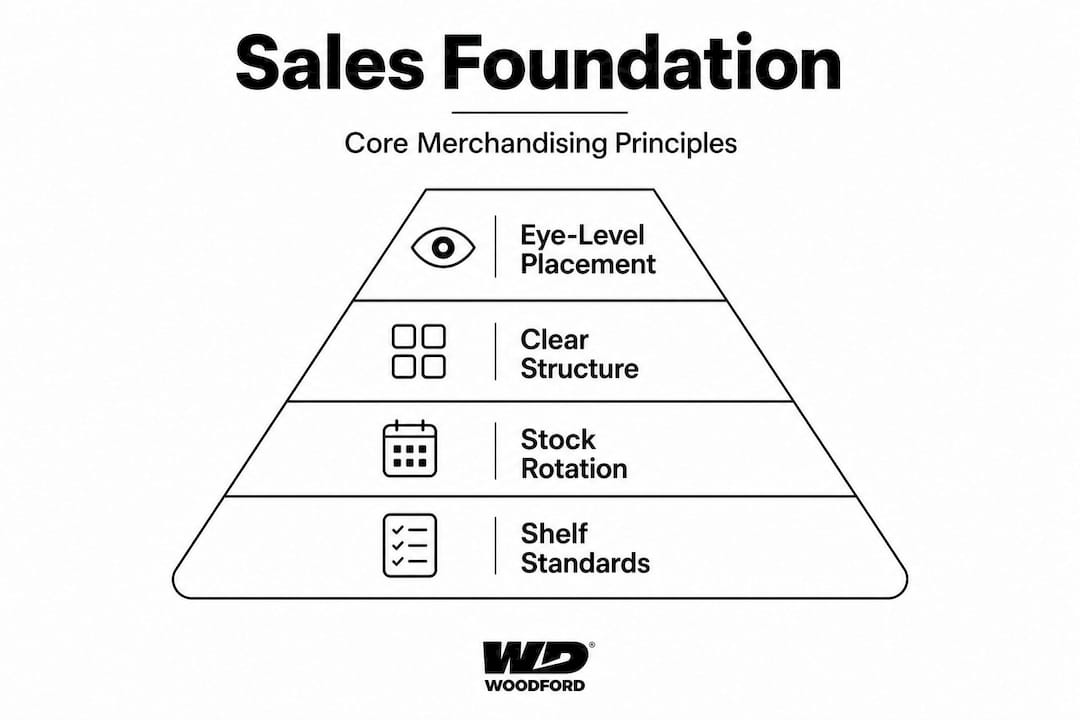
Follow this sequence to build a reliable merchandising foundation:
- Map your category structure — Walk every bay and assign each a clear category role. Grocery staples, chilled convenience, ambient snacking, speciality and world foods. Do not let products drift between bays because it once seemed practical.
- Identify and promote your hero products — Every category has a handful of lines that drive footfall or basket value. Strategic food brands should occupy eye-level positions, typically between 1.2 and 1.6 metres from the floor, because that is where shoppers look first and longest.
- Build or adopt a planogram — A planogram is a data-led blueprint for shelf placement, specifying quantities, facings, and product adjacencies. Even a simple hand-drawn one for your key bays transforms consistency.
- Clear dead stock from prime space — A slow-moving line sitting at eye level is costing you sales every single day. If a product is not earning its position through sell-through rate, it loses its spot.
For UK independent retailers, good shelf practice means setting category structure bay by bay and shelf by shelf, assigning hero ranges to prime placement, and maintaining consistency in shelf heights and spacing to prevent dead prime space appearing.
Pro Tip: When building your planogram, allocate facing width proportionally to sales volume rather than pack size. A product that sells three times as fast as its neighbour deserves three times the shelf space, regardless of how large the box is.
Here is a practical checklist mapped to the outcomes you can expect:
| Merchandising action | Expected outcome |
|---|---|
| Move hero lines to eye level | Increased rate of sale on key SKUs |
| Group by sub-category within bays | Reduced shopper search time, higher satisfaction |
| Apply consistent shelf edge labels | Fewer price queries, faster purchase decisions |
| Remove delisted or slow lines | More space and attention for performing products |
| Use planogram for facings | Consistent availability and reduced out-of-stocks |
| Add cross-category adjacency displays | Higher basket value through associated purchases |
The planning stage is also when to think carefully about food logistics tips and replenishment rhythms, because a brilliant shelf plan collapses the moment a bestseller is out of stock. Good merchandising and good stock management are inseparable. If you source bulk-buy baking supplies or similar ambient staples, having a reliable supply chain behind your planogram is non-negotiable.
Going beyond shelves: Secondary displays, cross-merchandising, and store flow
A planogram gets your shelves right. But the highest-performing independent stores generate additional sales from space that many retailers overlook entirely: endcaps, gondola ends, clip strips, counter displays, and promotional bays positioned near natural footfall pinch points.
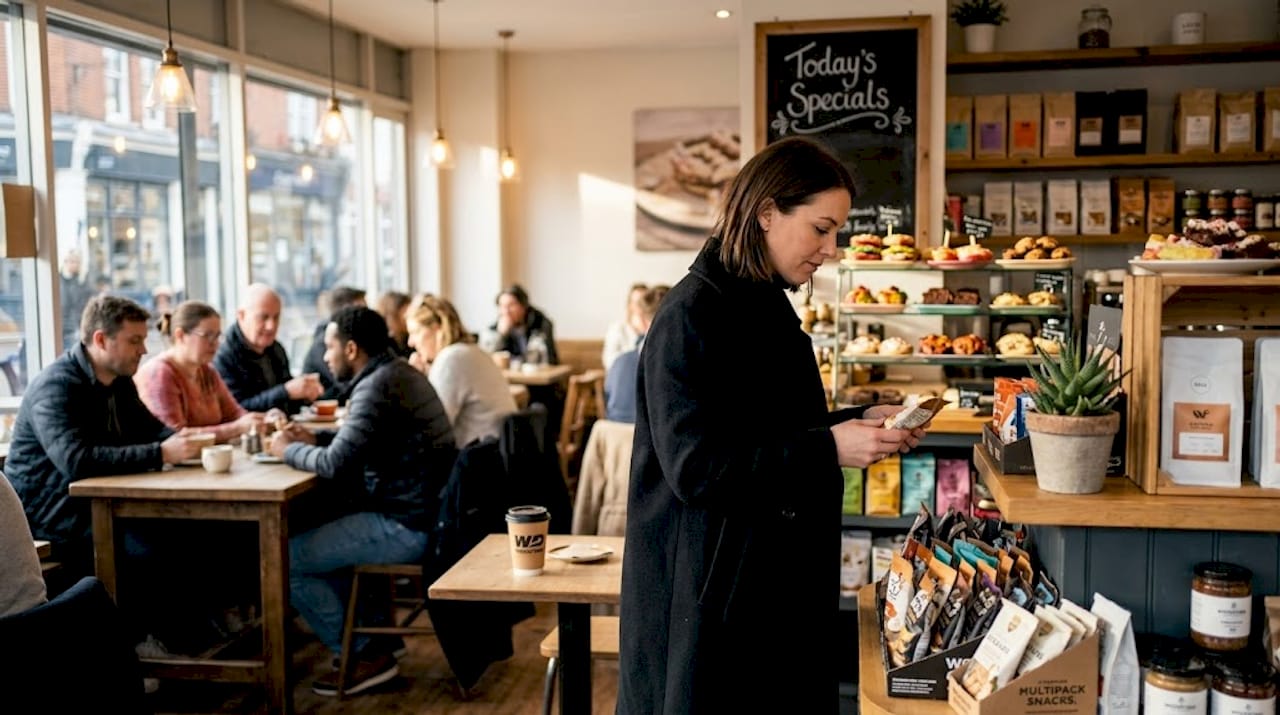
Secondary placements offer real commercial upside. A product featured at an endcap can see dramatically higher visibility than it achieves on its home shelf, particularly for impulse lines such as snacks, confectionery, and chilled grab-and-go. Cross-merchandising takes this further. Placing complementary products together encourages additional purchases and reduces the effort shoppers put into searching. Pasta beside pasta sauce. Coffee beside branded biscuits. Gourmet popcorn positioned near craft drinks for an evening entertaining occasion set.
However, there is a real risk in over-doing it. Research into fixture-induced crowding shows that additional displays can create navigational costs through aisle crowding that actually offsets the sales benefit they are supposed to deliver. More is not always more.
| Approach | Benefit | Risk |
|---|---|---|
| Standard shelf placement | Consistent category navigation | Lower visibility for individual lines |
| Endcap or feature bay | High visibility and impulse uplift | Can confuse category flow if overused |
| Cross-merchandising adjacency | Higher basket value | Shopper frustration if logic is unclear |
| Counter display | Last-minute impulse at point of payment | Clutter if poorly edited |
Common mistakes that undermine secondary displays include:
- Overcrowding aisles with too many free-standing units
- Featuring products with no clear occasion or use-case logic
- Changing displays so frequently that regular shoppers lose orientation
- Placing promotional bays where they interrupt the main shopping flow rather than complement it
- Forgetting to maintain secondary displays with the same rigour as home shelves
Pro Tip: Before adding any secondary display, stand at the entrance to the affected aisle and ask yourself whether a first-time visitor could navigate to what they need without confusion. If not, the display is doing more harm than good. One well-edited cross-merchandising feature outperforms three cluttered gondola ends every time.
Understanding cross-docking basics can help here too. If you are rotating featured displays regularly with seasonal or trend-led products, you need a logistics model that allows fast, accurate delivery of smaller quantities without disrupting your core stock flow.
Operational excellence: Execution, auditing, and ongoing refinement
Even the most thoughtfully designed shelf plan degrades quickly without disciplined day-to-day maintenance. This is where many retailers lose the gains they worked hard to create.
Here is a practical operational workflow to keep your merchandising performing:
- Daily fronting and facing — Pull products to the front of shelves so branding is visible and the bay looks full at all times. Fronting and facing keeps labels visible, guides attention at the shelf edge, and signals to shoppers that the store is well-managed.
- Daily gap check — Walk every bay at the same time each morning and record out-of-stocks. A gap at eye level is a missed sale and a poor brand impression.
- Weekly facing audit — Check that facings match your planogram. Delivery drivers, stock rotation, and rushed replenishment shifts can all cause products to drift out of position.
- Weekly sales data review — Compare actual sell-through against your planogram assumptions. Lines underperforming expectations may need repositioning, promotion, or removal.
- Monthly full bay review — Reassess the entire category structure in each bay. Remove delisted or end-of-life products. Introduce new lines only when you have a clear position for them.
- Seasonal reset — Conduct a deeper review ahead of key trading periods (Christmas, Easter, summer), updating hero products and cross-merchandising features to match shopper intent.
“Review and refresh by data and sell-through rather than leaving prime space unused.” — SIG Europe
That last point is worth reinforcing. Prime shelf space is a finite, valuable resource. A line that has stopped selling but has not been formally delisted will quietly cost you for weeks, sometimes months, if you do not act. Food logistics strategies that give you visibility into sell-through rates make this far easier to manage in practice.
Pro Tip: Use shelf accessories such as shelf dividers, risers, and edge label holders to maintain facing standards with less manual effort. A divider ensures a product always looks correctly positioned even as stock depletes during the day, without staff needing to front the bay every hour.
Support systems: Leveraging symbol groups, partners, and external expertise
You do not have to figure out every aspect of food merchandising alone. UK independents have access to a growing range of external support that can save significant time and reduce costly trial-and-error.
The types of support available include:
- Planogram templates from suppliers and distributors, often tailored by category and store size
- Category advice from brand representatives who have data on what performs in stores like yours
- Merchandising consultants who can conduct full store audits and produce a prioritised action plan
- Auditing tools ranging from simple spreadsheet-based checklists to digital shelf audit applications
- Seasonal and trend briefings from wholesale partners who track what is selling across multiple retail accounts
Symbol groups deserve particular mention. Groups like SPAR, through partners such as AF Blakemore, provide blueprint planograms and hands-on merchandising support that help independents standardise their layouts and free up owner-operator time. The value is not just in the planogram itself. It is in the accountability structure: when you commit to a blueprint, you are less likely to let the execution drift.
Knowing when to seek help is a skill in itself. If you are introducing a new category, launching into chilled or fresh for the first time, or refreshing your speciality food range ahead of a key season, an external perspective is worth far more than the time you would spend working it out independently.
Staying on top of adapting to food trends means knowing what to bring in, in what quantity, and where it fits your existing category structure. A reliable wholesale partner simplifies this considerably. For retailers exploring new snack categories, for example, working directly with a popcorn wholesale partnership can provide both product access and category guidance for a growing impulse segment.
A fresh perspective: Rethinking merchandising for modern independents
Here is something we see repeatedly working with independent retailers across the UK: the shops that struggle with merchandising are almost never suffering from a lack of ideas. They are suffering from too many ideas applied without discipline.
Every new display unit, seasonal promo, and cross-merchandising feature feels like a good idea in isolation. The result is often a store that looks busy but feels chaotic, where the shopper cannot find what they came for, cannot trust the logic of the layout, and cannot identify what the shop actually stands for.
The stores that genuinely outperform, including against well-funded multiples, are the ones that have accepted a harder truth: less done consistently beats more done sporadically. A shop with twelve well-maintained, correctly faced, intelligently cross-merchandised bays will always outperform one with twenty bays in various states of disarray and three rotating promotional features that change every fortnight.
This is where UK independents have a structural advantage they consistently underestimate. Chains are slow. Planogram changes require committee sign-off, regional approval, and a rollout schedule. You can change your eye-level hero in a morning. You can respond to a local event, a weather pattern, or a trend your community is excited about in hours. That agility is powerful. But only if it is applied with discipline, not impulse.
Our view, informed by working with ambitious independents across the UK, is that brand acceleration happens when retailers stop trying to imitate what the multiples do and start doubling down on what makes their shop irreplaceable. Curated ranges. Consistent presentation. Visible pride in the selection. That is a merchandising strategy that no chain can replicate, because it requires a shop owner who genuinely cares about what they sell.
Connect with food merchandising solutions from Woodford
At Woodford, we work directly with independent UK food retailers who want to merchandise smarter, not just stock more. Our role as a strategic food wholesaler means we do not just ship products. We help you understand where they belong in your store, which categories they anchor, and how they support the trading outcomes you are working towards. Whether you are looking to refresh your range through our brands or you represent a food business seeking wider distribution through our brand owner partnerships, Woodford provides the commercial context and logistical support that turns good products into strong performers on your shelves. Talk to us about building a merchandising-led approach to your range strategy.
Frequently asked questions
What is a planogram and why is it important for food merchandising?
A planogram is a visual shelf plan showing exactly where each product sits, guiding placement by sales data and shopper insights to ensure consistency and maximise sales potential across every bay.
How can independent retailers improve sales through merchandising?
Retailers see the strongest results by structuring categories clearly, placing bestselling lines at eye level, and using product adjacencies to place complementary items together, which encourages shoppers to add more to their baskets naturally.
What are the risks of too many in-store displays?
Fixture-induced crowding is a documented problem in retail: excess displays can block aisle navigation and disorient shoppers, ultimately reducing overall sales rather than lifting them.
How often should food merchandising be reviewed and updated?
Merchandising needs at least a weekly review to keep facings, stock levels, and featured ranges current. The principle is to review by sell-through data rather than waiting until problems become visible to shoppers.
Can symbol groups really help small retailers with merchandising?
Absolutely. Groups like SPAR through AF Blakemore provide standardised planograms and expert support that free up owner time while significantly improving the consistency and commercial performance of in-store layouts.
Recommended
- Food logistics tips for UK independent retailers in 2026 - WOODFORD - Bringing quality foods your way
- Food brand strategy drives UK retail success in 2026 - WOODFORD - Bringing quality foods your way
- What is brand acceleration in food: a guide for UK retailers - WOODFORD - Bringing quality foods your way
- Strategic food brands for UK independent retailers - WOODFORD - Bringing quality foods your way