Food distributor contracts explained for UK brands

TL;DR:Understanding contract types and key clauses helps UK food brands avoid costly disputes.Compliance with competition law and including termination protections are critical for contract validity.Building flexible, transparent relationships with shared forecasting ensures long-term distribution success.
Signing a food distributor contract without fully understanding it is one of the most expensive mistakes UK retailers and brand owners make. A poorly worded exclusivity clause or a vague performance target can quietly erode your margins before you even notice. This guide cuts through the legalese to give you a clear picture of contract types, the clauses that actually matter, the legal risks you must avoid, and how to negotiate with confidence. Whether you are an independent retailer reviewing a new supply agreement or a food brand owner looking to scale, by the end of this piece you will know exactly what to look for and what to push back on.
Table of Contents
- Understanding food distributor contract types in the UK
- Key clauses and legal essentials in distributor contracts
- Navigating competition law, risks and contract restrictions
- Termination, margin protection and practical negotiation tips
- A fresh perspective: What most guides miss about distributor contracts
- Next steps: Find strategic food distribution support
- Frequently asked questions
Key Takeaways
| Point | Details |
|---|---|
| Know your contract type | Choosing the right distributor agreement structure is critical for your rights and supply chain control. |
| Focus on key contract clauses | Nail down vital terms like price, IP, delivery standards, and legal compliance for supply security. |
| Watch for legal risks | Stay compliant with UK competition law by avoiding restrictive or unauthorised terms. |
| Negotiate termination terms | Plan clearly for how to end agreements and protect your margins when market circumstances change. |
| Resilience depends on relationships | Build flexibility and forecasting into distributor contracts to adapt in a low-margin, volatile market. |
Understanding food distributor contract types in the UK
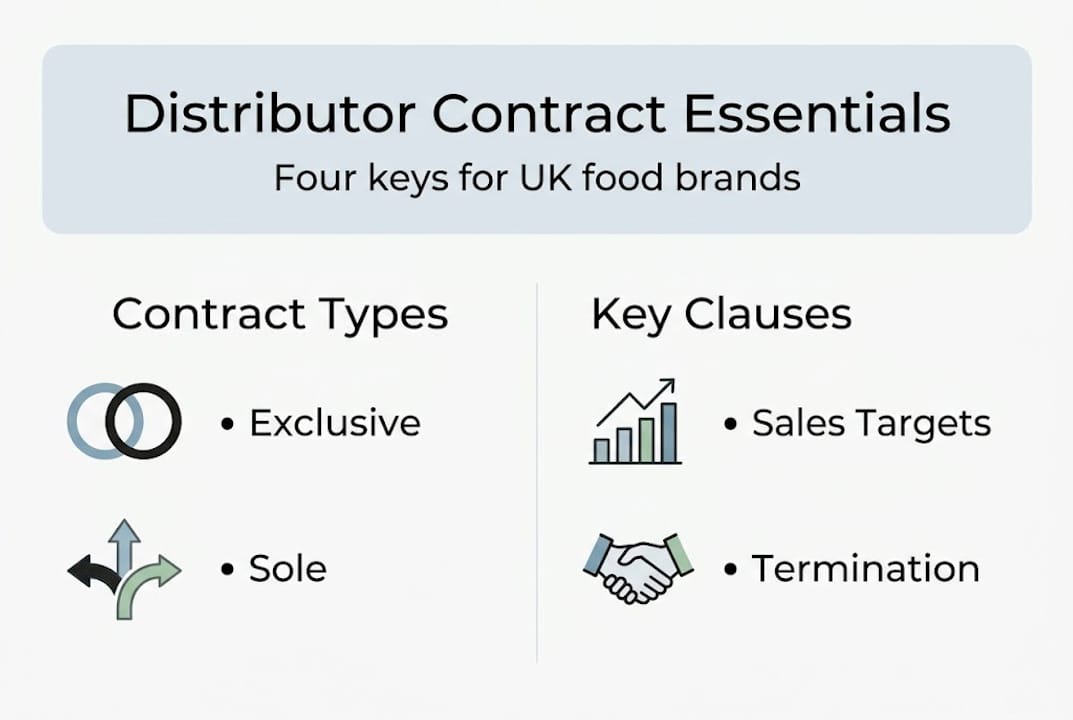
Not all distribution agreements are built the same way, and picking the wrong structure can limit your growth or expose you to obligations you never intended to accept. Food distributor contracts in the UK typically include exclusive, sole, and non-exclusive arrangements, each with defined territory, minimum purchase requirements, and performance obligations to avoid disputes.
Here is a quick breakdown of what each type actually means in practice:
- Exclusive distribution: The distributor is the only party permitted to sell your product within a defined territory. Even you, as the supplier, cannot sell directly into that region. This gives the distributor strong incentive to invest in your brand, but it also means you are heavily reliant on their performance.
- Sole distribution: You appoint one distributor, but you retain the right to sell directly into the territory yourself. It is a middle ground that suits brands wanting to keep a foot in the door without flooding the market with multiple agents.
- Non-exclusive distribution: Multiple distributors can operate in the same territory. This generates broader reach quickly, but price competition between distributors can undermine your brand positioning over time.
For strategic food brands entering new regional markets, exclusive contracts often accelerate growth because they motivate the distributor to champion your product. However, for established suppliers with strong demand, non-exclusive arrangements can increase coverage without surrendering control.
| Contract type | Supplier can sell direct | Multiple distributors | Best for |
|---|---|---|---|
| Exclusive | No | No | New market entry |
| Sole | Yes | No | Growing brands |
| Non-exclusive | Yes | Yes | High-volume products |
The most common pitfall here is vagueness. Contracts that do not define the territory with postcode-level precision, or that set minimum purchase volumes without specifying how shortfalls are managed, almost always lead to disputes. A small challenger brand and an established food supplier will face very different consequences from the same ambiguous clause. Understanding brand acceleration explained can help you choose the contract structure that matches your actual growth stage rather than your ambitions on paper. If you are a food brand looking to formalise distribution, exploring your options for brand owners is a sensible first step.
Key clauses and legal essentials in distributor contracts
With contract types established, the specifics within the contract are what truly protect your business. A beautifully structured agreement that fails on the detail is no protection at all.
Key clauses in UK retail distribution agreements cover product specifications, pricing structures, payment terms, IP protection, sales targets, termination conditions, and compliance with UK food law including traceability, safety, and hygiene under General Food Law.
Let us break these down into the ones most likely to affect your day-to-day operations:
- Product specifications: Define the exact standards your product must meet at the point of delivery. Vague specs lead to rejected deliveries, disputes, and damaged retailer relationships.
- Pricing and payment terms: Net-30 or net-60 payment windows are common in the sector. Confirm whether prices are fixed or subject to review, and under what circumstances a supplier can raise them.
- Intellectual property: Ensure your brand assets, recipe data, and packaging designs remain yours. A distributor should have a licence to use them, not ownership.
- Sales targets and SLAs: These are a double-edged tool. Strong targets can motivate a distributor, but unrealistic ones become a contractual weapon against you if you miss them. Make sure service-level agreements for delivery timescales and quality checks are measurable and fair.
- UK food law compliance: Traceability records, allergen labelling, and temperature controls are not optional. Your contract should specify which party holds legal responsibility at each stage of the supply chain.
Understanding the range of food distribution channels available will help you assess whether your chosen partner can realistically meet the SLAs you agree to.
“Payment terms of net-30 to net-60 days are standard in UK food distribution, but they can create serious cash flow pressure for smaller brands. Always model the impact on working capital before you sign.”
Pro Tip: Insist that every sales target in your contract is tied to a specific, measurable KPI such as unit volume per quarter, not vague revenue estimates. Review food logistics tips to build realistic baselines before committing to targets. Solid food brand strategy planning before you sign will give you real data to negotiate from.
Navigating competition law, risks and contract restrictions
Getting the clauses right is not enough. Legal and regulatory hurdles can undermine contracts if overlooked, and in the food sector the consequences can be severe.

Competition law restricts practices like resale price maintenance and territorial restrictions if market share exceeds 30%, and contracts must avoid certain hardcore restrictions to qualify for block exemptions. In practical terms, this means you cannot dictate the minimum price at which your distributor resells your products. You can recommend a retail price, but fixing it is illegal.
Here are the key steps to keep your contract legally compliant:
- Check your combined market share with the distributor. If it exceeds 30% in the relevant market, you will not benefit from block exemptions and will need a more detailed competition law review.
- Remove any clauses that restrict the distributor from selling to customers in other territories who actively seek out the product.
- Avoid any language that prevents the distributor from setting their own resale prices.
- Include a clear governing law clause specifying UK jurisdiction to avoid post-Brexit ambiguity.
- Have a solicitor review any exclusivity clause before signing, particularly if the term exceeds two years.
Beyond competition law, force majeure clauses, SLAs for delivery and quality, exclusivity provisions, and dispute resolution processes such as mediation or arbitration are essential for supply chain resilience in food contracts. The last two years have shown just how quickly supply chains can fracture. A contract without a well-drafted force majeure clause leaves both parties exposed.
“Courts in the UK have consistently held that commercial agreements must provide reasonable certainty of obligations. Ambiguous exclusivity clauses, in particular, have been struck down or interpreted against the party who drafted them.”
Pro Tip: Do not confuse exclusivity with restriction. Granting exclusive rights in a territory is perfectly legal. Preventing a distributor from responding to unsolicited orders from outside that territory is not. Understand navigating UK food logistics so you can assess whether exclusivity is operationally feasible, and read up on cross-docking in food if rapid distribution across territories is part of your model.
Termination, margin protection and practical negotiation tips
All solid contracts plan for what happens at the end. Exits are rarely clean, and without the right clauses in place, a contract termination can damage your brand, your cash flow, and your relationships with retailers simultaneously.
On termination, brands retain control over stock repurchase and resale to avoid fire sales, and EU countries may grant distributors indemnity that does not apply in UK law. This distinction matters enormously. In France or Germany, a distributor you terminate after several years may be legally entitled to compensation. In the UK, no such statutory right exists, so your contract terms govern everything.
Food industry net margins are typically thin, often between 1% and 2%, which means a botched termination can wipe out an entire year of profit in one write-off.
| Scenario | Typical net margin | Repurchase approach | Key risk |
|---|---|---|---|
| Healthy exit | 1.5 to 2% | Agreed buyback at cost price | Slow stock clearance |
| Disputed exit | Below 1% | Ad hoc negotiation | Fire sale below cost |
| Planned wind-down | 1 to 1.5% | Pre-agreed liquidation schedule | Retailer confidence loss |
Here are practical negotiation tips to protect your position whether you are entering or exiting a distributor relationship:
- Negotiate a stock buyback clause before you sign, specifying the price formula and timeline.
- Agree a brand protection clause that restricts the distributor from discounting your products below a floor price even after termination.
- Build in a notice period of at least 90 days so both parties can plan stock levels and retailer communications.
- Request an audit right so you can verify sell-through data and royalty payments independently.
- If you are an independent retailer, insist on a clear process for stock returns if a brand exits the market.
Margin resilience does not come from hoping for the best. It comes from clauses that anticipate realistic worst-case scenarios before either party is under pressure.
A fresh perspective: What most guides miss about distributor contracts
Most guides focus on legalese, clause checklists, and worst-case scenarios. What they rarely acknowledge is that the most resilient distributor relationships are not built on airtight contracts alone. They are built on shared forecasting and adaptive planning.
UK food supply chain profits are startlingly thin, with just 29p earned on a typical £20.24 grocery basket, making it clear that the margin for error in any supply disruption is almost zero.
With margins this tight, a contract dispute that runs for even a few months can be commercially catastrophic. The brands and retailers who survive market volatility are not those with the sharpest lawyers. They are those who have built quarterly forecasting reviews, honest performance conversations, and genuine flexibility into their distribution relationships from day one.
Treat your distributor contract as the foundation of a supply partnership, not a weapon to reach for when things go wrong. The document should reflect the spirit of the relationship you actually want. If your contract reads like a list of punishments, you are negotiating a transactional arrangement, not a long-term growth partnership. Build in review mechanisms, not just fixed targets, and you will find your distribution relationships far more durable under pressure.
Next steps: Find strategic food distribution support
Ready to put these insights to work? At Woodford, we specialise in connecting ambitious independent retailers with trusted food brands that are built for long-term partnership, not short-term volume plays. Our distribution model is designed around the kind of transparency, shared forecasting, and flexible terms that this article highlights as genuinely protective.
If you are a food brand owner looking to scale through distribution channels that actually understand your margins and your growth ambitions, explore what we offer for brand owners. We can help you navigate contract structures, identify the right distribution model, and connect with retail partners who share your values. Getting the contract right starts with getting the right partner.
Frequently asked questions
What are the main differences between exclusive, sole, and non-exclusive food distribution contracts?
Exclusive contracts give a single distributor full rights in a territory with no direct supplier competition; sole contracts allow both supplier and one distributor to sell; non-exclusive permits multiple distributors to operate simultaneously in the same area.
What clauses should every UK food distributor contract have?
Every contract should include product specifications, pricing and payment terms, IP protection, measurable sales targets, UK food law compliance obligations, clear termination conditions, and a defined dispute resolution process.
How does UK competition law affect distributor contracts?
UK competition law prohibits resale price maintenance and restricts territorial exclusivity arrangements where combined market share exceeds 30%, meaning certain contract clauses can be rendered void or attract regulatory penalties.
What should brands do to protect margins when ending a contract?
Brands should negotiate stock repurchase terms and brand protection floors before signing, so that termination cannot trigger a fire sale that undermines retailer confidence or destroys the product’s perceived value.
Recommended
- Navigating UK food logistics for wholesalers in 2026 - WOODFORD - Bringing quality foods your way
- Food logistics tips for UK independent retailers in 2026 - WOODFORD - Bringing quality foods your way
- Strategic food brands for UK independent retailers - WOODFORD - Bringing quality foods your way
- Food brand strategy drives UK retail success in 2026 - WOODFORD - Bringing quality foods your way