Build your product range: food brand selection guide
TL;DR:Independent retailers should focus on curation, provenance, and storytelling rather than competing on price and convenience.Understanding customer values and local sourcing is essential for selecting brands that meet consumer expectations for quality, sustainability, and ethics.Piloting brands with small orders and ongoing testing ensures commercial viability, operational fit, and long-term range relevance.
Supermarkets will always win on price and convenience. That is simply not the game independent food retailers should be playing. Your advantage lies in curation, provenance, and the kind of product storytelling that no national chain can replicate at scale. But choosing the wrong brands wastes shelf space, ties up cash, and confuses customers. This guide walks you through a practical, step-by-step process for selecting food brands that genuinely fit your shop, your customers, and your long-term ambitions. From understanding what your shoppers actually value to piloting new lines with minimal risk, every stage is covered.
Table of Contents
- Understand your market and customer priorities
- Research and shortlist suitable food brands
- Evaluate commercial appeal and operational fit
- Test and refine your selection for long-term success
- Our take: the balancing act for UK independent retailers
- Discover exclusive brands with Woodford
- Frequently asked questions
Key Takeaways
| Point | Details |
|---|---|
| Know your customers | Understanding shopper values and demand helps guide effective brand selection. |
| Shortlist exclusive brands | Use wholesalers, certifications, and supply criteria to identify brands suited to independents. |
| Check margin and packaging | Evaluate commercial terms like margin, MOQs, and retail-ready packaging for operational fit. |
| Pilot and refine | Test brands in small batches, gather feedback, and adjust range for consistent performance. |
| Balance premium and value | Differentiation comes from provenance and experience, not simply price or luxury positioning. |
Understand your market and customer priorities
Before you approach a single brand, you need a clear picture of who walks through your door and what they care about. Many retailers skip this step and end up with a range that reflects personal taste rather than customer demand. That is an expensive mistake.
Start with demographics. Consider the age range, income levels, and lifestyle priorities of your core shoppers. A shop near a university will attract different buyers than one in a rural market town. Location shapes everything from price sensitivity to interest in niche certifications. Understanding these factors gives you a filter before you even open a brand catalogue.
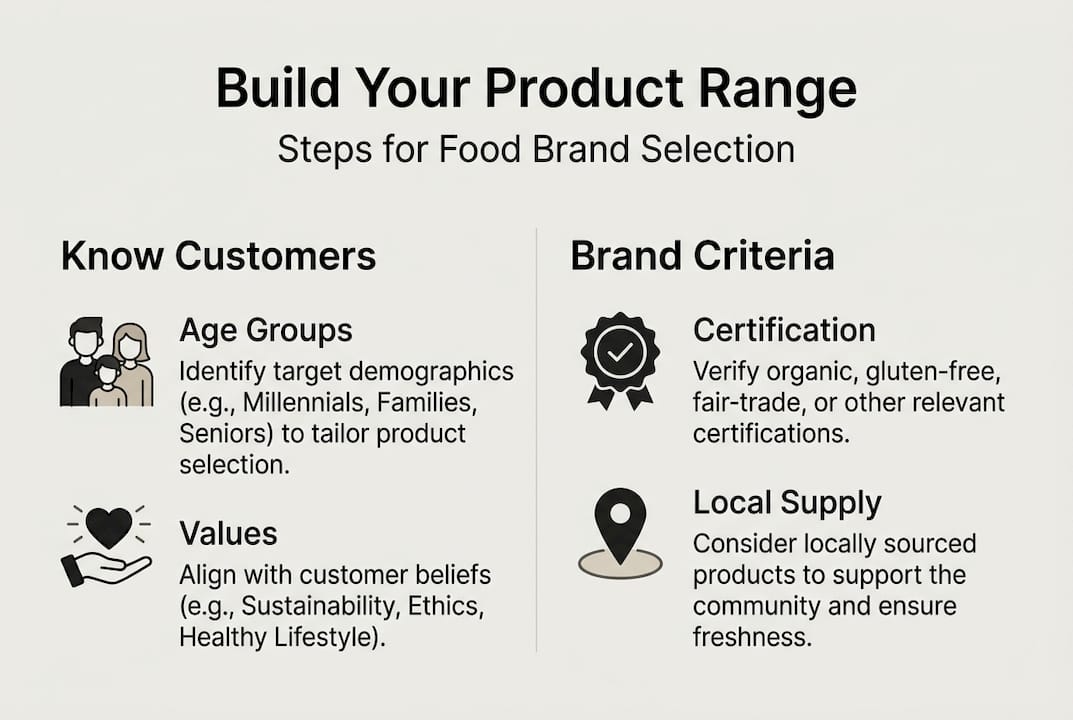
Consumer values have shifted considerably in recent years. 46% of UK consumers shop at independents specifically for quality, provenance, and sustainability. That is not a niche concern. It is the primary reason people choose you over the supermarket. Equally, 79% of shoppers consider animal welfare crucial when buying food, with 50% checking product origin and 43% actively preferring local brands. These are not marginal preferences. They are baseline expectations for your audience.
| Priority factor | % of UK independent shoppers who value it |
|---|---|
| Animal welfare | 79% |
| Product origin | 50% |
| Local sourcing | 43% |
| Sustainability credentials | Included in 46% shopping independents |
Gathering this data for your specific shop does not require a research budget. Practical methods include:
- Customer surveys at the till or via email, kept short and focused on product preferences
- POS data analysis to identify which categories and price points sell fastest
- Social media listening to spot what your followers share, comment on, and ask about
- Conversations with staff who hear direct feedback every day
- Competitor observation, visiting nearby independents and farmers markets to spot gaps
Pro Tip: Use postcode mapping tools to analyse where your customers travel from. Shoppers driving 20 minutes to reach you are motivated buyers. Understanding their postcodes can reveal regional sourcing preferences and help you prioritise local producers from specific counties or areas.
Building this foundation connects directly to brand strategy insights and broader market trend analysis that can sharpen your decisions further.
Research and shortlist suitable food brands
With a clear picture of your customers, you can now search for brands with genuine intent rather than browsing aimlessly at trade shows. Systematic research separates retailers who build strong ranges from those who accumulate a random collection of products.
Reputable wholesalers and distributor platforms are your most efficient starting point. Wholesalers such as Cotswold Fayre, Diverse Fine Food, and CLF provide access to thousands of exclusive brands, many of which are not available in supermarkets. This exclusivity is a genuine competitive advantage. When your customer cannot buy the same product from Tesco, they have a reason to come back to you.
Certifications matter because they act as shorthand for your customers. Key ones to look for include:
- B Corp: Signals high social and environmental standards across the whole business
- Organic (Soil Association): Confirms farming practices free from synthetic pesticides
- Pasture for Life: Guarantees 100% grass-fed livestock, valued by ethical meat buyers
- LEAF (Linking Environment and Farming): Demonstrates sustainable, environmentally aware farming
| Certification | What it signals | Typical MOQ range | Supply reliability |
|---|---|---|---|
| B Corp | Whole business ethics | Varies | Generally strong |
| Organic | Farming standards | Low to medium | Seasonal variation |
| Pasture for Life | Grass-fed livestock | Low | Good for small farms |
| LEAF | Sustainable farming | Low to medium | Consistent |
Systematic research and spreadsheet organisation are the practical backbone of a good shortlisting process. Use a simple spreadsheet to track each brand by category, certifications, minimum order quantities (MOQs), lead times, and contact details.
Here is a step-by-step approach to building your shortlist:
- Define your category gaps based on customer insight data
- Search wholesaler catalogues, trade directories, and food trade shows for candidates
- Log each brand in a spreadsheet with key commercial details
- Check certifications and verify claims on brand websites
- Make initial contact to request sell sheets and sample pricing
- Narrow to a shortlist of 5 to 10 brands per category gap
Pro Tip: Prioritise local producers in your first round of research. Shorter supply chains reduce logistical risk, strengthen your provenance story, and often allow for more flexible ordering terms. A producer two counties away is far easier to build a relationship with than one based overseas.
For deeper guidance on making these decisions strategically, explore strategic brand selection and food logistics tips to understand how supply chain choices affect your day-to-day operations.
Evaluate commercial appeal and operational fit
A brand might look perfect on paper but fail commercially in your shop. Before committing to any new line, you need to stress-test the numbers and the practicalities. This is where many enthusiastic buyers come unstuck.
Margin is the starting point. Convenience retailers typically seek 30 to 40% gross margin, with pilots often beginning with just 24 to 72 units. If a brand cannot meet that margin threshold at a realistic retail price for your customer base, it is not commercially viable regardless of how appealing the product is.
Margin benchmark: Aim for 30 to 40% gross margin as a baseline for any new food brand in a UK independent retail setting.
Packaging readiness is often overlooked. Check that every product carries a barcode, clear ingredient and allergen labelling, and a shelf life that suits your stock turnover. Visually, packaging needs to work on your shelves without looking out of place. A beautifully crafted product in poorly designed packaging will underperform every time.

Operational fit also covers order flexibility. High MOQs are a real barrier for smaller independents. Brands that insist on large minimum orders before you have tested demand are asking you to take all the risk. Look for suppliers willing to start small.
Use this checklist when evaluating any new brand:
- Gross margin meets your 30 to 40% target at a competitive retail price
- Packaging includes barcodes, allergen info, and shelf-ready presentation
- Shelf life suits your typical stock turnover rate
- MOQ is manageable for a pilot without overcommitting cash
- Lead times are reliable and fit your replenishment schedule
- Brand support includes sell sheets, imagery, and point-of-sale materials
Pro Tip: Ask brands directly whether they offer pilot-friendly terms. Many smaller producers are willing to negotiate starter orders precisely because they want to build a track record with independents. This reduces your financial exposure while you test real customer response.
Understanding how your supply chain is structured also matters. Reviewing distribution channel tips can help you identify the most efficient route to market for different brand types.
Test and refine your selection for long-term success
Even the most carefully chosen brand needs to prove itself on your shelves. Piloting is not a sign of indecision. It is disciplined retail practice. The best independent retailers treat their product mix as a living thing, constantly evolving based on evidence rather than assumption.
Run a structured pilot for every new brand. Give it a defined shelf position, a clear price point, and a fixed review period of four to eight weeks. During that time, track unit sales, customer comments, and any supply issues. Fast feedback loops stop you from holding dead stock for months out of optimism.
“Consistency, not selection alone, makes you a destination.”
Range consistency is what separates a destination retailer from a shop people visit once. Dwindling range post-launch is one of the most common reasons independent retailers lose the loyal shoppers they worked hard to attract. If a product sells and then disappears, customers feel let down. Reliable replenishment is as important as the initial selection.
Look at what the best farm shops do. Fordhall Farm Shop stocks from over 40 nearby producers, with more than 75% of products sourced or produced on-site. That level of provenance density creates a genuinely irreplaceable shopping experience. You do not need to replicate it exactly, but the principle applies: the more your range tells a coherent, local, ethical story, the more loyal your customer base becomes.
Follow these steps to build a testing and refinement cycle:
- Pilot the brand with a limited initial order in a visible shelf position
- Collect feedback from customers and staff during the review period
- Analyse sales data against your margin and turnover targets
- Adjust the mix by expanding winners and replacing underperformers
- Review supply reliability and flag any consistency issues with the brand
- Repeat the cycle quarterly to keep your range fresh and relevant
Building this kind of iterative approach connects to broader thinking around brand acceleration in food, where the brands that grow fastest are those supported by retailers who actively champion them.
Our take: the balancing act for UK independent retailers
Here is something the standard advice rarely says plainly: chasing premium for its own sake is just as dangerous as competing on price. We see retailers stock a shelf full of beautifully packaged, expensive products and then wonder why footfall drops. The issue is not quality. It is accessibility.
True differentiation comes from experience and provenance, not from having the most expensive range on the high street. A £4 jar of locally made chutney with a compelling farm story will outsell a £9 imported luxury preserve almost every time in a well-run independent.
Sustainability is no longer a differentiator. It is a hygiene factor. Shoppers now expect ethical credentials as a baseline, not a bonus. If you are still treating sustainability as a marketing angle, you are behind the curve. The retailers winning right now are those who treat it as a minimum standard and then go further with provenance and community connection.
Balancing premium appeal with accessible value broadens your customer base considerably. It lets you serve both the weekly shopper and the occasional treat buyer. Pro Tip: Feature brand stories and ethical credentials prominently on shelf labels and social media. Shoppers engage far more with products when they understand the people and values behind them.
For more thinking on this, explore adapting to food trends and how the most resilient independents stay ahead of shifting consumer expectations.
Discover exclusive brands with Woodford
At Woodford, we work directly with independent retailers across the UK to connect them with curated, high-quality food brands that are not available on supermarket shelves. Our role is to make the selection process faster, lower-risk, and genuinely exciting. Whether you are filling a category gap or refreshing an entire range, we bring the brands to you rather than leaving you to search alone.
Browse our brands to see the full range of producers we represent, from certified organic staples to trend-led speciality lines. You can also check our exclusive promotions for current deals that make trialling new brands even more accessible. If you want to talk through your specific needs, our team is ready to help you build a range that genuinely sets your shop apart.
Frequently asked questions
What certifications should I prioritise for food brands in the UK?
Focus on B Corp, Organic, Pasture for Life, and LEAF certifications, as these directly address the provenance and sustainability expectations of UK independent shoppers. Plastic-Free accreditation is also growing in relevance for environmentally conscious buyers.
How do I test a food brand before committing to a full range?
Pilot new brands with limited orders of 24 to 72 units, gather real customer feedback over four to eight weeks, and monitor both sales performance and supply consistency before expanding the range.
Why is sourcing from local producers important for independent retailers?
Local sourcing strengthens your provenance story and builds consumer trust, particularly as 43% of shoppers actively prefer local food brands. It also reduces logistical complexity and supports your regional community.
How do I calculate the right profit margin for a new food brand?
Aim for 30 to 40% gross margin as a baseline for convenience and independent retail. Compare this against your store’s typical category margins and the retail price your customers will realistically pay.
What mistakes should independents avoid when selecting brands?
Avoid neglecting range consistency post-launch, skipping demand testing, and choosing brands purely on luxury appeal rather than balancing premium quality with accessible value and genuine provenance.
Recommended
- Strategic food brands for UK independent retailers - WOODFORD - Bringing quality foods your way
- Food brand strategy drives UK retail success in 2026 - WOODFORD - Bringing quality foods your way
- What is brand acceleration in food: a guide for UK retailers - WOODFORD - Bringing quality foods your way
- How to conduct trend analysis for UK food brands in 2026 - WOODFORD - Bringing quality foods your way