How to distribute food products efficiently: UK indie guide

TL;DR:Poor distribution erodes margins, increases waste, and drives customers to competitors.UK food distribution channels include wholesalers, short supply chains, and exclusive arrangements, each with different risks and margins.Success depends on strategic blending, proper preparation, effective execution, compliance, and resilient supplier relationships.
Poor distribution doesn’t just slow you down. It quietly erodes your margins, inflates your waste, and hands your customers a reason to shop elsewhere. For independent food retailers across the UK, the gap between a thriving shop and a struggling one often comes down to how efficiently products move from supplier to shelf. This guide walks you through the main distribution channels, how to prepare your range for them, how to execute your strategy, and how to handle the structural challenges that most guides gloss over. Whether you’re setting up your first wholesale account or rethinking an existing network, there’s something actionable here for you.
Table of Contents
- Understanding UK food distribution channels
- Preparing for successful food product distribution
- Executing your food product distribution strategy
- Troubleshooting, compliance, and overcoming structural challenges
- What most guides miss about food product distribution
- Partner with Woodford for food distribution excellence
- Frequently asked questions
Key Takeaways
| Point | Details |
|---|---|
| Choose the right channel | Select wholesalers for scale or SFSCs for local edge, balancing reach with margin. |
| Prepare rigorously | Audit your products, build relationships, and ensure you meet all technical and compliance requirements. |
| Leverage technology | Use inventory, traceability, and AI tools to boost efficiency and reduce waste. |
| Resilience beats scale | Diversify suppliers and infrastructure to withstand market shocks and competition. |
| Stay compliant | Keep contracts clear and processes aligned with UK and food safety regulations. |
Understanding UK food distribution channels
Before you can improve your distribution, you need to know what your options actually are. The UK food sector offers several distinct models, and the right one depends on your product range, your margins, and how much infrastructure you can realistically manage.
Food distribution channels in the UK broadly fall into three categories: wholesalers and symbol groups, short food supply chains (SFSCs), and selective or exclusive distribution arrangements. Each carries a different risk profile, margin potential, and operational demand.
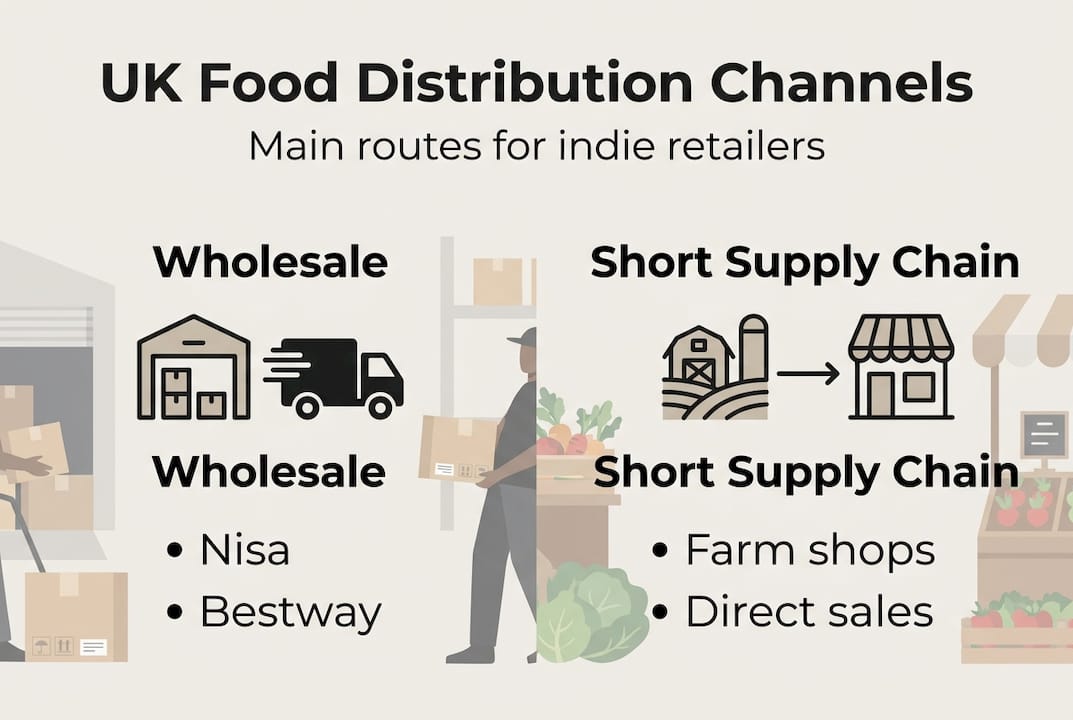
Wholesalers and symbol groups are the backbone of independent retail distribution. Groups like Nisa, Bestway, and Spar give retailers access to wide product ranges, reliable logistics, and competitive pricing through collective buying power. Independent retailers distribute primarily through wholesalers and symbol groups, benefiting from logistics and high product availability. The trade-off is reduced differentiation. When every independent in your area stocks the same lines, it’s harder to stand out.
Short food supply chains are growing fast, particularly for local, artisan, and high-margin products. SFSCs cut out intermediaries, connecting retailers directly with producers. Margins can be significantly better, but the operational burden is higher. You’re managing more relationships, more deliveries, and more compliance paperwork.
Selective and exclusive arrangements sit somewhere in between. Working with strategic food brands on an exclusive basis gives you product focus and a point of difference, though it requires stronger relationships and often longer-term commitments.
Here’s a quick comparison to help you weigh the options:
| Channel | Reach | Margin potential | Risk level | Infrastructure demand |
|---|---|---|---|---|
| Wholesaler/symbol group | High | Moderate | Low | Low |
| SFSC (direct from producer) | Local/regional | High | Medium | High |
| Selective/exclusive | Targeted | High | Medium | Medium |
The supply chain models you choose will shape everything from your cash flow to your customer offer. A blended approach, using wholesalers for staples and SFSCs or exclusive lines for premium products, is increasingly how successful independents operate. It’s also worth reviewing your brand strategy for success to ensure the products you’re distributing align with where your market is heading.
- Wholesalers: best for volume, speed, and reliability
- SFSCs: best for margin, locality, and differentiation
- Exclusive deals: best for brand identity and customer loyalty
- Blended approach: best for resilience and competitive range
Preparing for successful food product distribution
With a clear sense of your channel options, here’s how to prepare your products for success. Preparation is where most retailers lose time. Skipping this stage leads to rejected orders, compliance headaches, and wasted stock.
Start with a product readiness audit. Before approaching any wholesaler or producer, check the following:
- Labelling compliance: All products must meet UK food labelling regulations, including allergen declarations, nutritional information, and country of origin.
- Shelf life: Does your product have sufficient shelf life to survive the distribution journey and still sell through before expiry?
- Volume capability: Can your supplier consistently meet your order volumes? Inconsistent supply is one of the fastest ways to damage a wholesale relationship.
- Pricing structure: Have you mapped your cost price, wholesale margin, and retail price to confirm the numbers actually work?
46% of UK consumers shop at independents monthly, which means your product offer needs to be consistently available and competitively priced to retain them.
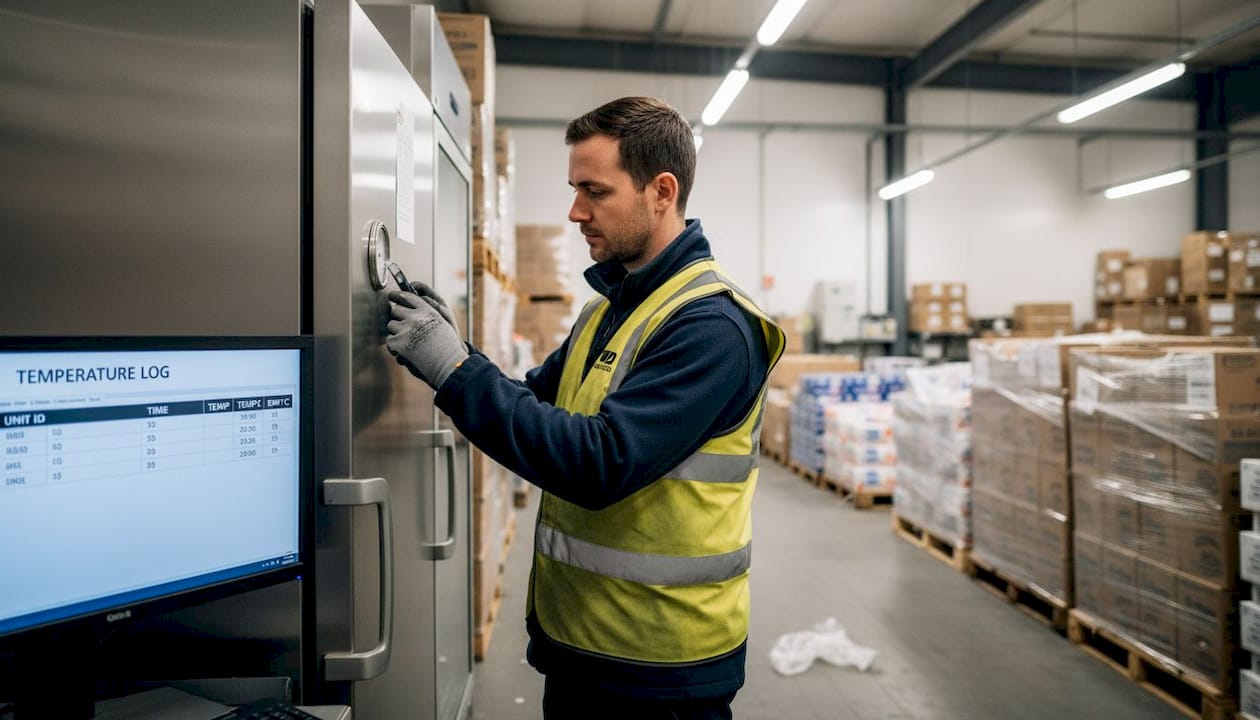
For chilled and frozen products, the technical bar is higher. You’ll need verified cold chain logistics, temperature monitoring during transit, and traceability systems that can satisfy both your wholesaler and environmental health officers. These aren’t optional extras. They’re baseline requirements.
When selecting distribution partners, look beyond price. Consider their delivery frequency, their minimum order requirements, and how they handle disputes. Symbol groups like Nisa, Co-op Wholesale, and The Wholesale Group all offer different membership structures with varying annual fees and compliance mandates. Read the small print carefully, particularly around exclusivity clauses and promotional obligations.
For distribution legal guidance, especially if you’re working across borders or with exclusive territory agreements, specialist legal advice is worth the investment early rather than after a dispute arises.
For practical day-to-day logistics, these logistics tips cover the operational detail that often gets overlooked during the planning phase.
Pro Tip: Before signing with any wholesaler, request a trial order period. This lets you assess delivery reliability, product condition on arrival, and the quality of their customer service before you’re locked into a contract.
Executing your food product distribution strategy
Execution is where planning meets the realities of the market. Even a well-researched strategy can stall if the operational steps aren’t followed in the right order.
Here’s a practical sequence to follow:
- Onboard your suppliers: Confirm product specs, lead times, and minimum order quantities in writing. Verbal agreements cause problems.
- Negotiate with wholesalers: Don’t accept the first offer. Volume commitments, prompt payment terms, and long-term relationships all create room for better pricing.
- Deploy inventory management tools: Basic spreadsheets won’t cut it beyond a certain scale. Look at systems that integrate with your EPOS and give you real-time stock visibility.
- Track deliveries actively: Don’t wait for problems to surface. Monitor delivery windows, check goods in properly, and flag discrepancies immediately.
- Review and adapt monthly: Demand shifts, seasons change, and suppliers have their own disruptions. Build a monthly review into your operations.
Technology is increasingly the differentiator here. Invest in technology and data to improve inventory management and supply chain resilience. IoT sensors can flag temperature breaches in chilled deliveries. Blockchain-based traceability systems, while still emerging for smaller retailers, are becoming more accessible and will matter increasingly for compliance.
Common mistakes at this stage include poor communication with partners when demand spikes, failing to maintain contingency suppliers for key lines, and being slow to respond when a product underperforms. The retailers who execute well treat their wholesale relationships like partnerships, not transactions.
“The independents that thrive aren’t the ones with the most products. They’re the ones who know exactly what’s on their shelves, where it came from, and what’s coming next.”
For detailed guidance on wholesaler logistics, including route optimisation and delivery scheduling, there’s a wealth of practical advice tailored specifically to the UK independent sector. It’s also worth watching how own-brand innovation is reshaping the wholesale landscape, as this creates new opportunities for retailers willing to move quickly.
Pro Tip: Run a first-tier visibility check every quarter. Map exactly which suppliers feed your top 20 selling lines and confirm you have at least one backup source for each. This single habit prevents most stock-out crises.
Troubleshooting, compliance, and overcoming structural challenges
Even the best strategies face systemic obstacles and regulatory hurdles. Independent retailers operate in a market where the structural odds are not always in their favour.
The most significant structural challenge is supermarket dominance. Supermarkets hold 78% market share, which gives them enormous leverage over suppliers and pricing. For independents, competing on price alone is a losing strategy. The answer is differentiation through product curation, local sourcing, and service quality.
On the compliance side, the key obligations are:
- Food safety standards: ISO 22000 certification is increasingly expected by larger wholesale partners and demonstrates a credible food safety management system.
- Traceability: You must be able to trace any product one step back and one step forward in the supply chain. This is a legal requirement, not a best practice.
- Audit readiness: Environmental health inspections can happen with limited notice. Your records, temperature logs, and supplier documentation need to be accessible and current.
- Contract clarity: Any exclusive distribution agreement must be clearly drafted. Avoid arrangements that could be construed as resale price maintenance, which is illegal under UK competition law.
“Compliance isn’t a cost centre. It’s the foundation that lets you trade with confidence and scale without legal exposure.”
SFSCs, while attractive for margin, carry their own structural risks. Smaller producers may lack consistent volumes, may not hold the right certifications, or may struggle with delivery reliability. Collaborating with local food processors or co-operatives can help bridge these gaps and spread the logistical burden.
For those interested in supply chain innovation at a deeper level, emerging research points to collaborative models between independents as one of the most effective ways to counter supermarket pricing power. And adapting to food trends is equally important. Stocking the right products at the right time is itself a distribution advantage.
What most guides miss about food product distribution
Most distribution guides focus on scale. Get bigger. Stock more. Win more wholesale accounts. But for independent retailers, chasing scale without building resilience is a trap.
The uncomfortable truth is that supermarket supply contracts might promise volume, but they rarely deliver long-term margin security for smaller operators. You end up price-matching at the bottom and losing the very identity that makes customers choose you.
Real distribution success is about building adaptive networks, not just bigger ones. That means blending SFSCs for high-margin lines with reliable wholesale for staples, using data to spot demand shifts before they hit your shelves, and investing in supplier relationships that hold up when the market gets difficult. The retailers we see thriving are those who treat strategic brands for independents as genuine partners and use trend analysis for brands to stay ahead of what customers actually want next. Infrastructure and relationships buffer shocks. Scale alone does not.
Partner with Woodford for food distribution excellence
If you want to put these strategies to work and leapfrog common barriers, consider how Woodford can help. As the UK’s leading strategic food wholesaler, we connect ambitious independent retailers with premium brands, exclusive distribution arrangements, and logistics support that removes the operational headaches. Whether you’re looking to refresh your product range, improve your supply chain resilience, or access current promotions that give you a competitive edge, we’re built for exactly this. Discover our brands and see what a strategic wholesale partnership looks like in practice. Visit Woodford food distribution to learn more.
Frequently asked questions
What are the most cost-effective distribution channels for UK independent retailers?
Wholesalers and symbol groups typically offer the most cost-effective, scalable solutions due to their logistics infrastructure, but SFSCs can yield higher margins for niche or local products. Wholesalers and symbol groups remain the primary channels for independents seeking efficiency at scale.
How can UK independent retailers improve visibility over their food supply chain?
Adopt technology such as IoT sensors and blockchain for traceability, and use data tools to monitor inventory and supplier performance in real time. Just 45% of businesses currently have first-tier supply chain visibility, which means there is a real competitive advantage available to those who invest.
What legal risks should be considered when distributing food products?
Pay close attention to contract clarity, exclusive territory terms, and competition law. Exclusive distributor contracts require clear terms and must avoid anti-competition practices such as resale price maintenance.
How does supermarket dominance affect independent retailers’ distribution?
Supermarket chains control 78% of the market, squeezing independent margins and forcing price competition that is difficult to match without clear product differentiation and a strong local identity.
Recommended
- Food logistics tips for UK independent retailers in 2026 - WOODFORD - Bringing quality foods your way
- Strategic food brands for UK independent retailers - WOODFORD - Bringing quality foods your way
- What is brand acceleration in food: a guide for UK retailers - WOODFORD - Bringing quality foods your way
- Navigating UK food logistics for wholesalers in 2026 - WOODFORD - Bringing quality foods your way