Bulk food buying: how UK retailers maximise profit
TL;DR:Bulk food buying can lower costs and streamline procurement, but it requires strategic planning to avoid waste and cash flow issues.Successful independence depends on careful inventory control, category selection, and understanding market demands before scaling bulk orders.
Bulk food buying sounds simple: buy more, pay less per unit, pocket the difference. Yet many independent retailers who commit to this approach end up with cash locked in slow-moving stock, mounting waste, and margins that look worse at the end of the quarter than before they started. Bulk food buying means purchasing food in larger quantities than typical retail replenishment orders, usually via wholesale channels, to reduce per-unit cost and improve procurement efficiency. The reality, though, is that doing it well requires strategic thinking, not just a bigger order.
Table of Contents
- What is bulk food buying?
- Key benefits and risks of bulk food buying
- Inventory control: how to avoid the bulk buying trap
- Is bulk right for your category? What to look for before scaling up
- Why bulk food buying isn’t a guaranteed win: our editorial perspective
- Need expert support with bulk purchasing? Woodford can help
- Frequently asked questions
Key Takeaways
| Point | Details |
|---|---|
| Know your definitions | Bulk buying and wholesale buying are not identical—margin structure matters. |
| Benefits come with risks | Lower prices and efficiency are offset by potential for waste and tied-up cash if not managed properly. |
| Inventory planning is vital | Careful forecasting and stock controls are essential for successful bulk purchasing. |
| Choose categories wisely | Bulk-buy products with long shelf life and demand predictability to avoid losses. |
| Expert help is available | Support from experienced suppliers can minimise the risk and maximise returns for independents. |
What is bulk food buying?
Bulk food buying and wholesale buying are often treated as the same thing, but there is a meaningful distinction. Bulk versus wholesale buying are related but not identical: “bulk” can refer to simply buying more for a discount, whereas “wholesale” implies a genuine B2B trade relationship with trade pricing specifically engineered for resale margin. When you buy in bulk from a cash-and-carry, you are accessing volume pricing. When you buy wholesale through a proper trade channel, you are accessing pricing structured to let you resell profitably.
For independent retailers, this distinction matters enormously. A volume deal from a general supplier may shave pennies off the unit price, but it does not necessarily give you the resale headroom to cover operating costs and still turn a profit. True wholesale purchasing, particularly through specialist distributors focused on strategic food brands, is designed with your margin in mind from the outset.
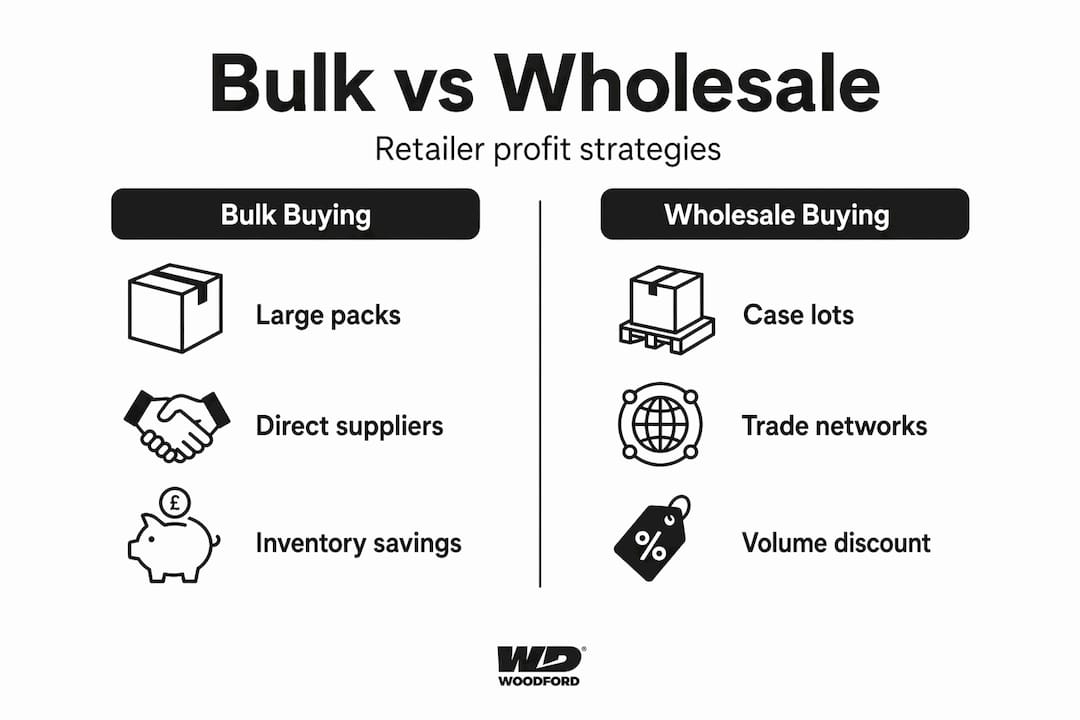
Here is a quick comparison to make the difference concrete:
| Feature | Bulk buying | Wholesale buying |
|---|---|---|
| Relationship type | Consumer or trade | B2B trade only |
| Pricing structure | Volume discount | Trade pricing for resale |
| Margin protection | Variable | Built into pricing |
| Minimum order qty | Lower | Higher, category-dependent |
| Typical categories | General goods | Branded, speciality, ambient |
The most common categories where UK independents apply bulk buying include:
- Dry ambient goods (rice, pasta, cereals, snacks)
- Cleaning and janitorial supplies
- Packaging and carrier bags
- Long-life beverages and condiments
- Frozen staples where cold storage allows
Understanding your distribution channels is the starting point for knowing which route suits which category.
“Bulk food buying is purchasing food in larger quantities than typical retail or short-replenishment orders, usually via wholesale channels, to reduce the per-unit cost and improve procurement efficiency.” — Amazon Business
Key benefits and risks of bulk food buying
With definitions clear, it is time to weigh what retailers can actually gain and potentially lose by moving to bulk buying. The benefits are real, but so are the pitfalls, and understanding both stops you from making costly assumptions.
Benefits of buying in bulk:
- Lower cost per unit. Buying a case of 24 units instead of six reduces the price per unit, directly improving gross margin if demand holds steady.
- Fewer purchase orders. Less time spent reordering means your team can focus elsewhere. For small teams, this administrative saving matters.
- Reduced stockout risk. Holding a larger safety buffer means you are less likely to run out of a fast-moving line at a critical moment, particularly around seasonal peaks.
- Supplier relationship leverage. Consistent larger orders can position you as a more valuable customer, occasionally unlocking better terms or early access to new lines.
- Predictable procurement cycles. Ordering in bulk at regular intervals makes cash flow easier to forecast, especially when combined with reliable supplier lead times.
Risks that erode the savings:
- Cash tied up in slow-moving stock. Every pound sitting in a pallet at the back of your storeroom is a pound not available for rent, wages, or a better-performing line.
- Spoilage and waste. Perishables and short shelf-life products can become a liability overnight if demand dips unexpectedly.
- Storage and handling costs. More stock requires more space, more labour to manage, and potentially refrigeration, all of which eat into the unit-price saving.
- Obsolescence risk. Food trends shift quickly. A bulk purchase of a line that falls out of favour can leave you sitting on unsellable stock.
Bulk buying can improve inventory control and reduce lead times and stockouts, but it requires strategy so that holding costs and waste do not erase the per-unit savings.
Pro Tip: Before committing to a bulk order, calculate your average weekly unit movement for that SKU over the past three months. If your bulk quantity represents more than eight weeks of stock for a perishable or trend-sensitive line, the risk almost certainly outweighs the saving.
Reviewing your food logistics approach before scaling up bulk orders will also help you spot storage and handling costs you may have overlooked. And if you are unsure which categories carry the greatest trend risk, understanding how to adapt to food trends is essential reading before you lock in a large purchase.

Inventory control: how to avoid the bulk buying trap
Understanding risk factors means you can now focus on the practical controls to make bulk buying work for your bottom line rather than against it. Inventory methodology is the single biggest determinant of whether bulk buying adds profit or destroys it.
Retailers need quantity planning and stock control, including forecasting, reorder timing, safety stock, and carrying-cost awareness, so that the savings from bulk discounts are not lost to cash tied up, shrink, or waste.
Here is a practical process for implementing those controls:
- Establish a stock baseline. Before you bulk buy anything, know your average weekly sales volume for that SKU. Use your EPOS data or purchase history, and look at at least 12 weeks of trading to smooth out anomalies.
- Set your safety stock level. Safety stock is the minimum quantity you need on hand to cover unexpected demand spikes or supplier delays. A simple formula: (maximum daily usage minus average daily usage) multiplied by maximum lead time in days.
- Define your reorder point. This is the stock level that triggers a new order. Reorder point equals average daily usage multiplied by average lead time in days, plus your safety stock.
- Calculate your carrying cost. Carrying cost (or holding cost) typically runs at 20 to 30 percent of the value of stock held per year, when you factor in storage, insurance, spoilage, and opportunity cost. If your bulk saving is five percent per unit but your annual holding cost is 25 percent, the maths only works if you sell through the stock quickly.
- Review and adjust quarterly. Demand shifts. What moved brilliantly in January may slow significantly by April. Build a quarterly review into your buying calendar.
Here is a simplified snapshot of how carrying costs compare across category types:
| Category type | Avg. shelf life | Typical carrying cost risk | Bulk suitability |
|---|---|---|---|
| Ambient dry goods | 12 to 24 months | Low | High |
| Ambient long-life beverages | 6 to 18 months | Low to medium | High |
| Chilled ready meals | 5 to 14 days | Very high | Very low |
| Frozen goods | 6 to 18 months | Medium (energy costs) | Medium |
| Snacks and confectionery | 3 to 9 months | Medium | Medium |
Aligning your food brand strategy with your inventory controls is also worth considering. If you are stocking a range of premium or trend-led brands, the velocity expectations are different from commodity staples, and your bulk quantities should reflect that difference.
Pro Tip: Map each SKU in your range to one of three categories: “fast and predictable,” “moderate and seasonal,” and “slow and specialist.” Only use bulk buying aggressively for the first category. The other two need smaller, more frequent orders even if the unit price is less attractive.
Is bulk right for your category? What to look for before scaling up
With a grip on inventory control, the next decision is knowing where bulk buying works and where it does not in your product mix. Not all deals are created equal, and not all categories reward volume purchasing with genuine profitability.
A cheaper per-unit price can still be unprofitable if your category has spoilage or waste risk, you cannot store it adequately, your lead times do not match demand, or your ability to reprice is constrained by price-marked packs. This last point catches many independents off guard: price-marked packs (PMPs) fix your selling price, so if your cost increases or your holding cost rises, your margin compresses with no way to compensate at the till.
Use this checklist before scaling any bulk purchase:
- Shelf life is long enough to accommodate your realistic sell-through timeline, with a safety margin of at least 30 percent remaining shelf life on arrival.
- Storage space is genuinely available, not just theoretically possible. Overcrowding a storeroom creates handling problems, hygiene risks, and breakage.
- Demand is predictable based on at least three months of consistent sales data, not speculation or gut instinct.
- Margin is clearly calculated, accounting for buying cost, delivery, storage, wastage allowance, and selling price (including any PMP constraints).
- Category is not trend-dependent in a way that could make the product hard to sell within its shelf life if consumer interest shifts.
- Supplier lead times are reliable, so that bulk buying genuinely reduces stockout risk rather than just moving the problem earlier in the supply chain.
Starting with items that can safely be held longer, typically ambient and long shelf-life lines, and setting a stock-holding baseline by turnover before scaling order quantities once you can forecast demand, is the safest and most profitable approach for independents.
For categories you are less certain about, understanding UK logistics constraints will help you identify which supply chains genuinely support bulk holding and which do not.
Pro Tip: Run a simple “bulk profit test” before any new bulk commitment. Take the total cost of the order including delivery and estimated holding cost, divide by your expected units sold in the holding period, and compare that true unit cost against your usual replenishment cost. The difference is your real saving, and it is often smaller than the headline price suggests.
Why bulk food buying isn’t a guaranteed win: our editorial perspective
There is a tempting logic that runs through the independent retail world: if the big supermarket chains buy in bulk, and they are profitable, surely doing the same will work for you. This is one of the most financially damaging assumptions a small retailer can make.
Large multiples operate with centralised distribution networks, sophisticated demand forecasting tools, and the storage infrastructure to absorb variation. They also carry loss leaders strategically, absorbing margin erosion on some lines because they have the volume on others to compensate. An independent retailer rarely has those levers.
Some guidance treats bulk buying as a tactic for near-retail discounts rather than true trade purchasing. If you rely on that approach for resale inventory, you may not protect the margin you expect. The danger is that you commit significant working capital to a deal that looks attractive on a per-unit basis but leaves you with lower effective margin once all costs are accounted for.
What actually works for independents is a more surgical approach. Rather than bulk buying broadly, the most successful retailers we work with bulk buy narrowly: a small number of consistently high-velocity, ambient, long shelf-life SKUs where the numbers genuinely hold up under scrutiny. Everything else is ordered on tighter replenishment cycles, sacrificing a small per-unit saving in exchange for much better cash flow and lower waste risk.
There is also a less obvious benefit to this discipline. Retailers who bulk buy selectively tend to have a clearer picture of their true bestsellers, because they have done the analytical work to justify the volumes. That clarity feeds better ranging decisions, better promotional planning, and ultimately better conversations with suppliers about the lines that genuinely drive their business. Aligning this approach with a clear focus on strategic food brands compounds the advantage further, because the right brand relationships come with margin support built in from the start.
The mindset shift is from “how do I buy cheaper?” to “how do I buy smarter?” Those are very different questions, and only one of them reliably improves your profit.
Need expert support with bulk purchasing? Woodford can help
If you are reconsidering your bulk strategy or searching for reliable supply partners, Woodford supports independent retailers in making smarter, more profitable purchasing decisions every day. Our supply network is curated specifically for ambitious independents, with category-led solutions that match the right products to the right buying volumes. Whether you are looking to explore the brands best suited to your store profile or take advantage of bulk-friendly deals that protect your margin, browsing our brands is the right starting point. You can also check our current promotions for time-sensitive opportunities on high-suitability, bulk-ready categories. We take the complexity out of sourcing so you can focus on selling.
Frequently asked questions
What is the difference between bulk buying and wholesale buying?
Bulk buying and wholesale buying are related but not identical: bulk simply means purchasing in larger quantities for a volume discount, while wholesale buying is a B2B transaction with trade pricing structured specifically to support resale margin.
Which food categories work best for bulk buying?
Ambient, long shelf-life items such as dry goods, long-life beverages, and packaging supplies are best suited to bulk purchasing because they can be held safely without spoilage risk eating into the per-unit saving.
How do I avoid losses from spoilage when buying in bulk?
Only scale up bulk orders where you have reliable sales data, adequate storage, and confirmed shelf life that exceeds your realistic sell-through period. Bulk buying works only if storage and shelf life are managed carefully against actual demand.
Can all independent retailers benefit from bulk food buying?
Not every retailer or category benefits equally. A cheaper per-unit price can still be unprofitable if spoilage risk is high, storage is limited, or selling price is constrained by price-marked packs, so profitability depends heavily on your specific margin structure and demand patterns.
Recommended
- Food logistics tips for UK independent retailers in 2026 - WOODFORD - Bringing quality foods your way
- Food brand strategy drives UK retail success in 2026 - WOODFORD - Bringing quality foods your way
- Strategic food brands for UK independent retailers - WOODFORD - Bringing quality foods your way
- Navigating UK food logistics for wholesalers in 2026 - WOODFORD - Bringing quality foods your way