
Wholesale payment terms UK: avoid the 60‑day trap with practical steps
If you haven’t agreed terms in writing, UK law says payment is due within 30 days of invoice or acceptance. Private B2B contracts can extend that to 60 days if it’s fair and clearly agreed, but nothing beyond that. Either way, you’re entitled to statutory interest at the Bank of England base rate plus 8%, plus fixed compensation for chasing the debt.
TL;DR:Payment is due within 30 days by default, with private contracts extending to 60 days only if fair and explicitly agreed; beyond that, it is not permitted.Statutory interest on late payments is fixed at the Bank of England base rate plus 8 percent, accruing from the day after the due date, plus fixed debt recovery costs.Clear written contractual clauses on due dates, late payment remedies, and dispute procedures significantly reduce the risk of payment disputes and enforceability issues.Proactive, documented communication, including reminders and formal demands, is crucial to recover overdue payments effectively.Future policy trends suggest increasing scrutiny and tightening of payment terms beyond 60 days, with government pushing for stricter enforcement and transparency.
Table of Contents
- What are the key legal rules for wholesale payment terms UK?
- How much statutory interest and compensation can you claim?
- How do you set and negotiate payment terms in wholesale contracts?
- What clauses should a wholesale payment agreement include?
- What should you do when a wholesale payment is overdue?
- Where can you get help enforcing payment terms?
- What does a wholesaler’s perspective add to the legal picture?
- Do payment terms differ across UK industries and sectors?
- How do wholesale payment terms affect cash flow management?
- What government proposals could change payment terms beyond 60 days?
- How should you document and communicate payment terms to customers?
- How Woodford supports wholesalers and retailers on trading terms
- Where can you read the original legislation and guidance?
- Sources
What are the key legal rules for wholesale payment terms UK?
The Late Payment of Commercial Debts (Interest) Act 1998 sits underneath every commercial contract in the country, whether the parties mention it or not. It implies a right to statutory interest into B2B contracts even when nothing has been written down, which is why “we never agreed anything” is not the defence late payers think it is.
Where no payment terms have been agreed, the default is 30 days from invoice or acceptance of goods, whichever is later. Public sector buyers work to tighter targets: government departments aim to pay 90% of SME invoices within five days and all undisputed invoices within 30 days, which is worth knowing if you supply catering contracts, schools, or NHS trusts alongside your independent retail customers.
Private B2B terms can run longer than 30 days, but government guidance treats 60 days as the practical ceiling for periods that count as fair. Anything beyond that needs to be expressly agreed and demonstrably not grossly unfair to the supplier, and once you’ve signed a contract with a 90 or 120 day term in it, challenging that later is genuinely difficult.
How much statutory interest and compensation can you claim?
The interest formula is fixed by law, not negotiation. You charge the Bank of England base rate plus 8 percentage points, and it starts accruing the day after the agreed or default payment date passes. Nobody needs to invoice for it separately in advance. It’s a statutory right that exists whether or not your contract mentions it.
On top of interest, you can claim fixed compensation for the cost of chasing the debt: £40 for debts under £1,000, £70 for debts between £1,000 and £9,999.99, and £100 for debts of £10,000 or more. You can also recover reasonable additional recovery costs beyond that fixed sum.
Worked example: a £5,000 invoice paid over a month late, with a base rate of around 4%, accrues statutory interest at a combined rate and fixed compensation corresponding to the debt size. That’s £144 you’re entitled to before you’ve made a single phone call.
How do you set and negotiate payment terms in wholesale contracts?
Verbal agreements are where late payment disputes go to die, mostly because nobody can prove what was actually agreed. Negotiate terms before you start supplying, not after, and put the due date in writing using an unambiguous trigger point rather than something open to interpretation.
- Define the due date against invoice date or delivery acceptance, never “end of month” or other vague phrasing that invites argument.
- Offer early-payment discounts (1% to 2% for payment within 7 to 10 days) to pull cash forward without touching your headline price.
- Use staged payments on large first orders from new retail accounts until a trading history justifies full credit terms.
- Set credit limits per account and review them against actual order volumes, not the customer’s opening promise.
Pro Tip: Never let a commercial concession quietly override your statutory rights. You can offer a discount for early payment while still stating in the contract that late payment triggers statutory interest and compensation automatically. The two are not mutually exclusive.
What clauses should a wholesale payment agreement include?
A contract that leaves the due date open to interpretation is a contract that invites a dispute eventually. Build these clauses in from the outset:
- Invoice requirements including delivery confirmation method and who signs for acceptance.
- Due date definition tied to a specific, unambiguous event, not a vague calendar reference.
- Late payment remedies stating statutory interest and fixed compensation apply automatically.
- Dispute resolution process with a defined timescale for raising a query before the invoice becomes payable.
- Suspension of supply rights if an account goes beyond an agreed number of days overdue.
- Retention of title clause so unpaid stock legally remains yours until settlement.
- Returns and damaged stock procedure with strict reporting windows suited to short shelf-life goods.
Perishable stock needs tighter reporting windows than most standard templates allow. A returns and damages policy UK wholesalers use for ambient goods rarely works for chilled or fresh lines, so write the clause around your actual product category.
What should you do when a wholesale payment is overdue?
Chase early and chase consistently. A polite reminder a few days before the due date, a follow-up on the day itself, and a formal written demand within a week of the date passing keeps you ahead of most disputes before they escalate.
- Send a courtesy reminder three to five days before the due date.
- Follow up on the due date itself if payment hasn’t cleared.
- Issue a formal written demand within seven days of the invoice becoming overdue, stating the statutory interest and fixed compensation now owed.
- Escalate to a final demand with a clear deadline if there’s still no response after 14 days.
- Prepare a statutory demand or consider court action through the small claims track for debts that remain unresolved after formal escalation.
Add the interest and compensation figures to your demand letter rather than leaving the buyer to calculate them. It removes the excuse of “we didn’t realise” and makes the numbers concrete from the first formal contact.
Where can you get help enforcing payment terms?
The Small Business Commissioner offers free advisory support for smaller firms in payment disputes with larger customers, and can intervene directly in qualifying cases. It’s worth checking eligibility before you spend money on legal advice, because SBC involvement often resolves disputes without either side reaching court.
Large businesses have a legal duty to publish payment practices reports twice yearly, covering average payment times and the proportion of invoices paid late. Pull a prospective customer’s report before extending significant credit. It tells you more about their actual behaviour than anything they’ll say in a sales call.
Mediation through the SBC is faster and cheaper than litigation, but it carries no binding enforcement power if the other side simply refuses to engage. A statutory demand carries more weight and can trigger insolvency proceedings if ignored, though it’s a blunter instrument best reserved for debts you’re confident are genuinely owed and undisputed. Court action remains the last resort: slower, costlier, but enforceable.
What does a wholesaler’s perspective add to the legal picture?
Woodford has watched enough retail accounts drift from 30-day payers into habitual late payers to know the pattern: it rarely happens overnight, it happens one quietly ignored invoice at a time. Nadim, who oversees trading relationships across Woodford’s retail network, has seen the same clause wording save accounts from going bad. Retention of title and a firm supply-suspension trigger written into the contract from day one change buyer behaviour long before a debt becomes a legal problem.
Operationally, that means credit checks before extending terms to a new account, staged fulfilment for first orders above a certain value, and a stock hold policy the moment an account crosses its agreed overdue threshold. Perishable inventory makes cashflow damage compound fast, so documenting these controls clearly matters more in food wholesale than in almost any other B2B sector.
Do payment terms differ across UK industries and sectors?
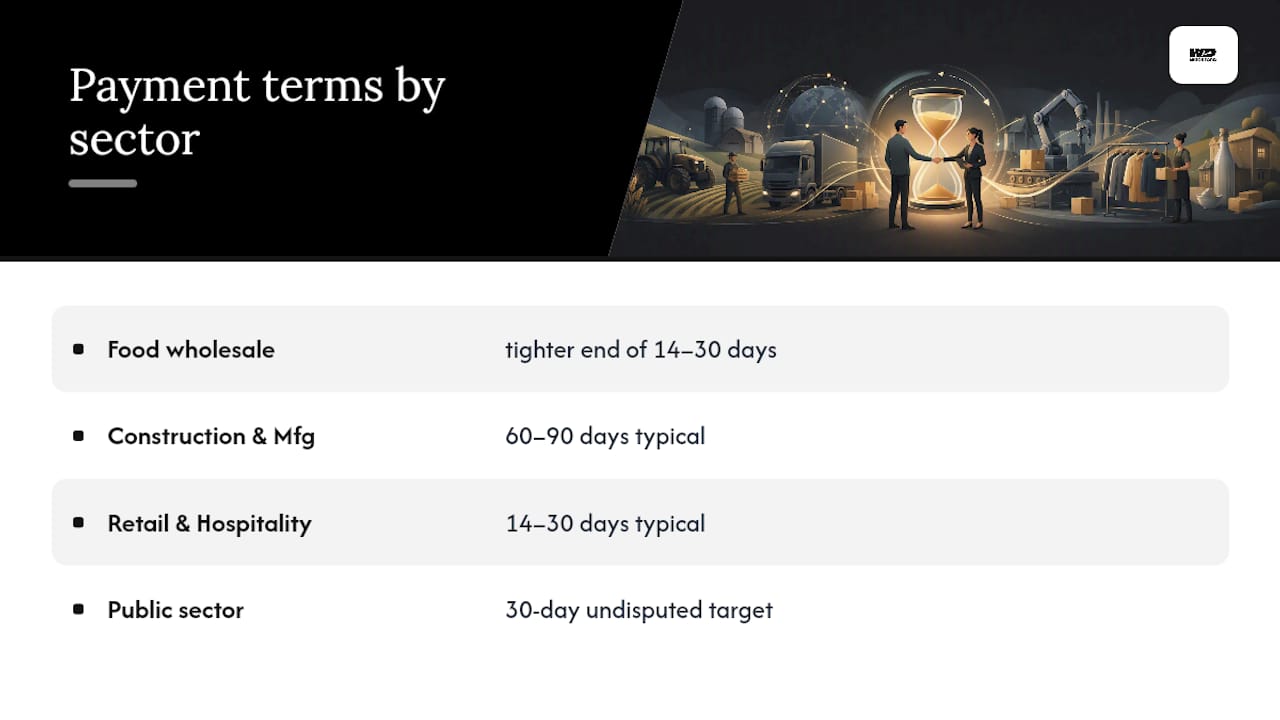
Payment culture varies enormously by sector, and food wholesale sits at the tighter end of that range for good reason. Fresh and chilled stock has a shelf life measured in days, so a 60-day payment term on goods that were sold to the end consumer within a week creates a cash gap that construction or manufacturing suppliers, dealing in durable goods, rarely face in the same way.
Construction and manufacturing frequently operate on 60 to 90 day terms as standard practice, backed by longer project cycles and larger contract values that can absorb the wait. Retail and hospitality supply chains, by contrast, tend to cluster around 14 to 30 day terms, particularly where the supplier is smaller than the buyer and has less leverage to push back on faster payment; understanding corporate travel terminology explained for hospitality vendors can help wholesalers align their procurement workflows more effectively.
Public sector procurement sits apart entirely, bound by the 30-day undisputed invoice target regardless of sector. A wholesaler supplying both an independent grocer and a local authority catering contract will run two very different payment clocks side by side, and needs separate credit terms for each rather than a single blanket contract.
The practical lesson for wholesalers: don’t benchmark your terms against manufacturing or construction norms just because they’re commonly quoted. Match your terms to your stock’s actual holding cost and shelf life, not to what a completely different sector considers standard.
How do wholesale payment terms affect cash flow management?
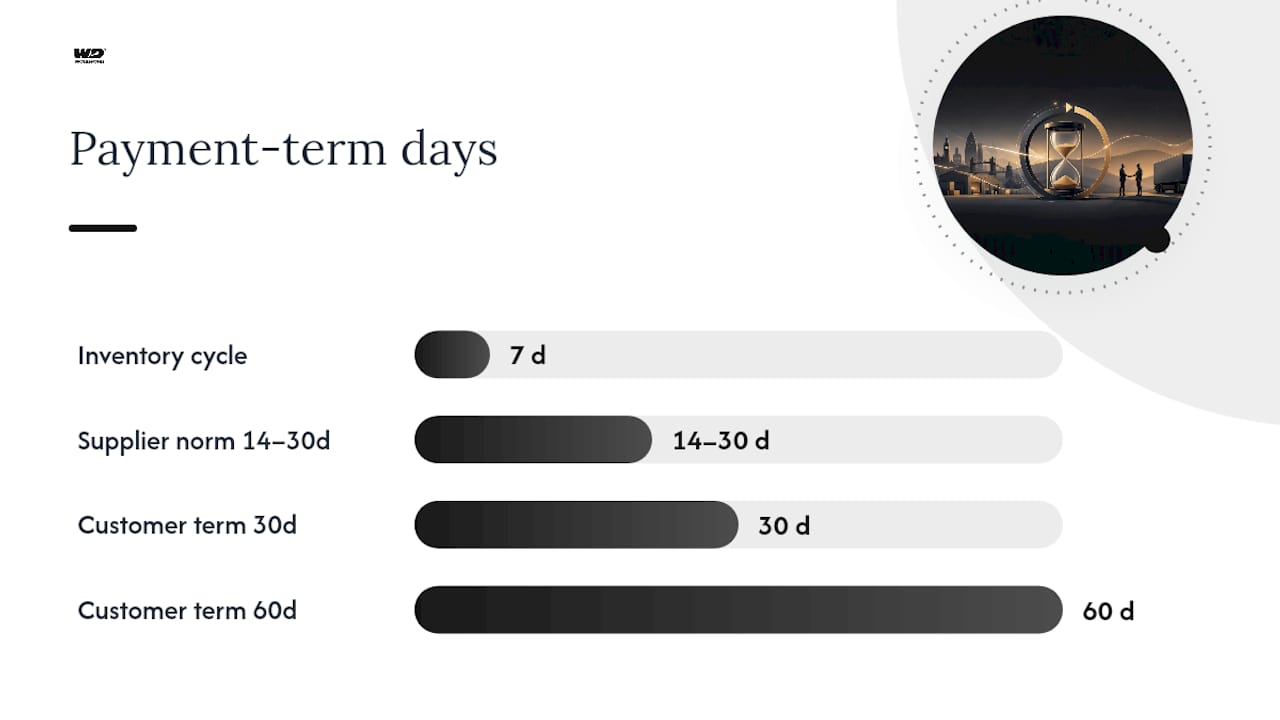
A 30-day term and a 60-day term on the same invoice value represent two entirely different working capital positions, and the gap compounds fast once you’re running dozens of accounts simultaneously. Extend 60 days across a supplier base that itself expects payment in 14 to 30 days, and you’re effectively financing your customers’ stock with your own working capital for a month or more.
Perishable goods sharpen that problem considerably. Stock that’s sold and consumed within a week but not paid for until day 60 means you’re funding two or three full inventory cycles before the first payment lands, which is a materially different cashflow burden than a supplier of durable goods carries on the same term length.
Late payment beyond agreed terms compounds the strain further, and it’s precisely why the statutory interest and compensation regime exists: it puts a real cost against slow payers rather than leaving suppliers to simply absorb the delay as a cost of doing business. Wholesalers who track average days-to-pay per account, rather than relying on headline contract terms, generally spot deteriorating customers weeks before a payment actually fails.
Credit insurance, invoice financing, and staged payment structures for larger orders are the standard levers here, but the cheapest fix is usually contractual: shorter terms for newer or higher-risk accounts, and firm suspension triggers that stop the cash gap from widening further once an account starts slipping.
What government proposals could change payment terms beyond 60 days?
The direction of policy travel is unambiguous: government has been pushing for stronger enforcement of existing rules rather than looser ones. The common framework guidance already treats 60 days as the practical ceiling for private B2B terms, and successive consultations have focused on making that ceiling harder to breach rather than raising it.
Reporting obligations on large businesses have tightened over recent years, with payment practices reports now published twice yearly and used increasingly by suppliers to vet prospective customers before extending credit. Expect that reporting regime to keep expanding in scope, potentially with sharper penalties for firms that consistently report poor payment performance without improving it.
There’s also continued pressure around strengthening the Small Business Commissioner’s own powers, since its current role is largely advisory rather than binding. Any move toward giving the SBC direct enforcement teeth, rather than mediation and reputational pressure alone, would materially change the calculus for wholesalers currently weighing mediation against costly court action.
None of this suggests 60 days will become the new statutory maximum by law any time soon. What it does suggest is that the gap between “technically legal” and “practically defensible” payment terms will keep narrowing, and wholesalers writing contracts today should assume scrutiny on long payment terms will only increase.
How should you document and communicate payment terms to customers?
Put terms in writing before the first order ships, not after the first invoice goes unpaid. A signed credit agreement, separate from your general terms and conditions, works far better for wholesale relationships than website boilerplate, because it can address the specifics that actually matter: recurring order patterns, delivery acceptance procedures, and what happens when an account’s balance creeps toward its credit limit.
State the payment term, the interest and compensation regime, and the suspension trigger in the same document the customer signs, not buried in a separate policy page they never read. Confirm receipt of terms in writing, ideally with a signature or explicit email acknowledgement, so there’s no ambiguity later about what was actually agreed.
Communicate changes to terms proactively rather than through a revised invoice that surprises the customer. If you’re tightening a credit limit or shortening a payment period for an account showing signs of strain, a direct conversation beats a silent contractual change every time, and it preserves the trading relationship if the account recovers.
Review terms annually against actual payment behaviour, not just against what felt reasonable when the account was opened. An account that pays reliably at 30 days for two years has earned different treatment from one that’s chronically at 55 days on a 60-day term, and your documentation should reflect that rather than treating all accounts identically.
How Woodford supports wholesalers and retailers on trading terms
Getting payment terms right matters just as much as getting the product range right, and Woodford builds both into how it works with independent retailers and brand partners across the country. Clear contract terms, credit checks before onboarding new accounts, and staged fulfilment on larger first orders are part of how Woodford protects cashflow for everyone in the chain, not just itself.
If you’re a retailer wanting to understand how Woodford structures its own trading terms, or a brand owner exploring exclusive distribution, get in touch through Woodford’s website to discuss how a contract might work for your business. It’s a straightforward conversation, and the sooner terms are agreed in writing, the fewer disputes either side has to deal with later.
Where can you read the original legislation and guidance?
- Small Business Commissioner – FAQs on payment rights, eligibility for support, and how to request intervention.
- Late Payment of Commercial Debts (Interest) Act 1998 for the full legislative text governing statutory interest.
- Gov, covering fixed compensation tiers and recovery costs.
- How to negotiate terms and conditions, the Small Business Commissioner’s practical negotiation guide.
- Government publication on the late payment common framework for the current policy position on 60-day terms.
This article is general information, not a substitute for advice from a qualified financial advisor. Consult a qualified financial professional about your own circumstances before acting on anything here.


