
Get stocked in UK retail: GS1 barcodes and GTINs for food brands
Yes: to list products with major UK retailers and marketplaces, you need GS1 barcodes issued through GS1 UK, not numbers bought from a third-party reseller. The route is straightforward: join GS1 UK, pick a membership tier based on turnover, then assign GTINs through My GS1. Membership works as an annual licence, and marketplace acceptance depends on that registration staying active.
TL;DR:Using GS1 UK memberships and GTINs ensures product data accuracy, recognition by retailers, and avoids delisting risks associated with reseller barcodes.Proper classification of barcode types, such as GTIN-13 for products and GTIN-14 for cases, is crucial, with placement and print quality affecting scanability at retail and logistics points.Marketplaces like Amazon require correct product ID selection and up-to-date propagation windows, with delays up to 72 hours after activation to recognize new GTINs.Verifying GTIN ownership through GS1 tools helps prevent mismatches, legal issues, and the costs linked to relabelling or reordering stock with invalid or reseller-owned numbers.Food brands must meticulously manage multiple GTINs for variants and adhere to strict data consistency, especially for allergens, to avoid compliance and safety problems during retail audits.
Table of Contents
- What is GS1 UK and why authentic GS1 GTINs matter
- How to get GS1 barcodes in the UK, step by step
- Which GS1 barcode type should you use, and where
- Marketplace and retailer rules: Amazon, supermarkets and timing
- How to check barcode authenticity and avoid pitfalls
- Practical notes for food brands and wholesalers
- Overview of GS1 standards and their role in global supply chains
- How to update GS1 barcodes when product details change
- Common GS1 barcode issues in the UK market
- Legal and compliance considerations for GS1 barcode use in the UK
- Ready to sell through retail once your GTINs are sorted?
- Sources
What is GS1 UK and why authentic GS1 GTINs matter
GS1 UK is the only authorised UK body issuing GS1 Company Prefixes, the number block every business needs before it can generate its own barcodes. When you join, GS1 is the authorised source of GTINs, and your membership fee buys you a licensed slice of that global numbering system, not just a picture of a barcode.
A GTIN (Global Trade Item Number) is the string of digits underneath the barcode lines. Most UK retail products use GTIN-13, better known as EAN, which is a 13-digit code printed on single retail units from a tin of soup to a bottle of hot sauce. Larger units, such as an outer case containing a dozen tins, typically carry a GTIN-14. Each digit sequence is unique worldwide once assigned, which is exactly why the system works: a scanner in a Tesco distribution centre and a scanner in a Berlin supermarket read the same number the same way.
Retailers and marketplaces lean on GS1 because it gives them a single, verifiable source of truth. When a product is scanned, the retailer’s system expects that number to map to one company, one product, one set of attributes. Correct GS1 licensing helps ensure the scan returns your official product data rather than pulling up someone else’s listing.
That trust breaks down fast with reseller barcodes. Numbers sold cheaply online outside the official GS1 system are often:
- Still licensed to the original reseller or a previous buyer, not to you
- Liable to show another company’s product information when scanned at checkout
- Unrecognised by Amazon’s brand registry and GTIN exemption checks
- A common cause of sudden delisting once a retailer’s data audit catches the mismatch.
The GTIN booklet from GS1 UK is blunt about this: numbers bought from resellers frequently remain licensed to someone else, which is precisely the kind of mismatch that gets products pulled from sale. There’s also a commercial upside to doing this properly. Adding a GS1 GTIN to your online listings can increase impressions, because marketplace search algorithms treat verified GTINs as a quality signal, not just a checkout requirement.
How to get GS1 barcodes in the UK, step by step
Getting your own GS1 barcode registration in the UK takes a few working days from start to finish, most of it spent waiting for propagation rather than filling in forms. Here’s the sequence.
- Work out how many GTINs you actually need. Use the GTIN calculator on the GS1 UK site before you buy anything. Count every distinct product, every pack size variant, and every case configuration you plan to sell, because each one typically needs its own number.
- Sign up as a GS1 UK member. You’ll need your company registration details, VAT status if applicable, and an honest estimate of your annual turnover, since pricing tiers are banded by turnover rather than by number of products alone.
- Choose your membership tier. Starter plans begin at £50 per year (excluding VAT) for businesses turning over up to £99,999, and include 10 GTINs. Larger organisations pay proportionally more but get a bigger allocation.
- Activate your membership. Once payment clears, GS1 UK activates your account and issues your unique GS1 Company Prefix, the digit block from which all your own GTINs will be built.
- Log into My GS1 (My Numberbank). This is where you draw down individual GTINs from your prefix, generate the actual barcode image files, and keep a running record of which number belongs to which product.
- Assign GTINs to each SKU. A genuinely new product, a different pack size, or a significant recipe or ingredient change generally needs a new GTIN, according to GS1 UK’s guidance on barcode types. Minor changes like a redesigned label with the same contents usually don’t.
- Download barcode artwork and hand it to your packaging supplier. My Numberbank generates print-ready files, so there’s no need for separate GS1 barcode generator UK software once you’re inside the portal.
Pro Tip: Buy a small buffer of extra GTINs beyond your current product count. New flavours, seasonal packs, and multipack variants all need fresh numbers, and moving up a pricing tier later costs more hassle than it saves.
Here’s how GS1 UK’s GS1 barcode pricing UK tiers broadly break down by turnover band, starting from £50 per year for smaller turnover bands, scaling up to higher fees for larger organisations with larger GTIN allocations.
Membership renews annually rather than as a one-off purchase, which is the trade-off for a system that keeps every number traceable to its rightful owner.
Which GS1 barcode type should you use, and where
Choosing the right identifier matters as much as getting one at all. Using a case code on a single retail unit, or vice versa, is one of the more common early mistakes among first-time sellers.
- GTIN-13 (EAN): the standard for point-of-sale single items, printed directly on the pack that a shopper picks up and a till scans.
- GTIN-14: used for cases and outer boxes containing multiple retail units, scanned at goods-in rather than checkout.
- UPC: the 12-digit US equivalent of EAN, relevant if you’re also selling into North American retail alongside the UK.
- SSCC and GS1-128: logistics identifiers applied to pallets and shipping units, letting distribution centres track a consignment through the supply chain rather than identifying the product itself.
- RFID and GS1 Data Matrix: worth considering for high-value or high-throughput logistics where line-of-sight barcode scanning slows things down.
- QR codes powered by GS1: increasingly used for digital links, carrying batch data, sourcing information, or a landing page, on top of the standard barcode rather than instead of it.
GTIN-13 is the standard for point-of-sale units and GTIN-14 is typically used for cases, and mixing the two up is exactly the kind of error that surfaces later at a retailer’s goods-in stage rather than at your own checkout.
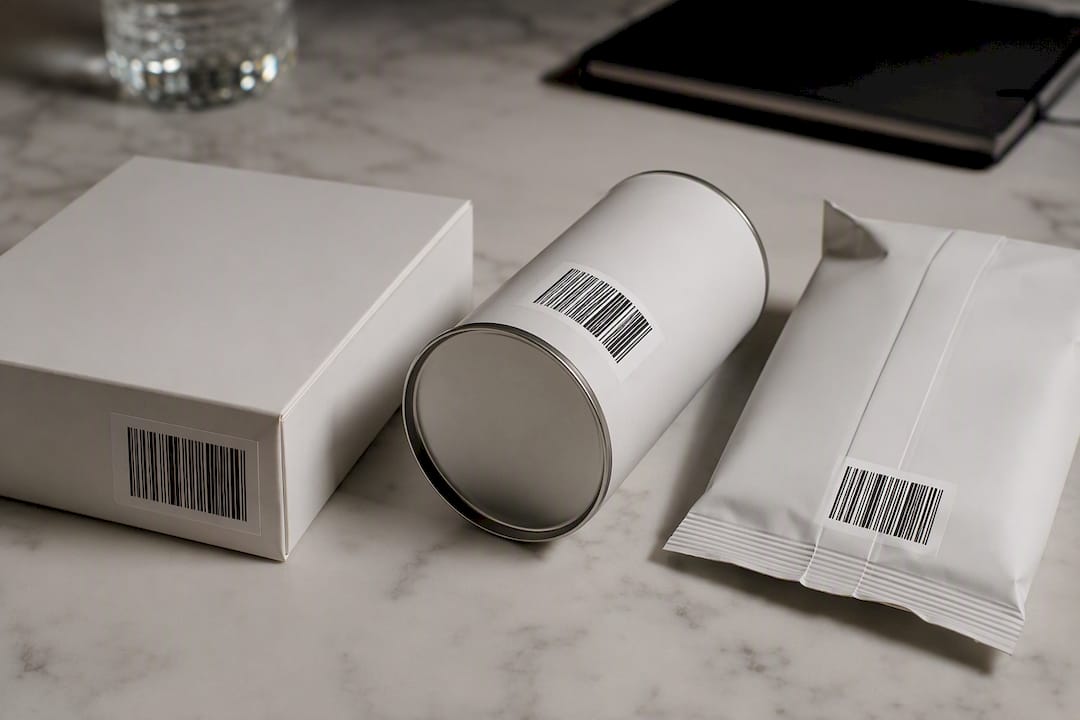
Placement matters more than most new sellers expect. A barcode printed too close to a curved edge, across a fold, or in a colour with poor contrast against its background will fail scanning tests even when the underlying GTIN is perfectly valid. Retailers’ own goods-in teams will reject stock on sight if a barcode doesn’t scan cleanly on the first pass, regardless of whose fault that turns out to be.
Marketplace and retailer rules: Amazon, supermarkets and timing
Getting a valid GTIN is only half the job. Marketplaces and supermarkets each have their own quirks about how that number needs to appear in their systems.
On Amazon specifically, the most common trip-up is a dropdown menu. When listing a product with a standard 13-digit GS1 GTIN, sellers must select “EAN” as the product ID type in Seller Central, not “GTIN”. Choosing the wrong product ID, such as selecting ‘GTIN’ instead of ‘EAN’, commonly causes listing errors. It sounds trivial, but it’s one of the most frequent reasons a perfectly valid barcode gets rejected at the listing stage.
Amazon also distinguishes between your manufacturer barcode (the GS1 GTIN on your packaging) and the FNSKU, Amazon’s own internal label used for Fulfilment by Amazon stock. Brand Registry can, in some cases, grant a GTIN exemption for certain categories, but that’s a separate process from simply owning a valid GS1 number.
Supermarkets work differently again. Buyers typically expect a GS1-registered GTIN as a baseline before a new product even reaches a listing meeting, because their own systems and those of their distributors are built entirely around GS1 data standards.
Timing catches people out too. GS1 UK updates marketplaces daily, but it can take up to 72 hours for new GTINs to be recognised by Amazon. Practical points worth flagging before you panic and start raising support tickets:
- Wait the full 72 hours after activating a new GTIN before assuming something has gone wrong.
- Double-check the product ID type field before resubmitting anything.
- Confirm the GTIN checksum digit is correct; a single mistyped digit produces an invalid barcode that still looks plausible on screen.
- Keep a record of exactly when each GTIN was activated, so you know when the propagation window has genuinely closed.
Pro Tip: If a listing is still rejected well after the 72 hour window, the fault is almost never GS1’s propagation delay by that point. Recheck the product ID field first; it’s the single most common cause.
How to check barcode authenticity and avoid pitfalls
A barcode that looks fine to the eye can still be worthless if the number underneath belongs to someone else. Verification takes minutes and saves weeks of listing headaches.
- Check ownership through GEPIR or Verified by GS1. These lookup tools confirm which company a GTIN is officially licensed to. If the result doesn’t show your business name, don’t use the number.
- Understand why reseller numbers cause mismatches. Reseller GTINs often remain licensed to the reseller, which means a scan can return a completely different company’s product data, confusing both retailers and shoppers.
- If a marketplace rejects a GTIN, contact GS1 UK support directly rather than the marketplace first. GS1 UK can confirm whether the number is correctly registered to your account before you spend time on a marketplace support ticket that can’t actually fix a licensing issue.
- Work out whether relabelling is unavoidable. If stock has already shipped with an invalid or reseller-owned barcode, relabelling before it reaches a retailer’s warehouse is almost always cheaper than a rejected delivery or a chargeback for non-compliant stock.
- Build the check into your supplier onboarding, not just your own product launches. A co-packer or contract manufacturer using their own barcode by mistake is a surprisingly common source of mismatched GTINs on finished stock.
Retailers respond to a mismatched or invalid GTIN in one of two ways: an outright rejection at goods-in, or a delisting once a data audit catches the anomaly weeks later. The second is worse, because by then you’ve usually already sold stock under a number that could be quietly pulled from sale.
Practical notes for food brands and wholesalers
Food brands face a wrinkle that non-food sellers often don’t: the same product frequently exists in three GTIN forms at once, a single unit, a multipack, and a shipping case, and each one needs its own number allocated correctly from day one. Get that wrong at launch and you’ll spend months untangling fulfilment errors as orders route against the wrong pack size.
GS1 identifiers also do heavier lifting in food supply chains than a barcode alone suggests. SSCC numbers on shipping labels let distribution centres track a pallet through goods-in without opening a single case, and that same infrastructure becomes critical if a recall ever happens, since traceable case-level data is what lets a recall be scoped precisely rather than pulled blanket-wide. GS1 identifiers also support logistics labelling and data synchronisation required by larger retail networks, and that expectation has only grown as more marketplaces plug into shared data pools.
Before pitching a supermarket buyer, Woodford recommends food brands have the following in place:
- Clean, consistent product data attached to every GTIN, matching exactly what appears on pack
- Allergen labelling that’s accurate and consistent across every pack size variant of the same recipe
- One GTIN per genuine product variant, with no reused numbers across different recipes or pack formats
- Case-level SSCC labelling ready for pallet tracking before the first wholesale order ships
Woodford’s own guidance on compliance as a competitive edge and on UK food compliance essentials covers the labelling and regulatory groundwork that tends to surface at exactly this stage, right before a brand goes to retail.
Overview of GS1 standards and their role in global supply chains
GS1 barcodes are one visible piece of a much larger identification system used across roughly 150 countries. The same numbering logic that puts a GTIN on a tin of beans also underpins the GLN (Global Location Number, identifying a specific warehouse or store) and the SSCC (identifying a specific pallet or shipment).
What makes this genuinely useful rather than just bureaucratic is consistency. A supplier in Kent and a distribution centre in Rotterdam can exchange stock using the same number formats, meaning a product’s data doesn’t need translating or reformatting as it crosses borders or changes hands between manufacturer, wholesaler, and retailer.
For UK food and drink specifically, this standardisation is what lets a single product move from a small production run through a wholesaler like Woodford, into multiple independent retailers, without every party needing to build a bespoke data mapping just to stock it. Retailers, in turn, get one format to build their systems around, rather than a different numbering scheme for every supplier they deal with.
How to update GS1 barcodes when product details change
Not every product tweak needs a new barcode, but getting this wrong in either direction causes problems: too cautious, and you’re paying for GTINs you didn’t need; too casual, and you end up with two different products sharing one number.
As a rule of thumb, a new GTIN is needed when the change is one a shopper would notice and care about: a different pack size, a reformulated recipe, a new allergen profile, or a materially different net weight. A redesigned label on an unchanged product typically doesn’t need a new number, though it’s worth checking against GS1 UK’s own guidance for edge cases specific to your category.
When you do need a new GTIN, the old number shouldn’t simply be reused for something else. Retire it properly through My Numberbank and keep a record of which GTIN mapped to which product version, particularly important if a retailer ever queries historical stock. Update your product information everywhere it lives, packaging artwork, your ecommerce listings, and any wholesale order systems, at the same time you generate the new barcode, rather than staggering the rollout and risking two versions circulating with mismatched data.
Common GS1 barcode issues in the UK market
Most problems that UK sellers run into fall into a handful of repeat offenders. A checksum digit typed incorrectly during manual data entry produces a barcode that looks valid but fails scanning. Selecting the wrong product ID field on a marketplace listing, as covered earlier with Amazon’s EAN versus GTIN dropdown, is the single most reported cause of listing rejections. Print quality problems, low contrast, poor placement over a curved surface, or a barcode printed too small, cause scan failures at goods-in even when the number itself is completely valid.
Another recurring issue is businesses assuming a GTIN transfers with a product if they buy a brand or product line from someone else. It doesn’t automatically; the GS1 Company Prefix stays with the original member account unless a formal transfer is arranged through GS1 UK. Skipping that step is how a business ends up unknowingly selling under someone else’s registered numbers.
Slow propagation after a genuine new activation is often mistaken for a fault, when it’s simply the normal processing window playing out.
Legal and compliance considerations for GS1 barcode use in the UK
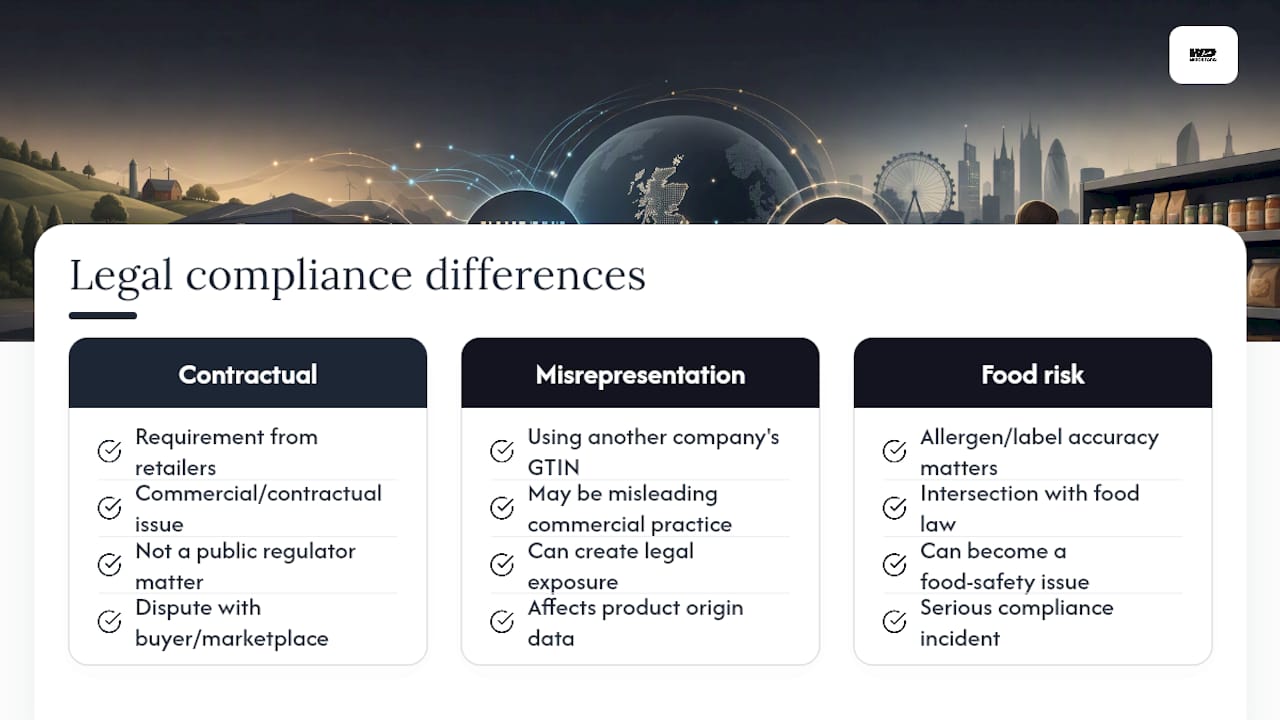
There’s no single UK statute that says a business must use GS1 barcodes to trade. The requirement comes contractually, through the terms retailers and marketplaces set for suppliers, rather than through general consumer law. That distinction matters: a barcode dispute with Amazon or a supermarket buyer is a contractual and commercial issue, not a matter for a public regulator.
Where genuine legal exposure creeps in is around misrepresentation. Using a GTIN licensed to another company, deliberately or by accident through a cheap reseller number, means your product’s scan data doesn’t match its actual origin. Depending on the circumstances, that can shade into misleading commercial practice, particularly if it affects safety-relevant information like allergen data reaching the wrong product record.
Food businesses carry an extra layer of responsibility here, because barcode and label accuracy intersects directly with food information and allergen labelling law. A GTIN mismatch that causes an allergen label to display against the wrong product isn’t just an inconvenience; it’s a food safety and legal problem. Keeping GTIN allocation, label content, and product data properly aligned isn’t optional housekeeping for food brands. It’s the difference between a smooth retail audit and a serious compliance incident.
Ready to sell through retail once your GTINs are sorted?
Once you’ve got your GS1 GTINs properly licensed and your product data cleaned up, the next hurdle is usually getting noticed by the retailers who’ll actually stock you. That’s where Woodford comes in: as the UK’s strategic food wholesaler, Woodford connects compliant, trend-led food and drink brands with independent retailers and multi-site groups actively looking for new lines, handling the distribution and logistics so you’re not chasing individual store orders yourself.
We look for partners who have already done the necessary groundwork: correctly licensed GTINs, one number per genuine product variant, accurate allergen labelling, and packaging that scans cleanly at goods-in. If that’s where your brand stands, or nearly stands, get in touch with Woodford about distribution to talk through how your products could reach independent retail shelves across the UK.


