
Oct 1, 2027: UK businesses' readiness for the Deposit Return Scheme
Britain’s Deposit Return Scheme goes live on 1 October 2027, run by the newly appointed Deposit Management Organisation, Exchange for Change. It covers single-use PET, steel and aluminium drinks containers sized between 150 ml and 3 litres. Producers must register and label in-scope stock ahead of launch; retailers of a certain size must host a return point. Neither obligation is optional, and the lead time is shorter than it looks.
TL;DR:Businesses must complete a full SKU audit and plan label redesigns with suppliers at least six months before October 2027 to meet scheme labelling requirements.The deposit level is not fixed but will be confirmed before launch; financial modeling of deposit liabilities and handling fees should begin now.Retailers with large outlets are expected to install reverse vending machines, while smaller stores can operate manual returns or share equipment, depending on exemption thresholds.Producers need to register, create scheme-specific labels, and prepare reporting systems by mid-2026 to avoid operational disruptions at launch.Wales’s inclusion of glass containers in its scheme will require separate labelling and equipment adjustments for products distributed across UK nations.
Table of Contents
- What is a deposit return scheme and which containers does it cover
- Key dates and the implementation timeline you need to plan around
- Who runs the scheme: the role of the Deposit Management Organisation
- Producer responsibilities: registration, labelling, reporting and fees
- Retailer responsibilities and how return points will work
- Deposit level, fees and the financial flows to model now
- Cross-border considerations: Wales and the glass divergence
- Woodford’s readiness checklist for producers, wholesalers and retailers
- What the scheme means for prices at the till
- Where to check the official detail
- Sources
What is a deposit return scheme and which containers does it cover
A deposit return scheme charges a small refundable deposit on a drink at the point of sale, then hands it back when the empty container is returned. It’s the mechanism behind bottle return machines already familiar to anyone who has shopped in Germany or Norway, and the UK version follows the same logic with its own scope rules.
The policy statement confirms the containers in scope are single-use drinks containers made from PET plastic, steel or aluminium, holding between 150 ml and 3 litres. That band captures everything from a small energy drink can to a large cider bottle, but it excludes cartons, pouches and most flavoured milk formats that fall outside those materials.
Glass is the notable exclusion. England, Scotland and Northern Ireland have left glass out of the scheme entirely, while Wales intends to bring it into scope, a divergence covered in more detail later in this guide.
Practical scope points worth checking against your own SKU list:
- Size band: 150 ml to 3 litres. A 5-litre water cooler bottle or a 100 ml miniature both fall outside scope.
- Materials: PET, steel and aluminium only. Glass bottles, cartons and pouches are excluded across England, Scotland and Northern Ireland.
- Refillable containers: designed-for-reuse formats are treated differently from single-use, so check whether a “refillable” claim on packaging is backed by an actual return-and-refill system.
- Multipacks: each individual in-scope container inside a multipack typically attracts its own deposit, not one deposit per pack.
- On-trade sales: drinks opened and consumed on licensed premises are generally treated differently from off-trade retail sales, so pubs and restaurants need separate guidance from packaged retail.
The common pitfall is measuring nominal pack size rather than actual fill volume, or assuming a mixed-material closure (aluminium cap on a PET bottle) changes classification. It doesn’t. Classification follows the primary container material.
Key dates and the implementation timeline you need to plan around
The headline date is 1 October 2027, when the scheme becomes operational across England, Scotland and Northern Ireland. But that date sits at the end of a chain of milestones businesses need to track from now.
- May 2025: Exchange for Change was formally appointed as the UK Deposit Management Organisation, giving it the mandate to build scheme infrastructure ahead of launch.
- 2025 to 2026: statutory instruments, including The Deposit Scheme for Drinks Containers (England and Northern Ireland) Regulations 2025, set the legal framework for return points, registers and DMO powers.
- 2026 through to mid 2027: expect phased guidance on deposit levels, producer registration windows, labelling specifications and return handling fees as Exchange for Change finalises operational detail.
- 1 October 2027: the scheme goes live. Producers must be charging deposits, retailers must have return points operating, and reporting obligations begin.
- 1 January 2028: a regulatory fallback date tied to packaging Extended Producer Responsibility (EPR) obligations, relevant if certain DRS elements are not fully established by then for specific container categories.
That’s a live sequence rather than a fixed countdown, and the practical planning window is tighter than eighteen months once you account for retooling packaging lines and renegotiating supplier contracts.
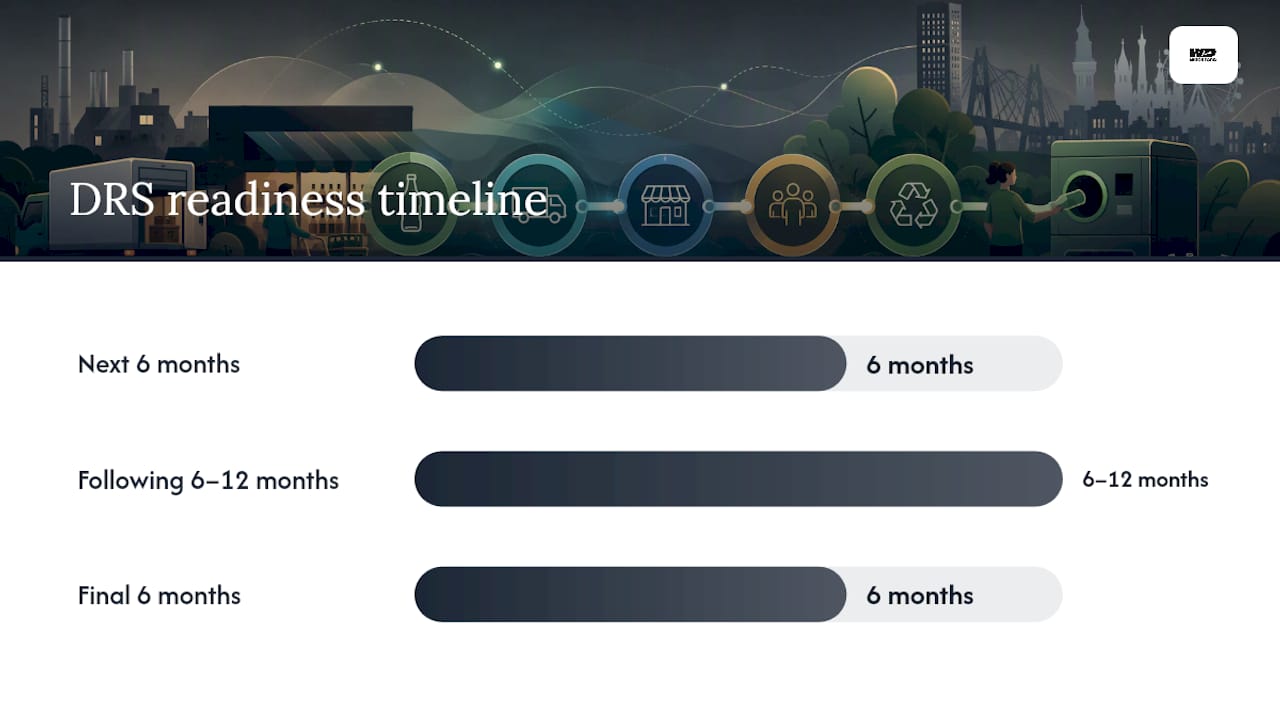
A sensible internal timetable looks like this. In the next six months, complete a full SKU audit against the scope criteria and open a dialogue with your packaging suppliers about label retooling lead times. Over the following six to twelve months, register with the DMO once registration opens, commission updated artwork carrying scheme labelling and return codes, and build deposit tracking into your accounting and ERP systems. In the final six months before October 2027, run supplier and retailer testing, confirm return handling fee agreements, and brief store teams and customer-facing staff on the new refund process.
Who runs the scheme: the role of the Deposit Management Organisation
Exchange for Change is not a regulator sitting above the scheme. It’s the operational body running it day to day, appointed to manage the DRS across England, Scotland and Northern Ireland after being named UK DMO in May 2025.
Pro Tip: Treat Exchange for Change as your primary operational contact, not GOV.UK. Legislation sets the rules; the DMO sets the practical detail, fee schedules and system access you’ll actually work with day to day.
Its remit, drawn from the 2025 Regulations and confirmed producer and retailer guidance, covers a wide operational span:
- Setting the final deposit level and confirming it publicly ahead of launch.
- Maintaining the registers of producers, retailers and take-back service providers required under the Regulations.
- Paying return handling fees to retailers and other return point hosts for collecting and storing containers.
- Managing collection logistics and the reverse supply chain that gets returned containers to recycling processors.
- Monitoring compliance and reporting scheme performance, including progress towards its own collection targets.
One figure worth flagging early: the joint UK policy work behind the scheme sets a target of more than 90% container collection by year three of operation, alongside an intention to keep deposit levels aligned across the nations running compatible schemes. That collection ambition is the benchmark the whole return-point network is being designed against.
Exchange for Change publishes ongoing operational updates and retailer support material as scheme detail firms up, and its guidance includes commitments to support smaller independent retailers through board representation and dedicated support packages, so it’s worth checking its site directly rather than relying solely on secondary summaries.
Producer responsibilities: registration, labelling, reporting and fees
If you manufacture, import or brand drinks in in-scope containers, you’re a producer under the scheme, and the obligations start well before launch day.
Registration comes first. From 1 October 2027, producers and retailers face new registration, labelling and reporting duties, and registration with the DMO needs to happen ahead of that date, not on it. Expect a formal registration window to open during the 2026 to 2027 build-up period, with your company details, brand list and container specifications recorded against the DMO’s producer register.
Deposit collection works as a pass-through mechanism. You charge the deposit at the point you sell the container into the supply chain, and it travels forward with the product, added at each wholesale and retail step, until the end consumer pays it at the till. When the container comes back, the deposit unwinds in the same direction, refunded to the consumer and then reconciled back through the return point and the DMO’s payment systems.
Labelling is where most operational disruption sits. Every in-scope container will need scheme-specific labelling, likely including a return code or mark that return point equipment can recognise, alongside deposit amount disclosure. That means:
- New artwork for every in-scope SKU, checked against the DMO’s final labelling specification once published.
- Retooling of print and application processes, which for high-volume can lines can mean lead times of several months.
- Coordination with co-packers and contract fillers so labelling changes land consistently across shared production runs.
Reporting and fees round out the producer picture. You’ll need to record volumes placed on the market, deposits charged, and reconcile against DMO reporting templates, alongside paying producer registration fees set by the DMO. Operations and finance teams should start building this into monthly reporting cycles now rather than retrofitting it under launch pressure. Businesses reworking packaging as part of this process may find it useful to revisit broader packaging decisions that shape consumer trust at the same time, since label changes are a natural moment to reassess pack design more widely.
Pro Tip: Don’t wait for the final labelling spec to start supplier conversations. Ask your printer now what lead time they need for a scheme-wide relabel, then work backwards from 1 October 2027 to set your own internal deadline with margin built in.
Retailer responsibilities and how return points will work
If you sell in-scope drinks, you’re very likely to need a return point, whether that’s a reverse vending machine, a manual over-the-counter process, or a take-back arrangement for online sales.
The 2025 Regulations place legal duties on return points to accept in-scope containers and issue refunds. Not every retailer is captured in the same way, though. Guidance on producer and retailer responsibilities indicates that smaller stores, particularly those with limited footprint in dense urban areas, may qualify for exemptions from hosting a physical return point, though the precise thresholds should be checked against final DMO guidance rather than assumed.
For retailers who are in scope, here’s how the mechanics generally work:
- Register with the DMO as a return point operator, confirming your store location, format and the return method you intend to use.
- Choose your return method. Larger stores with sufficient floor space often opt for a reverse vending machine (RVM), which scans the container, verifies it against scheme codes, and triggers a refund automatically. Smaller stores may run manual returns over the counter instead, checking containers by eye and code.
- Arrange storage and collection. Returned containers need somewhere to sit before collection, so factor in stockroom space and agree a collection cadence with the DMO or its contracted logistics partners.
- Set up your refund method. Refunds are likely to be available via voucher, card credit or cash, depending on store systems and DMO specification. Retailers already running loyalty or voucher infrastructure may find it worth reviewing customer loyalty software options as part of deciding how deposit refunds get issued at the till.
- Train staff and update signage. Front-of-house teams need a clear, simple process to explain to customers, particularly in the first few months when public awareness will still be building.
Retailers who don’t want the capital cost of an RVM, or who fall just outside an exemption, have a middle option: third-party take-back services or clustered RVM arrangements shared across a retail parade or shopping centre, which spreads infrastructure cost without requiring every single store to install its own machine.
Pro Tip: If you operate multiple small sites, start mapping which ones are likely exempt and which aren’t before assuming you need an RVM everywhere. A mixed strategy, manual returns in your smallest stores and machines in your largest, is usually cheaper than a one-size-fits-all rollout.
Storage and collection logistics deserve early attention too, and retailers coordinating this alongside a wholesaler may want to look at logistics planning tailored to independent retailers to see how return handling fits alongside existing delivery and stock cycles.
Deposit level, fees and the financial flows to model now
Government policy work has floated an illustrative deposit figure around 20p per container, but that number isn’t fixed. The DMO is responsible for confirming the final deposit level, and businesses should treat any specific pence figure circulating before an official announcement as indicative only.
What is clearer is how the money moves once the level is set. Three separate financial flows sit inside the scheme, and each needs its own line in your systems:
- The deposit itself, charged by the producer at first sale, passed through wholesale and retail pricing, then refunded to the consumer on return. This should sit as a liability on your books, not revenue, since it’s money you’re holding on behalf of the eventual refund.
- Return handling fees, paid by the DMO to retailers and other return point hosts to cover the cost of collecting, storing and processing returned containers.
- Producer registration fees, paid by producers to the DMO to fund scheme administration, separate from the deposit itself.
One planning figure worth anchoring on: the scheme’s own collection target of over 90% by its third year of operation gives you a rough sense of the return volume the DMO expects to be processing, and therefore the scale of return handling fee payments retailers can expect to receive once the scheme matures.
Finance teams should start modelling deposit liability separately from revenue now, ahead of a confirmed pence figure, so the accounting treatment is ready rather than rushed. Businesses reworking margin structures around this may find it useful to revisit wholesale pricing strategy alongside deposit accounting, since deposit-inclusive shelf pricing changes how margin and cashflow interact through the chain.
Cross-border considerations: Wales and the glass divergence
Wales is the outlier. While England, Scotland and Northern Ireland exclude glass from their deposit return scheme, Wales intends to include it, creating a genuine four-nation patchwork rather than one uniform UK scheme.
That divergence has real operational consequences, particularly for producers and wholesalers distributing the same product across multiple nations:
- Labelling: a glass bottle destined for Wales may need scheme labelling that an identical bottle sold in England does not, so batch segregation by destination becomes necessary rather than optional.
- RVM compatibility: return point equipment calibrated for PET, steel and aluminium in England won’t necessarily process glass containers accepted under the Welsh scheme, meaning retailers trading near the Wales border need to check equipment specification carefully.
- Trade protections: the UK Internal Market Act generally protects the free flow of goods between the four nations, but scheme-specific labelling and return mechanics still need managing at the operational level even where goods themselves can cross borders freely.
The practical fix, backed by the policy statement’s own guidance, is segmentation. Businesses selling across nations should plan nation-specific SKUs or dual labelling rather than assuming one pack design will satisfy every scheme, and distributors need separate palletisation and labelling runs by destination nation to avoid returns rejection at the point of collection. It’s a small addition to production planning now that saves a much bigger headache in late 2027.
Woodford’s readiness checklist for producers, wholesalers and retailers
Regulatory guidance tells you what’s required. It doesn’t tell you how to sequence the work against a live wholesale operation, and that’s where most businesses actually get stuck. Here’s how Woodford would sequence it if this were our own product range going through the change.
- Run a full SKU audit first. Map every product against the 150 ml to 3 litre band and the PET, steel and aluminium material rule before you do anything else. This single step usually surfaces more in-scope lines than businesses initially expect, particularly among smaller pack formats.
- Open DMO registration early, and don’t wait for the deadline to book your slot. Registration systems tend to see a rush close to any compliance date, and early registration gives you more time to fix data errors before they become operational problems.
- Prepare sample labelling and return codes as soon as DMO specifications are published, and test them with your printer or co-packer before committing to a full production run.
- Plan your logistics split. Decide, site by site if you’re a retailer, or lane by lane if you’re a distributor, whether returns are handled through RVMs, manual processes, or third-party take-back. Test the chosen approach with real stock before launch month, not during it.
- Model the commercial impact. Build deposit liability into your accounting separately from revenue, forecast return handling fee income if you’re a return point host, and revisit wholesale pricing to reflect deposit-inclusive shelf prices.
- Brief your network before the switch, not after. Retail customers buying through Woodford’s distribution channels need clear notice of labelling changes and deposit timing well ahead of October 2027, and internal teams need the same clarity to field customer questions confidently.
Pro Tip: Start the SKU audit even if you think none of your lines are in scope. Businesses that assumed they were exempt because they sell mostly glass or cartons have, in past scheme rollouts elsewhere, discovered a handful of PET or can-based lines they’d overlooked.
Coordinating collection cadences and storage across a distribution network is a logistics problem as much as a compliance one, and it sits close to the kind of planning covered in navigating UK food logistics for wholesalers and the food distribution cycle between producers, wholesalers and retailers. Getting the sequencing right now, while the DMO is still finalising detail, is considerably cheaper than retrofitting it against a live deadline.
What the scheme means for prices at the till
Consumers will notice two separate effects on price, and they’re easy to conflate. The first is the deposit itself, a refundable charge added at the point of sale that isn’t a real cost increase, since it’s fully returned when the container comes back. The second is a possible small underlying price adjustment as producers and retailers absorb labelling, logistics and administrative costs tied to compliance.
Government policy framing presents the deposit as broadly cost-neutral for consumers who return their containers, since the pound or so added at checkout comes straight back. The friction, in practice, tends to sit with consumers who don’t return containers regularly, effectively paying a small premium for convenience, and with the minority of shoppers without easy access to a return point.
For businesses, the more material question is whether compliance costs, retooled packaging, new labelling runs, registration fees, get absorbed into margin or passed through in shelf pricing. Most operators are likely to take a blended approach: absorbing some cost as a competitive move on higher-margin lines, while passing modest increases through on tighter-margin ranges. Retailers should expect early customer questions about why a familiar drink suddenly costs a few pence more at checkout, distinct from the deposit line, and having a clear, simple answer ready will matter more than the actual pence amount involved.
Where to check the official detail
Treat this guide as your working map, not your final reference. For legal text and formal obligations, go to The Deposit Scheme for Drinks Containers (England and Northern Ireland) Regulations 2025 directly. For producer and retailer duties in plain guidance form, GOV.UK’s Deposit Return Scheme responsibilities page and its policy statement are the primary references. For a concise parliamentary summary of dates and rationale, the House of Commons Library briefing is worth bookmarking. And for ongoing operational updates as the DMO firms up deposit levels and fees, check Exchange for Change directly rather than relying on secondary commentary.


