
UK food labelling requirements: essential compliance guide
Every prepacked food product sold in Great Britain must carry nine mandatory elements under the retained Food Information to Consumers (FIC) Regulation (No 1169/2011): the name of the food, a full ingredients list with allergens emphasised, date marking, net quantity, storage conditions and instructions for use, a batch or lot number, the food business operator’s (FBO) name and address, a nutrition declaration (where required), and country or place of origin (where required). The Food Labelling Regulations 1996 and Food Standards Agency (FSA) guidance sit alongside that framework.
Three first actions for any FBO:
- Determine whether any of your products qualify as prepacked for direct sale (PPDS) and apply Natasha’s Law requirements immediately if they do.
- Confirm the FBO name and address on every label matches your current legal entity and that supplier allergen declarations are up to date.
- Run a font and legibility check: mandatory text must meet a minimum x-height of 1.2 mm on most packaging.
The bottom line: if your products are prepacked and sold in Great Britain, the retained FIC Regulation governs your labels. If you sell into Northern Ireland, EU food law applies instead. Get the jurisdiction right before you print anything.
Key takeaways
UK food labelling compliance requires getting nine mandatory elements right on every prepacked product, applying Natasha’s Law to any PPDS food you produce, and choosing the correct legal framework for your target market (GB or Northern Ireland).
| Point | Details |
|---|---|
| Nine mandatory elements | Every prepacked label must carry the food name, ingredients with emphasised allergens, date marking, net quantity, storage conditions, batch number, FBO details, nutrition declaration, and origin where required. |
| Natasha’s Law (PPDS) | Any food packaged on the same premises before sale needs a full ingredients list with allergens emphasised; this has applied since October 2021. |
| GB vs Northern Ireland | Great Britain follows the retained FIC Regulation; Northern Ireland follows EU food law. Businesses selling into both markets need separate label versions. |
| FBO legal responsibility | The named FBO on the label is legally responsible for all product information, including distributors and importers who place their name on the pack. |
| Legibility minimum | Mandatory text must meet a minimum x-height of 1.2 mm and remain legible throughout the product’s shelf life. |
Table of Contents
- What do UK food labelling requirements cover for each mandatory element?
- How does Natasha’s Law affect your PPDS products?
- When is a nutrition declaration mandatory on UK food labels?
- Special rules for specific commodities and additional mandatory statements
- Which laws govern UK food labelling, and does Northern Ireland differ?
- How to build a repeatable label compliance workflow
- What happens when a labelling error is found?
- Sources
What do UK food labelling requirements cover for each mandatory element?
GOV.UK’s food labelling guidance sets out the full list of mandatory information and the rules for how it must appear. Here is what each element demands in practice.
Name of the food
The legal name takes priority over a brand or marketing name. Where no legal name exists, use a customary name or a descriptive name that is clear enough for the consumer to understand the product’s true nature. Quantitative ingredient declarations (QUID) are required when an ingredient is highlighted on the label by words, images, or emphasis and consumers would expect it to be present in a meaningful quantity.
Ingredients list
List ingredients in descending order of weight as incorporated. Use the name specified in food law where one exists (for example, “vegetable oil” must name the specific plant source).
Allergen emphasis
The 14 major allergens must be emphasised every time they appear in the ingredients list, using a format that clearly distinguishes them from the rest of the text. Bold is the most common approach; colour contrast and underlining also work, provided the distinction is unambiguous. For non-prepacked food sold loose, allergen information must still be available to the consumer, either on a label, a menu, or verbally with written backup.
Key rule: the emphasis must appear each time an allergen ingredient appears in the list, not just on first mention. A product containing both wheat flour and wheat starch must emphasise both.
Date marking
Use-by dates apply to microbiologically perishable foods where safety is the concern. Best-before dates apply to quality rather than safety. Selling food past a use-by date is illegal; selling food past a best-before date is not illegal but may affect quality claims. Your stock management and ordering systems must treat these two date types differently.
Net quantity
State net quantity in metric units (grams, kilograms, millilitres, litres). The >5g/5ml rule means products below those thresholds are exempt from a net quantity declaration. For foods packed in liquid, state both the drained net weight and the total net weight.
Storage conditions, instructions for use, and batch number
Storage conditions must appear whenever the product requires specific handling to remain safe or fit for purpose. Instructions for use or cooking are required where the absence of such instructions would make it difficult to use the product appropriately. The batch or lot number (often prefixed with “L”) allows traceability and is mandatory on all prepacked foods; it can appear anywhere on the label but must be legible.

Legibility and placement
GOV.UK and FSA guidance specify a minimum x-height of 1.2 mm for mandatory information on most packaging. Text must be indelible, clearly legible, and remain readable throughout the product’s shelf life under normal storage conditions. Mandatory information must appear in the same field of vision where the regulation requires it.
Common compliance mistakes to avoid:
- Allergens listed only in a separate “contains” statement rather than emphasised within the ingredients list (this does not satisfy the FIC requirement on its own).
- Net quantity stated in imperial units only.
- Batch numbers printed in ink that fades before the use-by date.
- FBO address listed as a PO Box rather than a full registered address.
- Storage instructions absent on chilled products.
Pro Tip: Run a physical label check under poor lighting conditions. If you struggle to read the mandatory text, so will Trading Standards.
How does Natasha’s Law affect your PPDS products?
Natasha’s Law came into force in October 2021. It applies specifically to prepacked for direct sale (PPDS) food: food that is packaged at the same premises from which it is sold, before the consumer selects or orders it. Think in-store bakery items wrapped before display, deli counter products pre-portioned and sealed, or sandwiches made and wrapped on site.
The PPDS applicability test: ask three questions.
- Was the food packaged on the same premises from which it is sold?
- Was it packaged before the consumer ordered or selected it?
- Is it sold directly to the final consumer (not to another business for resale)?
If all three answers are yes, the product is PPDS and Natasha’s Law requires a full ingredients list with allergens emphasised on the label.
What must a PPDS label show?
Under the FSA’s PPDS labelling guidance, a PPDS label must carry:
- The name of the food
- A full ingredients list in descending order of weight
- Allergens emphasised (bold, colour, or contrasting type) every time they appear
No other mandatory elements from the full FIC list are required for PPDS, but including storage conditions and a best-before or use-by date is strongly recommended for safety and stock management.
Example PPDS ingredient snippet:
The bold text on wheat, milk, and almonds satisfies the emphasis requirement.
Operational checklist for PPDS producers
- Map every PPDS product in your range and confirm applicability using the three-question test above.
- Create a master ingredients and allergen record for each PPDS product, updated every time a recipe or supplier changes.
- Print labels that carry the product name and full ingredients list with emphasised allergens before placing items on display.
- Train all staff who handle ingredients or apply labels on the 14 allergens and the consequences of mislabelling.
- Keep written records of recipe versions and label sign-off dates for audit purposes.
Why this matters: the FSA frames allergen labelling as a transparency tool that builds consumer trust, and the named FBO on the label bears the legal burden for accuracy. For retailers producing PPDS items in-store, that burden sits with you, not your ingredient supplier.
Pro Tip: Integrate allergen management into your recipe development process rather than treating it as a final packaging step. The FSA’s allergen technical guidance covers staff training frameworks and best-practice audit approaches that reduce recall risk significantly.
When is a nutrition declaration mandatory on UK food labels?
A nutrition declaration is mandatory on most prepacked foods sold in Great Britain. The retained FIC Regulation requires it unless the product falls within a recognised exemption.
Common exemptions include:
- Unprocessed single-ingredient products (e.g. a bag of whole apples or loose dried herbs).
- Products where the largest surface area of packaging is less than 25 cm².
- Alcoholic beverages above 1.2% ABV (though these must declare alcoholic strength).
- Dietary supplements and natural mineral waters, which are governed by separate regulations.
- Foods supplied directly by small businesses to the final consumer in limited quantities, where local authority guidance confirms the exemption applies.
What the declaration must show
The mandatory nutrition declaration covers energy (in kJ and kcal), fat, saturates, carbohydrate, sugars, protein, and salt, expressed per 100g or per 100ml. You may additionally state values per portion, provided the number of portions in the pack is declared alongside. Voluntary nutrients (fibre, vitamins, minerals) may be added after the mandatory set.
Format rule: the mandatory nutrients must appear in the order listed above, in a clearly formatted table or linear format. You cannot rearrange the sequence or omit a nutrient from the mandatory set.
Front-of-pack labelling
Front-of-pack (FOP) signposting is voluntary in Great Britain, but the government has consulted on a mandatory scheme. The most widely used format is the traffic light system showing energy, fat, saturates, sugars, and salt per portion with colour coding (green, amber, red). If you use FOP labelling, the values must be consistent with the mandatory back-of-pack declaration; any discrepancy creates a compliance risk and consumer confusion.
Avoid implying health benefits through FOP design unless you hold an authorised nutrition or health claim under the retained Nutrition and Health Claims Regulation. Phrases like “supports immunity” or “good for your heart” require specific authorisation; decorative imagery of fruit or vegetables without a claim is generally acceptable but should be reviewed if it could mislead consumers about the product’s composition.
For independent retailers, provenance and front-of-pack messaging are increasingly important retail differentiators, particularly for premium and artisan products.
Special rules for specific commodities and additional mandatory statements
Several product categories carry labelling requirements beyond the standard FIC mandatory set. Missing these is one of the most common reasons food businesses receive improvement notices.
| Commodity | Specific requirement |
|---|---|
| Beef, veal, pork, sheep, goat meat | Country of origin and provenance mandatory |
| Fish and shellfish | Species name, production method (caught/farmed), catch area |
| Honey | Country of origin of all source countries |
| Olive oil | Designation of origin category (e.g. extra virgin) |
| Wine | Variety, vintage, geographical indication where applicable |
| Fruit and vegetables | Country of origin |
| Bread and flour | Flour treatment agents must be declared |
| Alcoholic drinks >1.2% ABV | Actual alcoholic strength by volume |
Origin labelling and misleading imagery
If packaging imagery (a countryside scene, a flag, a place name) implies the product originates from a particular location but the primary ingredient comes from elsewhere, the label must state the actual origin of that primary ingredient. A cheese labelled with imagery evoking a specific region but made from milk sourced outside that region requires a clear origin statement for the milk.
Additional mandatory statements to include when relevant:
- GM ingredients: if a product contains or consists of genetically modified organisms above the 0.9% threshold, the label must state “genetically modified” or “produced from genetically modified [name of organism].”
- Irradiated food: must be labelled “irradiated” or “treated with ionising radiation.”
- Protective atmosphere packaging: must state “packaged in a protective atmosphere.”
- Sweeteners: products containing certain sweeteners require advisory statements (e.g. “contains a source of phenylalanine” for aspartame).
Hidden allergen sources are a particular risk in complex ingredient chains. Understanding where hidden additives and allergens appear in processed ingredients helps when reviewing supplier specifications.
Which laws govern UK food labelling, and does Northern Ireland differ?
The legal framework for food labelling in Great Britain rests on three instruments.
- Retained FIC Regulation (No 1169/2011): the primary legislation for Great Britain, governing mandatory information, presentation, and nutrition declarations.
- Food Labelling Regulations 1996: earlier statutory detail that supplements the FIC framework for specific requirements; still operative alongside retained EU law.
- Assimilated and national regulations: commodity-specific rules (meat, fish, honey, etc.) implemented through separate statutory instruments.
The GB vs Northern Ireland split: under the Northern Ireland Protocol (Windsor Framework), Northern Ireland continues to follow EU food law rather than GB retained law. A product labelled for the GB market and a product labelled for the Northern Ireland market may need different FBO details, different regulatory references, and potentially different format requirements. Businesses selling across both markets should maintain separate label versions.
Practical implications for distributors and importers
The FBO named on the label is legally responsible for the accuracy of all product information, regardless of whether they manufactured the product. Distributors and importers who place their name on a label as the responsible FBO must have the supplier documentation to back every claim on that label. The GOV.UK guidance on FBO responsibilities makes this explicit.
Enforcement and official guidance sources to consult:
- GOV.UK food labelling guidance for the mandatory elements checklist.
- FSA technical guidance for allergen management and PPDS.
- Local authority Trading Standards for enforcement queries and pre-market advice.
- Food Standards Scotland for Scottish-specific queries.
For a detailed breakdown of how the FIC Regulation and post-Brexit retained law affect day-to-day operations, the Woodford guide on UK food compliance laws covers the practical implications for brand owners and distributors.
How to build a repeatable label compliance workflow
Legal responsibility for label accuracy sits with the FBO named on the label. For distributors and wholesalers, that means you cannot simply accept a manufacturer’s label at face value if your name is on it.
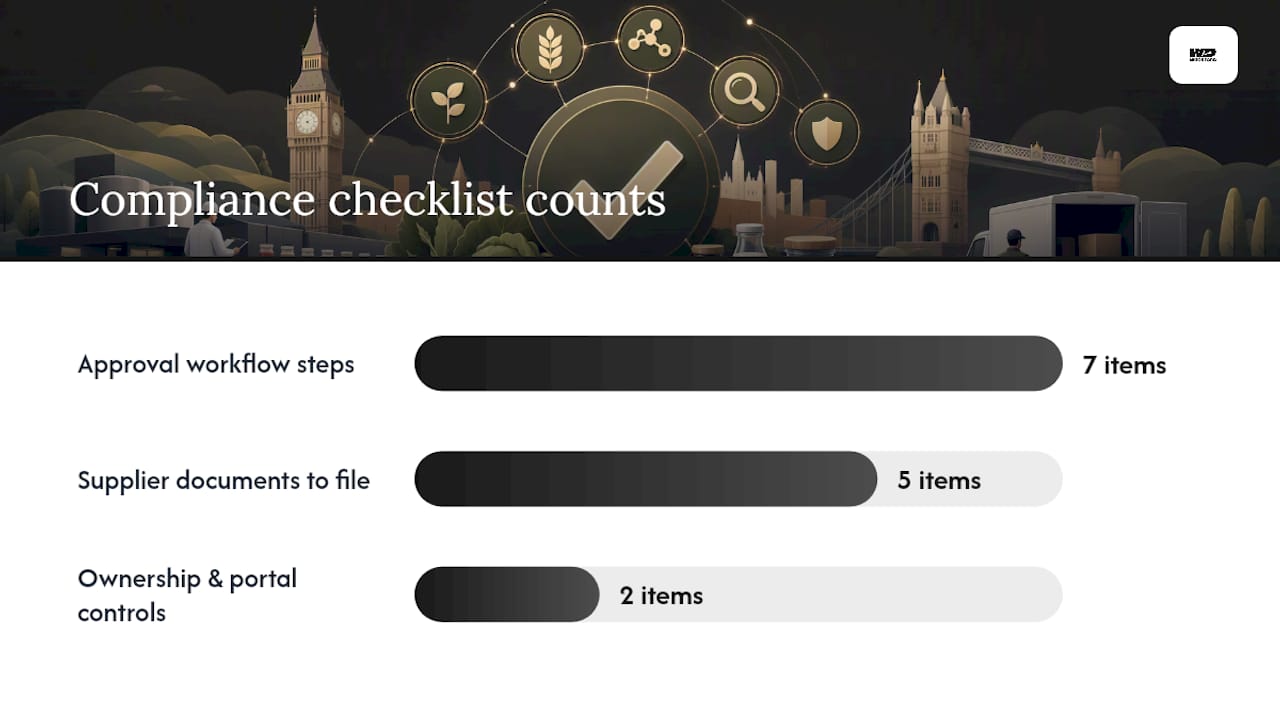
Step-by-step label approval workflow:
- Product specification sign-off: obtain a full product specification from the manufacturer or supplier, including recipe, ingredient breakdown, allergen status, and nutritional data.
- Label draft creation: create the label draft against the mandatory FIC checklist, incorporating all required elements in the correct format and order.
- Allergen and ingredient cross-check: compare the label’s ingredients list and allergen emphasis against the product specification line by line.
- Legibility check: verify minimum x-height (1.2 mm), contrast, and permanence of print under simulated shelf conditions.
- Jurisdiction check: confirm whether the product is destined for GB, Northern Ireland, or both, and apply the correct regulatory framework.
- Internal sign-off: obtain written approval from a named responsible person before sending to print.
- Post-production verification: check a physical sample from the first print run against the approved proof before releasing stock.
Supplier documents to collect and file:
- Full ingredient specifications with allergen declarations for each ingredient.
- Nutritional analysis (laboratory or calculated) supporting the nutrition declaration.
- Packaging supplier declaration of compliance for food contact materials (the glass-and-fork symbol confirms suitability; written declarations are the compliance record).
- Country of origin certificates where origin labelling is mandatory.
- GM status declarations where relevant.
Label information on digital ordering portals must match the physical label exactly. As wholesale increasingly moves online, keeping portal product data linked to current manufacturing specifications is a compliance requirement, not just good practice.
Pro Tip: Assign a named data owner for each label field in your product database. When a supplier changes an ingredient, the data owner for that field is responsible for triggering a label review. This single process change prevents the most common source of labelling errors in wholesale operations.
For a broader view of how supplier documentation and label ownership interact in a wholesale context, the Woodford compliance guide covers traceability requirements in detail.
What happens when a labelling error is found?
Enforcement of food labelling sits primarily with local authority Trading Standards officers, supported by the FSA and Food Standards Scotland. Outcomes range from informal advice and improvement notices through to prosecution, fines, and mandatory product recalls. Allergen mislabelling in particular carries serious legal and reputational consequences.
Step-by-step response when you discover a labelling error:
- Stop sale immediately: withdraw the affected product from sale at all points in your supply chain.
- Isolate stock: identify and quarantine all affected batch numbers across your warehouse and any third-party logistics partners.
- Notify buyers: contact all wholesale customers and retailers who received the affected stock with clear written instructions to remove it from sale.
- Correct digital listings: update any online product pages, ordering portal listings, or digital menus to remove or correct the affected product information.
- Assess the risk: determine whether the error poses a food safety risk (particularly allergen mislabelling) or is a technical non-conformance. Allergen errors require immediate FSA or Trading Standards notification.
- Notify the regulator: for allergen errors or safety risks, contact your local Trading Standards office and, where appropriate, the FSA. Do not wait for them to contact you.
- Document everything: keep a written record of when the error was discovered, what action was taken, who was notified, and when corrected labels were approved and applied.
Internal and external notifications:
- Internally: quality manager, commercial director, logistics team, and customer service.
- Externally: all retail customers who received the batch, Trading Standards, and the FSA where a safety risk exists.
For practical guidance on managing date-sensitive stock and recall logistics, the Woodford article on food logistics for independent retailers covers stock rotation and handling procedures.
Sources
Bookmark these pages for compliance work and regulatory updates.


