
Trend-led product selection guide for UK retail buyers

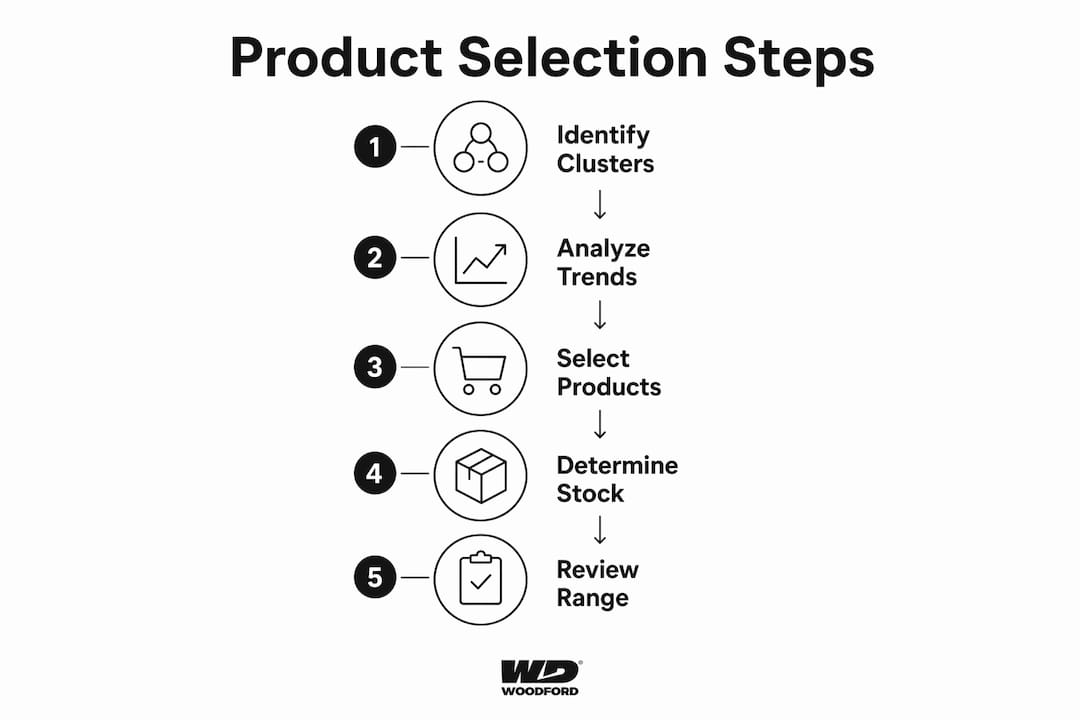
Selecting trend-led products effectively comes down to one principle: compliance first, trend appeal second. Before any product earns shelf space, it must clear allergen controls, labelling requirements, and ingredient quality checks. Once those boxes are ticked, the practical framework is straightforward: anchor roughly 70–80% of your range on reliable staples, then use the remaining 20–30% for trend-driven products that reflect genuine consumer momentum. Combine that with scheduled assortment reviews, supplier collaboration, and real sales data, and you have a repeatable system rather than a series of gut-feel gambles.
The core checklist for any trend-led buying decision:
- Verify allergen declarations and labelling before evaluating any other criteria
- Confirm ingredient quality, provenance claims, and third-party audit status
- Apply a rule that staples anchor the range while trends add differentiation
- Use predictive trend data alongside your own sales velocity, not historical data alone
- Align new introductions with key retail moments and authentic trend cycles
- Build monthly velocity reviews and quarterly trend checks into your buying calendar
- Test new products in small batches before committing to full range listings
- Maintain open supplier dialogue to protect availability and margin
Why compliance must come before trend appeal
The phrase Woodford uses internally is “start with compliance, not charisma,” and it holds up under scrutiny. A product can be the most talked-about item on TikTok and still be unsellable if its allergen labelling is incomplete. In the UK, allergen controls and labelling are legal obligations, not optional extras. A single mislabelled product can trigger a recall, and the reputational damage that follows tends to far outweigh any short-term margin gain.
Practical compliance checks for every new product:
- Allergen declarations present, accurate, and formatted to UK legal standards
- Ingredient list complete, with country of origin stated where required
- Third-party audit certification or supplier compliance documentation on file
- Packaging durability confirmed for your storage and transit conditions
- MSRP and margin reviewed against your category threshold before approval
Supplier transparency is worth treating as a selection criterion in its own right. Brands that cannot produce audit documentation quickly are a supply risk as well as a compliance risk. For a detailed breakdown of UK food sector compliance requirements, Woodford’s guidance covers the key obligations buyers face.
How to balance product variety and stock depth using store clustering
Assortment planning is the process of deciding which products to stock, in what quantities, and for which locations. Two terms matter here: breadth refers to the variety of product categories you carry; depth refers to how many variants (sizes, flavours, formats) you hold within each category. Getting both wrong in the same direction is how dead stock accumulates.
Store clustering solves this by grouping locations with similar customer profiles, demographics, and performance patterns, then tailoring the product mix to each cluster rather than applying a single national range. A convenience store near a university has different depth requirements for functional snacks than a community shop serving older regulars.

| Assortment dimension | What it means | Common mistake |
|---|---|---|
| Breadth | Number of distinct product categories | Stocking too many categories without depth in any |
| Depth | Variants within a category (size, flavour, format) | Over-indexing on variants for slow-moving lines |
| Store clustering | Grouping stores by customer profile and performance | Applying one national range to all formats |
| Evergreen vs trend | Ratio of staples to trend-led SKUs | Letting trend items crowd out reliable sellers |
AI-driven analytics tools now make cluster-level planning accessible without a large merchandising team. The key input is your own sales data by location, combined with demographic signals. Pair this with food merchandising principles to ensure the physical layout reinforces the assortment logic.
When to introduce new products: timing trend cycles and retail moments
Timing a product launch badly is one of the most common and costly mistakes in independent retail. A gut health drink introduced in january with no promotional context lands flat. The same product launched ahead of a “new year, new habits” moment, with clear shelf signage and a small tasting bay, has a genuine chance of building repeat purchase.
Key retail moments to plan around:
- Veganuary (january): plant-based, dairy-free, and clean-label products
- Summer BBQ season (may to august): bold flavours, sharing formats, functional drinks
- Back to school (august to september): convenient snacks, lunchbox formats, high-protein lines
- Christmas (october to december): premium gifting, indulgent formats, limited editions
The rule Woodford applies is to plan new introductions at least eight weeks ahead of the target moment. That window covers supplier lead times, packaging checks, and in-store merchandising preparation. Aligning launches with 2026’s top food trends such as snackification, functional foods, and clean labels gives each introduction a broader tailwind beyond the seasonal moment alone.
Pro Tip: Before committing to a full range, trial a small mixed bay or snack bundle. Low investment, fast feedback, and no overstock risk if the product does not convert.
Authentic trend cycles move more slowly than social media suggests. Snackification and functional foods have been building for several years; emerging drink flavours in 2026 reflect the same sustained shift toward health-forward, flavour-diverse formats. A product backed by retail sales data and search volume is a different proposition from one that trended on TikTok for a fortnight.
How to keep your range relevant through regular review cycles
Trend-driven assortment is not a one-time decision. Products that performed well six months ago can become margin traps if the trend has moved on and you have not. Scheduled review cycles prevent dead stock by catching slow movers before they tie up capital and shelf space.
A practical review cadence:
- Monthly velocity reviews: compare each product’s sales rank against the previous four weeks; flag anything dropping consistently
- Quarterly trend checks: use trade publications, wholesale data, and customer feedback to assess whether your range still reflects where tastes are heading
- Seasonal rotations: plan limited-time offerings sufficiently in advance to allow sourcing and merchandising; retire them on schedule rather than letting them linger
The “one in, one out” principle keeps ranges tight. Every time a new product joins the range, identify the weakest performer it replaces. This prevents the slow accumulation of marginal lines that individually seem harmless but collectively dilute your offer. For practical guidance on managing food inventory and reducing dead stock, Woodford’s approach covers the operational steps in detail.
Combining qualitative social trend signals with quantitative sales data gives you the most reliable basis for ranging decisions. Sales velocity tells you what is happening; trend signals tell you what is coming. Neither alone is sufficient.
Woodford’s expert approach to trend-led curation
Woodford’s approach to trend-led curation rests on a few principles that independent retailers consistently find useful:
- Compliance as the gateway: no product enters the evaluation process without allergen and labelling verification
- The staple-to-trend composition rule: keep a strong base of 70-80% evergreen staples and a 20-30% share for trend or niche products, with regular review cycles
- Pre-vetted supply reliability: every brand in Woodford’s portfolio has passed compliance, supply chain, and category fit checks before it reaches retailers
- UK consumer trend data: Woodford analyses retail performance signals and trend data to identify which products are genuinely ready for independent retail, not just brands that pitch well
- Small-scale trials first: testing new products in customer tastings or limited bays before full listing reduces financial exposure and validates real-world appeal
Independent retailers working with Woodford gain access to a pre-vetted portfolio of food brands that have already cleared the compliance, supply, and category fit checks described throughout this guide. Browse Woodford’s curated portfolio to explore what is available for your range right now.
Key takeaways
Effective trend-led product selection in UK retail requires compliance as the non-negotiable foundation, a staple-to-trend ratio of 70-80% staples and 20-30% trend products, and scheduled review cycles to prevent dead stock and protect margin.
| Point | Details |
|---|---|
| Compliance comes first | Verify allergen controls and labelling before evaluating any product’s trend appeal. |
| Apply the 70/30 rule | Keep 70-80% of your range as evergreen staples; limit 20-30% to trend or niche products. |
| Time introductions carefully | Plan new product launches at least eight weeks ahead of key retail moments or trend cycles. |
| Review on a schedule | Run monthly velocity checks and quarterly trend reviews to phase out slow movers promptly. |
| Test before committing | Trial new products in small batches or customer tastings to validate demand before full listing. |


