
The role of modern wholesale platforms in 2026
TL;DR:Modern wholesale platforms are digital marketplaces that streamline ordering, discovery, and payment processes for brands and retailers. They enhance efficiency by reducing costs, improving logistics, and serving as essential customer acquisition channels. Brands should build hybrid models, focusing on data ownership and migration strategies to protect margins and ensure long-term growth.
Modern wholesale platforms are digital marketplaces and B2B ordering systems that connect brands, wholesalers, and retailers through a single infrastructure layer, replacing paper catalogues, phone orders, and fragmented spreadsheets. Platforms like Faire, Shopify B2B, and Orderchamp have redefined how independent retailers source products, offering digital ordering, net payment terms, discovery algorithms, and integrated inventory management. Faire alone has processed over $10 billion in gross merchandise volume, connecting 700,000 retailers with 100,000 brands by 2026. That scale signals a structural shift, not a trend. The role of modern wholesale platforms now extends far beyond convenience. They are the primary infrastructure through which food brands, wholesalers, and independent retailers compete, grow, and manage distribution at speed.
How modern wholesale platforms transform distribution and logistics
Traditional wholesale distribution relied on sales reps, printed order forms, manual invoicing, and phone-based reordering. The operational cost of that model was high, the error rate was significant, and the buyer experience was slow. Digital wholesale platforms replace every one of those friction points with automated workflows, real-time inventory visibility, and self-service ordering portals.

The shift in buyer preference is decisive. 80% of B2B buyers now prefer self-service or remote cooperation for identifying suppliers, placing orders, and reordering. This means that brands and wholesalers who rely solely on rep-led sales are already misaligned with how the majority of their buyers want to work. Platforms meet buyers where they are, available at any hour, with clear pricing and instant order confirmation.
Logistics coordination has also improved materially. Modern platforms integrate with third-party logistics providers, offer real-time stock updates, and automate dispatch notifications. Returns policies, credit risk management, and payment terms are built directly into the platform layer, removing the need for separate negotiations on each account. For food retailers sourcing ambient, chilled, or speciality products, this means faster onboarding of new suppliers and fewer fulfilment errors.
Key operational improvements platforms deliver include:
- Real-time inventory visibility across multiple brand catalogues in one interface
- Automated reorder triggers based on sell-through data and minimum stock thresholds
- Integrated payment terms such as net 60 or net 90, reducing cash flow friction for retailers
- Centralised order history that simplifies account management for both buyer and supplier
Pro Tip: When evaluating wholesale platforms, prioritise those with ERP or CRM integration capabilities. Connecting platform order data to your existing systems eliminates double-entry, reduces errors, and gives you a single source of truth for sales reporting and demand planning.
The wholesale logistics implications of this digital shift are significant for UK food retailers in particular, where short shelf lives and regional sourcing complexity make real-time data non-negotiable.
What financial impacts arise from using wholesale marketplaces?
The benefits of online wholesale are real, but so are the costs. Commission structures on major platforms are tiered and material. Faire charges 25% on the first order from a new retailer and 15% on subsequent reorders. For a food brand operating on 40% gross margins, a 25% commission on new orders leaves very little room before fixed costs are applied. Understanding this arithmetic before committing to a platform is not optional.
The table below compares the financial profile of different wholesale channel types:
| Channel type | Commission rate | Margin impact | Best use case |
|---|---|---|---|
| Discovery marketplace (e.g. Faire) | 25% new, 15% reorder | High on new accounts | New retailer acquisition |
| Direct B2B portal (e.g. Shopify B2B) | 0–2% (platform fee only) | Minimal | Repeat order management |
| Traditional distributor | 30–40% margin share | High but fixed | Complex or regulated categories |
| Hybrid model | Variable | Controlled | Scaling brands with mixed needs |
The ROI calculation shifts significantly once reorder behaviour is factored in. Early adopters of direct B2B portals report converting 20 to 30% of marketplace reorder volume to direct channels within six months. That migration meaningfully reduces commission drag without sacrificing the discovery benefit that marketplaces provide.
The strategic implication is clear. Marketplaces are a high-leverage customer acquisition channel, not a permanent home for your entire wholesale volume. Treating them as the latter is where brands erode margin without realising it. Brands with £3 to £5 million in wholesale revenue frequently find marketplace fees cost-prohibitive at scale and favour hybrid architectures to protect profitability.
Pro Tip: Build a 90-day migration plan for every new account acquired through a marketplace. Use the platform for discovery and the first order, then introduce your direct ordering portal at the reorder stage. Even a 20% migration rate materially improves your annual margin position.
For food brands working through wholesale pricing strategies, understanding the full cost of each channel before setting list prices is the difference between a profitable wholesale programme and one that grows revenue while shrinking returns.
Wholesale platforms vs traditional distributors: what are the real differences?
Modern wholesale platforms and traditional distributors are not competing for the same job. They serve different functions, and the most effective wholesale strategies use both deliberately.
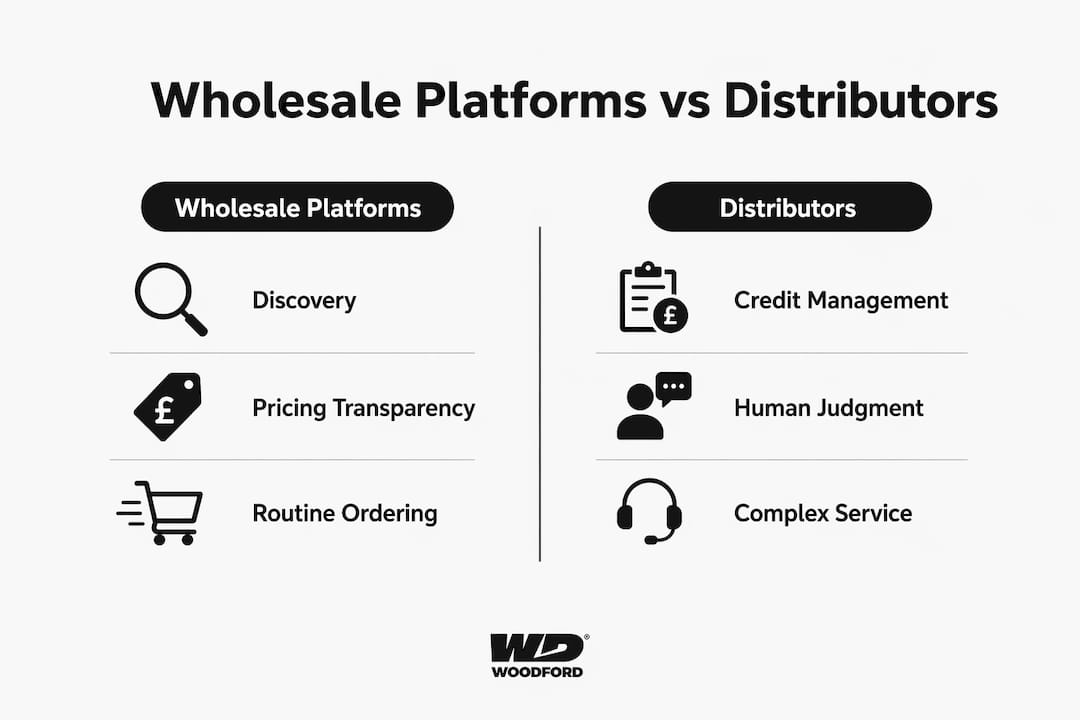
Platforms excel in three specific areas. Marketplaces reduce friction by providing clearer pricing, faster comparison, and easier ordering, but they do not replace value-added distributor services. That distinction matters enormously for food brands selling into regulated or temperature-controlled categories where compliance, cold chain integrity, and credit management require human judgement.
| Function | Modern wholesale platform | Traditional distributor |
|---|---|---|
| New retailer discovery | Strong, algorithm-driven | Limited, rep-dependent |
| Pricing transparency | High | Variable |
| Order speed and convenience | Excellent | Moderate |
| Credit risk management | Basic or absent | Strong, relationship-based |
| Complex delivery coordination | Limited | Strong |
| Compliance and regulatory support | Minimal | Category-specific expertise |
| Personalised account support | Low | High |
Distributors maintain a competitive advantage in areas requiring human judgement, particularly credit risk management and resolving delivery issues in regulated categories. A platform cannot call a retailer’s bank, negotiate a payment plan, or make a judgement call on whether to extend credit to a new account in a difficult trading environment. A good distributor does all of this as a matter of course.
The practical conclusion for food brands and wholesalers is that platforms are superior for acquisition and routine reorder processing, while distributors remain the right choice for complex accounts, regulated products, and situations where relationship depth creates commercial advantage. Sales teams should focus their time on strategic accounts and complex negotiations, leaving routine reorder processing to automated platform workflows. Understanding the types of food wholesalers available in the UK market helps brands make this allocation decision with greater precision.
How to leverage wholesale platforms for growth in 2026
The brands and wholesalers extracting the most value from digital platforms in 2026 are not simply listing products and waiting. They are building deliberate architectures that use platforms for what they do well and direct channels for everything else.
A hybrid model is the standard approach for any brand with meaningful wholesale revenue. Use discovery marketplaces like Faire or Orderchamp to reach new independent retailers at scale. Once a retailer has placed their first order and demonstrated reorder intent, introduce them to your direct B2B portal, whether that is built on Shopify B2B, a brand-owned wholesale system, or a specialist platform. Failing to capture retailer contact data on marketplaces leads to platform dependency. Effective brands funnel buyers to owned direct ordering systems as quickly as commercially possible.
Data ownership is the strategic asset most brands undervalue. Every retailer relationship managed exclusively through a marketplace is a relationship the platform owns, not you. If the platform changes its algorithm, raises commission rates, or restricts your category, you have no fallback. Building an owned CRM of retailer contacts, order histories, and buying patterns is the single most important long-term investment a wholesale brand can make alongside its product development.
Practical steps for a growth-oriented wholesale platform strategy:
- Rationalise your SKU range on commission-heavy platforms to your highest-margin, fastest-moving lines only
- Use platform analytics to identify which regions, retailer types, and product categories generate the strongest reorder rates
- Deploy AI demand forecasting tools where available. AI forecasting tools launched by platforms provide replenishment recommendations based on order and sell-through data, reducing overstock and improving fill rates
- Invest in account management for your top 20% of platform-acquired retailers to accelerate migration to direct channels
- Negotiate platform terms actively. Larger brands with consistent GMV have leverage to negotiate reduced commission rates or preferred placement
Pro Tip: Treat your marketplace account manager as a commercial partner, not a support contact. Brands that schedule quarterly reviews, share sell-through data, and co-invest in promotional placements consistently outperform those that list and leave. The workflow efficiencies gained from this relationship compound over time.
The wholesale digital transformation underway in 2026 rewards brands that treat platforms as one channel within a broader architecture, not as the architecture itself. The strategic positioning of food brands for UK independent retail requires this kind of channel discipline to sustain margin while growing distribution reach.
Key takeaways
Modern wholesale platforms deliver the greatest value when used as customer acquisition infrastructure within a hybrid sales architecture, not as a complete wholesale strategy.
| Point | Details |
|---|---|
| Platforms accelerate discovery | Marketplaces like Faire connect brands with thousands of retailers faster than any rep-led model. |
| Commission costs require management | At 25% on new orders, marketplace fees demand a clear migration plan to direct channels. |
| Distributors remain essential | Human judgement in credit, compliance, and complex logistics cannot be replicated by a platform. |
| Data ownership is non-negotiable | Brands must capture retailer contact data and build direct ordering relationships to avoid platform dependency. |
| Hybrid models protect margin | Combining marketplace discovery with direct B2B portals is the most profitable architecture for scaling brands. |
How Woodford supports your wholesale growth strategy
Woodford is the UK’s leading strategic food wholesaler, working with ambitious independent retailers and forward-thinking food brands to build distribution that actually performs. Where marketplace platforms offer scale and discovery, Woodford offers something platforms cannot: category expertise, curated brand selection, and logistics support built specifically for the UK independent retail market. If you are a food brand looking to reach independent retailers without surrendering margin to commission structures, or a retailer seeking trend-led products with reliable fulfilment, Woodford provides the distribution infrastructure that complements your platform strategy. Get in touch to find out how Woodford can extend your reach while protecting your commercial position.
FAQ
What is the role of modern wholesale platforms?
Modern wholesale platforms are digital infrastructure that connects brands, wholesalers, and retailers through centralised ordering, payment, and discovery systems. Their primary role is to reduce friction in the buying process and expand market reach for both suppliers and buyers.
How do wholesale platform commission structures affect brand margins?
Platforms like Faire charge 25% on first orders and 15% on reorders, which materially reduces margin on new account acquisition. Brands with significant wholesale revenue typically adopt hybrid models to migrate repeat orders to direct, commission-free channels.
Are wholesale platforms replacing traditional distributors?
Platforms excel at discovery, pricing transparency, and routine ordering, but distributors retain clear advantages in credit risk management, complex logistics, and regulated category support. The two models are complementary rather than competitive for most food brands.
What is a hybrid wholesale model?
A hybrid wholesale model uses discovery marketplaces to acquire new retail accounts and direct B2B portals to manage repeat orders at lower cost. Early adopters report converting 20 to 30% of reorder volume to direct channels within six months.
How can food brands avoid over-dependence on wholesale marketplaces?
Brands should capture retailer contact data from the outset, introduce direct ordering portals at the reorder stage, and invest in owned CRM systems. Delegating pricing, data, and relationships entirely to a platform creates commercial vulnerability if the platform changes its terms or algorithm.


