
Why brands choose curated wholesalers in 2026
Curated wholesalers are defined as selective distribution networks that vet every product before listing it, filtering out low-quality suppliers so that only trusted, on-trend brands reach retail buyers. This model is why brands choose curated wholesalers over generic bulk platforms: the quality filter itself becomes a commercial advantage. Platforms like Faire and networks like Woodford have made this approach the standard for ambitious food brands in 2026. The result is higher order values, fewer returns, and retail relationships built on genuine product fit rather than price alone.
Why brands choose curated wholesalers over generic platforms
The economic case for curated supply is grounded in retention, not just acquisition. Customer retention boosts profits by 25–95%, according to Bain & Company research. That figure matters because curated platforms are structurally designed to keep buyers coming back: every product on the shelf has already passed a quality threshold, so reorder confidence is built in from the first purchase.
“Curated platforms act as a trust signal for buyers. When a retailer discovers your brand through a vetted network, they arrive with lower scepticism and higher intent to reorder.”
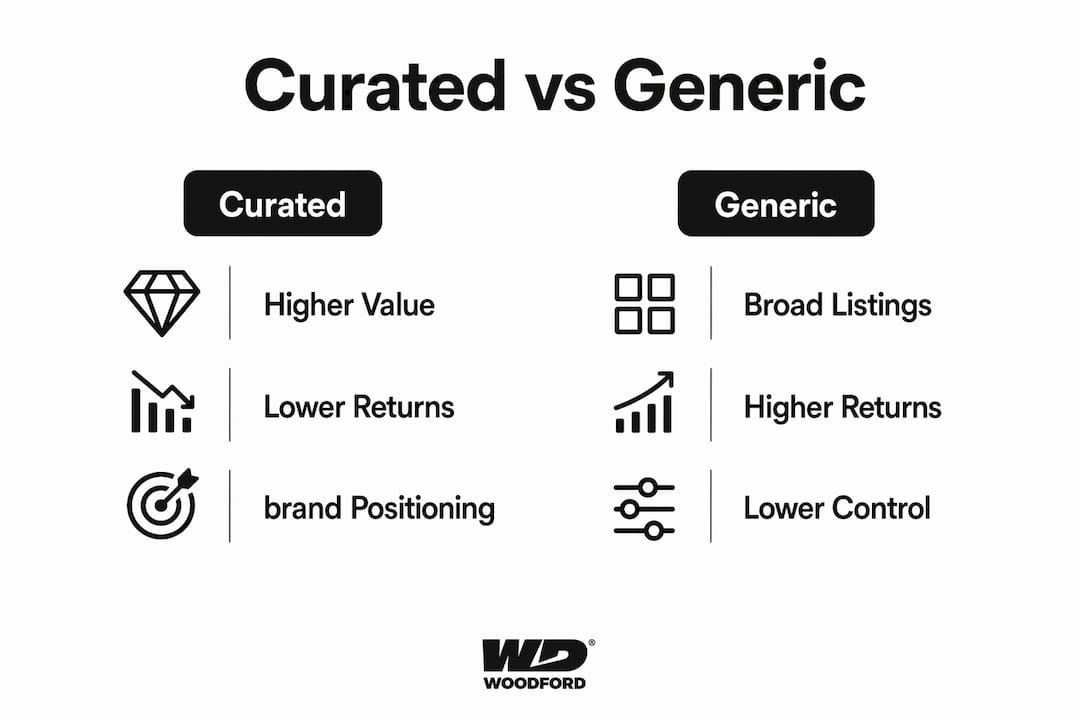
Brands on curated platforms report higher average order values and lower return rates compared to generic marketplaces. The mechanism is straightforward. Buyers on curated networks are not browsing thousands of undifferentiated listings. They are choosing from a pre-filtered selection, which means their purchases align more closely with their actual store needs. Fewer mismatches equal fewer returns. Fewer returns equal better margins for both brand and retailer.
The benefits of curated wholesalers also extend to brand positioning. Being accepted onto a curated platform signals quality to every retailer who encounters your listing. That signal does work your marketing budget cannot replicate.

How do curated wholesalers reduce risk for food brands?
Risk reduction is one of the most underrated curated wholesaler advantages, particularly for food brands entering new markets or scaling from direct-to-consumer into retail. The structural protections built into modern curated platforms remove several barriers that would otherwise require significant capital or legal resource to overcome.
Key risk-mitigation features common to curated wholesale platforms include:
- Net-60 payment terms: Retailers receive stock and pay 60 days later. Faire’s net-60 programme allows retailers to stock inventory without upfront cash, which directly lowers the barrier for independent shops to trial new food brands.
- Free returns on opening orders: Retailers can test a brand with no financial downside. This removes the hesitation that kills trial and dramatically increases the number of stockists willing to take a chance on a new product.
- Regulatory compliance support: Curated platforms increasingly assist brands with labelling requirements, allergen declarations, and market-specific standards. For food brands expanding across UK regions or into export markets, this support reduces the cost and complexity of UK food compliance considerably.
Pro Tip: Before signing with any curated wholesaler, ask specifically about their compliance vetting process. A platform that checks your labelling and allergen information before listing protects you from costly recalls and retailer disputes down the line.
The net-60 model deserves particular attention. For a food brand with 90-day production cycles, receiving payment 60 days after delivery is far preferable to chasing invoices from dozens of independent retailers on inconsistent terms. Cash flow predictability is a genuine operational advantage, not a minor perk.
Does product presentation affect sales on curated platforms?
Product presentation is the single biggest variable a brand controls on any curated wholesale platform. The platform does the vetting; you do the selling through your listing. Brands that treat their wholesale storefront as a first-party brand asset generate inbound orders without any outbound sales effort.
The evidence is concrete. One brand generated $280,000 in wholesale revenue in 2025 using an inbound-first strategy with no cold sales emails. That result came from a fully optimised listing, not from a sales team. The implication for food brands is significant: your listing is your sales rep.
To replicate that result, focus on four elements:
- High-resolution product photography: Shoot on white and in context. Retail buyers need to visualise the product on their shelf, not just in isolation.
- Complete line sheets: Include SKU codes, case sizes, minimum order quantities, and shelf-life information. Buyers who cannot find this information move on immediately.
- Accurate minimum order quantities (MOQs): Overstating MOQs kills trial. Understating them creates fulfilment problems. Set realistic figures and review them quarterly.
- Brand story and provenance: Curated platforms attract buyers who care about the story behind the product. A two-paragraph brand narrative on your listing converts browsers into stockists.
Pro Tip: Treat your wholesale storefront the same way you treat your direct-to-consumer website. Update it seasonally, refresh photography annually, and respond to buyer enquiries within 24 hours. Platforms reward active sellers with higher placement in search results.
High-quality product presentation also reduces the number of buyer questions you receive, which saves time on both sides of the transaction.
What operational advantages do curated wholesalers offer retail managers?
For retail managers, the operational case for curated supply is as strong as the commercial one. Generic wholesale platforms require buyers to manage multiple supplier relationships, inconsistent invoicing formats, and unpredictable delivery windows. Curated wholesalers consolidate all of that into a single, managed experience.
The core operational benefits include:
- 24/7 restocking capability: Retail managers can place orders at any time without waiting for a sales representative to be available. Retail expert Bob Phibbs identifies operational simplicity as the defining advantage of curated platforms for independent retailers.
- Consolidated invoicing: One invoice per period across multiple brands reduces administrative overhead and simplifies reconciliation.
- Reduced decision fatigue: A curated selection means buyers choose from 50 relevant products rather than 5,000 undifferentiated ones. That reduction in cognitive load translates directly into faster, more confident purchasing decisions.
The table below compares the operational experience of curated versus generic wholesale for a typical retail manager:
| Operational Factor | Curated Wholesaler | Generic Marketplace |
|---|---|---|
| Supplier vetting | Pre-vetted by platform | Buyer’s responsibility |
| Payment terms | Standardised (e.g., net-60) | Varies by supplier |
| Returns process | Centralised, often free | Negotiated per supplier |
| Invoicing | Consolidated | Multiple formats |
| Restocking | 24/7 self-service | Variable |
Seamless store integration is not a luxury for independent retailers managing lean teams. It is the difference between a buyer spending two hours a week on procurement and spending two days.
How do curated wholesalers protect brand identity?
Curation is not just a distribution mechanism. It is an extension of brand identity. When your product sits alongside other carefully selected, quality-assured brands, the association itself communicates something to the buyer. That context is absent on mass-market aggregators, where your artisan cold-brew coffee appears next to thousands of unrelated listings.
“Curated platforms are one of the few wholesale channels where the environment your product is sold in actively supports your brand positioning rather than diluting it.”
Curated platforms help brands compete with big-box retailers by amplifying storytelling and supporting independent identity. This matters most for food brands whose value proposition rests on provenance, craft, or ethical sourcing. A buyer discovering your product through a curated network already understands the context: this is a considered, quality product, not a commodity.
The practical implication is that brands should treat their curated wholesale partnerships as brand-building activity, not just revenue generation. The retailers who stock you through a curated platform become advocates. They chose you from a vetted selection, which means they believe in the product. That belief shows up in how they merchandise and recommend it.
One important caveat: maintain direct wholesale channels alongside any platform partnerships. Over-reliance on a single curated platform’s commission model limits your control over customer data and pricing. The strongest brands use curated platforms to discover new retail partners, then deepen those relationships through direct supply agreements over time.
Curated wholesalers also function as real-time market research tools. Bestseller lists and trend reports from your platform reveal which products are gaining traction across the wider retail market, not just in your own customer base. Brands that act on this data reduce inventory risk and improve cash flow management.
Key takeaways
Brands that partner with curated wholesalers gain measurable commercial advantages through quality filtering, operational efficiency, and brand-aligned distribution that generic wholesale channels cannot replicate.
| Point | Details |
|---|---|
| Retention drives profit | Customer retention boosts profits by 25–95%, and curated platforms are built to maximise reorder rates. |
| Risk mitigation is structural | Net-60 terms, free returns, and compliance support lower entry barriers for food brands at scale. |
| Listings are your sales team | One brand generated $280,000 in wholesale revenue through an optimised listing alone, with no cold outreach. |
| Operations simplify for buyers | Consolidated invoicing and 24/7 restocking reduce procurement time for retail managers significantly. |
| Brand identity is protected | Curated environments reinforce provenance and quality positioning in ways mass-market platforms cannot. |
Partner with Woodford for curated food wholesale
Woodford is the UK’s leading strategic food wholesaler, connecting quality food brands with independent retailers through a rigorous curation process that protects brand integrity and drives commercial performance. Every brand in the Woodford portfolio is vetted for quality, provenance, and retail fit before it reaches a buyer. That means your product arrives in front of retailers who are already primed to stock it.
Woodford provides exclusive food brand distribution alongside practical operational support including compliance guidance, consolidated logistics, and trend-led category insight. Whether you are a food brand seeking new retail partners or a retail manager looking to discover niche food categories that set your shop apart, Woodford offers a curated supply partnership built for growth. Explore what Woodford can do for your business at woodford.food.
FAQ
What are curated wholesalers?
Curated wholesalers are selective distribution networks that vet products before listing them, ensuring only quality-assured, on-trend brands reach retail buyers. Unlike generic marketplaces, they filter suppliers based on quality, provenance, and retail fit.
Why do food brands prefer curated wholesalers over generic platforms?
Food brands prefer curated wholesalers because they deliver higher average order values, lower return rates, and stronger retailer relationships built on trust rather than price competition. The quality filter built into curation does commercial work that marketing spend cannot replicate.
How do net-60 payment terms benefit food brands?
Net-60 payment terms allow retailers to receive and sell stock before paying, which lowers the barrier for independent shops to trial new food brands. For brands with longer production cycles, this creates more predictable cash flow than managing invoices across dozens of accounts.
Can small food brands benefit from curated wholesale platforms?
Small food brands often benefit most from curated platforms because the vetting process signals quality to buyers who would otherwise be unfamiliar with the brand. Free returns on opening orders and compliance support reduce the financial and regulatory risk of entering new retail markets.
Should brands use curated wholesalers as their only wholesale channel?
Brands should use curated wholesalers as one channel within a broader wholesale strategy, not as their sole route to market. Maintaining direct wholesale relationships alongside platform partnerships preserves control over customer data, pricing, and long-term retailer relationships.


