
The role of branding in wholesale food markets
Branding in wholesale is defined as the deliberate use of identity, positioning, and product presentation to differentiate a wholesaler’s offer and build lasting commercial relationships. For food wholesalers and independent retailers, strong branding is not a marketing luxury. It is the mechanism that determines shelf placement, buyer loyalty, and long-term profitability. Whether you are distributing artisan condiments or ambient grocery staples, how your brand is perceived at every touchpoint shapes the deals you win and the margins you hold. Woodford works with food brands and independent retailers across the UK, and the pattern is consistent: branded wholesale relationships outperform transactional ones at every stage of growth.
How does branding shape market positioning in wholesale food?
Brand identity in wholesale acts as a signal of quality and reliability before a buyer ever places an order. Retailers make stocking decisions quickly. A wholesaler or brand with clear positioning, consistent packaging, and a coherent story reduces the perceived risk of that decision. That reduction in perceived risk is the commercial value of branding, and it is measurable.
High-frequency replenishment models increase retailer confidence, which directly improves shelf placement and repeat orders. When a retailer knows a product will arrive on time, in the right quantity, and looking exactly as expected, they give it more prominent shelf space. That visibility compounds over time into genuine brand authority.
Strong wholesale brand positioning also reduces transaction costs. Buyers spend less time evaluating familiar, trusted brands. They negotiate less aggressively on price when they perceive quality. The result is a more efficient sales cycle for the wholesaler and a more predictable revenue stream for the food brand.
Consider what this looks like in practice:
- A well-branded ambient snack range with consistent packaging and clear provenance claims commands a higher wholesale price than a generic equivalent.
- Retailers are more likely to feature a branded product in promotional displays because it gives their own shop a quality signal.
- Buyers return to wholesalers who carry recognisable, trusted brands because it simplifies their own buying process.
- Treating wholesalers as partners rather than commodities is critical for sustained market resilience, particularly in competitive food categories.
“Branding in wholesale has evolved from sales transactions to strategic partnerships with value-added services and intelligence sharing.” This shift means the wholesalers who invest in brand identity and relationship depth are the ones building durable market positions, not just volume.
The importance of branding in wholesale becomes most visible when a brand loses control of it. Generic pricing, inconsistent presentation, and poor availability all erode the trust that branding builds. The food industry is particularly unforgiving here because consumers associate product quality with the retailer who stocks it.
What strategies do wholesalers use to build a strong brand identity?
The most effective branding strategies for wholesale combine product differentiation, channel incentives, and supply reliability. Each of these levers works independently, but they compound when used together.
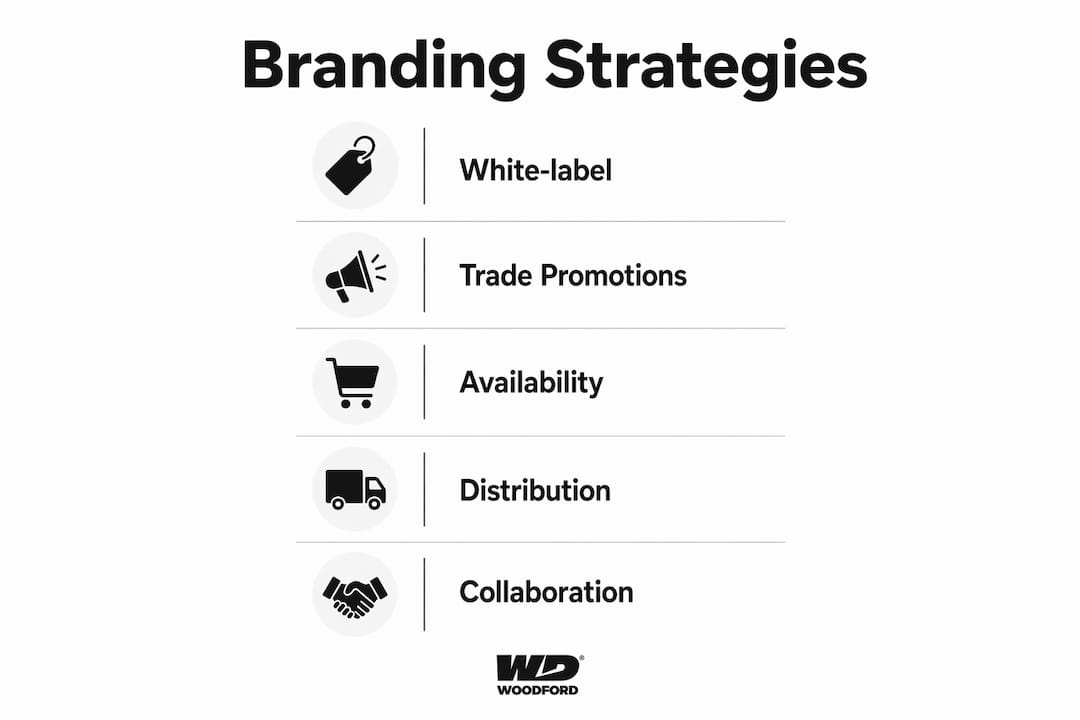
1. White-label and private label development
White-label customisation can unlock a 50% or greater brand premium and shift wholesalers from generic pricing to unique product identities. This is one of the most underused tools in food wholesale. By developing exclusive product lines under a proprietary label, a wholesaler stops competing on price alone and starts competing on identity. Independent retailers benefit too, because they can offer products that larger supermarkets do not carry.
2. Trade promotions as brand engagement tools
Trade promotions account for roughly 60% of consumer packaged goods (CPG) volume. That figure reflects how much of the food market moves through structured channel incentives rather than passive availability. Volume discounts, display allowances, and listing fees are not just sales tactics. They are branding tools that signal to retailers how seriously a supplier takes their partnership.
3. Consistent availability as a brand promise
Availability is a brand statement. A product that is frequently out of stock tells retailers it is unreliable, regardless of how good the packaging looks. Consistent shelf presence influences consumer choice more than advertising recall, providing cost-effective brand strength that no campaign can replicate. For food wholesalers, this means investing in supply chain reliability as a direct brand-building activity.
4. Distribution network as a market entry accelerator
Utilising established wholesale distribution networks allows new products to reach target markets 20–40% faster and reduces transportation costs by 15–25%. Speed to shelf matters enormously in food, where trends move quickly and first-mover advantage in independent retail is real. Partnering with a wholesaler who already has retailer relationships compresses the time between product launch and meaningful sales volume.
Pro Tip: When launching a new food product through wholesale, align your trade promotion calendar with your packaging refresh cycle. Retailers notice when a product looks updated, and a simultaneous promotion amplifies the impact of both.
How do branding and distribution work together for food brand growth?
Distribution is the most undervalued branding tool in the food industry. Most food brands focus on packaging design, social media presence, and PR. They treat distribution as a logistics function. That is a costly mistake.
Distribution acts as a growth lever in brand building by ensuring product availability and visibility at the point of purchase, sometimes reducing heavy advertising needs entirely. A product that is physically present in the right shops, at the right price, with the right shelf positioning does more brand work than most digital campaigns. This is especially true in independent food retail, where shoppers browse and discover rather than search with intent.
The table below shows how different distribution approaches affect brand outcomes in food wholesale:
| Distribution Approach | Brand Outcome | Risk Level |
|---|---|---|
| Exclusive wholesale partnership | High brand control, premium positioning | Low |
| Multi-wholesaler open distribution | Broad reach, lower price control | Medium |
| Direct-to-retailer only | Maximum control, slower growth | Low to medium |
| Unmanaged open marketplace | Fast volume, high dilution risk | High |
Manufacturers who adopt collaborative approaches with wholesalers see 15% higher year-on-year revenue growth compared to top-down control models. The reason is straightforward. Wholesalers who feel like partners invest more in selling your brand. They share market intelligence, recommend your products proactively, and prioritise your lines when shelf space is contested.
The role of wholesalers in brand growth also extends to direct-to-consumer (DTC) amplification. Using wholesale as a funnel to direct-to-consumer branding efforts leads to 40% higher 90-day customer lifetime value versus cold acquisition. In-store sampling and QR-coded shelf talkers are practical examples of how wholesale presence feeds digital brand engagement. A shopper who discovers a product in an independent deli and then follows the brand online becomes a far more valuable customer than one acquired through paid social.
Pro Tip: Ask your wholesale partner to share sell-through data by store location. That intelligence tells you which retail environments are building your brand and which are simply moving volume without creating loyalty.
What should food wholesalers and retailers know about brand protection?
Brand equity is built slowly and lost quickly. The practical side of wholesale branding is not just about building identity. It is about protecting it once you have it.
Wholesale volume can mask brand dilution risks if online resale restrictions, territory agreements, and marketplace monitoring are not enforced. Unauthorised third-party sellers can destabilise pricing and erode the brand equity that took years to build. For food brands distributed through independent retail, this risk is particularly acute on platforms like Amazon and eBay, where grey-market listings undercut authorised retailers and confuse consumers about the brand’s true positioning.
Practical steps to protect brand equity in wholesale include:
- Establishing clear territory agreements with wholesale partners to prevent channel conflict.
- Monitoring online marketplaces regularly for unauthorised listings and acting on them promptly.
- Aligning packaging, pricing, and promotional activity so every touchpoint reinforces the same brand message.
- Leveraging merchandising support and market intelligence from wholesale partners to identify where the brand is performing and where it is being undercut.
- Reviewing wholesale pricing structures to prevent the race-to-the-bottom dynamics that devalue premium food brands.
The food industry has a particular vulnerability here because product quality is perishable in perception as well as in fact. A brand associated with discount channels loses its premium positioning even if the product itself has not changed. Independent retailers who stock well-managed brands benefit from this protection too, because it preserves the exclusivity that makes their shop offer distinctive. You can read more about sourcing exclusive food brands to understand how this works in practice for UK independent retailers.
Balancing control with collaboration is the defining challenge of wholesale brand management. Tight control without partnership investment limits growth. Open distribution without governance destroys value. The wholesalers and food brands that get this balance right are the ones building durable market positions in 2026.
Key takeaways
Strong branding in wholesale food markets is the single most reliable driver of better margins, stronger retailer relationships, and sustainable market expansion.
| Point | Details |
|---|---|
| Branding reduces buyer risk | Clear brand identity lowers transaction costs and speeds up retailer stocking decisions. |
| White-label strategy adds margin | Private label development can unlock a 50% or greater price premium over generic alternatives. |
| Distribution is a brand tool | Consistent product availability builds brand authority more reliably than advertising alone. |
| Collaboration drives revenue growth | Wholesalers treated as partners generate 15% higher year-on-year revenue than controlled models. |
| Brand protection is non-negotiable | Unauthorised resale and unmanaged channels erode pricing and brand equity over time. |
How Woodford supports branded wholesale in UK independent retail
Woodford works with independent retailers across the UK to provide access to a curated portfolio of food brands that are positioned, priced, and supplied to build genuine retail differentiation. Every brand in the Woodford range is selected for quality, market relevance, and supply reliability. That means you stock products that carry their own brand authority into your shop, rather than competing on price alone. Woodford also provides the logistics and market intelligence that independent retailers need to make confident buying decisions. Explore the full Woodford brand portfolio to find the right products for your shelves. You can also learn more about food brand strategy and how it translates into retail success in 2026.
FAQ
What is the role of branding in wholesale food distribution?
Branding in wholesale food distribution defines how a product is perceived by retailers and consumers at every point of sale. It determines shelf placement, pricing power, and the strength of wholesaler-retailer relationships.
How does branding affect wholesale pricing and margins?
Strong brand identity reduces price sensitivity among buyers. White-label and private label strategies can unlock a 50% or greater price premium compared to unbranded equivalents, directly improving wholesale margins.
Why do wholesalers need to invest in brand protection?
Unauthorised third-party resellers can destabilise pricing and erode brand equity built through years of consistent positioning. Territory agreements and marketplace monitoring are the primary tools for preventing this.
How does wholesale distribution support brand growth?
Consistent product availability at the point of purchase builds brand recognition more cost-effectively than advertising. Established distribution networks also allow new food products to reach markets 20–40% faster.
What is the difference between brand building and brand dilution in wholesale?
Brand building occurs when a product is distributed through controlled, quality retail environments with consistent pricing and presentation. Brand dilution occurs when unmanaged channels, discount listings, or inconsistent availability undermine the brand’s perceived value.


