Why regional food matters: beyond the local label
TL;DR:Supporting regional food involves understanding that environmental, cultural, nutritional, and economic factors are all conditional and complex.Effective local sourcing depends on logistics, traditional preparation, infrastructure, and community control, not just proximity.
Most people assume that buying local is straightforwardly good. Better for the planet, better for your health, better for the economy. The reality is considerably more interesting. Why regional food matters is a question that cuts across life cycle science, cultural identity, traditional nutrition, and community economics simultaneously. Reducing it to “shorter supply chains equal better food” misses most of the picture. This article unpacks what the evidence actually says across four dimensions, so you can make genuinely informed choices rather than well-intentioned guesses.
Table of Contents
- Key takeaways
- Why regional food matters environmentally
- The cultural significance of regional food
- Regional food and nutritional reality
- Economic and social benefits of regional food
- My perspective on the nuance behind the label
- How Woodford supports regional food sourcing
- FAQ
Key takeaways
| Point | Details |
|---|---|
| Environment is context-dependent | Local food can reduce water use and emissions, but only when logistics and infrastructure support it. |
| Culture is non-negotiable | Regional food carries identity, tradition, and community governance that conventional nutrition metrics simply ignore. |
| Preparation beats proximity | Traditional processing methods like fermentation often drive nutritional benefit more than food miles alone. |
| Economics require infrastructure | Short supply chains build local resilience, but they need scale-appropriate distribution networks to function. |
| Nuance is the point | Blanket claims about local food oversimplify. Understanding the conditions that make it beneficial is what matters most. |
Why regional food matters environmentally
The most cited argument for regional food is environmental. Buy local, cut emissions. The truth is more conditional than that, and understanding the conditions is what separates useful thinking from feel-good marketing.
Life cycle assessment (LCA) is the standard methodology researchers use to measure the total environmental impact of a food product from farm to fork. A 2026 study modelling the U.S. Midwest food system found that local food scenarios produce 25% less water use and 15% fewer greenhouse gas emissions compared to a conventional baseline. That is genuinely encouraging. But the same research revealed that LCA model results vary dramatically depending on assumptions, with one modelling approach showing more than double the per-person impact compared to another.
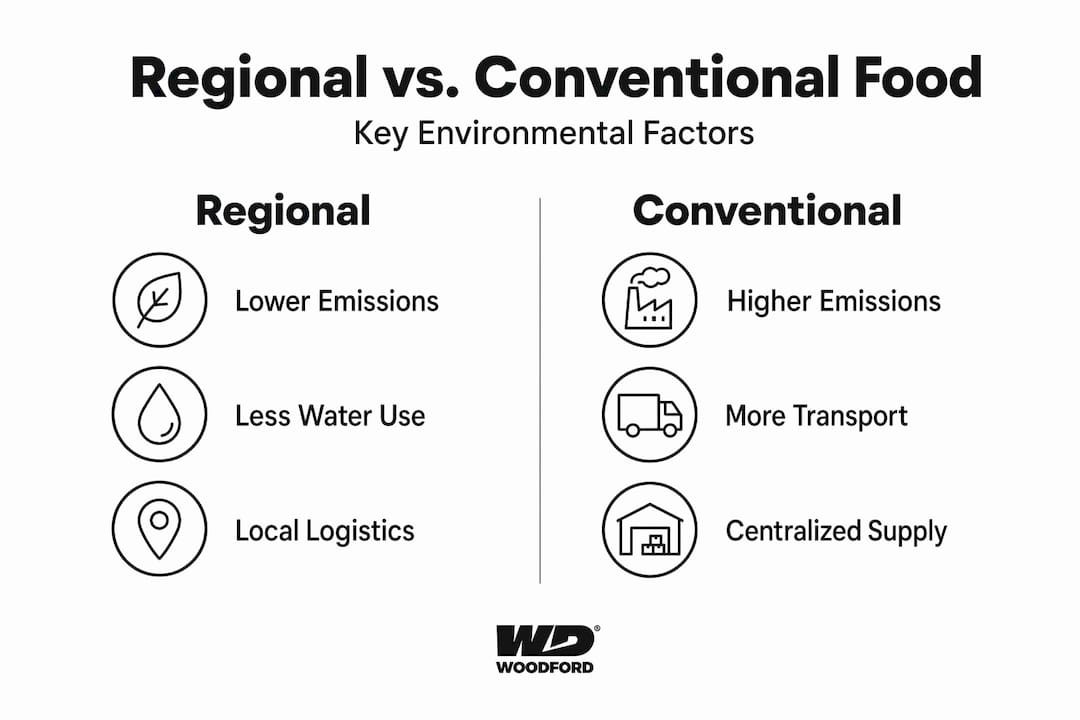
What that means practically is that the environmental benefit of regional food is real but conditional. It depends heavily on transport logistics, cold storage infrastructure, the scale of the operation, and the specific crops being grown. A small farm supplying a single urban market efficiently can outperform a large distributor. A farm supplying the same market using inefficient refrigerated van runs may not.
The insight that sustainability depends on logistics and enabling infrastructure rather than locality alone is one of the most important findings in this space. Goodwill does not move food efficiently. Systems do.
Pro Tip: When evaluating a regional food supplier’s environmental credentials, ask specifically about their distribution model and cold chain infrastructure, not just their postcode. The logistics story matters as much as the origin story.
| Environmental factor | Local food scenario | Conventional baseline |
|---|---|---|
| Water use | Up to 25% lower | Higher across most models |
| Greenhouse gas emissions | Up to 15% lower | Higher, especially in transport |
| Model variability | High, depends on assumptions | More standardised but still variable |
| Infrastructure dependency | Significant | Significant |
The cultural significance of regional food
Nutrition science tends to measure food in calories, macronutrients, and micronutrients. What it consistently underweights is meaning. Regional food culture carries something that a standardised supply chain simply cannot replicate: identity.
The framework of cultural food security addresses exactly this gap. Where conventional food security asks whether people have enough calories and nutrients, cultural food security and sovereignty adds a further dimension: do communities have access to culturally appropriate foods, and do they retain local control over how those foods are produced and distributed? These are political and social questions as much as nutritional ones.
When communities lose access to their traditional foods, the consequences extend well beyond diet. Intergenerational knowledge transmission breaks down. Ceremonies and seasonal practices built around food lose their anchor. The social cohesion that gathers around a shared table, a particular harvest, or a preparation method passed from grandparent to grandchild, erodes quietly.

Nutrition policies that focus solely on caloric adequacy routinely miss this, and the resulting interventions often fail because they do not account for identity and local decision-making. A community that is calorically fed but culturally disconnected from its food system is not food secure in any meaningful sense.
| Perspective | Conventional food security | Cultural food security and sovereignty |
|---|---|---|
| Primary measure | Caloric and nutrient availability | Access to culturally appropriate foods |
| Community role | Recipients of supply | Active decision-makers and custodians |
| Traditional knowledge | Not measured | Central to the framework |
| Political dimension | Largely absent | Explicit: who controls the food system? |
| Resilience indicator | Supply chain stability | Intergenerational food practice continuity |
For chefs, this is directly relevant. The decision to source a heritage grain, a regional cheese, or a traditional cured meat is not just an aesthetic one. It is a decision to keep a food tradition economically viable and therefore alive.
Regional food and nutritional reality
Here is where the “fresh equals nutritious” narrative gets complicated. The importance of local cuisine to health is real, but the mechanism is frequently misunderstood.
Freshness matters, certainly. Nutrient degradation in highly processed and long-distance supply chains is well documented. But a growing body of research points to something more significant: the traditional preparation methods associated with regional food systems often do more for nutrition than mere freshness or reduced travel distance.
Fermentation, soaking, and drying are traditional processing techniques that actively increase nutrient bioavailability. They break down anti-nutritional factors, pre-digest complex compounds, and in some cases synthesise new micronutrients entirely. A fermented grain from a local mill may deliver substantially better nutrition than the same grain consumed fresh without processing. The health benefit, in that case, is about process rather than proximity.
Consider also that traditional food systems depend on regional raw materials, seasonality, and minimal industrial processing. That combination shapes dietary patterns that often align well with both nutrient density and gut health outcomes, though the research cautions strongly that “traditional” does not automatically mean nutritionally superior in every context.
A compelling real-world example comes from healthcare. A pilot programme achieved over 80% regional sourcing within medically tailored meals, benefiting 26 local producers while generating clinical benefits and high patient satisfaction. What made it work was intentional supply chain design and genuine partnerships, not simply swapping one vendor for another. The lessons for chefs and food businesses are clear.
Key considerations when thinking about regional food and nutrition:
- Origin plus preparation together determine nutritional outcome, not origin alone.
- Ancient grains and heritage varieties processed traditionally can offer superior micronutrient profiles compared to modern equivalents.
- Seasonality alignment in regional diets often produces natural dietary variety that supports broader nutrient intake.
- Supply chain transparency matters because knowing the producer means knowing the preparation and storage conditions.
Pro Tip: When designing menus around regional sourcing, ask producers not just where ingredients come from but how they are prepared and stored post-harvest. A traditionally dried or fermented product from a regional supplier may outperform a fresh equivalent nutritionally.
Economic and social benefits of regional food
The economic case for supporting local agriculture is strong, provided the conditions are right. Short food supply chains (SFSCs) create a more direct relationship between producers, distributors, and consumers, and that directness generates value at multiple points simultaneously.
Research into short food supply chains demonstrates economic, environmental, and social benefits including local employment creation, reduced transport emissions, and better market access for smaller producers. Critically, local supply chains can also create more reliable income streams for farmers. When producers are not entirely exposed to global commodity price swings, they can plan investments and maintain quality more consistently.
Community resilience is another dimension that is frequently underestimated. The value of regional foodshed infrastructure connecting farms to cities becomes most visible during disruptions. The Ontario Food Terminal example illustrates how regional distribution infrastructure underpins urban food security precisely when global supply chains face stress from trade disruptions or climate events. That protection cannot be improvised during a crisis. It must already exist.
For independent retailers in the UK, there is a direct practical implication here. Stocking regional food brands is not simply a positioning decision. It is a supply chain resilience decision. As Woodford’s work with strategic food brands for UK independents demonstrates, regional sourcing done well generates authentic product stories that convert reliably at the shelf, while simultaneously building the kind of producer relationships that weather disruption.
The enabling conditions that matter most include:
- Distribution networks scaled appropriately for the region, not just artisan-level direct delivery.
- Wholesale infrastructure that can aggregate produce from multiple small producers efficiently.
- Policy support for regional food systems rather than exclusive focus on national supply standardisation.
- Consumer and buyer education about seasonality, variety, and the economics behind pricing.
Regional food diversity, when supported by the right infrastructure, creates local economies that are both more equitable and more resistant to global shocks. That is a considerable return on the choice of where to source your ingredients.
My perspective on the nuance behind the label
I have spent years working closely with chefs, buyers, and food businesses across the UK supply chain, and the pattern I keep seeing is this: the people most genuinely committed to regional food are also the most precise about it. They do not reach for “local” as a marketing badge. They ask specific questions about variety, preparation, distribution, and producer relationships.
What frustrates me about the popular narrative is how often it collapses into a single variable: distance. As though kilometres travelled were the only number that counted. The science does not support that simplification, and neither does the cultural reality. The most significant meal I have seen on a restaurant menu in recent years was not impressive because the ingredients were grown within twenty miles. It was impressive because the chef understood the heritage variety, sourced it from a producer using traditional preparation methods, and could explain exactly why that combination produced something nutritionally and culinarily distinct.
Regional food systems need infrastructure, investment, and rigorous thinking to function at scale. Goodwill and farmer’s markets are a start, not a solution. The chefs and buyers who understand that distinction are the ones driving real change. The others are buying into a label.
— Nadim
How Woodford supports regional food sourcing
At Woodford, we have built our model around exactly the kind of regional food sourcing that this article describes. Not just proximity, but provenance, preparation, and the producer relationships that make consistent quality possible.
We work with independent retailers across the UK to bring genuinely regional brands into their product mix, with the food distribution infrastructure to make that commercially viable rather than aspirational. Our curation process prioritises brands with clear stories of origin and traditional production, because that is what today’s consumers are willing to pay for and come back to.
If you want to understand how food provenance builds trust and sales in an independent retail context, or you are looking to bring more regional products into your range, Woodford is the partner built for exactly that conversation. Explore our catalogue and find out what genuine regional sourcing looks like at commercial scale.
FAQ
Does local food always have a lower carbon footprint?
Not automatically. LCA studies show that local food scenarios can reduce greenhouse gas emissions by up to 15%, but the outcome depends heavily on distribution logistics and regional infrastructure, not origin alone.
What is cultural food security?
Cultural food security refers to communities having access to foods that reflect their cultural identity and traditions, alongside the local governance to maintain those food systems. It addresses gaps that conventional calorie-based food security metrics consistently miss.
Is traditional food always more nutritious?
Not always, but traditional processing methods such as fermentation and soaking do often enhance nutrient bioavailability significantly. The method of preparation frequently matters more than the food’s origin or how recently it was harvested.
How do short food supply chains benefit local economies?
Short food supply chains create local employment, reduce transport costs, and build more stable income for producers. Research shows they also improve market access for smaller farms and generate measurable social cohesion within communities.
Why does regional food infrastructure matter?
Regional food infrastructure such as wholesale markets and distribution networks is what makes local sourcing scalable and resilient. Without it, urban food security becomes vulnerable during global trade disruptions, regardless of how many local farms exist nearby.
Recommended
- Food provenance: Build trust and boost sales for independents - WOODFORD - Bringing quality foods your way
- Strategic food brands for UK independent retailers - WOODFORD - Bringing quality foods your way
- Ambient food explained: a retailer’s guide to new opportunities - WOODFORD - Bringing quality foods your way
- UK food retailers: lead with 2026’s top food trends - WOODFORD - Bringing quality foods your way