
Why choose wholesale for retailers: a 2026 guide

Wholesale purchasing is defined as buying goods in bulk from an intermediary supplier who sources directly from manufacturers, passing lower per-unit costs to the retailer. For independent retailers, this model is the most reliable route to stronger margins and a more manageable supply chain. Businesses using bulk purchasing saved an average of 15–30% on total inventory costs, according to a 2023 study by the National Retail Federation. That saving compounds quickly across a full product range. Understanding why choose wholesale for retailers comes down to one core truth: buying more for less, from fewer suppliers, with predictable terms, is simply better economics.
Why does wholesale purchasing improve profit margins for retailers?
Retail and wholesale operate on fundamentally different margin structures. Retail profit margins typically run at 40–60% per unit, while wholesale margins sit at 15–25%, relying on volume to stay profitable. For retailers, this gap is the opportunity. Sourcing wholesale means you buy at the lower wholesale price and sell at the higher retail price, capturing that spread as gross profit.
Bulk purchasing amplifies this advantage through economies of scale. When you order larger quantities, your cost per unit falls. That lower base cost gives you room to price competitively without sacrificing margin. It also means you can absorb promotional discounts, offer free delivery thresholds, or fund loyalty incentives without eroding profitability.

Wholesale also provides a pricing cushion against price wars. When a competitor drops prices aggressively, a retailer with a thin direct-to-consumer sourcing model has little room to respond. A retailer buying wholesale already operates at a lower cost base, so matching a competitor’s price cut is far less damaging. This structural advantage is one of the most underappreciated benefits of wholesale buying.
Pro Tip: Track your gross margin per product line, not just overall. Wholesale savings show up unevenly across categories. Identifying which lines benefit most from bulk purchasing lets you prioritise those orders and negotiate harder on volume.
The table below shows how wholesale sourcing affects margin at different price points.
| Retail selling price | Wholesale cost per unit | Gross margin |
|---|---|---|
| £5.00 | £2.50 | 50% |
| £10.00 | £4.50 | 55% |
| £20.00 | £8.00 | 60% |
| £50.00 | £18.00 | 64% |
Margins widen as price points rise, which is why premium product sourcing through wholesale is particularly attractive for independent retailers. Woodford’s wholesale pricing strategies for UK food brands explore this in detail.
What operational efficiencies do retailers gain from wholesale sourcing?
Wholesale sourcing reduces the number of transactions a retailer manages. Instead of placing dozens of small orders with multiple suppliers, you consolidate purchasing into fewer, larger orders with a smaller number of trusted wholesalers. That reduction in transaction frequency cuts administrative time significantly.
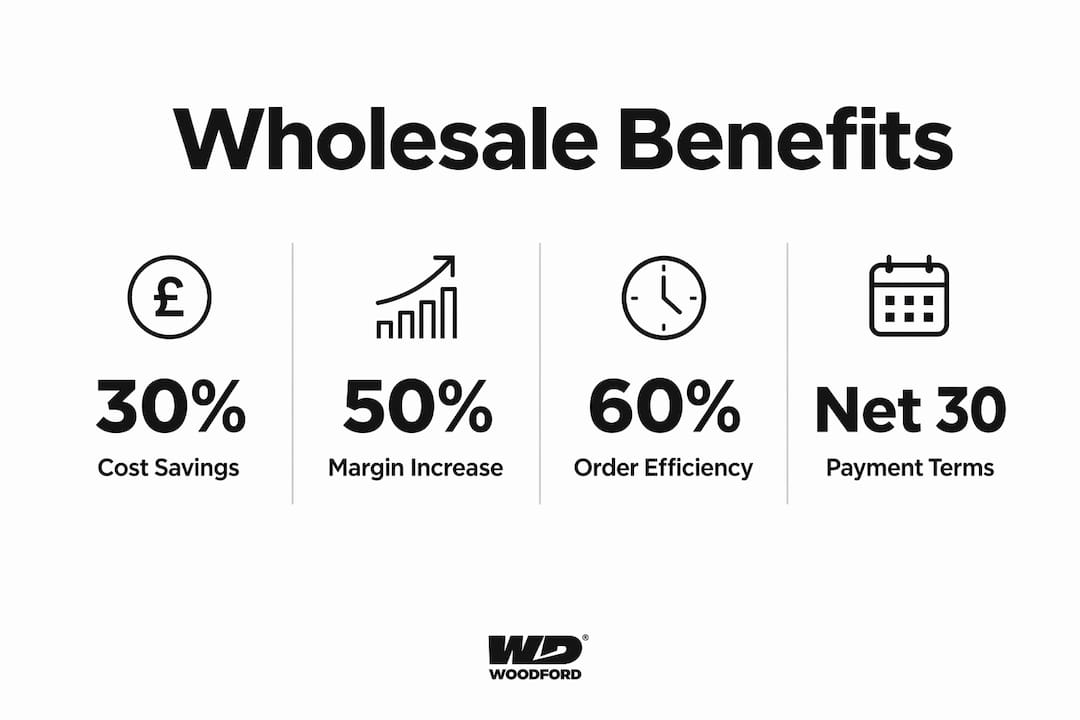
Payment terms like Net 30 or Net 60 are standard in wholesale, and they simplify cash flow planning considerably. You receive stock, sell it, and pay your invoice within a predictable window. Consumer-facing retail payments, by contrast, involve card processing fees, refund disputes, and fragmented reconciliation. Wholesale B2B terms are cleaner and far easier to manage at scale.
Logistics also become more predictable. Bulk orders mean fewer deliveries, lower shipping costs per unit, and more consistent lead times. For food retailers in particular, this matters enormously. Woodford’s guide to wholesale logistics for UK retailers outlines how consolidated ordering reduces both cost and complexity in the supply chain.
The operational benefits of wholesale sourcing include:
- Fewer supplier relationships to manage, reducing time spent on procurement administration
- Predictable payment terms that make cash flow forecasting more accurate
- Consolidated deliveries that lower per-unit shipping costs and reduce handling time
- Simplified stock replenishment, with bulk orders reducing the frequency of reordering cycles
- Better storage utilisation, as consistent bulk orders allow for planned warehouse or stockroom layouts
Wholesale inventory planning works best when it is treated as a cross-department process, with buying, finance, and operations aligned on stock levels and budgets. That collaborative approach turns bulk purchasing from a simple cost saving into a genuine operational advantage.
How do retail-wholesale relationships affect sourcing advantages?
The price on a wholesaler’s catalogue is rarely the final price. Wholesale success is highly relationship-driven, and retailers who invest in building trust with their suppliers consistently secure better rates, priority stock access, and exclusive product lines. A wholesaler who knows your buying patterns and business goals will work with you, not just process your orders.
Long-term relationships also unlock market intelligence. Experienced wholesalers carry deep knowledge of category trends, seasonal demand shifts, and emerging brands. That knowledge is genuinely valuable for independent retailers who lack the research budgets of larger chains. A good wholesale partner functions as a market consultant as much as a supplier.
Wholesale also enables horizontal scaling. Retailers can add related accessories or complementary products through wholesale sourcing, increasing average order value without needing to develop new supplier relationships from scratch. A food retailer stocking artisan condiments, for example, can extend into premium crackers, chutneys, or gift sets through the same wholesale channel.
Pro Tip: Share your sales data with your wholesale supplier before negotiations. Showing a wholesaler your volume history and growth trajectory gives them a commercial reason to offer you better terms. Treat it as a business conversation, not just a price discussion.
Data-backed planning strengthens these relationships further. When you arrive at a negotiation with clear purchasing history, projected volumes, and category performance data, you signal that you are a serious, predictable buyer. That credibility translates directly into better deals.
What challenges should retailers consider when choosing wholesale suppliers?
Wholesale buying is not without risk. The advantages of bulk purchasing come with real trade-offs that retailers must plan for carefully.
Minimum order quantities are the most common barrier. Wholesalers set minimum thresholds to make bulk pricing viable on their end. For smaller retailers, meeting those minimums can require significant upfront capital, particularly when launching a new product line or testing an unfamiliar category.
Key challenges to weigh before committing to wholesale sourcing:
- Overstocking risk: ordering too much of a slow-moving line ties up cash and storage space
- Supplier reliability: a single supplier disruption can leave shelves empty if you have no backup source
- Demand forecasting accuracy: bulk orders require confidence in your sales projections, which newer retailers may lack
- Single-supplier dependence: relying on one wholesaler for a core category creates vulnerability if that relationship breaks down
- Lead time variability: some wholesalers have longer or less consistent lead times, which complicates just-in-time stock management
Mitigating these risks requires a combination of demand forecasting, diversified sourcing, and clear supplier agreements. Reviewing types of food wholesalers available to grocery and speciality retailers helps you understand which supplier models suit your volume and category needs. For foodservice operators, understanding how to procure bulk commercial cooking appliances illustrates how the same wholesale principles apply across different retail and hospitality contexts.
How to select and negotiate with wholesale suppliers effectively
Choosing the right wholesale supplier is as important as the decision to buy wholesale at all. A poor supplier relationship will erode every margin advantage the model offers.
- Assess price competitiveness across your core categories. Request quotes from at least two or three wholesalers for the same products. Price differences between suppliers on identical lines are often larger than retailers expect.
- Evaluate product range depth. A wholesaler with a broad, curated range reduces the number of supplier relationships you need to manage. Woodford, for example, specialises in trend-led food brands suited to independent UK retailers, which means fewer sourcing conversations for a wider product selection.
- Check reliability and fulfilment rates. Ask prospective suppliers for their order fulfilment accuracy rates and average lead times. A cheap supplier who regularly ships late or short is more expensive in practice than a slightly pricier reliable one.
- Prepare your purchasing data before any negotiation. Retailers who approach wholesalers with clear catalogue scans and purchasing history identify profitable deals faster and negotiate from a position of knowledge rather than guesswork.
- Negotiate for exclusivity on key lines. If a product is central to your offer, ask whether the wholesaler can provide regional or category exclusivity. This is more achievable than most retailers assume, particularly with smaller or emerging brands.
- Build in review points. Agree on quarterly performance reviews with your main suppliers. These conversations keep terms competitive and give you a structured opportunity to renegotiate as your volume grows.
Ongoing communication is the factor most retailers underestimate. Flexible, collaborative inventory planning with your wholesaler, adjusting stock levels and budgets in response to real sales data, produces better outcomes than rigid annual purchasing plans.
Woodford: wholesale sourcing built for independent retailers
Woodford works with independent UK retailers who want access to premium, trend-led food brands without the complexity of managing dozens of direct supplier relationships. As the UK’s leading strategic food wholesaler, Woodford curates a product range built around what independent retailers actually sell, not what large multiples demand. The ordering process is straightforward, the logistics are handled, and the product selection reflects where the UK food market is heading. Retailers looking to maximise profit through bulk food buying will find Woodford’s model designed precisely for that goal. For a full view of what Woodford offers independent retailers, visit woodford.food.
Key takeaways
Wholesale purchasing is the most cost-effective sourcing model for independent retailers because it combines lower per-unit costs, predictable payment terms, and relationship-driven advantages that compound over time.
| Point | Details |
|---|---|
| Margin advantage | Bulk purchasing saves retailers 15–30% on inventory costs, directly widening gross margins. |
| Operational simplicity | Net 30/60 payment terms and consolidated orders reduce admin and improve cash flow forecasting. |
| Relationship value | Long-term wholesaler relationships unlock better rates, exclusive lines, and market intelligence. |
| Risk management | Diversifying across multiple wholesalers and forecasting demand reduces overstocking and supply disruption. |
| Supplier selection | Prepare purchasing data before negotiations to secure better terms and identify the most profitable deals. |
FAQ
What are the main benefits of wholesale buying for retailers?
Wholesale buying reduces per-unit costs through bulk purchasing, simplifies supply chain management, and provides predictable payment terms. Retailers typically save 15–30% on inventory costs compared with sourcing smaller quantities.
How does wholesale sourcing affect retail profit margins?
Retail profit margins run at 40–60% per unit, while wholesale purchase prices are set at the 15–25% margin level. Retailers capture the difference between their wholesale cost and retail selling price as gross profit.
What should retailers look for when choosing wholesale suppliers?
Retailers should assess price competitiveness, product range depth, fulfilment reliability, and payment terms. Preparing purchasing history data before approaching a supplier leads to faster deal identification and stronger negotiation outcomes.
How do minimum order quantities affect smaller retailers?
Minimum order quantities require upfront capital investment and can create overstocking risk if demand forecasting is inaccurate. Smaller retailers should start with wholesalers whose minimums align with their current sales volumes and scale orders as turnover grows.
Why do retailers prefer wholesale over direct-to-consumer sourcing?
Wholesale offers lower per-unit costs, fewer supplier relationships to manage, and a structural pricing advantage that protects margins during competitive price pressure. The operational simplicity of B2B payment terms also reduces administrative overhead significantly.


