
Why adopt seasonal product lines: a retailer's guide

Seasonal product lines are defined as time-limited collections tied to calendar periods, harvests, cultural events, or shifting consumer habits. Retailers and food brand owners who adopt seasonal product lines gain three measurable advantages: more stable revenue across the year, stronger customer engagement through novelty, and better alignment between production capacity and real demand. The UK food sector is particularly well placed to benefit, given the depth of British food culture around events from Christmas to summer barbecue season. This guide covers the financial, behavioural, and operational case for seasonal collections, plus the practical steps to execute them well.
Why adopt seasonal product lines for financial performance
Seasonal product lines stabilise cash flow by smoothing revenue spikes and using production capacity more consistently across the year. That matters because relying on a single high-stakes revenue window, such as Christmas or Easter, creates fragile income streams that leave retailers exposed when one season underperforms.
The operational benefits are equally significant. When you plan production around a seasonal calendar, you avoid the costly chaos of last-minute orders, expedited shipping, and emergency stock purchases. Seasonal demand forecasting enables retailers to align inventory with real demand, cutting overstock, markdowns, and waste. A well-forecasted seasonal range means you order the right volume at the right time, rather than gambling on a single bulk buy.

Inventory alignment also reduces the need for costly financing. Many seasonal businesses rely on unplanned borrowing to cover peak inventory build, which increases costs. Structured seasonal financing tools such as pre-approved overadvances size borrowing capacity to match peak demand, replacing reactive and expensive credit with planned capital. Retailers who build this into their seasonal strategy protect margins rather than eroding them.
Key financial benefits of seasonal product lines include:
- Revenue smoothing: Multiple seasonal peaks replace a single high-risk window.
- Production efficiency: Planned capacity use reduces idle time and rush costs.
- Inventory control: Forecasting reduces markdowns and clearance losses.
- Cost avoidance: Planned financing replaces costly reactive borrowing.
Pro Tip: Map your revenue by month for the past two years before building a seasonal calendar. The gaps you find are the seasons you are not yet capitalising on.
What consumer behaviours drive the benefits of seasonal products?
Consumer demand for seasonal products is rooted in three distinct motivations: the desire for novelty, the pull of nostalgia, and a growing preference for nutritional quality. Seasonal limited-time offers disrupt habitual purchasing by giving consumers psychological permission to try something new. That disruption is commercially valuable. It pulls shoppers out of autopilot and creates a moment of genuine engagement with your brand.
Nutritional quality is a concrete, measurable driver. Produce peaks in vitamin content during in-season harvest. Leafy greens lose 50% of their vitamin C within days of being harvested out of season. Shoppers who understand this actively seek seasonal food products, and food brands that communicate this advantage build real credibility.
Sustainability is the third pillar. Seasonal sourcing reduces resource use including pesticides, artificial ripening agents, and refrigeration energy, which lowers the carbon footprint of the product. For independent retailers, this is a genuine point of difference against large supermarkets that stock the same imported produce year-round. Pairing seasonal lines with sustainable nutrition messaging strengthens both the environmental and commercial case.
Consumer motivations that seasonal lines address:
- Novelty and discovery: Limited availability creates urgency and excitement.
- Nostalgia: Seasonal flavours and formats trigger emotional memories tied to time of year.
- Nutritional quality: In-season produce delivers higher vitamin and mineral content.
- Environmental values: Seasonal sourcing aligns with growing consumer concern about food miles and resource use.
“Seasonal products serve as cultural touchstones, offering brands opportunities to flex creativity and create consumer memories, deepening loyalty.” — Symrise Insight Report
What practical strategies help implement seasonal lines effectively?
Effective seasonal product strategy begins with a product calendar built at least six months in advance. Retailers who plan this far ahead can secure production capacity before demand peaks and supply chains tighten. Acting early is not just good practice. It directly protects your margins by avoiding expedited shipping costs and crowded supplier queues.
A practical implementation process looks like this:
- Audit past sales data. Identify which months show demand spikes and which show troughs. Use this to prioritise which seasons to target first.
- Select categories with proven repeat demand. Successful seasonal categories show repeated demand signals over multiple years. Avoid chasing short-term hype with unproven products.
- Build your supplier relationships early. Contact suppliers in the season before you need stock. Early engagement secures better pricing, priority allocation, and production slots.
- Create a marketing timeline. Launch campaigns four to six weeks before the seasonal window opens. Tease limited availability to build anticipation rather than announcing at the point of sale.
- Set clear stock limits. Defined limits create genuine scarcity, which drives purchase urgency. They also protect you from overordering and the markdowns that follow.
- Review and iterate. After each seasonal cycle, record what sold, what did not, and what margin you achieved. Use this to refine the next cycle rather than starting from scratch.
Pro Tip: Treat your seasonal product calendar as a living document. Review it quarterly and adjust based on supplier lead times, emerging food trends for 2026, and shifts in consumer interest.
Timing your marketing campaigns is as important as timing your stock. Retailers who launch seasonal promotions too late miss the anticipation window that drives pre-purchase decisions. Pair limited-time offers with food marketing strategies that emphasise scarcity and seasonal story to maximise conversion.
How can brands stay relevant outside peak seasons?
Brands that disappear between peak seasons pay a real commercial penalty. Losing shelf space and consumer mindshare during off-seasons makes re-entry harder and more expensive each time. Retailers who drop a brand from their shelves in January rarely rush to reinstate it in March without a compelling reason.
The answer is a year-round seasonal strategy built on micro-seasons and cultural moments. Rather than targeting only Christmas and summer, brands can build ranges around Valentine’s Day, Veganuary, British Food Fortnight, Bonfire Night, and Ramadan. Each of these moments carries genuine consumer interest and creates a reason to engage.
| Seasonal moment | Timing | Product opportunity |
|---|---|---|
| Veganuary | january | Plant-based limited editions |
| Valentine’s Day | february | Premium gifting formats |
| British Food Fortnight | september | Provenance-led British produce |
| Bonfire Night | october | Warming flavours, comfort foods |
| Advent and Christmas | november to december | Gifting, indulgence, festive formats |
Year-round seasonal relevance also protects retailer relationships. Independent retailers value suppliers who bring them niche food categories and fresh reasons to engage customers throughout the year. A brand that shows up with a new seasonal story every quarter is far easier to keep on shelf than one that only calls in october.
Year-round seasonal innovation also reduces the financial risk of any single season underperforming. When your revenue is spread across six or eight seasonal moments rather than two, a warm December or a wet August does not threaten the whole year.
Key takeaways
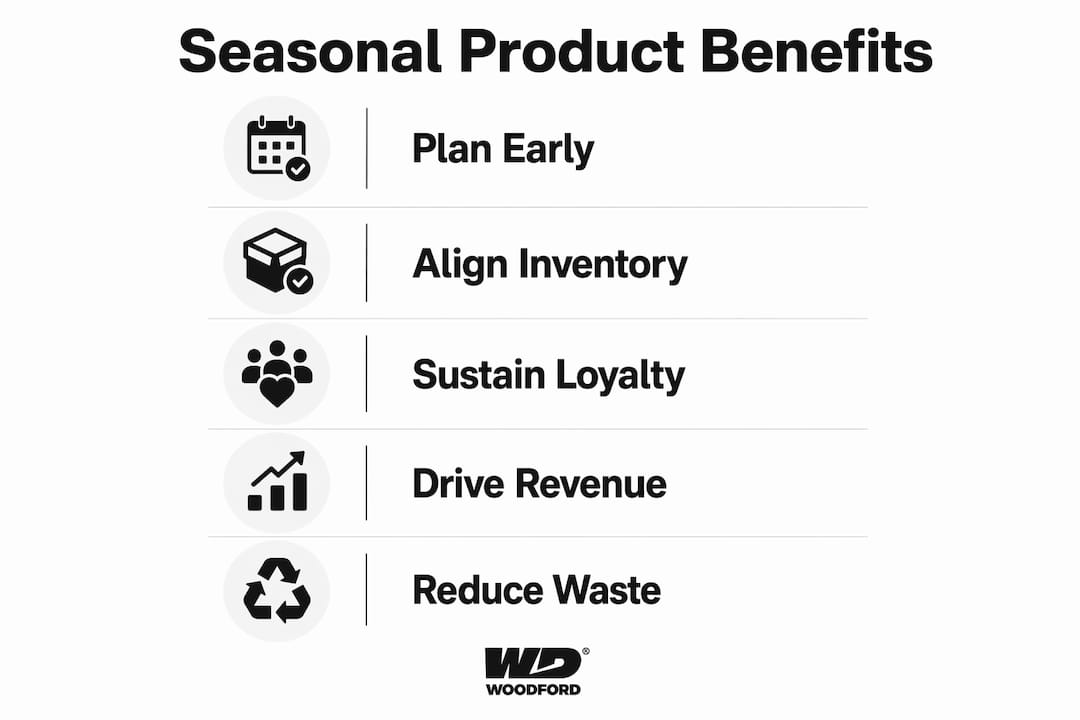
Seasonal product lines deliver the strongest results when brands plan early, align inventory with real demand, and maintain market presence across multiple seasonal moments throughout the year.
| Point | Details |
|---|---|
| Revenue stability | Multiple seasonal peaks replace a single high-risk window, smoothing annual cash flow. |
| Consumer engagement | Limited-time seasonal offers disrupt habitual buying and create genuine brand moments. |
| Nutritional and sustainability edge | In-season produce carries higher vitamin content and a lower environmental footprint. |
| Early supplier action | Securing production capacity before peak demand protects margins and execution quality. |
| Year-round presence | Brands that use micro-seasons avoid re-entry penalties and maintain retailer shelf space. |
How Woodford helps retailers build seasonal product strategies
Woodford works with independent retailers and food brand owners across the UK to bring quality seasonal food brands to shelf at the right time. As the UK’s leading food wholesaler, Woodford curates trend-led ranges that align with seasonal demand, handles logistics, and supports retailers in planning inventory around the moments that matter. Whether you are building your first seasonal calendar or extending an existing range into new cultural moments, Woodford provides the brands, the distribution, and the market knowledge to make it work. Reach out to Woodford to find out which seasonal lines are available for your shop right now, and how to manage food inventory more profitably across the year.
FAQ
Why adopt seasonal product lines rather than stocking year-round ranges?
Seasonal product lines create purchase urgency through limited availability, which drives higher conversion rates than permanent ranges. They also allow retailers to align stock with real demand, reducing overstock and markdowns.
How far in advance should retailers plan seasonal product lines?
Retailers should plan at least six months ahead. Early planning secures supplier capacity before demand peaks, avoids expedited shipping costs, and allows time to build marketing campaigns that open before the seasonal window.
Do seasonal products improve customer loyalty?
Seasonal limited-time offers create emotional associations and memories tied to specific times of year, which deepens brand loyalty. Consumers who associate a brand with a positive seasonal experience are more likely to return the following year.
What are the sustainability benefits of seasonal food products?
Seasonal sourcing reduces the need for artificial ripening, long-distance refrigerated transport, and heavy pesticide use. This lowers the carbon footprint of the product and aligns with the environmental values of a growing segment of UK food shoppers.
How do brands avoid losing shelf space between peak seasons?
Brands maintain shelf presence by building ranges around micro-seasonal moments such as Veganuary, British Food Fortnight, and Bonfire Night. Year-round seasonal activity removes the re-entry penalty that comes from disappearing between major peaks.


