
What is food wholesaler accreditation: 2026 guide
Food wholesaler accreditation is the formal recognition that a wholesaler meets mandatory regulatory requirements and voluntary quality standards to legally operate and trade with confidence. The term covers two distinct categories: government licences that every wholesaler must hold, and voluntary certifications such as BRCGS, SQF, and IFS that signal quality to buyers. Understanding what is food wholesaler accreditation matters whether you run an established distribution business or are entering the sector for the first time. The requirements, the process, and the ongoing obligations are all manageable once you know what each category demands and why retailers increasingly treat voluntary certification as a non-negotiable condition of trade.
What is food wholesaler accreditation and what types exist?
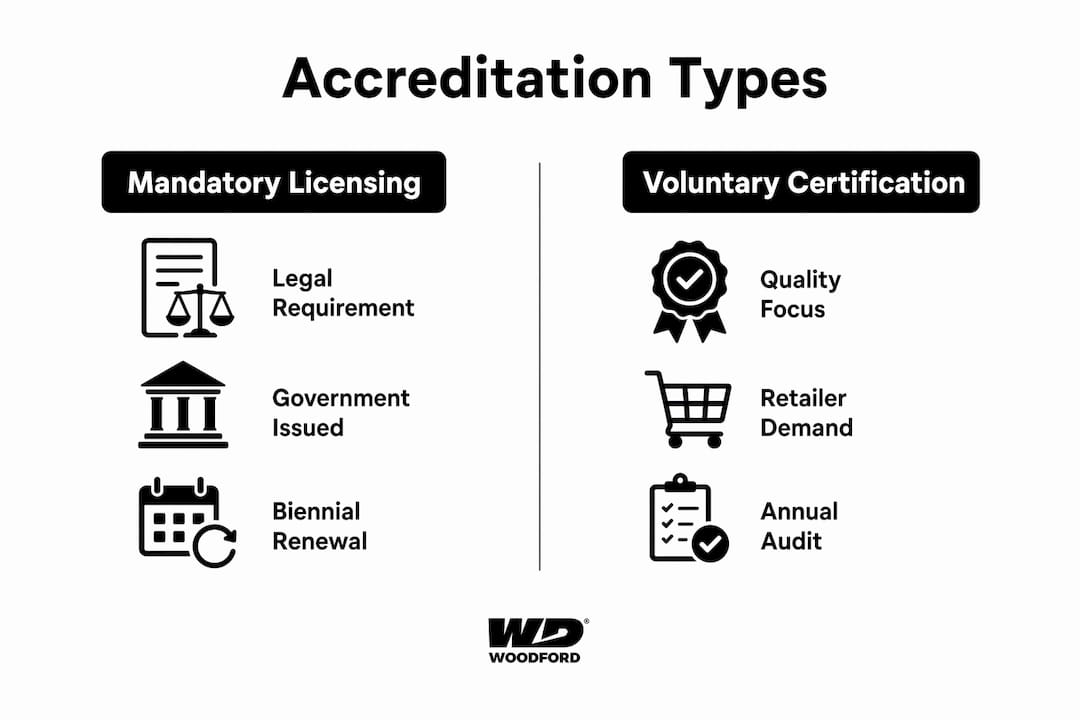
Food wholesaler accreditation divides cleanly into two categories: mandatory regulatory licensing and voluntary quality assurance certification. Each serves a different purpose, and most serious wholesalers need both.
Mandatory regulatory licensing covers the legal minimum. Food wholesalers must register with regulatory agencies and obtain local health permits before they can legally operate. In the UK, registration with your local authority Environmental Health department is required. In the United States, FDA registration applies to facilities that manufacture, process, pack, or hold food. These licences vary by jurisdiction but share one characteristic: without them, you cannot trade.

Voluntary quality certifications go further. Schemes such as BRCGS (Brand Reputation through Compliance Global Standards), SQF (Safe Quality Food), and IFS (International Featured Standards) are recognised under the Global Food Safety Initiative, known as GFSI. They are not legally required, but retailers including Tesco, Walmart, and Starbucks expect GFSI-recognised certifications from their suppliers. That commercial reality makes voluntary certification effectively mandatory for any wholesaler seeking growth.
The IFS Wholesale and Cash & Carry scheme is worth noting specifically. Its inclusion under IAF MLA as of june 2025 means businesses can use a single certification to satisfy compliance requirements across multiple markets. That reduces both cost and administrative burden considerably.
| Feature | Mandatory regulatory licensing | Voluntary quality certification |
|---|---|---|
| Legal requirement | Yes | No |
| Examples | FDA registration, local health permits | BRCGS, SQF, IFS |
| Renewal cycle | Typically every 2 years | Annual surveillance, full re-assessment every 3 years |
| Issued by | Government agencies | Third-party certification bodies |
| Market access impact | Permits basic operation | Unlocks major retail and foodservice buyers |
For a broader view of how different types of food wholesalers structure their compliance obligations, the distinctions above become even clearer in practice.
What does the food accreditation process involve?
The food accreditation process follows a defined sequence. Typical certification involves eight steps, from choosing the right scheme through to maintaining your certificate after the initial audit.
- Select your scheme. Choose a GFSI-recognised standard that fits your geography and customer base. BRCGS is dominant in the UK and Europe. SQF carries strong recognition in North America. IFS suits businesses trading across multiple European markets.
- Study the standard. Obtain the current version of your chosen scheme and read it in full. Each standard specifies exact requirements for documentation, hygiene, traceability, and management systems.
- Conduct a gap assessment. Compare your current operations against the standard’s requirements. This step identifies where your business falls short before any auditor visits.
- Develop your Food Safety Management System (FSMS) and HACCP plan. An FSMS is the documented framework covering all food safety controls. HACCP (Hazard Analysis and Critical Control Points) is the risk-based methodology within it that identifies and controls biological, chemical, and physical hazards.
- Train your staff. Every person involved in food handling, storage, or documentation must understand their role within the FSMS. Auditors assess staff knowledge directly.
- Select a certification body. Choose an accredited third-party auditor approved to assess your chosen scheme. UKAS-accredited bodies are the standard in the UK.
- Undergo the on-site audit. Audits typically last 1–3 days depending on the size and complexity of your operation. The auditor reviews documentation, inspects facilities, and interviews staff.
- Maintain your certification. Certification is not a one-time event. Annual surveillance audits and a full re-assessment every three years are required to keep your certificate active.
Pro Tip: Commission a professional gap assessment before you apply. Pre-audit gap assessments significantly reduce the likelihood of failing your initial certification. Identifying non-conformities yourself costs far less than a failed audit and the delay it creates.
Developing a sound FSMS is the most time-consuming part of the process. A well-structured food wholesaling workflow makes HACCP implementation considerably more straightforward, because your processes are already documented and consistent.
What are the benefits of food wholesaler accreditation?
Accreditation delivers value well beyond a certificate on the wall. The benefits fall into three areas: risk management, market access, and credibility.
Risk management is the most underappreciated benefit. Accreditation acts as a critical risk-management tool that protects wholesalers from costly product recalls and the loss of buyer trust. A single recall event can cost a business its most important retail relationships. Certified wholesalers have documented controls that make recalls less likely and responses faster when issues do arise.
Market access is the most commercially visible benefit. Major retailers treat GFSI certification as a baseline requirement, not a differentiator. Without it, you are simply not considered. With it, you can approach buyers at Tesco, Costco, or any major foodservice operator with a credible compliance record behind you.
Credibility and trust compound over time. Buyers who see a current BRCGS or SQF certificate know that a third party has independently verified your operations. That verification carries more weight than any self-declared quality claim.
Tangible benefits for accredited wholesalers include:
- Access to major retail and foodservice supply chains
- Reduced insurance premiums in many cases, as documented food safety controls lower risk profiles
- Faster onboarding with new buyers who require less due diligence from certified suppliers
- A structured framework for identifying and fixing operational weaknesses before they become costly problems
- Stronger negotiating position when discussing contracts and pricing with buyers
“Certification bodies provide more than a pass or fail verdict. Their detailed audit reports act as operational roadmaps, identifying non-conformities that, once addressed, genuinely improve how a business runs.”
That last point matters more than most wholesalers initially realise. The audit process is not just an external check. It is a structured review that surfaces problems you may not have noticed internally. Businesses that treat certification as a genuine improvement tool rather than a compliance box to tick get the most from the process.
For a deeper look at how compliance builds competitive advantage in UK food wholesale, the relationship between accreditation and long-term business performance becomes clear.
What are the ongoing requirements for maintaining accreditation?
Initial certification is the beginning, not the end. Ongoing compliance is mandatory, and many businesses underestimate the commitment required after their first certificate is issued.
Annual surveillance audits check that your operations continue to meet the standard between full re-assessments. These are shorter than the initial audit but still rigorous. A full re-assessment occurs every three years and covers your entire operation from scratch. Missing either triggers suspension or withdrawal of your certificate.
The most common reason businesses fail audits is not a lack of knowledge. The most frequent failures arise from a gap between what written procedures say and what staff actually do. A documented hygiene procedure that nobody follows is worse than no procedure at all, because it signals to an auditor that your management system is not embedded in daily practice. Temperature control records that are incomplete or backdated are a classic example of this failure mode.
Maintaining accreditation requires three consistent habits:
- Align documentation with practice. Review your SOPs regularly and update them whenever your processes change. Never let a written procedure drift out of step with reality.
- Conduct internal audits. Schedule internal reviews between surveillance visits. Treat them with the same seriousness as an external audit.
- Train continuously. Staff turnover is a compliance risk. New employees need induction training on food safety procedures before they handle product.
Pro Tip: Book an advisory or pre-surveillance visit from your certification body six to eight weeks before your annual audit. These visits identify gaps while you still have time to fix them, and they signal to your auditor that your business takes continuous improvement seriously.
Businesses that build a genuine culture of food safety monitoring find that surveillance audits become routine rather than stressful. The goal is for your daily operations to be audit-ready at any time, not just in the weeks before a scheduled visit. Exploring premium food wholesale practices shows how the best operators embed compliance into every stage of their supply chain.
Woodford and accredited food wholesaling
Woodford operates as the UK’s leading food wholesaler, working with independent retailers and food brands that take quality and compliance seriously. Every brand in the Woodford portfolio is selected with food safety standards and buyer requirements in mind. That means the businesses Woodford works with benefit from a distribution partner that understands accreditation requirements from the inside, not just in theory. If you are looking for a wholesale partner whose operations align with the standards your buyers expect, explore Woodford’s brand portfolio to see the quality and range on offer. Working with an accredited wholesale partner removes a significant layer of due diligence from your supply chain.
Key takeaways
Food wholesaler accreditation requires both mandatory regulatory licensing and voluntary quality certification to satisfy legal obligations and meet the commercial expectations of major retail buyers.
| Point | Details |
|---|---|
| Two distinct categories | Mandatory licences permit legal operation; voluntary certifications like BRCGS and SQF unlock major retail buyers. |
| Eight-step process | From scheme selection and gap assessment through to on-site audit and ongoing surveillance. |
| Annual and triennial reviews | Surveillance audits occur every year; full re-assessments are required every three years. |
| Common failure point | Gaps between documented procedures and actual daily practice cause most audit failures. |
| Commercial necessity | Retailers including Tesco and Walmart require GFSI-recognised certification, making voluntary schemes effectively mandatory for growth. |
FAQ
What is food wholesaler accreditation?
Food wholesaler accreditation is the formal recognition that a wholesaler meets both mandatory regulatory requirements and voluntary quality standards. It covers government licences such as FDA registration and voluntary certifications such as BRCGS, SQF, and IFS.
How long does the accreditation process take?
The timeline varies, but most businesses take several months to prepare their FSMS and HACCP documentation before an audit. The on-site audit itself typically lasts 1–3 days depending on the size of the operation.
Are voluntary certifications legally required for food wholesalers?
Voluntary certifications are not legally required, but major retailers including Tesco, Walmart, and Starbucks require GFSI-recognised certification from their suppliers. That commercial pressure makes them effectively mandatory for wholesalers seeking to grow.
How often do food wholesalers need to renew their accreditation?
Mandatory government licences typically renew every two years. Voluntary quality certifications require annual surveillance audits and a full re-assessment every three years to remain valid.
What causes most food wholesaler audit failures?
The most common cause of audit failure is a mismatch between written standard operating procedures and actual daily practices, particularly in hygiene and temperature control. Pre-audit gap assessments help identify and resolve these issues before the formal audit.


