What is food trend curation: a professional guide
TL;DR:Food trend curation uses AI and multiple data sources to identify, validate, and prioritize emerging culinary trends.Trend cycles now last under three months, demanding faster decision-making and structured menu planning.
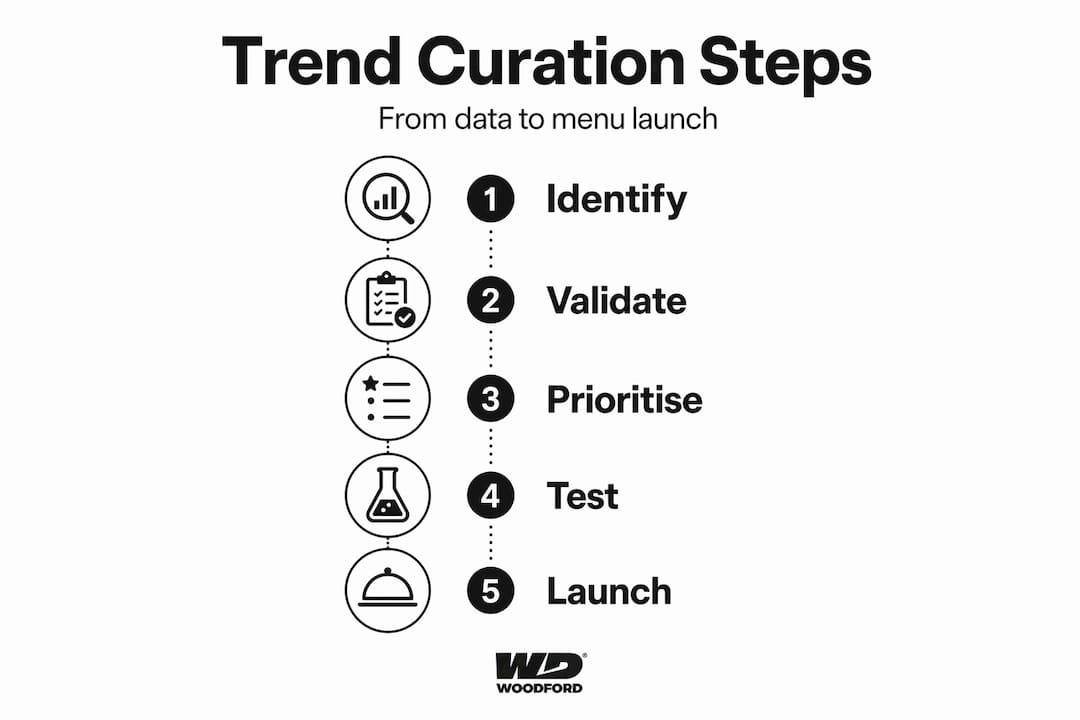
Food trend curation has moved well beyond flicking through trade magazines and calling a meeting. Today, what is food trend curation is a structured, data-intensive discipline that uses AI to analyse billions of data points across social media, menus, retail channels, and consumer reviews, flagging emerging signals before they reach mainstream awareness. For chefs, menu planners, and food industry professionals, understanding this process is no longer a luxury. It is the difference between capturing a profitable moment and spending margin on a trend that peaked three weeks ago.
Table of Contents
- Key takeaways
- What food trend curation actually means
- Why trend cycles are shrinking
- Practical workflows for menu planning
- Common pitfalls and how to avoid them
- The future of food trend curation
- My take on trend curation
- How Woodford supports your trend strategy
- FAQ
Key takeaways
| Point | Details |
|---|---|
| Curation is not guesswork | Modern food trend curation uses cross-source AI analysis to validate trends before committing budget or menu space. |
| Trend cycles are shrinking | 84% of industry respondents expect trend cycles to last under three months, demanding faster decision-making. |
| Menu architecture matters | Structuring menus by role — staples, heroes, halos — protects margins and reduces operational waste. |
| Pitfalls are avoidable | Chasing unvalidated social buzz and ignoring supply chain realities are the two most common and costly mistakes. |
| Systems beat inspiration | Repeatable sprint cycles and data dashboards outperform one-off creative bursts in sustaining trend-led growth. |
What food trend curation actually means
At its core, food trend curation is the process of systematically identifying, validating, and prioritising emerging culinary trends using multiple data sources and structured analytical frameworks. It is not the same as retrospective trend spotting, which involves looking back at what already sold well and labelling it a trend. Curation works forward.
The modern workflow begins with data aggregation. AI tools pull signals from Instagram and TikTok, scan thousands of restaurant menus, monitor retail shelf changes, and process customer reviews. The critical next step is tagging and clustering. AI tagging translates messy consumer language into structured, repeatable themes, which allows analysts and chefs to spot micro-trends earlier and with far greater reliability than manual monitoring ever could.
Data sources feeding a strong curation process include:
- Social media signals: Volume and velocity of mentions, hashtag growth rates, and cross-platform replication
- Menu scanning: Frequency and geographic spread of ingredients or dishes appearing on new menus
- Retail and sales data: Rate of new product launches and shelf placement shifts in supermarkets and speciality shops
- Customer reviews and reservations: Sentiment shifts, wait-time data, and repeat visit patterns
- Waste data: Which items are being returned or left on plates, a frequently overlooked but telling signal
These data streams are organised using taxonomies. A well-built taxonomy might classify trends by ingredient, flavour profile, occasion, format, or dietary driver. This layered structure enables a trend like “fermented vegetables” to appear not just as a single data point, but as a validated pattern across ingredient sourcing, menu appearance, and social conversation simultaneously.
Pro Tip: Cross-validate any trend across at least three distinct data sources before committing to it. A single viral moment on social media is not a reliable indicator of genuine demand.
Why trend cycles are shrinking
The window between a trend emerging and it feeling dated has collapsed. Trend lifecycles now typically last under three months, with 36% of industry respondents reporting cycles as short as one month. This is not a temporary blip. It reflects a structural change in how consumers discover, share, and discard food experiences.
The practical implication is stark. A chef who spots a validated trend today may have eight to ten weeks to design, source, test, and launch a menu response before the peak demand window closes. Traditional planning cycles built around six-month lead times are structurally incompatible with this reality.
“Success comes from timing and adaptability, not trying to build permanent long-lasting trends.” — Insight Trends World
Agile operators are responding with limited-run specials and seasonal “hero” dishes that are explicitly positioned as time-bound. A street food concept might launch a kimchi butter corn feature for six weeks, supported by specific social content, then retire it cleanly. This approach manages customer expectations honestly and avoids the operational drag of carrying items past their commercial peak.
The risk on the other side is real. Chasing viral but unvalidated trends is one of the most expensive habits in the industry. A single TikTok video showing a niche ingredient does not constitute demand. Without cross-source validation, kitchens end up over-ordering, training staff on dishes that never sell, and cluttering menus with items that confuse rather than attract. Understanding food trends through multiple data lenses is what separates sustainable agility from reactive panic.
Practical workflows for menu planning
Knowing what food trend curation is matters far less than knowing how to apply it. The most effective operators translate trend insights into structured planning cycles rather than ad hoc creative decisions.
A four-week sprint cycle is the practical gold standard for menu updates. The framework works as follows:
- Week one: supply confirmation. Verify that the ingredients underpinning the trend are available at volume and acceptable margin from current or new suppliers.
- Week two: test and cost. Develop dishes in the kitchen, run sensory tests, and calculate food cost percentages against target margins.
- Week three: train and prepare. Brief front-of-house and back-of-house teams. Build the marketing materials and social content for launch.
- Week four: launch and monitor. Release the new items and track performance against pre-agreed metrics from day one.
This sprint aligns neatly with farmer release calendars and seasonal availability, which reduces sourcing risk considerably.
Menu architecture is equally critical. Treating every dish as equally important is a common and costly mistake. A structured approach assigns each item a commercial role:
| Menu role | Purpose | Success metric |
|---|---|---|
| Staple | Anchors the menu, drives repeat visits | Consistent high volume |
| Traffic driver | Attracts new guests, often price-led | Footfall and cover increases |
| Hero special | Peak seasonal item, commands premium | Revenue per cover |
| Halo item | Signals freshness and creativity | Press mentions, social sharing |
AI price elasticity models help protect margins without pushing prices beyond what guests will bear, and they do this at an item-by-item level, recognising that a signature dish and a side dish respond very differently to price changes.
A well-built data dashboard brings this all together. Effective dashboards integrate review sentiment, check-in volume, reservation lead times, top-selling items, and waste percentages. This combination allows a menu planner to see in near real time where guest preference and operational performance converge or diverge.
Pro Tip: Build your marketing calendar in the same sprint as your menu cycle. Marketing cadence that matches menu changes trains customers to anticipate new releases and drives repeat visits through genuine scarcity messaging.
Common pitfalls and how to avoid them
Even well-resourced teams make predictable mistakes in food trend curation. Recognising them in advance is the fastest way to avoid paying for them.
- Confusing buzz with demand. Relying solely on social signals causes menu misalignment. A dish trending on a food influencer’s feed may have zero resonance in your specific market or demographic. Always cross-reference social data with sales, reservation trends, and local competitor activity.
- Treating the menu as a creative canvas only. Menus serve a commercial function. Every item needs a role, a margin target, and an exit plan. Chefs who design purely for creative expression without data-backed product roles tend to create menus that are interesting but operationally unsustainable.
- Ignoring supply chain realities. Adopting a trend that requires ingredients you cannot source reliably, or at viable cost, turns a promising idea into a procurement headache. Curation must loop in your supply team from the first week of any sprint, not the last.
- Missing the marketing cadence. Launching a trend-led dish without a planned communications schedule means spending on development and getting nothing back in awareness. Teasers, launch storytelling, and scarcity signals all need to be planned in advance.
- Confusing operational complexity with creativity. A dish that requires a new technique, a specialist piece of equipment, and ingredients from three different suppliers adds cost and risk at every step. The best curated food experiences tend to be operationally straightforward beneath their surface sophistication.
Pro Tip: Before launching any trend-led item, score it across three dimensions: guest appeal, operational fit, and margin potential. Menu items tagged by commercial role and scored consistently are far easier to prioritise, defend, and retire when the moment has passed.
The future of food trend curation
The trajectory is clear. AI and cross-source orchestration will only deepen, and trend cycles will continue to shorten, requiring faster and more confident decision-making from operators at every level. The professionals who build systematic curation workflows now will be significantly better positioned than those still relying on intuition and trade press.
Consumer expectations are also shifting in ways that make curation more complex. Diners increasingly want both novelty and familiarity. They want menus that feel current without feeling unstable. This means sustainability must be built into curation from the start, not bolted on. Sourcing transparency, supplier relationships, and waste reduction are not separate concerns from trend adoption. They are part of the same decision.
Investing in data infrastructure and team capability is the practical priority. A chef or analyst who knows how to read a trend dashboard, validate signals, and feed insights into a sprint cycle is worth considerably more to their business than one who relies on inspiration alone.
My take on trend curation
I have worked with enough food teams to know that the hardest shift is not technical. It is psychological. People who care deeply about food tend to be attached to the idea that great menus come from instinct and creativity. And they do, partly. But instinct without data is just expensive guesswork at scale.
What I have seen consistently is that timing beats insight. A team that spots a validated trend two weeks later than a competitor, but executes faster because they have a sprint framework in place, will often win more of the commercial benefit. The framework is the advantage, not the discovery.
The teams that struggle most are those who treat curation as a one-off exercise, something to do before a seasonal menu refresh and then forget. The ones who win make it a rhythm. They review signals weekly, score trends monthly, and adapt menus as a portfolio, not as artwork. That mental shift, from menu as expression to menu as managed product set, is where the real value unlocks.
— Nadim
How Woodford supports your trend strategy
Woodford works with food industry professionals across the UK to connect them with the brands and ingredients that align with current and emerging food trends. Whether you are building a quarterly menu sprint, validating a sourcing decision, or looking for curated wholesale food ranges that reflect where consumer demand is heading, Woodford’s expertise sits squarely at that intersection. Explore the Woodford blog for food businesses for practical guidance on trend analysis and agile menu planning, or speak with the team directly about how distribution and curation can work together for your operation.
FAQ
What is food trend curation?
Food trend curation is the structured process of identifying, validating, and prioritising emerging culinary trends using AI and multiple data sources including social media, menus, retail data, and customer reviews.
How do you curate food trends reliably?
Reliable curation requires cross-validating signals across at least three distinct data sources. A single viral post or social mention does not constitute a validated trend without corroboration from sales, reservations, or menu adoption data.
How long do food trends last now?
Most food trend cycles last under three months, with some as short as one month, making agile sprint-based menu planning more effective than traditional long-cycle development.
What is a menu sprint cycle in trend curation?
A four-week sprint cycle structures trend adoption into supply confirmation, testing and costing, staff training, and launch monitoring, aligning each stage with seasonal availability and supplier schedules.
What are the biggest mistakes in food trend curation?
The most common mistakes are relying on social buzz without cross-source validation, ignoring supply chain constraints, and failing to plan a marketing cadence that matches the menu update cycle.
Recommended
- How to identify food trends: a guide for UK retailers - WOODFORD - Bringing quality foods your way
- Why adapt to food trends: boost independents’ growth - WOODFORD - Bringing quality foods your way
- Discover niche food categories to set your shop apart - WOODFORD - Bringing quality foods your way
- UK food retailers: lead with 2026’s top food trends - WOODFORD - Bringing quality foods your way