What is food traceability? A guide for 2026

TL;DR:Food traceability is the ability to track a food product through every stage of the supply chain using reliable records linking batches, movements, and transformations. It functions as an operational tool for rapid safety responses, targeted recalls, and building consumer trust through transparent provenance data. Effective systems link batch identifiers to origin, processing, and distribution data, enabling quick reconstruction of the product’s journey in compliance with global regulations.
Food traceability is one of those terms the industry throws around constantly, yet its true scope is frequently misunderstood. Most people assume it simply means keeping paperwork. It is far more than that. At its core, food traceability is the ability to track any food product or ingredient through every stage of the supply chain, from field to fork, using reliable records that link batches, movements, transformations, and destinations. Get it right and you have a powerful tool for protecting consumers and your business. Get it wrong and the consequences can be serious.
Key takeaways
| Point | Details |
|---|---|
| Traceability is operational, not administrative | It is a live tool for rapid response to safety incidents, not a filing exercise. |
| Data must be captured at defined events | Key Data Elements recorded at Critical Tracking Events are what make tracing fast and precise. |
| Recall scope depends on batch linkage | Systems that cannot link parent and child batches quickly will always produce overbroad, costly recalls. |
| Compliance requirements are tightening globally | FSMA 204, BRC, IFS, and Australian food law all demand structured, retrievable traceability records. |
| Consumer trust follows transparency | Clear provenance data and traceability records build credibility with retailers and end consumers alike. |
What is food traceability? Definition and scope
The industry term most professionals use alongside “food traceability” is supply chain traceability, and the two are closely related. Food traceability, specifically, refers to the capacity to reconstruct the complete history of a food product by following documented evidence across three core questions: what entered the business, what happened to it during processing or handling, and what left and where it went.
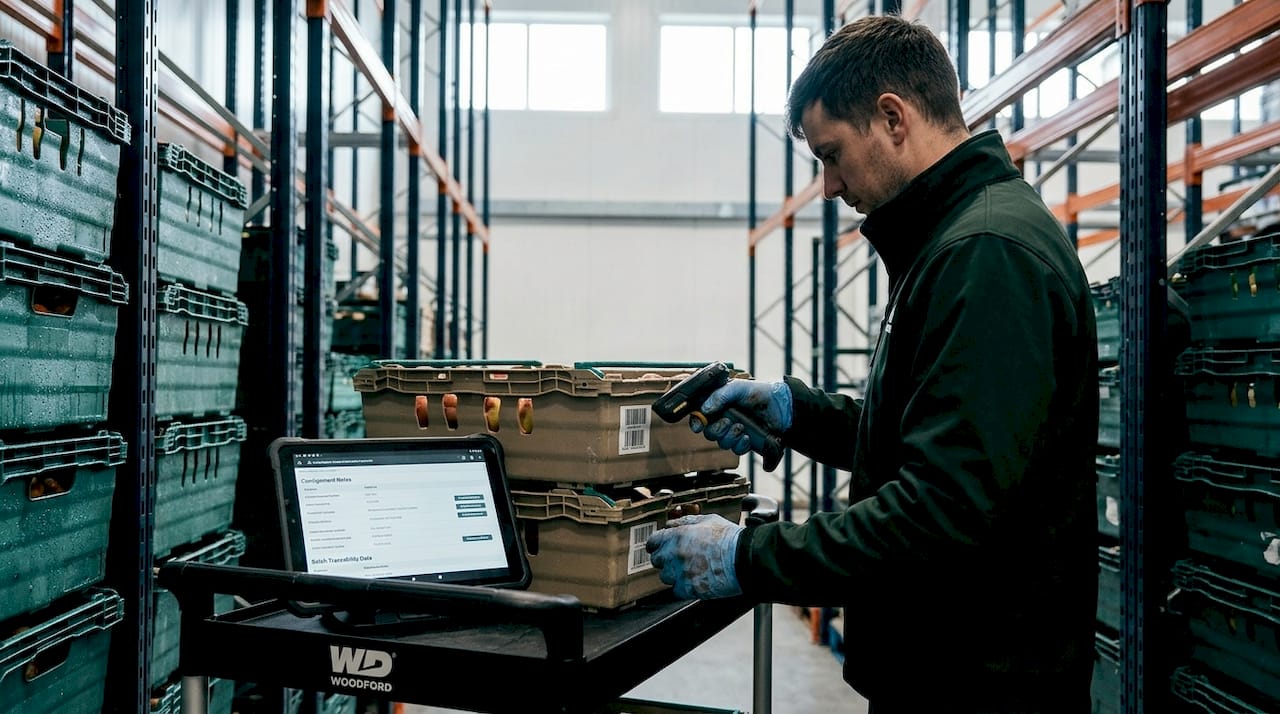
Those three questions sound simple. In practice, each one demands structured data capture across multiple parties, systems, and physical locations.
The key components of a well-designed traceability system cover:
- Batch identification: Every lot or batch of product must carry a unique identifier, typically a traceability lot code (TLC), that links it to its origin and journey.
- Origin data: Where raw materials were grown, caught, or produced, including producer identifiers and relevant certifications.
- Internal processing records: What happened to the product inside your facility, including any transformations, mixing, or repackaging that creates new batch relationships.
- Distribution records: Where finished product went, to whom, in what quantity, and when.
Traceability systems link all of these elements into a coherent chain, so that any point in the journey can be reconstructed quickly and accurately. Internationally, frameworks from the EU, the US FDA, and Food Standards Australia New Zealand all share this foundational logic, even where the specific regulatory requirements differ.
Pro Tip: When assessing your traceability system, ask whether you could tell regulators exactly which customers received product from a specific raw material batch within two hours. If the answer is uncertain, your system needs attention.
How food traceability works in practice
Understanding how traceability works operationally means understanding two core concepts: Critical Tracking Events and Key Data Elements.
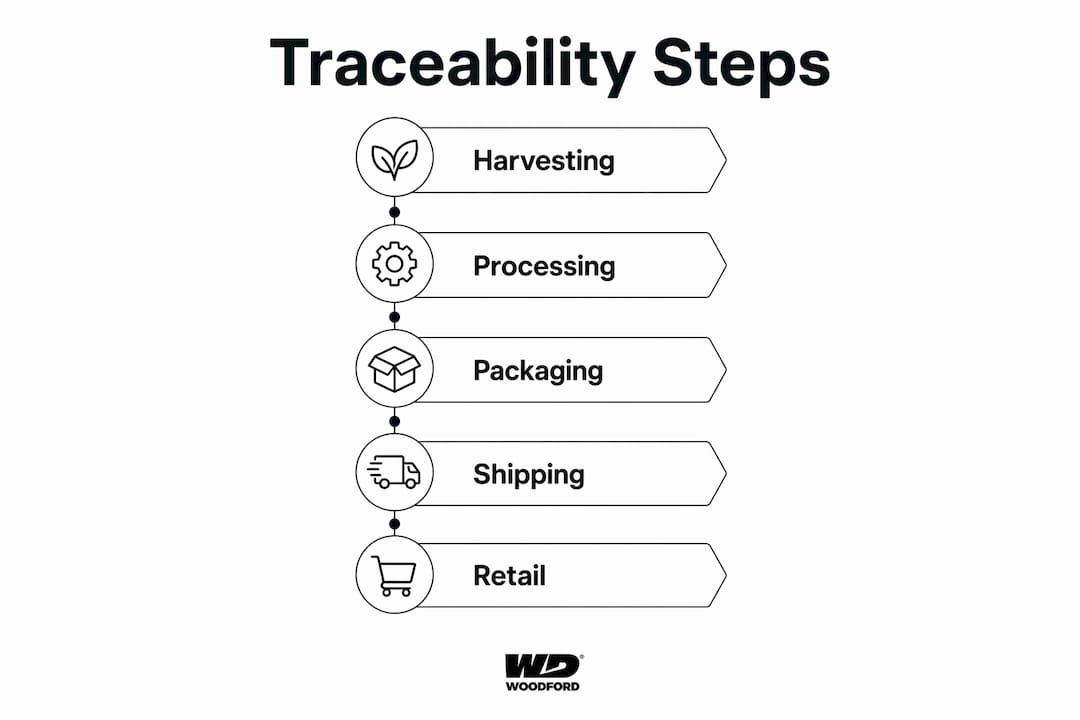
A Critical Tracking Event (CTE) is any point in the supply chain where meaningful data about a food product must be captured. Common CTEs include harvesting, cooling, packing, shipping, receiving, and transformation. Transformation is particularly important because it is the moment when inputs become a new product, creating a parent-to-child batch relationship that must be explicitly recorded.
A Key Data Element (KDE) is the specific piece of data that must be recorded at each CTE. KDEs vary by event type but typically include the traceability lot code, quantity, date, location, and the identity of the immediate previous or next recipient in the chain.
Here is how a typical traceability flow operates for a processed food product:
- Receiving: Raw material arrives. The business records the supplier, TLC, quantity, and date. Any existing supplier lot codes are linked to an internal identifier.
- Processing or transformation: Raw material is converted into a new product. The business records which input lots were used, in what quantities, and assigns a new TLC to the output batch.
- Packing: Finished product is labelled with the TLC and packed for despatch. Packaging records link physical units to batch data.
- Shipping: Product leaves the facility. The shipping record captures the recipient, TLC, quantity, and date of despatch.
- Retail or food service receiving: The next party in the chain records receipt, linking the TLC to their own inventory system.
| Stage | Critical tracking event | Key data elements captured |
|---|---|---|
| Farm or production | Harvesting | Location, date, grower ID, lot code |
| Processing facility | Transformation | Input lots, output TLC, quantity, date |
| Distribution | Shipping | Recipient, TLC, quantity, despatch date |
| Retail or food service | Receiving | Supplier, TLC, quantity, date received |
The FDA’s FSMA 204 rule, which covers high-risk foods on its Food Traceability List, requires that businesses be able to provide this data to regulators within 24 hours of a request. That 24-hour requirement is not a target for future planning. It is a current operational standard.
Pro Tip: Do not rely on retrospective reconstruction. Event-based data capture at defined operational stages is the only way to meet 24-hour responsiveness requirements with confidence.
Benefits of food traceability
The importance of food traceability goes well beyond regulatory box-ticking. When a traceability system is genuinely embedded in operations, the benefits are concrete and measurable.
- Faster, more targeted recalls: Traceability enables rapid identification and removal of contaminated product, reducing the number of consumers exposed to harm. A well-linked system can isolate the affected batch within hours rather than days.
- Reduced recall scope: Instead of withdrawing every product made in a given week, a business with strong internal traceability can pinpoint exactly which units are at risk. That precision limits food waste, cost, and reputational damage.
- Audit readiness: Whether you are working towards BRC, IFS, or SALSA certification, traceability records are a core audit requirement. Structured systems make evidence retrieval straightforward rather than stressful.
- Consumer confidence: Food supply chain transparency has become a genuine commercial differentiator. Consumers and buyers increasingly want to know where food comes from, and traceability data is what makes credible provenance claims possible.
- Quality control: Traceability records create a factual basis for investigating quality deviations. If a batch of finished product fails a test, you can trace back through inputs and processing steps to find the source of the problem.
“Traceability is not simply recordkeeping; it is an operational tool that limits the scope of problems and enables rapid response during customer complaints, alerts, or audits.” — AINIA
For UK businesses specifically, food compliance obligations under Regulation (EC) No 178/2002, retained in UK law post-Brexit, require that all food business operators maintain one-step-back and one-step-forward traceability at minimum. That is the legal floor. Best practice goes considerably further.
Common challenges in implementing traceability
The most common failure in food traceability is not a lack of data. It is a lack of linked data. Businesses often record plenty of information across their operations, but store it in siloes that cannot be connected quickly when an incident occurs.
| Approach | Traceability outcome |
|---|---|
| Single-step tracking only | Cannot reconstruct full journey; broad, costly recalls |
| Batch data without transformation links | Loses parent-child relationships at processing stage |
| Event-based, linked batch records | Full journey reconstructed in hours; targeted response |
| Real-time digital capture at CTEs | Meets 24-hour regulatory responsiveness requirements |
Traceability systems that fail to link parent and child batch relationships are particularly problematic. If your processing records cannot tell you which finished goods were made from a specific input lot, your recall will inevitably be broader than necessary. That costs money, wastes food, and damages supplier relationships unnecessarily.
A second common pitfall is treating traceability as a paper-based, retrospective exercise. When data is reconstructed after the fact from memory or informal notes, it is slow, inaccurate, and unreliable under regulatory scrutiny. The practical solution is to design workflows so that data capture happens at the moment of each operational event, tied to a specific batch identifier.
Good inventory management practices support traceability significantly. FIFO (first in, first out) stock rotation, clear batch labelling, and disciplined receiving processes all reduce the likelihood of traceability gaps forming in day-to-day operations.
Pro Tip: Run a mock recall exercise at least twice a year. Choose a specific raw material lot code and test how quickly your team can identify all finished goods produced from it, along with every customer who received those goods. The result will tell you exactly where your system needs strengthening.
Food traceability examples in real supply chains
Concrete food traceability examples help clarify what the system looks like in practice across different sectors.
- Leafy greens from farm to supermarket: A bag of spinach carries a TLC linked to the specific field, harvest date, grower, packing facility, and distribution centre it passed through. When contamination is identified, the retailer and supplier can jointly isolate affected units within a single shift rather than pulling product from an entire region.
- Seafood compliance: Under both UK and international rules, seafood must be traceable from landing vessel through any transformation such as filleting or smoking, to the final point of sale. Transformation records must capture which input lots were used and what new batch codes were assigned.
- Food service establishments: A restaurant or contract caterer receiving chilled ingredients must record supplier details, batch codes, and delivery dates at the point of receipt. During a food safety incident, those records allow the establishment to quickly confirm whether affected product entered their kitchen.
- Consumer-facing provenance: Some food producers and retailers now use QR codes on packaging to give consumers direct access to traceability data, covering origin, production date, and certifications. This is traceability as a marketing and trust-building tool, not merely a compliance measure. Local sourcing practices and transparent supply chains are increasingly what consumers expect.
- Recall management: When a major allergen contamination occurred in a European ready meal brand, companies with strong internal traceability isolated the affected production runs within hours and issued targeted recalls. Companies with weaker systems withdrew entire product lines for weeks, at vastly greater cost.
The distribution cycle for UK retailers adds another layer of complexity, particularly for businesses managing multiple suppliers and product categories simultaneously. Structured traceability plans that define roles, data ownership, and record formats across each stage of the chain are what separate businesses that cope well under pressure from those that struggle.
My take: traceability is a discipline, not a document
I have worked alongside food businesses at various points of the supply chain, and what strikes me most is how often traceability is treated as something that exists in a folder rather than something that lives in the operation itself.
The businesses I have seen handle incidents well share one characteristic: their traceability data is accurate because it was captured accurately in the first place, at the moment things actually happened. They did not scramble to reconstruct records. They retrieved them.
What I find equally underestimated is the cultural dimension. Technology can help enormously, whether that is a purpose-built traceability platform or a well-structured spreadsheet system. But if the team does not understand why a batch code matters or why a transformation record needs to be completed in real time, the system will have gaps. Training and operational discipline matter as much as software.
The other thing I would push back on is the idea that traceability is primarily a burden imposed by regulators. The businesses I have seen invest genuinely in it discover that it improves quality consistency, reduces waste, and gives them something genuinely useful to say to buyers and consumers about where their food comes from. Compliance treated as a competitive advantage rather than an obligation produces better outcomes across the board. That shift in perspective is, in my experience, the single most useful thing a food business can adopt.
— Nadim
How Woodford supports food supply chain confidence
At Woodford, we work with independent retailers and ambitious food brands across the UK, and we see the practical implications of food traceability every day. The brands we represent are held to high standards of provenance, quality, and compliance, and we take those expectations seriously across our distribution operations.
If you are an independent retailer looking for suppliers who take traceability and food safety compliance seriously, or a food brand seeking a wholesale partner who understands the regulatory environment, explore what Woodford offers and see how we can support your supply chain. We curate products with provenance, and we work with brands that can back their claims with the records to match. Get in touch to discuss your specific needs.
FAQ
What is food traceability in simple terms?
Food traceability is the ability to follow a food product through every stage of the supply chain using reliable records. It covers where ingredients came from, what happened to them during processing, and where the finished product was sent.
How does food traceability work in practice?
Traceability works by capturing Key Data Elements at Critical Tracking Events such as harvesting, processing, and shipping. Each event generates a record linked to a unique batch identifier, allowing the full journey to be reconstructed quickly.
Why is food traceability important for businesses?
Traceability allows businesses to respond rapidly to safety incidents, limit recall scope, satisfy audit requirements, and demonstrate provenance to buyers and consumers. Poor traceability leads to overbroad recalls and significant financial and reputational damage.
What is FSMA 204 and who does it affect?
FSMA 204 is an FDA rule requiring businesses handling high-risk foods on the Food Traceability List to maintain structured traceability records and provide them to regulators within 24 hours. It affects growers, processors, distributors, and retailers in the US supply chain.
What are some common food traceability examples?
Common examples include tracking leafy greens from farm to retailer using lot codes, tracing seafood from landing vessel through processing to sale, and retailers recording batch data at the point of receipt to support rapid recall responses.
Recommended
- UK food retailers: lead with 2026’s top food trends - WOODFORD - Bringing quality foods your way
- Food provenance: Build trust and boost sales for independents - WOODFORD - Bringing quality foods your way
- UK food compliance: essential laws and best practices - WOODFORD - Bringing quality foods your way
- How to identify food trends: a guide for UK retailers - WOODFORD - Bringing quality foods your way