
The role of convenience in product selection
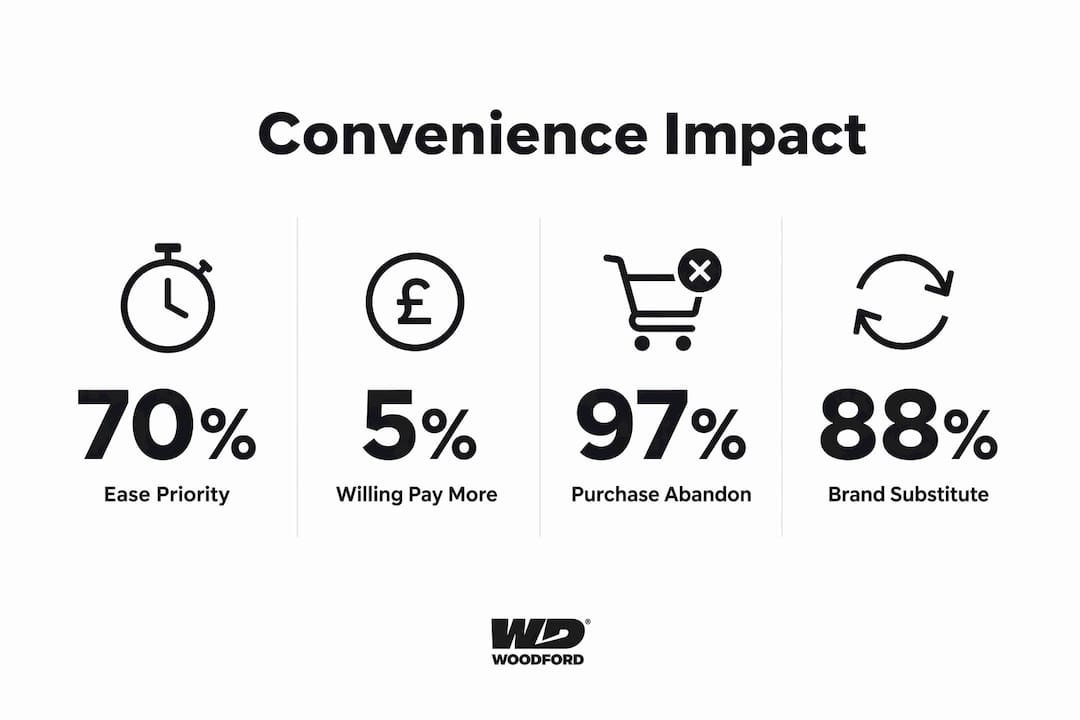
Convenience is the dominant factor in product selection, outweighing price, brand loyalty, and quality perception for the majority of shoppers. Over 70% of consumers now prioritise ease of access over discounts when choosing products, a shift confirmed by survey data from april 2026. The role of convenience in product selection has moved from a secondary consideration to the primary driver of purchasing behaviour. For independent retailers and food brands alike, understanding this shift is no longer optional. It is the foundation of every effective merchandising and ranging decision.
How does convenience influence product selection?
Convenience in product selection is best understood through the lens of purchase friction, the total mental and physical effort a shopper expends to complete a purchase. The lower the friction, the higher the likelihood of a completed sale. 77% of consumers name convenience as a key factor in their purchasing decisions. That figure tells you convenience is not a niche preference; it is a near-universal expectation.
The importance of convenience in buying goes beyond saving time. Mintel frames convenience as a core value exchange, one focused on reducing mental load and decision fatigue rather than simply cutting seconds from a transaction. A shopper who cannot quickly locate a product, understand its benefits, or complete a purchase without friction will abandon the process entirely. The product’s quality becomes irrelevant at that point.
Retailers who grasp this distinction gain a measurable edge. Convenience factors in product purchase include shelf clarity, checkout speed, product findability, and assortment simplicity. Each of these reduces the cognitive cost of buying and increases the probability of conversion.

Why does consumer psychology drive convenience-based choices?
The human brain processes roughly 3 to 5 items at once before decision fatigue sets in. That cognitive ceiling explains why large, undifferentiated product ranges often reduce sales rather than increase them. When shoppers face too many options, they default to the path of least resistance: they either pick the most visible product or abandon the purchase altogether.
This phenomenon is formalised in Hick’s Law, a principle from behavioural design stating that more choices increase decision time and reduce satisfaction. Applied to retail, it means that a shelf with 40 variants of the same product category will consistently underperform a shelf with 8 well-chosen options. The shopper’s experience deteriorates, and so does the retailer’s conversion rate.
How convenience affects choices also operates at an emotional level. Research into rapid grocery delivery shows that 75% of users are motivated by convenience, yet nearly 50% of purchases in those environments are still driven by emotional impulse. Convenience and impulse are not opposites. Convenience creates the conditions in which impulse purchases thrive.
The practical implication for retailers is clear:
- Curate, do not accumulate. Align your range with the cognitive capacity of your shoppers, not the maximum number of SKUs your shelves can hold.
- Reduce visible friction. Clear labelling, logical category groupings, and fast checkout processes all lower the mental cost of buying.
- Position for visibility. Eye-level placement and prominent positioning amplify both planned and unplanned purchases.
- Use in-store prompts. Shelf talkers, digital signage, and well-placed promotional materials guide mission-led shoppers to products they did not plan to buy.
Pro Tip: Apply the “rule of three” when curating a category: offer a good, better, and best option. Three clear tiers satisfy the majority of shoppers without triggering choice paralysis.
What retail environment factors shape convenience-driven buying?
The physical and digital retail environment is where the importance of convenience in buying becomes most tangible. 68% of convenience store shoppers arrive without a pre-planned shopping list. They are mission-led, meaning they enter with a need rather than a specific brand in mind. The store environment then determines what they buy.
This is a critical insight for independent retailers. If the majority of your shoppers are not brand-committed when they walk in, then shelf positioning, signage, and product visibility matter more than the brands you stock. The store itself becomes the primary sales tool.
Eye-level shelf placement consistently outperforms lower or higher positions for impulse and convenience categories. Digital signage amplifies this effect by drawing attention to specific products at the moment of decision. For food retailers in particular, combining strong physical placement with clear, benefit-led messaging on-shelf is the most direct way to convert a browsing shopper into a buyer.
The table below compares the impact of key retail environment factors on convenience-driven product selection:
| Environment factor | Effect on convenience | Impact on conversion |
|---|---|---|
| Eye-level shelf placement | Maximises product visibility | High |
| Simplified assortment (8–12 SKUs per category) | Reduces decision fatigue | High |
| Digital signage at point of decision | Triggers impulse and mission purchases | Medium to high |
| Clear category signage and navigation | Lowers search effort | Medium |
| Fast, frictionless checkout | Removes final purchase barrier | High |
Consumer convenience in selection is also shaped by how well a retailer’s assortment matches the shopper’s mission. A customer entering for a quick lunch solution does not want to navigate a full grocery range. Simplified, mission-aligned sections, such as a “grab and go” bay or a clearly signed meal solution area, convert browsers into buyers far more reliably than broad, undifferentiated displays.
Pro Tip: Review your store layout quarterly against your top five shopper missions. If a mission-led shopper cannot complete their task in under two minutes, your layout is losing you sales.
What is the economic impact of convenience on retail spending?
The financial case for prioritising convenience is direct. Consumers are willing to pay up to 5% more for services or products that make purchasing easier. That premium is not driven by luxury or exclusivity. It is driven purely by the reduction of effort. Retailers who deliver on convenience can charge more and retain customers longer.
The cost of ignoring convenience is equally clear. 97% of shoppers have abandoned a purchase because of inconvenience, whether that was a slow checkout, confusing navigation, or a product they could not locate. That figure is not a warning about edge cases. It means that virtually every shopper you have ever had has walked away from a purchase somewhere because the process was too difficult.
Why convenience matters in shopping is also visible in brand substitution data. 88% of convenience shoppers who cannot find their intended product choose a substitute in-store rather than visiting another retailer. This is a significant commercial opportunity. Shoppers are not brand-loyal in convenience environments. They are convenience-loyal. The product that is present, visible, and easy to select wins the sale, regardless of whether it was the shopper’s first choice.
For independent retailers, this data reframes the competitive conversation. You do not need to match the range or price of a large supermarket. You need to be easier to shop. Speed, clarity, and product availability in the right categories will consistently outperform a wider range delivered with friction.
How can retailers and shoppers apply convenience principles?
Applying convenience factors in product purchase requires deliberate decisions at every stage of the retail operation, from ranging to layout to checkout.
- Audit your friction points. Walk your store or review your online shop as a first-time customer. Note every moment where a decision requires effort, a product is hard to find, or a process slows the purchase down.
- Curate your range by shopper mission. Identify the top five reasons shoppers visit you and build your assortment around those missions. Remove SKUs that do not serve a clear mission need.
- Invest in placement and signage. Reserve eye-level space for your highest-margin and fastest-moving convenience lines. Use clear, benefit-led shelf signage rather than product names alone.
- Simplify checkout. Every additional step in the payment process increases abandonment risk. Contactless payment, self-checkout options, and clear queue management all reduce this risk.
- Partner with curated suppliers. Working with a wholesaler who pre-selects trend-led, consumer-tested products removes the burden of ranging decisions from the retailer. Woodford’s food marketing approach is built on exactly this principle, giving independent retailers access to products already validated for convenience-driven shoppers.
- Use data to refine. Track which products sell fastest in convenience-led categories and rotate slow movers out. A tighter, faster-selling range always outperforms a broad, slow one in convenience retail.
For shoppers, the practical application is simpler. Curated shopping lists, loyalty to retailers with clear layouts, and using digital tools to pre-select products all reduce the cognitive load of buying. The shopper who arrives with a clear mission and shops a well-organised store spends less time and makes better decisions.
Understanding how packaging drives consumer choice is also part of the picture. Clear, benefit-led packaging reduces the effort required to evaluate a product on-shelf and accelerates the decision to buy.
Key takeaways
Convenience is the single most powerful driver of product selection, and retailers who reduce purchase friction consistently outperform those who compete on range or price alone.
| Point | Details |
|---|---|
| Convenience outranks price | Over 70% of consumers prioritise ease over discounts when selecting products. |
| Cognitive limits drive curation | Shoppers process 3–5 items at once; smaller, focused ranges convert better than large ones. |
| Friction causes abandonment | 97% of shoppers have abandoned a purchase due to inconvenience, regardless of product quality. |
| Mission-led shoppers are brand-flexible | 88% substitute products in-store rather than switching retailers when their first choice is unavailable. |
| Convenience commands a price premium | Shoppers will pay up to 5% more for a purchase experience that reduces effort. |
Woodford’s approach to curated, convenient food selection
Woodford works with independent retailers across the UK to take the complexity out of food ranging. Rather than leaving retailers to sift through hundreds of SKUs, Woodford curates a selection of quality food brands that are already aligned with convenience-driven shopper missions. Every product in the Woodford range is chosen for its ability to sell quickly, clearly, and with minimal friction at the shelf. Retailers benefit from a pre-validated assortment that reduces ranging risk and improves the shopping experience for their customers. If you are looking to stock products that meet the expectations of today’s convenience-focused shoppers, explore the Woodford range and see which brands fit your store’s mission.
FAQ
Why does convenience matter more than price for most shoppers?
Convenience reduces the mental effort of buying, which shoppers value more than small price savings. Survey data from 2026 confirms that over 70% of consumers prioritise ease over discounts when selecting products.
How does choice overload affect product selection?
Too many options trigger decision fatigue, causing shoppers to either pick the most visible product or abandon the purchase. Human cognitive capacity tops out at roughly 3–5 items, making curated ranges more effective than large ones.
What convenience factors most influence in-store product choice?
Eye-level shelf placement, simplified assortments, fast checkout, and clear signage are the most influential factors. The majority of convenience shoppers arrive without a fixed list and rely on in-store cues to make their final selection.
Can independent retailers compete on convenience against larger chains?
Independent retailers can compete effectively by personalising convenience, using curated ranges, clear layouts, and fast service. Research shows that 97% of shoppers have abandoned purchases due to friction, meaning ease of shopping matters more than store size.
What happens when a shopper cannot find their preferred product?
88% of convenience shoppers substitute with an alternative product in-store rather than visiting another retailer. This means product availability and visibility are more important than brand loyalty in convenience environments.


