
Step by step food brand launch: your 2026 guide
TL;DR:Launching a food brand requires a structured process spanning 28 to 32 weeks, with each phase completed sequentially to avoid costly errors. Essential groundwork includes thorough market research, detailed cost modeling, and early product positioning to ensure retail success. Proper formulation, regulatory compliance, packaging design, and distribution planning are vital for a sustainable, profitable launch.
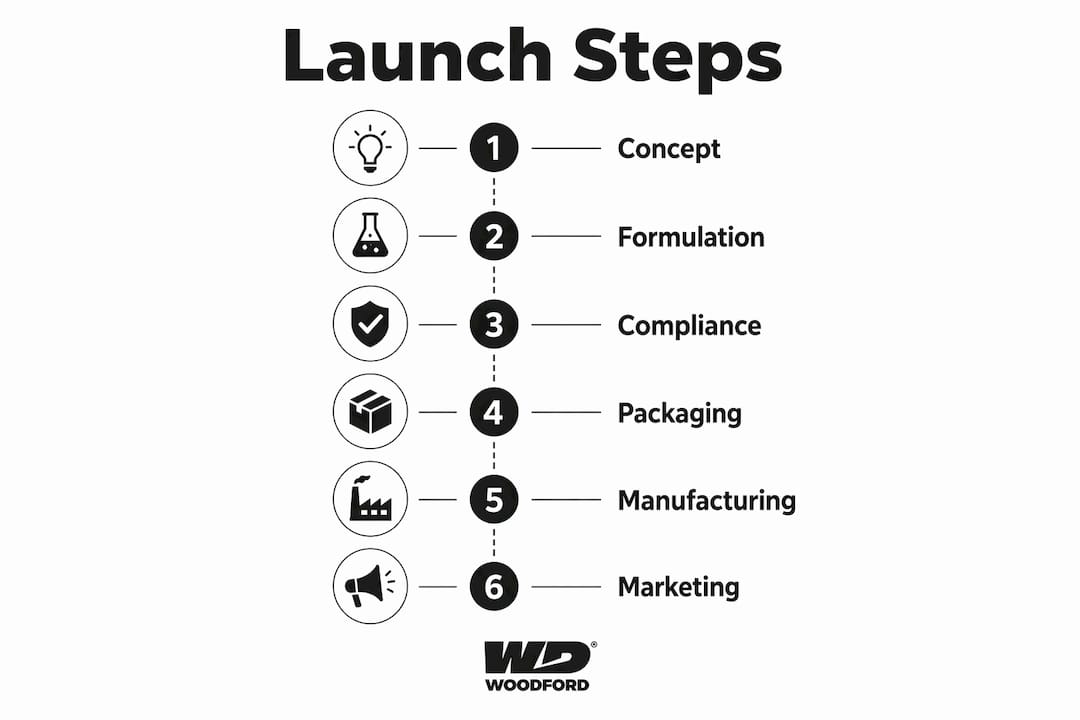
A step by step food brand launch is a structured process that moves your concept through formulation, compliance, packaging, manufacturing, and distribution in a sequence that typically spans 28 to 32 weeks from first brief to first production run. Most founders underestimate this timeline and pay for it with missed retail windows, costly reformulations, and compliance failures. The brands that succeed treat the launch as a project with defined phases, not a creative sprint. This guide covers every stage in the order you need to tackle it, with the tools, frameworks, and real-world examples that make the difference between a product on shelf and a product that stays there.
What do you need before starting a food brand launch?
The groundwork you lay before touching a recipe or briefing a designer determines everything that follows. Market research is the non-negotiable starting point. You need to understand the category you are entering, who already owns it, and where the genuine white space sits. Tools like Mintel, Kantar, and Nielsen IQ give you category data; social listening platforms like Brandwatch reveal what consumers are saying that brands are not yet addressing.

Alongside research, you need a landed cost model before you commit to a single ingredient. Trade spend and slotting fees can compress gross margins significantly, as Once Upon a Farm discovered when fees reduced their margin from 43.6% to 42.3%. That is not a rounding error. It is the difference between a profitable brand and one that burns through investment. Build your cost model in a spreadsheet that includes raw materials, co-packer fees, packaging, freight, distributor margin, retailer margin, and promotional spend before you finalise your retail price.
Product positioning must also be locked in early. Brands like Poppi price at 3 to 4 times the mass-market equivalent as a deliberate brand equity decision, not an afterthought. Deciding whether you are premium, accessible premium, or mass-market shapes every subsequent decision from packaging material to distribution channel.
| Resource | Role in your launch |
|---|---|
| Food scientist | Formulation development, stability testing, scaling |
| Packaging designer | Structural and graphic design aligned to brand identity |
| Co-packer or contract manufacturer | Commercial production and quality assurance |
| Regulatory consultant | Label compliance, allergen declarations, facility registration |
| Logistics partner | Warehousing, fulfilment, and retailer delivery |
Pro Tip: Conduct a trend analysis before finalising your product concept. Aligning with a confirmed consumer trend adds tailwind to your launch and makes retailer conversations significantly easier.
How do you develop and validate your food product formulation?
Product formulation is where most founders spend the most time and make the most expensive mistakes. A structured food brand launch allocates up to 20 weeks to formulation and testing alone, which tells you how seriously this phase deserves to be treated.
Start with a detailed product brief that specifies your target flavour profile, texture, shelf life requirement, packaging format, and any dietary claims you intend to make. This brief becomes the reference document your food scientist works from. Without it, iterations become guesswork and timelines slip.
The formulation process itself is iterative. Expect three to five rounds of refinement before you reach a formula that performs consistently. Each round should be evaluated against your brief on taste, texture, appearance, and cost per unit. Sensory panels, even informal ones with your target consumer, provide feedback that no founder’s palate can replicate objectively.
Testing must go beyond taste. Product stability testing must account for humidity, temperature variation, and transport vibrations to simulate real-world conditions. A product that tastes perfect in your kitchen may separate, discolour, or lose texture after three weeks on a warm shelf or in a delivery van. Accelerated shelf life testing compresses months of real-time ageing into weeks using controlled temperature and humidity chambers.
- Write a detailed product brief covering flavour, texture, shelf life, and dietary claims.
- Commission initial formulation from a qualified food scientist.
- Conduct internal sensory evaluation against the brief.
- Refine the formula and repeat sensory testing until consistent.
- Submit samples for accelerated shelf life and stability testing.
- Conduct a regulatory label review before finalising the formula.
- Produce a pilot batch at near-commercial scale to identify scaling issues.
Regulatory compliance must be integrated into formulation, not bolted on afterwards. Label compliance issues causing recalls most commonly involve missing allergen declarations, inaccurate nutrient content claims, and incorrect statements of identity. In the UK, the Food Standards Agency sets the labelling framework; in the US, FDA facility registration under 21 CFR 1.226 is mandatory for any food manufacturer. If your formula changes after labels are designed, your compliance review must restart. Building label review into each formulation round prevents costly repackaging later.
Pro Tip: Work with a regulatory consultant who specialises in food sector compliance from the first formulation round, not the last. Catching an allergen declaration issue at prototype stage costs hours; catching it after 10,000 units are printed costs thousands.
How do you design packaging and choose a manufacturing partner?
Packaging is your most powerful sales tool at the point of purchase, and it is also a technical document that must meet legal requirements. These two demands must be resolved simultaneously, not sequentially.
Your structural packaging format, whether that is a stand-up pouch, glass jar, carton, or rigid tray, determines your manufacturing options, your freight costs, and your retail shelf footprint. Brief your packaging designer with the structural format confirmed, not as a variable. Graphic design that ignores structural constraints produces artwork that cannot be printed or filled without expensive modifications.
When comparing co-packers and contract manufacturers, evaluate them across four dimensions:
- Certifications: SQF Level 2 or BRC Global Standard are the minimum for most major retailers. Verify certificates are current, not expired.
- Minimum order quantities: A co-packer with a 50,000-unit MOQ is the wrong partner for a first production run of 5,000 units.
- Lead times and capacity: Manufacturing partner vetting must include capacity for scaling volumes, not just your launch quantity.
- Allergen controls: If your product is nut-free or gluten-free by claim, your co-packer’s allergen management procedures must support that claim.
| Criterion | What to look for | Red flag |
|---|---|---|
| Certifications | SQF Level 2, BRC, or equivalent | Expired or absent certificates |
| MOQ | Matches your launch volume | MOQ far exceeds initial order |
| Lead time | 6 to 10 weeks for first run | Vague or unconfirmed timelines |
| Allergen controls | Documented procedures and testing | No written allergen policy |
Pre-production sample approval is the final gate before committing to a full production run. Approve samples against your product brief, your packaging specification, and your regulatory label. Any deviation at this stage is far cheaper to correct than a full batch recall or a retailer rejection.
What operational and marketing strategies drive retail success?
Getting your product to shelf is one milestone. Staying on shelf is the real challenge. The brands that achieve both treat sales, operations, and finance as a single coordinated function from day one. Disconnection between these teams is the single biggest operational failure that causes missed retail commitments. Demand planning must precede every operational decision, including production scheduling, raw material purchasing, and logistics contracts.
Successful food brand strategies in 2026 rely heavily on building consumer demand before approaching retailers, not after. Social media content, sampling campaigns, and influencer partnerships generate the sell-through data that gives buyers confidence. A buyer at Waitrose or Whole Foods Market wants evidence that consumers will pull the product off the shelf, not just that the brand has a good story.
- Build a 12-month demand plan before your first retail meeting.
- Identify your primary distribution channel: direct to retailer, through a wholesaler, or via a distributor.
- Allocate a dedicated marketing budget for sampling, social content, and influencer seeding.
- Negotiate slotting fees and promotional commitments before signing any retailer agreement.
- Track sell-through weekly and respond to slow-moving lines before the buyer does.
Owning dedicated retail space, such as branded chillers or display units, creates a competitive moat but pressures gross margin initially. This is a trade-off worth making if your product category benefits from visibility and trial, as Once Upon a Farm demonstrated at scale. For independent retailers, Woodford’s distribution network offers a faster route to shelf without the capital outlay of owned fixtures.
Pro Tip: Use food marketing strategies that generate user content. A customer photograph of your product in a real kitchen is worth more than a studio shot in a paid advertisement, and it costs you nothing beyond the product sample.
What are the most common pitfalls in a food brand launch?
The most damaging mistakes in a food brand launch share a common cause: moving to the next phase before the current one is complete. Scaling from small batch to commercial scale changes the texture, colour, and taste of products in ways that home kitchen testing cannot predict. Founders who skip the pilot batch stage and go straight to a full production run often receive a product that does not match their approved sample.
Regulatory non-compliance is the second most costly error. Missing allergen declarations and inaccurate nutrient content claims are the leading causes of food recalls, and a recall at launch can permanently damage retailer relationships and consumer trust. Integrate compliance review into every phase, not just the final one.
Underestimating distribution complexity is the third trap. Rapid expansion can succeed if the product is ready and retail doors are open, but premature distribution risks delisting and failure. Secure your supply chain before you secure your listings.
“Define your brand’s why and your audience before you define your flavour or your design. Retailers and investors buy into a mission they can sell, not just a product they can stock.” Kelly Bennett, CPG brand strategist
Tony’s Chocolonely is a textbook example of this principle. The brand’s mission-led positioning did not replace product quality; it amplified it. A compelling story built on an average product will not survive its first retail review.
Key takeaways
A successful food brand launch requires a sequenced process covering formulation, compliance, packaging, manufacturing, and distribution, with each phase completed before the next begins.
| Point | Details |
|---|---|
| Timeline is fixed | A structured launch spans 28 to 32 weeks; compressing phases creates costly errors. |
| Cost model first | Build your landed cost model before finalising retail price or committing to a co-packer. |
| Compliance is continuous | Integrate label and allergen reviews into every formulation round, not just the final one. |
| Demand before distribution | Generate consumer pull-through evidence before approaching major retailers. |
| Team alignment is non-negotiable | Sales, operations, and finance must plan together from the first demand forecast. |
How Woodford supports your food brand launch
Woodford works with emerging food brands at the exact point where most founders feel most exposed: getting a quality product in front of the right independent retailers without the overhead of building a distribution network from scratch. As the UK’s leading strategic food wholesaler, Woodford provides exclusive brand distribution alongside trend-led curation and logistics support that removes the complexity of retail market entry. Whether you are finalising your route to market or looking to scale an existing listing, Woodford’s team brings category knowledge and retailer relationships that accelerate your path to shelf. Speak to Woodford about how your brand fits the independent retail opportunity in 2026.
FAQ
How long does a food brand launch take?
A structured food brand launch typically spans 28 to 32 weeks from concept to first production run. Formulation and testing alone can consume up to 20 of those weeks.
What regulations apply to food brands in the UK?
UK food brands must comply with Food Standards Agency labelling requirements, including allergen declarations, nutrition panels, and statements of identity. Facilities supplying certain markets must also meet FDA registration requirements under 21 CFR 1.226 if exporting to the US.
How do I choose the right co-packer for my food brand?
Evaluate co-packers on certifications such as SQF or BRC, minimum order quantities, lead times, and allergen management procedures. Request pre-production samples and approve them against your product brief before committing to a full run.
When should I approach retailers?
Approach retailers after you have confirmed supply chain readiness and generated initial consumer demand through sampling or social media. Premature distribution before the product is stable risks delisting, which is far harder to recover from than a delayed launch.
How do slotting fees affect my food brand’s margins?
Slotting fees and trade spend reduce gross margins directly. One brand saw its margin fall from 43.6% to 42.3% due to these costs. Build all retailer fees into your landed cost model before agreeing to any listing terms.


