
Role of distribution networks in food supply chains
Distribution networks are the structured systems that move products from producers to consumers by creating time and place utility, reducing transaction complexity, and managing product flow across facilities and transport routes. In the food industry, the role of distribution networks extends far beyond simple logistics. It determines whether a product arrives fresh, at the right price, and at the right location. Deloitte frames distribution as a strategic capability that directly affects resilience, working capital, and customer retention. For food brands and independent retailers, understanding how these networks function is the difference between consistent shelf presence and costly supply failures.
What is the role of distribution networks in food supply chains?
Distribution networks connect producers to consumers through a structured chain of intermediaries, warehouses, and transport routes. OpenStax defines this channel system as a mechanism that reduces the number of transactions needed to reach consumers, freeing producers to focus on production rather than logistics. That transaction reduction is significant in food, where a single manufacturer may need to supply hundreds of independent retailers across multiple regions.
The core functions of a food distribution network are sorting, accumulating, allocating, and delivering goods. Sorting separates products by type, grade, or destination. Accumulating consolidates smaller quantities into economically viable loads. Allocating breaks bulk shipments into smaller units for individual customers. Together, these channel functions determine whether products reach the right customer at the right time and in the right condition.
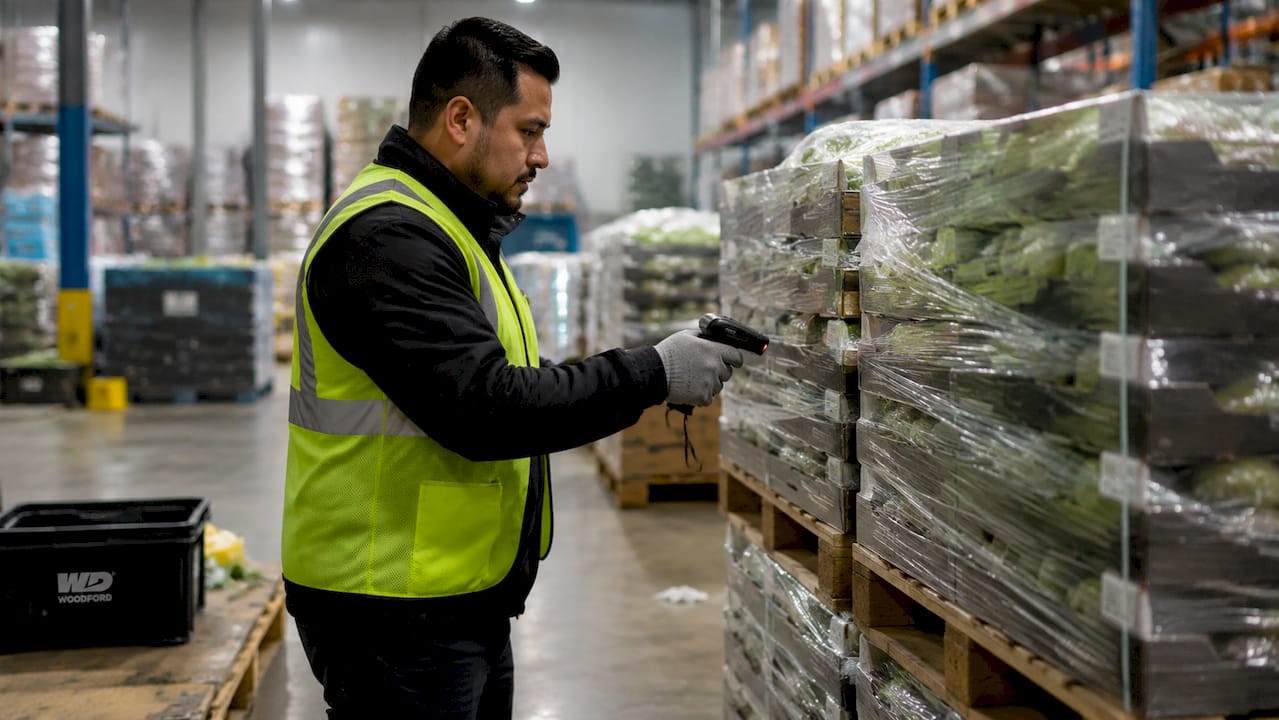
The importance of distribution channels in food is amplified by perishability. A network that works adequately for ambient grocery products may be entirely unsuitable for chilled or frozen goods. Time and place utility, the ability to have the right product available where and when customers need it, is the central objective of any well-designed food supply network.
Pro Tip: Treat your distribution network as a product in its own right. Map every function it performs, from sorting to final delivery, and assess whether each step adds value or adds cost.
The strategic framing matters here. Deloitte’s analysis shows that businesses optimising distribution solely for cost or speed create fragile networks prone to margin erosion and customer churn. A balanced approach, weighing service level, cost, and sustainability together, produces networks that hold up under demand volatility and supply disruption.
- Service level: On-time delivery rates, order fill accuracy, and product freshness on arrival
- Cost efficiency: Freight, handling, storage, and administrative overhead per unit delivered
- Sustainability: Carbon footprint per delivery, packaging waste, and route efficiency
- Resilience: Ability to reroute, scale, or substitute when disruption occurs
How does network design affect freshness and cost?
The physical structure of a distribution network, where facilities are located and how routes are planned, has a direct and measurable impact on food quality and total logistics cost. A PLOS ONE study on agricultural cold chains found that centralised pre-cooling reduced total logistics cost by 3.79% compared to decentralised approaches, while also preserving product freshness more effectively. That figure represents a material saving at scale for any food business running high volumes of perishable goods.
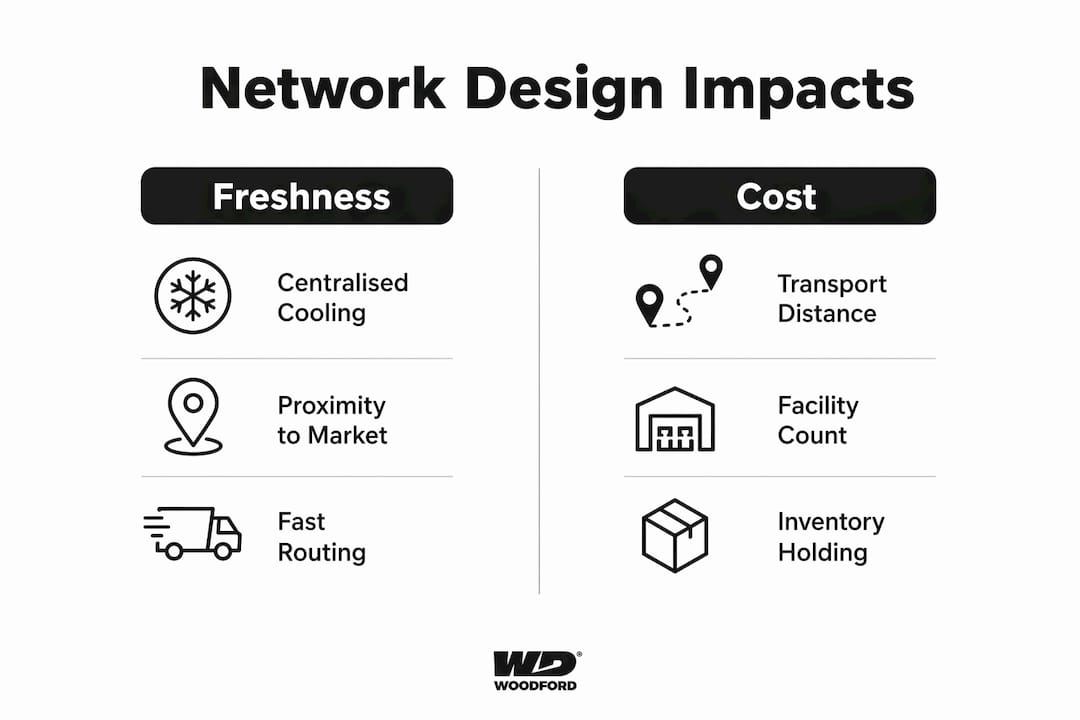
The study’s most important finding is that facility location and routing cannot be optimised independently. Treating them as separate decisions leads to suboptimal outcomes on both cost and freshness. Integrated planning, where warehouse placement and delivery routes are designed together, produces better results across every performance measure.
Here is a practical sequence for approaching cold-chain network design:
- Map current product flows from origin to final delivery point, noting temperature requirements at each stage.
- Identify pre-cooling requirements and assess whether centralised or distributed pre-cooling better serves your geographic footprint.
- Model facility location options against route length, transit time, and freshness loss thresholds.
- Calculate total logistics cost including storage, handling, pre-cooling energy, and transport, not just freight invoices.
- Test scenarios for demand growth, new customer locations, and potential supply disruptions before committing to a fixed network design.
| Network Design Factor | Impact on Freshness | Impact on Total Cost |
|---|---|---|
| Centralised pre-cooling | Higher freshness retention | Lower total cost (3.79% reduction) |
| Decentralised pre-cooling | Greater freshness variability | Higher total cost |
| Longer route distances | Increased freshness loss | Higher fuel and handling cost |
| Integrated location and routing | Optimised freshness | Lowest achievable cost |
Pro Tip: Many food businesses track freight invoices but miss the full picture. Use a cost-to-serve approach that captures storage, handling, pre-cooling, and service time windows to get an accurate read on true distribution efficiency.
What factors shape distribution network strategy?
Selecting the right network structure requires balancing several competing priorities. No single model suits every food business, and the right choice depends on product type, customer geography, order frequency, and service expectations. Understanding the food distribution cycle helps decision-makers see where each structural choice creates advantage or constraint.
Product perishability is the most decisive factor. Ambient products tolerate longer transit times and larger distribution footprints. Chilled and frozen products demand shorter routes, tighter temperature controls, and more frequent replenishment cycles. A network designed for ambient goods will consistently underperform when applied to chilled lines.
Customer location and order profile shape network footprint directly. A food brand supplying dense urban independent retail clusters can operate efficiently from a single regional hub. A brand supplying rural convenience stores across multiple regions needs either a multi-depot model or a reliable third-party network with genuine geographic reach.
| Network Type | Key Advantage | Primary Challenge |
|---|---|---|
| Centralised (single hub) | Lower fixed cost, simpler management | Longer delivery distances for outlying customers |
| Decentralised (multi-depot) | Faster local delivery, better freshness | Higher fixed cost, complex coordination |
| Mixed (hub and spoke) | Balance of reach and speed | Requires strong route planning capability |
| Third-party intermediary | Flexible, lower capital commitment | Less direct control over service standards |
WSU Pressbooks notes that distribution creates time and place utility, and that channel structure choices must be guided by the objective of satisfying customers effectively. For food businesses, that means selecting intermediaries and network configurations that match your product’s specific service requirements, not simply the lowest-cost option available.
Resilience is a factor that many businesses underweight until a disruption forces the issue. A network with no redundancy, no alternative routes, and no secondary supplier relationships is exposed to significant operational risk. Building flexibility into network design from the outset costs less than retrofitting it after a crisis.
How do distribution costs affect business performance?
Distribution expenses carry more weight in business performance than most food companies recognise. CEPR research documents that distribution costs represent over half of labour costs for many firms, and that these expenses have a large influence on firm-scale productivity and market outcomes. That finding reframes how food businesses should think about their logistics spend.
When distribution costs are high relative to revenue, they suppress manufacturing consumption, limit the ability to scale, and distort productivity metrics. A business that appears efficient at the production level may be systematically underperforming because its distribution costs are absorbing margin that should fund growth.
“Distribution expenses affect firm behaviour and productivity metrics and should be closely monitored rather than treated as overhead.” — CEPR, DP21515
The practical implication is that distribution network performance needs its own measurement framework, separate from general overhead tracking. Key performance indicators worth monitoring include:
- Sorting and allocation accuracy: The percentage of orders correctly sorted and delivered to the right customer without error
- Availability rate: The proportion of SKUs available for dispatch on the day an order is placed
- Cost per case delivered: Total distribution cost divided by cases shipped, tracked by channel and customer type
- Freshness on arrival: Temperature compliance and product condition at point of delivery
- Working capital tied to stock in transit: The value of inventory held within the network at any given time
Monitoring these metrics consistently reveals where a network is generating cost without generating value. That visibility is the foundation for any meaningful improvement programme.
What practical strategies improve distribution network performance?
Improving a food distribution network starts with visibility, not redesign. Deloitte’s framework for network transformation begins with establishing transparency across flows, costs, and service constraints before any footprint changes are made. Redesigning a network without that baseline is a common and expensive mistake.
Follow this sequence to build a structured improvement programme:
- Establish flow visibility. Map every product movement from supplier to end customer, including volumes, frequencies, and temperature requirements.
- Build cost transparency. Capture all distribution costs, including storage, handling, pre-cooling, and service time windows, using a cost-to-serve methodology rather than freight invoices alone.
- Define service objectives. Set clear targets for delivery frequency, freshness thresholds, and order fill rates before evaluating network options.
- Evaluate outsourcing versus vertical integration. Assess whether third-party intermediaries can deliver your service requirements at lower cost than in-house operations, particularly for specialist cold-chain capability.
- Apply multi-objective optimisation. Use scenario modelling to test network configurations against service, cost, and sustainability targets simultaneously, not sequentially.
- Build in resilience. Design alternative routing options and secondary supplier relationships into the network from the start.
The question of outsourcing versus vertical integration deserves particular attention. Intermediaries add genuine value to food supply channels by managing the operational complexity of sorting, accumulating, and allocating product flows. For food brands without the scale to justify dedicated logistics infrastructure, a specialist distributor with established retailer relationships and cold-chain capability will consistently outperform a self-managed network on both cost and service.
Modern analytics tools, including demand forecasting platforms and route optimisation software, make scenario planning accessible to businesses of all sizes. The functions of supply networks have not changed, but the ability to model and test design decisions before committing capital has improved substantially. Food businesses that invest in this analytical capability make better network decisions and adapt more quickly when market conditions shift.
Pro Tip: Before any network redesign, run a cost-to-serve analysis by customer and channel. You will almost certainly find that a small number of customers or routes account for a disproportionate share of your distribution cost. That insight shapes every subsequent decision.
Key takeaways
Effective food distribution networks require integrated design decisions across facility location, routing, cost measurement, and service objectives to deliver consistent freshness and commercial performance.
| Point | Details |
|---|---|
| Functions drive performance | Sorting, accumulating, and allocating goods accurately matters more than transport speed alone. |
| Centralised pre-cooling saves cost | PLOS ONE data shows centralised pre-cooling cuts total logistics cost by 3.79% and preserves freshness better. |
| Distribution costs are material | CEPR research confirms distribution expenses exceed half of labour costs, directly affecting firm productivity. |
| Integrated design is non-negotiable | Facility location and routing must be optimised together in cold-chain networks, not treated as separate decisions. |
| Visibility precedes redesign | Establishing full cost and flow transparency before changing network structure prevents costly errors. |
How Woodford supports your distribution strategy
Woodford is the UK’s leading strategic food wholesaler, connecting ambitious independent retailers with quality food brands through a distribution model built for the specific demands of the UK food market. Where generic logistics providers treat food as freight, Woodford treats it as a product with freshness, presentation, and availability requirements that demand specialist handling.
If the insights in this article have prompted questions about your own network structure, cost visibility, or service performance, Woodford offers the expertise and infrastructure to help you act on them. From food distribution solutions tailored to independent retail, to trend-led curation that puts the right products in front of the right buyers, Woodford removes the operational complexity that holds food brands back. Explore the full range of distribution channel options or get in touch directly to discuss your network requirements.
FAQ
What is the primary role of distribution networks in food?
Distribution networks connect food producers to consumers by creating time and place utility, reducing transaction complexity, and managing product flow through sorting, accumulating, and allocating goods. In food specifically, they also protect product freshness across the supply chain.
How does network design affect food freshness?
Facility location and routing decisions directly affect freshness loss and total logistics cost. PLOS ONE research shows centralised pre-cooling reduces total cost by 3.79% and preserves freshness better than decentralised alternatives.
Why should distribution costs be tracked beyond freight invoices?
Freight invoices capture only a fraction of true distribution cost. A cost-to-serve methodology includes storage, handling, pre-cooling, and service time windows, giving a far more accurate picture of network efficiency and margin impact.
What is the difference between centralised and decentralised food distribution?
Centralised networks operate from a single hub, offering lower fixed costs but longer delivery distances. Decentralised networks use multiple depots for faster local delivery and better freshness, but carry higher fixed costs and greater coordination complexity.
When should a food brand use a third-party distributor?
A food brand should use a third-party distributor when it lacks the scale to justify dedicated logistics infrastructure, or when a specialist intermediary offers superior cold-chain capability, retailer relationships, and geographic reach at a lower cost than in-house operations.


