Premium food wholesale: a guide for UK retailers and brands
TL;DR:Premium food wholesale sales are rapidly growing in the UK, driven by consumer demand for quality and provenance.Choosing the right wholesale partner involves vetting product quality, range, delivery, and digital tools to ensure success.Investing in premium wholesale is essential for independents to enhance margins, differentiate, and stay competitive.
Despite the cost-of-living squeeze, premium food sales are surging across the UK. Premium own-label sales are up 16 to 18%, while premium deli growth sits at 10.8%. Many independent retailers and brand owners still treat ‘premium food wholesale’ as a vague, aspirational term rather than a practical growth channel. That misconception is costly. This guide cuts through the noise: we define exactly what premium food wholesale means in the UK, show you the data behind its rise, explain how the supply chain works, and give you a clear framework for choosing the right wholesale partner to strengthen your range and margins.
Table of Contents
- Defining premium food wholesale in the UK
- Why invest in premium: Market trends and data
- How premium food wholesale works: People, process and pitfalls
- Choosing and succeeding with a premium food wholesaler
- Why the future of UK independents depends on smart premium wholesale choices
- Explore premium wholesale opportunities with Woodford
- Frequently asked questions
Key Takeaways
| Point | Details |
|---|---|
| Premium wholesale defined | Premium food wholesale provides access to high-quality, differentiated products that drive growth and meet demand. |
| Market momentum | Sales and margins in premium and own-label categories outpace standard and budget lines, especially for agile retailers. |
| Partnerships essential | Supplier relationships, digital ordering, and flexible logistics underpin success in premium wholesale. |
| Application tips | Choose partners wisely, prioritise quality and innovation, and monitor results to maintain a winning range. |
Defining premium food wholesale in the UK
Premium food wholesale is the distribution of higher-quality, differentiated food products through wholesale channels, where the emphasis is on quality, provenance, packaging, and innovation rather than simply lowest price. It is not the same as buying own-label baked beans in bulk. The distinction matters enormously for margin, positioning, and long-term resilience.
At its core, premium wholesale covers several overlapping product categories:
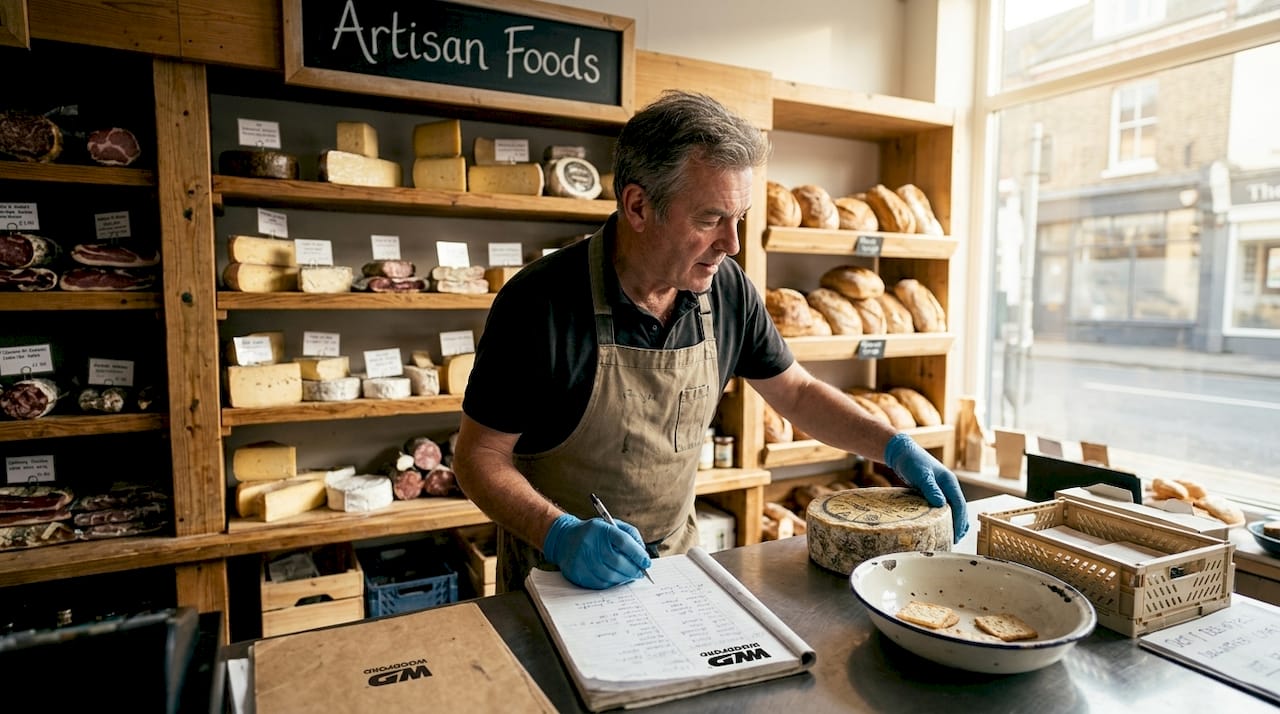
- Artisan and craft foods: Small-batch breads, charcuterie, cheeses, and preserves with clear provenance stories
- Speciality and deli lines: Imported or regionally distinctive products with authentic credentials
- Sustainable and ethical ranges: Organic, Fairtrade, or regeneratively farmed products meeting growing shopper values
- Premium own-label: Retailer-branded lines positioned above standard tier, commanding higher shelf prices
- Innovative branded products: Emerging food brands with strong identity, distinctive ingredients, or functional benefits
The contrast with budget wholesale is stark. Standard wholesale competes on volume and price. Premium wholesale competes on quality signals, brand story, and the ability to command a higher retail price point. That is why strategic food brands are central to any premium wholesale strategy: they carry the narrative that justifies the price tag.
Why does this matter right now? UK symbols and multiples are aggressively expanding their premium ranges because they recognise where margin growth lives. Market share for symbols is growing to 38.6%, driven in part by faster premium margins. Independent retailers who do not engage with premium wholesale risk ceding ground to better-resourced competitors.
A strong food brand strategy is what separates retailers who thrive in this environment from those who simply survive. Premium wholesale is not a luxury add-on. It is becoming the baseline expectation for any independent that wants to attract discerning shoppers and grow basket spend.
“Premium is no longer a niche play for specialist retailers. It is a competitive necessity for any independent that wants to hold margin and attract the modern food shopper.” — Industry perspective on the 2025 UK food landscape
The practical implication is simple: if your current wholesale mix is dominated by standard or budget lines, you are already behind the curve.
Why invest in premium: Market trends and data
The data is unambiguous. Premium food wholesale is not a trend driven by optimism. It is backed by hard numbers that independent retailers and brand owners cannot afford to ignore.
Branded margins sit at 9.6% versus private label at 3.3%, and premium deli growth is running at 10.8%. Meanwhile, independents are declining at -2.1%, with own-label premium inflation now the highest category at 8.2%. The retailers absorbing that inflation are the ones with premium ranges that justify higher shelf prices to shoppers.
| Metric | Premium segment | Standard/budget segment |
|---|---|---|
| Own-label sales growth | 16 to 18% | Below 5% |
| Branded margin | 9.6% | Lower |
| Premium deli growth | 10.8% | Declining |
| Independent retailer trend | Outperform with premium | Declining at -2.1% |
| Own-label premium inflation | 8.2% (highest) | Lower |
16 to 18% — that is the growth rate for premium own-label sales, a figure that dwarfs performance in standard categories and signals where shopper appetite genuinely sits.
What is driving this demand? Several converging forces are at work. Top-up shopping habits mean consumers visit independent stores specifically for quality and discovery, not just convenience. Health and wellness awareness is pushing shoppers toward products with cleaner ingredients and clearer provenance. Gifting occasions create consistent demand for premium formats and artisan lines. Understanding these drivers is essential for food trends and independents who want to stock with purpose rather than guesswork.
The benefits of stocking premium wholesale lines are tangible:
- Higher margin per unit: Premium products command better shelf prices, improving overall category profitability
- Differentiation from multiples: Stocking exclusive or speciality lines that supermarkets do not carry builds loyalty
- Stronger basket spend: Shoppers buying premium tend to add complementary products, lifting average transaction value
- Brand halo effect: Premium ranges elevate the perception of your entire store
- Resilience against price wars: You compete on quality, not price, reducing vulnerability to supermarket discounting
For brand owners, the picture is equally compelling. Aligning with premium wholesale channels accelerates route to market and builds the retail credibility needed for long-term growth. Investing in trend analysis for UK food brands helps ensure your product development stays ahead of what premium wholesale buyers are actively seeking.
How premium food wholesale works: People, process and pitfalls
Understanding the mechanics of premium food wholesale helps you avoid costly mistakes and build relationships that actually deliver results.
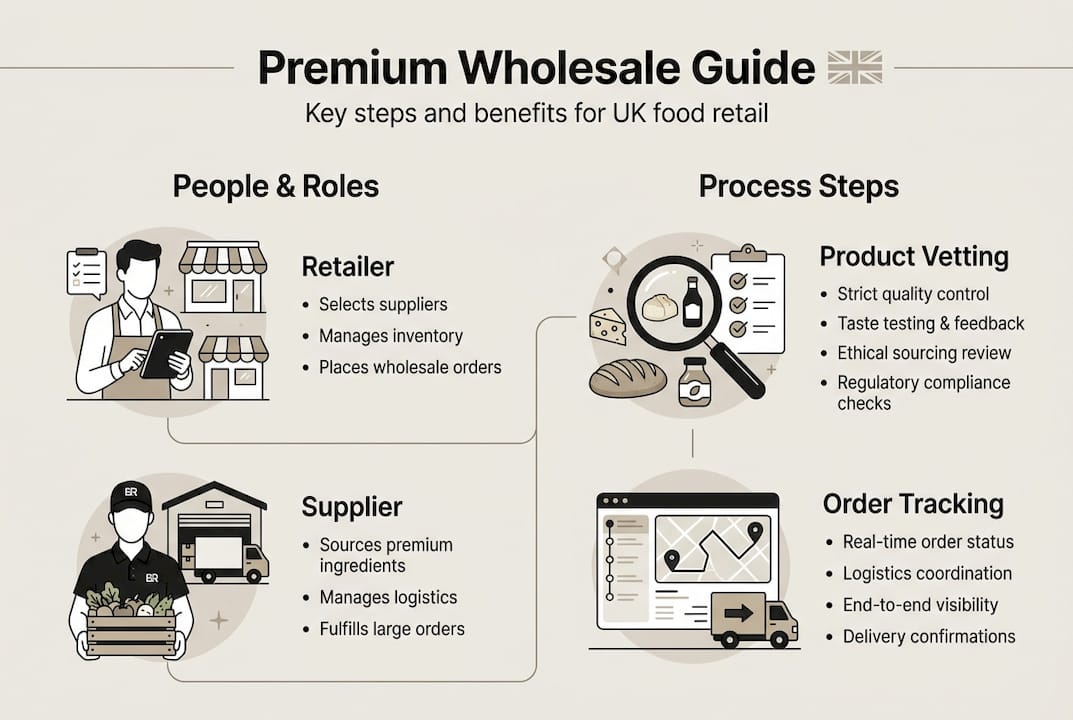
The procurement flow typically runs from producer or brand owner, through a specialist wholesaler, to the independent retailer. Each step adds value: the producer creates the product with quality and provenance credentials; the wholesaler curates, consolidates, and handles logistics; the retailer merchandises and sells. The wholesaler’s role is not passive. In premium wholesale, curation is everything. A good wholesaler filters out products that do not meet quality or commercial thresholds, saving you the risk of stocking lines that disappoint.
Here is how acquiring premium products for your store typically works:
- Identify category gaps: Review your current range and pinpoint where premium lines would add margin or differentiation
- Research specialist wholesalers: Look for partners with explicit premium or artisan credentials, not generalist catalogues
- Request samples and pricing: Always trial before committing to volume; assess quality, packaging, and shelf appeal
- Calculate total cost of ownership: Factor in delivery charges, minimum order quantities, and storage requirements alongside unit price
- Place a trial order: Start with a focused range rather than overcommitting to niche stock that may move slowly
- Review sell-through and adjust: Monitor sales data after four to six weeks and refine your range accordingly
The pitfalls are real. Overcommitting on niche stock is the most common error. A product that looks exciting in a catalogue can underperform if it lacks shopper recognition or the right merchandising support. Building supplier partnerships and calculating total cost of ownership are consistently cited as key success factors, alongside prioritising delivery reliability.
Pro Tip: Treat your wholesaler as a strategic partner, not just a supplier. Share your store’s customer profile and sales data with them. The best premium wholesalers will use that information to recommend lines with genuine fit, rather than simply pushing volume.
Digital ordering platforms and supply chain transparency are increasingly important differentiators. Understanding the full range of distribution channels available to you, and how UK food logistics operate at a premium level, will sharpen your procurement decisions. Reliable logistics tips for retailers can make the difference between a smooth launch and a costly stock problem.
Choosing and succeeding with a premium food wholesaler
Not every wholesaler that claims to offer ‘premium’ products actually delivers on that promise. Choosing the right partner requires a structured evaluation.
Use this checklist when assessing any potential premium wholesale partner:
- Quality assurance: Do they vet products for quality, provenance, and compliance before listing them?
- Range depth and breadth: Is the range genuinely differentiated, or is it standard lines with premium pricing?
- Minimum order quantities: Are MOQs realistic for an independent retailer’s cash flow and storage capacity?
- Delivery reliability: What are their lead times, and do they offer chilled or ambient options suited to your category needs?
- Digital ordering tools: Can you browse, order, and track digitally, or are you reliant on phone and paper catalogues?
- Account management: Is there a dedicated contact who understands your business and can advise on range development?
| Feature | Strong wholesale partner | Weak wholesale partner |
|---|---|---|
| Product vetting | Rigorous quality and provenance checks | Lists anything with a premium price tag |
| Range innovation | Regular new product introductions | Static catalogue updated infrequently |
| Digital tools | Full e-commerce ordering and tracking | Phone or email only |
| Delivery | Reliable, flexible, temperature-controlled | Frequent delays, limited options |
| MOQ flexibility | Scalable for independents | High minimums unsuitable for small stores |
| Support | Proactive account management | Reactive only |
Market data confirms that the market favours premium and symbol groups with wider ranges, and that independents must leverage premium options to counter decline. The right wholesale partner is your single biggest lever for doing exactly that.
Pro Tip: Before signing any agreement, negotiate a trial period of six to eight weeks with a small initial order. This lets you assess delivery performance, product quality, and sell-through without significant financial exposure.
Once you have chosen a partner, sustaining the relationship requires active engagement:
- Share sales performance data regularly so your wholesaler can recommend relevant new lines
- Attend trade previews or new product sessions to stay ahead of range changes
- Review your range quarterly to remove slow movers and introduce fresh lines
- Communicate shopper feedback to help your wholesaler understand what resonates in your specific market
A brand acceleration guide can help you understand how to build momentum with new premium lines once they are on shelf, turning a trial into a permanent fixture.
Why the future of UK independents depends on smart premium wholesale choices
There is a persistent myth in independent retail that budget lines are the safe bet because shoppers are always price-sensitive. The data does not support this. Premium segments are growing faster, recovering margins more quickly, and attracting the higher-spending shoppers that independents need to survive.
The uncomfortable truth is that independents who stick to standard wholesale models are not standing still. They are actively declining. The retailers gaining ground are those treating strategic food brand advice as a business priority, not an afterthought.
What actually works is a combination of strategic premium range selection, close supplier dialogue, and investment in digital ordering tools. Price cutting is a race you cannot win against multiples. Premium positioning is a race where independents can genuinely compete, because they offer discovery, expertise, and curation that a supermarket aisle cannot replicate. The window to act is open now. It will not stay open indefinitely.
Explore premium wholesale opportunities with Woodford
At Woodford, we work exclusively with independent retailers and ambitious food brands to make premium wholesale straightforward and commercially rewarding. We curate trend-led ranges, manage logistics, and provide the kind of hands-on account support that turns a good range into a great one. Whether you are a retailer looking to elevate your offer or a brand owner seeking the right distribution partner, we have built our model around making premium accessible without the complexity. Browse our premium brands to see the quality and diversity of what we bring to independent retail, and get in touch to discuss how we can strengthen your range in 2026.
Frequently asked questions
What qualifies as a premium food product in wholesale?
Premium wholesale products are higher-quality items differentiated by origin, ingredients, or packaging, commanding stronger margins than budget lines. Premium own-label sales are up 16 to 18%, reflecting clear shopper appetite for quality and differentiation.
How can independents benefit more from premium food wholesale?
By partnering with trusted wholesalers focused on innovation and stocking well-chosen premium lines, independents can increase margins and meet evolving consumer demand. Supplier partnerships and innovation are consistently identified as the key factors that capture growth in the current market.
What should I check when choosing a premium food wholesaler?
Review their quality guarantees, range diversity, delivery reliability, digital ordering tools, and flexibility on minimum orders. Delivery reliability and digital ordering are among the most critical differentiators between strong and weak wholesale partners.
Is premium food wholesale resilient against inflation?
Yes. Premium segments recover margins faster and show stronger sales growth than budget lines even during inflationary periods. Premium own-label inflation is running at 8.2%, the highest of any category, yet branded and premium margins remain significantly stronger than standard alternatives.
Recommended
- Strategic food brands for UK independent retailers - WOODFORD - Bringing quality foods your way
- Food brand strategy drives UK retail success in 2026 - WOODFORD - Bringing quality foods your way
- Navigating UK food logistics for wholesalers in 2026 - WOODFORD - Bringing quality foods your way
- Food logistics tips for UK independent retailers in 2026 - WOODFORD - Bringing quality foods your way