Foodservice vs retail: what you need to know

TL;DR:Foodservice involves active food preparation for immediate consumption, while retail sells finished, pre-manufactured goods.Hybrid models require careful management of costs, compliance, staffing, and margin tracking due to their operational complexities.
Many food industry professionals treat foodservice and retail as interchangeable sectors. They are not, and conflating them leads to costly strategic errors. Understanding what is foodservice vs retail is not just useful background knowledge. It directly shapes how you price, staff, source, comply, and grow. Combined retail and food service sales reached $757.1 billion in April 2026, yet the two sectors operate on entirely different logic. This article breaks down those differences clearly, covering definitions, operational realities, market shifts, and what they mean for your business.
Table of Contents
- Key takeaways
- What is foodservice vs retail: the core definitions
- How the two sectors operate day to day
- Market trends: when foodservice meets retail
- Practical implications for food entrepreneurs
- Quick-reference comparison
- My perspective on the foodservice-retail divide
- How Woodford supports both sectors
- FAQ
Key takeaways
| Point | Details |
|---|---|
| Definitions differ fundamentally | Foodservice involves active food preparation for immediate consumption; retail sells finished goods for customers to take away. |
| Operations diverge sharply | Foodservice requires skilled kitchen labour and tight safety controls; retail prioritises merchandising, logistics, and pricing. |
| Hybrid models are growing | Convenience retailers integrating foodservice programmes must manage added complexity in compliance, staffing, and margin tracking. |
| Profitability tracking is harder in hybrids | Standard POS systems rarely separate foodservice costs from retail inventory, obscuring true margin performance. |
| Strategic clarity drives better decisions | Knowing which sector you operate in, or blend, determines your regulatory burden, staffing model, and customer value proposition. |
What is foodservice vs retail: the core definitions
The clearest way to separate these sectors is to follow how regulators and industry bodies already do it. NAICS codes formally classify retail trade under codes 44 to 45, covering the resale of finished goods to consumers. Foodservice, including quick-service restaurants, sits under NAICS 722513, reflecting its defining characteristic: active food preparation for immediate consumption.
That single operational distinction, transformation versus resale, is the axis around which everything else turns.
Foodservice: the foodservice definition in practice
The foodservice industry covers any operation where food is prepared and served for immediate consumption. This includes:
- Restaurants (from fine dining to fast casual)
- Catering companies and event foodservice
- Quick-service operations (QSRs) and food trucks
- Institutional providers in schools, hospitals, and prisons
- Workplace canteens and staff dining facilities
Institutional foodservice operates quite differently from commercial foodservice. Institutional providers serve captive audiences on fixed budgets, prioritising nutritional provision over profit maximisation. Commercial foodservice competes for customers the same way retail does, but the operational toolkit is entirely different.
What is retail: the retail business model explained
Retail involves purchasing finished or pre-manufactured goods and selling them on to consumers, typically without transforming the product. Grocery chains, supermarkets, convenience stores, and specialist food shops all fall under the retail umbrella. The value proposition centres on product selection, pricing, availability, and presentation. The retailer does not make the food. They curate, stock, and merchandise it.
This distinction matters more than it might appear. A bakery selling packaged loaves through a supermarket is operating in retail. The same bakery selling freshly baked goods over the counter is operating in foodservice. The product is similar but the regulatory, operational, and financial frameworks are not.
How the two sectors operate day to day
The differences between foodservice and retail become most visible when you look at daily operations. Understanding these distinctions is the practical core of any foodservice vs retail comparison.
Inventory and perishability
Foodservice operations work with perishable ingredients that often have shelf lives measured in days or even hours. A restaurant receiving fresh fish at 7am needs to track usage, temperature, and waste in real time. Managing food inventory tightly is not optional in foodservice. It is a direct driver of margin.
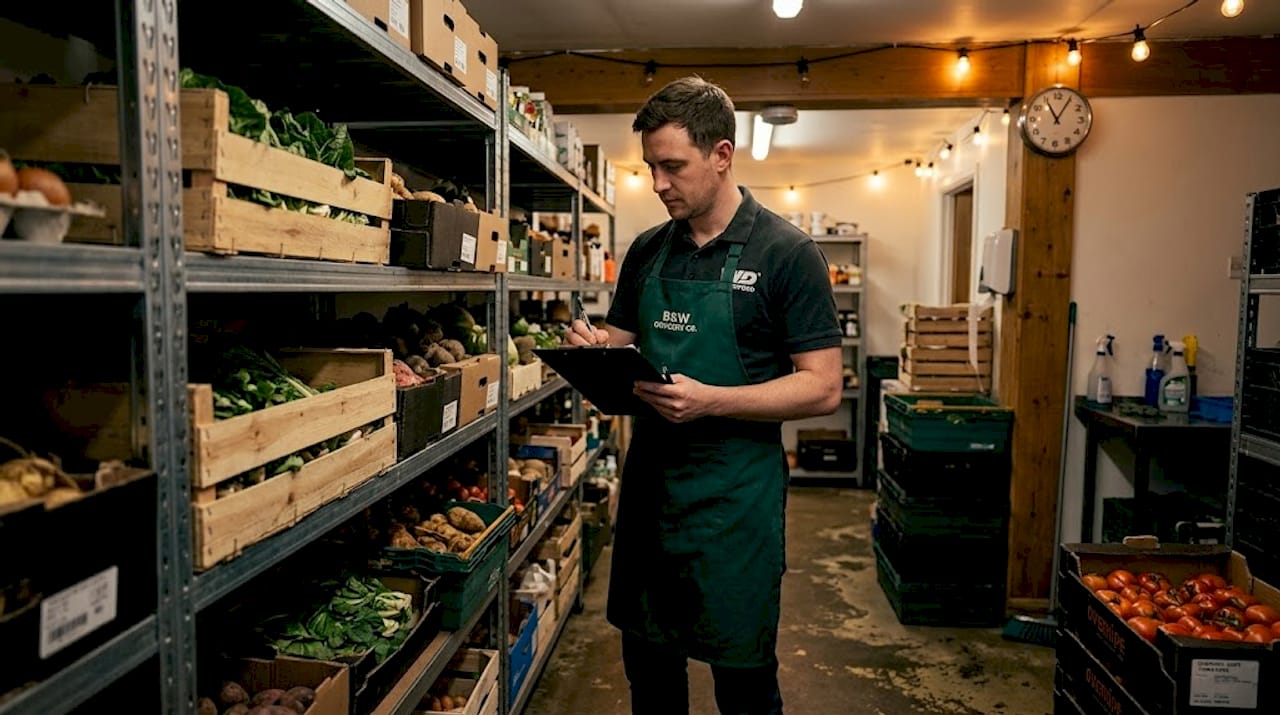
Retail inventory cycles are longer. A grocery buyer managing ambient goods works in weeks, not hours. Even fresh produce in retail benefits from more predictable turnover patterns compared to a busy kitchen. The operational rhythm is fundamentally different.
Labour and skills
Foodservice is one of the most labour-intensive sectors in the economy. Skilled chefs, kitchen porters, front-of-house staff, and supervisors all need to work in close coordination. The margin for error on service timing or food quality is narrow, and the cost of getting it wrong (a poor review, a food safety incident) is immediate.
Retail labour is more focused on logistics, replenishment, and customer guidance. The skills required are real but less specialised than in a professional kitchen. This difference in labour cost and complexity is one reason many retailers underestimate the challenge of adding a foodservice element to their offer.
Customer experience and regulatory burden
Foodservice value is driven by quality, speed, and the experience of being served. Retail value comes from price, availability, and the ease of finding the right product. These are different emotional contracts with the customer, and they require different management disciplines.
On the regulatory side, foodservice carries significantly higher compliance demands. Cross-contamination risks, time-temperature controls, allergen management, and food hygiene ratings all apply with greater intensity when food is being prepared on site. Foodservice sanitation standards are not just bureaucratic requirements. They reflect genuine safety risks that retail, dealing in sealed and pre-packaged goods, largely avoids.
Pro Tip: If you are a retailer considering adding a hot food counter, get a food safety consultant in before you start fitting out the space. The compliance requirements for a preparation kitchen are far more demanding than for a standard retail unit.
| Factor | Foodservice | Retail |
|---|---|---|
| Inventory cycle | Hours to days (perishable) | Days to weeks (more stable) |
| Labour focus | Skilled food preparation | Logistics, replenishment, sales |
| Customer value driver | Experience, quality, speed | Price, availability, range |
| Regulatory intensity | High (safety, allergens, hygiene) | Moderate (labelling, storage) |
| Margin tracking | Complex, preparation-cost based | Simpler, buy-sell margin model |
Market trends: when foodservice meets retail
The retail industry explained through a 2026 lens looks increasingly blurry at the edges. One of the most significant shifts in the food sector right now is the convergence of these two models. 65% of convenience store operators agree that foodservice programmes require flexible solutions because of store-to-store variability. That figure points to something important: operators who assumed they could copy-paste a foodservice programme across their estate quickly discovered it does not work that way.
Convenience retailers adding hot food, freshly made sandwiches, or barista coffee are the most visible example of this trend. But the drivers go beyond customer preference. Prepared food commands higher margins than ambient grocery. It generates foot traffic at times of day when packaged goods do not. It differentiates a convenience store from a competitor 200 metres down the road.
The operational implications, though, are significant. Here is what hybrid operators are grappling with:
- Recruiting and retaining staff with food preparation skills, at retail wages
- Meeting the food hygiene standards required for on-site preparation
- Integrating foodservice costs into a retail-oriented accounting system
- Managing fluctuating demand without over-producing and wasting food
- Staying compliant with allergen labelling requirements across both offer types
Retailers adapting to food trends who do this well are building a genuinely hard-to-replicate competitive position. Those who do it badly end up with a cold hot counter and a hygiene notice in the window.
Digital tools and automation are helping on both sides of the equation. Inventory management platforms that handle both retail stock and foodservice ingredients in a single system are increasingly accessible at independent scale. Technology supports operations in both sectors, but it does not replace the fundamentally human nature of great service.
Practical implications for food entrepreneurs
Understanding the foodservice industry overview matters most when you are actually making decisions. Here are the key operational considerations for entrepreneurs choosing between, or blending, these models.
- Separate your margin tracking from day one. Standard POS systems rarely separate foodservice labour and food costs from retail inventory costs. Without that separation, you cannot tell whether your hot food counter is making money or eroding the margin your packaged goods are generating. Invest in integrated software before you scale, not after.
- Understand your regulatory starting point. If you are currently retail-only, adding foodservice preparation means entering a different compliance world. You will need a Food Hygiene Rating scheme registration, HACCP documentation, allergen protocols, and probably a separate food preparation space. Budget for this properly.
- Plan your labour model before your menu. Many entrepreneurs design the food offer first and then realise they cannot find or afford the staff to deliver it consistently. Work out your labour cost at the intended volume before you commit to equipment or branding.
- Test hybrid formats small before rolling out. The most successful hybrid operators typically start with a single location, learn what actually sells and what gets thrown away, then refine the model before expanding. The 2026 food trends shaping UK retail all point toward more hybrid formats. The retailers winning are the ones testing deliberately, not copying blindly.
- Revisit your supplier relationships. Foodservice procurement operates on different terms to retail buying. You will be ordering fresher goods more frequently, often in smaller quantities. Your existing retail supplier may not be the right partner for your foodservice ingredients.
Pro Tip: When modelling a hybrid business case, run the foodservice and retail arms as separate profit centres in your spreadsheet, even if they share a physical space. This will reveal quickly whether the foodservice element is genuinely profitable or simply cross-subsidised by your core retail trade.
Quick-reference comparison
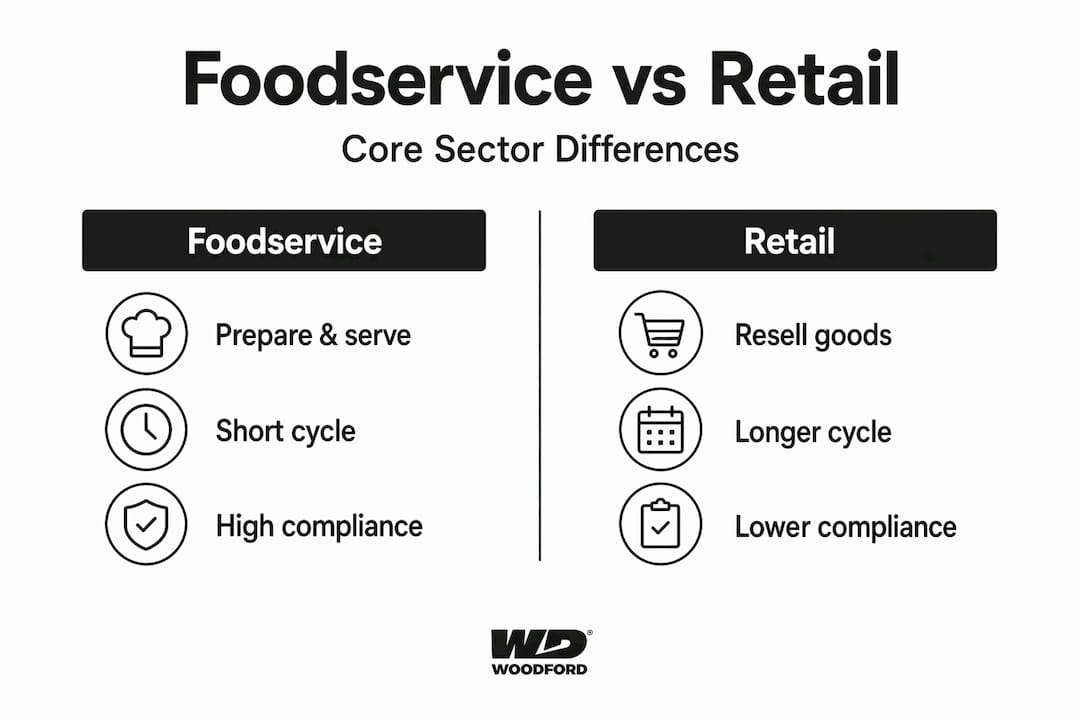
For those making a decision or briefing a team, here is a side-by-side summary of the core differences between foodservice and retail.
| Dimension | Foodservice | Retail |
|---|---|---|
| Core activity | Prepare and serve food immediately | Buy and resell finished goods |
| Classification | NAICS 722513 | NAICS 44-45 |
| Primary customers | Diners, consumers seeking immediate food | Shoppers buying goods to use at home |
| Key success factors | Execution, quality, service speed | Pricing, range, availability |
| Main compliance areas | Food hygiene, allergens, safety | Labelling, storage, trading standards |
| Labour model | Skilled, intensive, schedule-dependent | Moderate skill, scalable |
| Profit margins | Variable, cost-sensitive | More predictable, volume-driven |
My perspective on the foodservice-retail divide
In my experience, the biggest mistake people make when crossing from retail into foodservice is not operational. It is attitudinal. Retail trains you to think about products. Foodservice demands you think about processes. The moment you start selling food you have prepared yourself, everything changes: the safety liability, the staffing model, the waste calculation, and the way you measure a good day.
I have seen operators launch a food-to-go offer with real enthusiasm and a solid menu, only to quietly shelve it six months later because they never sorted the margin tracking or the rota. The food was good. The business model was not thought through.
What I have found actually works is treating the two disciplines with equal seriousness. Do not bolt foodservice onto a retail operation as an afterthought. It deserves its own plan, its own budget line, and its own compliance review. Similarly, if you are a foodservice operator looking at retail (bottling a sauce, selling merchandise), understand that the retail buyer’s world is driven by data and ranging decisions, not by how good your product tastes.
The convergence is real and the opportunity is genuine. But respecting the structural differences between these sectors is what separates the operators who make it work from those who learn the lesson the expensive way.
— Nadim
How Woodford supports both sectors
Whether you are working in foodservice, retail, or a hybrid of both, having the right supplier on your side makes a material difference. Woodford is the UK’s leading strategic food wholesaler, working with independent retailers to provide access to quality food brands, exclusive distribution, and the kind of trend-led curation that makes a range genuinely competitive.
We work closely with ambitious independents who want to stock products that stand out on the shelf and satisfy customers coming back for more. Our portfolio spans the categories that matter most to both food-to-go and ambient retail. Explore our full brand portfolio to see the range of quality food brands we work with, and get in touch if you want to discuss how Woodford can help you build a stronger, more profitable food offer.
FAQ
What is the difference between foodservice and retail?
Foodservice involves actively preparing food for immediate consumption, such as in restaurants or catering. Retail involves selling pre-manufactured or packaged goods directly to consumers without transformation.
Is fast food classified as foodservice or retail?
Fast food is classified as foodservice under NAICS 722513 because it involves active food preparation and immediate service, despite its retail-like logistics and volume.
Can a business operate in both foodservice and retail?
Yes. Hybrid models, such as convenience stores with hot food counters, operate in both sectors. However, they require separate compliance frameworks, staffing approaches, and margin tracking systems.
Why does profitability tracking differ in hybrid operations?
Standard retail POS systems do not separate food preparation costs from inventory costs. Separating these cost centres through specialised software is necessary to understand the true margin of each part of the business.
What are the main regulatory differences between foodservice and retail?
Foodservice operations face more intensive food safety obligations, including HACCP documentation, temperature controls, and on-site hygiene inspections. Retail compliance focuses more on labelling accuracy and storage standards.
Recommended
- Food merchandising tips to boost your UK retail sales - WOODFORD - Bringing quality foods your way
- Understanding the food distribution cycle for UK retailers - WOODFORD - Bringing quality foods your way
- Innovation in UK food retail: A practical guide for independents - WOODFORD - Bringing quality foods your way
- Food sector compliance: What every UK brand must know - WOODFORD - Bringing quality foods your way