
Wholesale health foods: trade account guide for UK retailers

For a UK independent retailer or food co-op, the fastest route to a reliable wholesale health-food supply is straightforward: open a trade account with a wholesaler that carries curated organic, vegan, and vegetarian ranges, offers a digital ordering portal, and provides genuine retailer support. Woodford is built precisely for that brief.
The UK food and drink wholesale sector generated £33.6 billion in turnover in 2023/24, with £17.5 billion of that flowing directly to independent retailers. That scale matters because it means the supply infrastructure exists to serve you well. The question is choosing the right partner within it.
Before you contact any wholesaler, run through this checklist:
- Confirm trade account requirements (VAT number, proof of trade, payment terms)
- Request product samples and full specification sheets before committing to stock
- Check minimum order values and delivery windows for your postcode
- Ask about promotional support, price-marked packs (PMPs), and online portal access
- Verify certifications: Soil Association Organic, The Vegan Society, Fairtrade, and BRC where relevant
Your immediate next steps:
- Identify two or three wholesalers whose range aligns with your store’s health-food focus
- Apply for trade accounts and submit your VAT registration or business letterhead
- Request a mixed sample order covering your core categories before placing a full pallet
- Set up automated re-orders via the digital portal once you have confirmed sell-through on initial lines
Pro Tip: Request a short initial mixed sample order rather than committing to a full pallet. Once you have confirmed which lines sell, set automated re-orders via the wholesaler’s digital portal to avoid stockouts during your launch period.
Table of Contents
- What product ranges do wholesale health-food suppliers carry?
- How do you open a trade account and start ordering?
- How does wholesale pricing work, and how do you protect your margins?
- What delivery minimums and lead times should you expect?
- Which certifications and labels must you verify before listing?
- How do you choose the right wholesale health-food supplier?
- How Woodford supports UK independent retailers
- Key takeaways
- Woodford trade account: start trading in under a week
- Useful sources and further reading
What product ranges do wholesale health-food suppliers carry?
The breadth of a supplier’s catalogue is the first thing to assess. A credible wholesale health-food distributor will carry ambient pantry staples, trend-led snacks, and speciality free-from lines under one roof.
Core categories to expect:
- Ambient pantry: pulses, grains, flours, seeds, and dried fruits in both retail packs and bulk formats
- Snacks and bars: protein bars, raw energy balls, rice cakes, and nut-based snacks
- Superfoods and powders: spirulina, maca, baobab, collagen, and plant-based protein blends
- Baking and sweeteners: coconut sugar, xylitol, alternative flours (buckwheat, oat, almond)
- Plant-based proteins: tofu, tempeh, seitan, and ambient meat-alternative products
- Speciality free-from: certified gluten-free, nut-free, and low-FODMAP lines
- Chilled and frozen vegan ready meals where the wholesaler operates cold-chain fulfilment
SKU formats matter as much as the categories themselves. Price-marked packs work well for impulse fixtures near the till. Bulk tubs suit refill stations and deli counters. Single-serve trial packs let you test a new superfood trend without tying up significant working capital in a full case.
Health and wellness trends and social media-driven products are creating fast-moving SKUs, and distributors that curate these trends reduce the sourcing burden for retailers considerably. Rather than monitoring dozens of emerging brands yourself, a wholesaler with a dedicated trend-curation team does that work for you. Look for suppliers that flag seasonal promotions and new-product launches within their catalogue, and that offer starter bundles specifically designed for independents trialling a new category.

When reviewing a catalogue, check that every SKU comes with a downloadable specification sheet, a full allergen declaration, and clear dietary icons. A supplier that cannot provide these documents promptly is one to approach with caution.
How do you open a trade account and start ordering?
The process is more straightforward than many first-time buyers expect, particularly with wholesalers that have invested in digital onboarding.
Typical trade account requirements:
- Registered business name and trading address
- VAT registration number (or a business letterhead if you are below the VAT threshold)
- Payment method: card on order, BACS transfer, or net terms subject to credit approval
- Signed terms and conditions covering returns, minimum orders, and delivery liability
Step-by-step order flow:
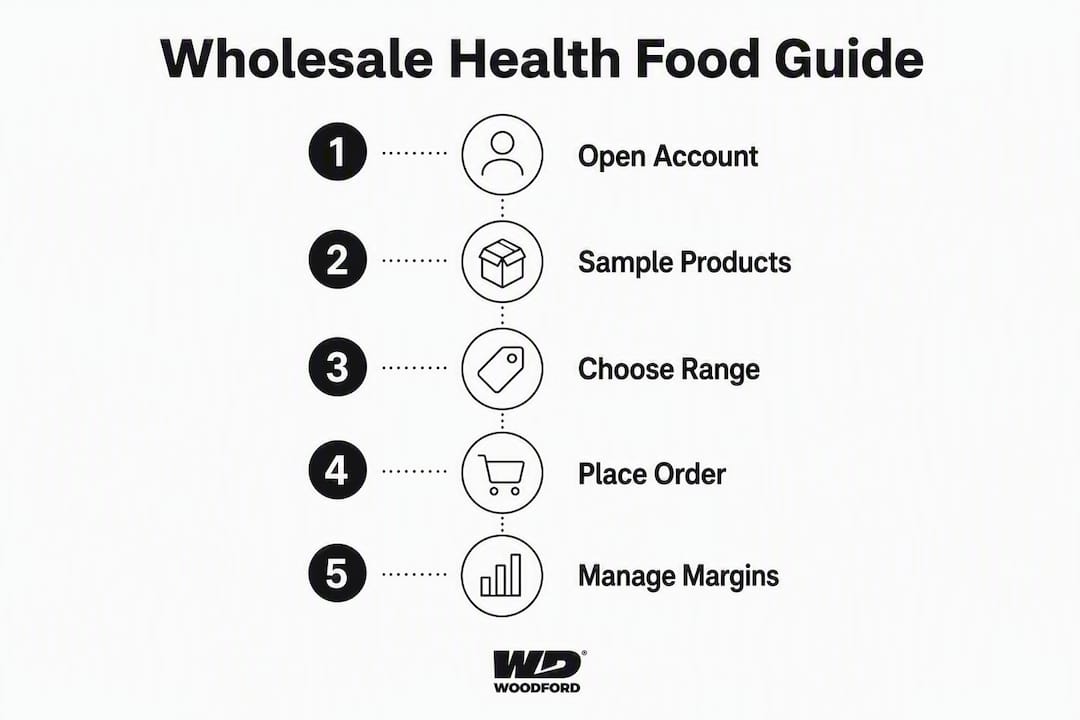
- Complete the online trade account application and upload your proof of trade
- Await account approval (typically 24–72 hours with digital-first wholesalers)
- Request samples and specification sheets for your shortlisted SKUs
- Place a small initial order or sample pallet to test sell-through
- Agree a recurring order cadence that matches your stock turnover
- Activate automated re-order rules via the portal, linked to your reorder points
Electronic ordering is now the largest purchasing platform in UK wholesale, and a good portal gives you real-time stock visibility, downloadable invoices, order history, and promotional flags in one place. Independents that adopt digital ordering and AI replenishment reduce stockouts and working capital tied up in slow-moving lines, which is a genuine operational advantage when you are managing a small team.
First-week practical checklist:
- Confirm your delivery day and the cut-off time for next-day dispatch
- Ask about the returns policy for damaged or short-dated goods
- Note the emergency replenishment process for fast-selling lines
- Download product data files for your EPOS or inventory system
For a deeper look at improving your wholesale workflow, Woodford’s operational guides walk through portal setup and ordering cadence in practical detail.

How does wholesale pricing work, and how do you protect your margins?
Wholesale pricing for health foods typically follows a list-price-plus-trade-discount model, with discount tiers that improve as your order volume increases. Common pricing structures include base list prices with percentage trade discounts, price-marked packs protecting margins, promotional price windows, and volume band discounts.
Price-marked packs boost consumer trust and deliver sales uplift for independents, and wholesalers that curate PMP ranges actively add value beyond just supplying stock. When reviewing discount tiers, check whether the breakpoints are realistic for your order size, and whether discounts apply to promotional items or are suspended during sale periods.
Payment terms vary. Card on order is standard for new accounts. BACS and net-14 or net-30 terms become available once a credit check is passed. Ask whether early-payment discounts exist, as some wholesalers offer 1–2% off for settlement within seven days.
With one in five retailers delaying investment due to rising operating costs, keeping initial orders conservative and leaning on PMPs to protect margin is a sound approach. For a detailed breakdown of wholesale pricing strategies, the principles apply directly to health-food ranging.
Pro Tip: Ask for a fixed-price period on your core SKUs, particularly seasonal bestsellers. Request full transparency on carriage charges and any fuel surcharges before signing terms, as these can erode margin on smaller orders.
What delivery minimums and lead times should you expect?
Delivery is the dominant fulfilment model in UK wholesale, accounting for roughly two-thirds of all buying. Understanding the logistics constraints upfront prevents the two most common problems for independents: unexpected out-of-stocks and cash tied up in over-ordering.
Key logistics variables to check:
Lead times for ambient health foods are generally 24–72 hours from a well-stocked wholesaler. Chilled and frozen lines often require 48 hours minimum and may carry a cold-chain surcharge. For urgent replenishment, ask whether next-day delivery is available and what the premium is.
The UK wholesale market is investing in digital ordering and AI-driven replenishment to meet convenience demand, which means the best suppliers now send automated low-stock alerts through their portals. Use those alerts to set reorder points that account for your lead time, not just your current shelf level. Woodford’s wholesale logistics guide covers this planning process in detail.
Which certifications and labels must you verify before listing?
Health-food shoppers are more label-literate than the average convenience customer. A product without the right certification mark will not sell as well, and in some cases listing it without proper documentation creates a compliance risk for your store.
Essential certifications to request from any supplier:
- Soil Association or equivalent EU/UK Organic certification (with a valid certification number)
- The Vegan Society trademark or equivalent vegan certification
- Fairtrade mark for relevant commodities (cocoa, coffee, sugar, bananas)
- BRC Global Standard for Food Safety for packed or manufactured goods
- Gluten-free certification from Coeliac UK or equivalent, where claimed
Mandatory documentation for every SKU:
- Full product specification sheet (ingredients, origin, net weight, shelf life)
- Official allergen declaration with the 14 major allergens highlighted per UK food law
- Batch traceability records and the supplier’s recall procedure
Label checks matter at the shelf edge too. UK allergen law requires the 14 major allergens to be emphasised in the ingredients list (bold, italic, or contrasting colour). Organic claims must carry a certification body code. Vegan and vegetarian icons should come from a recognised body, not a self-declaration. Any supplier that cannot supply these documents within 48 hours of a request is not operating at the standard a health-food retailer needs.
How do you choose the right wholesale health-food supplier?
A four-part framework covers the decision well: product fit, operational reliability, commercial terms, and retailer support.
Questions to ask every supplier shortlisted:
- What is your minimum order value and how frequently do you deliver to my postcode?
- Can I request samples and full specification sheets before placing a first order?
- Do you offer a digital ordering portal with real-time stock visibility?
- What promotional support do you provide (POS, planograms, promotional funding)?
- What are your payment terms for new accounts, and when do net terms become available?
- How do you handle short-dated or damaged stock on delivery?
Red flags to watch for:
- Delivery windows that change frequently with little notice
- Pricing that shifts without a formal price list or advance warning
- Missing or incomplete allergen and specification documentation
- Refusal to provide samples before a minimum order commitment
- No digital portal, or a portal that does not show live stock levels
Wholesalers that offer digital ordering, flexible fulfilment, and retailer support outperform those relying on passive volume supply. Run a 4–6 week trial order period with any new supplier. Measure sell-through on the lines you listed, track delivery accuracy, and assess how quickly the account manager responds to queries. That trial period tells you more than any sales conversation.
Wholesalers that supply marketing collateral, promotional incentives, and planogram advice materially improve independent retailers’ sell-through. Treat that support as a genuine selection criterion, not a nice extra. A supplier that helps you merchandise a new superfood range will outperform one that simply delivers the stock.
For context on how different wholesaler models compare, Woodford’s guide to wholesaler types is a useful reference before you finalise your shortlist.
How Woodford supports UK independent retailers
Woodford operates as a strategic food wholesaler, not a passive stock supplier. The distinction matters for independents and food co-ops that need more than a price list and a delivery lorry.
What Woodford offers in practice:
- Curated, trend-led product selection across organic, vegan, vegetarian, and free-from categories
- Exclusive distribution agreements with emerging and established food brands
- A digital ordering portal with real-time stock visibility, order history, and promotional flags
- Full logistics and fulfilment, including consolidated shipments for mixed-category orders
- Promotional and merchandising support: POS materials, planogram advice, and promotional funding windows
- Sample packs and full specification sheets for every SKU before you commit to stock
- Account management for multi-site buyers and food co-ops with more complex ordering needs
Treating your wholesale partner as an extension of your retail marketing team is the approach that consistently improves sell-through for independents. Woodford’s promotional support is designed exactly for that: use their POS and planogram advice to accelerate trial on new SKUs rather than funding your own in-store campaigns from scratch.
The onboarding process is straightforward. You submit your trade account application with your business details and VAT number, and Woodford’s team handles the rest. Once approved, you have immediate access to the portal and can request samples on any line in the catalogue.
Pro Tip: When you first access the Woodford portal, download the specification sheets for your top 20 target SKUs before placing any order. Cross-reference allergen declarations against your current shelf labelling to catch any compliance gaps early.
How UK distributors support independent retail success is covered in detail in Woodford’s retailer guides, with practical examples of promotional campaigns and ranging decisions.
Key takeaways
Choosing the right wholesale health-food partner comes down to three things: a curated range that matches your shoppers’ expectations, a digital ordering process that keeps your shelves full, and a supplier that actively supports your sales rather than just delivering stock.
| Point | Details |
|---|---|
| Open a trade account first | Gather your VAT number and proof of trade before approaching any wholesaler to speed up approval. |
| Sample before you stock | Request mixed sample orders and full specification sheets on every SKU before committing to a full case or pallet. |
| Check certifications rigorously | Verify Soil Association Organic, Vegan Society, Fairtrade, and allergen documentation for every line you list. |
| Use the digital portal actively | Set automated re-orders based on sell-through data to reduce stockouts and free up working capital. |
| Woodford as your trade partner | Woodford offers curated organic and vegan ranges, exclusive brand access, and full retailer support via a digital ordering portal. |
Woodford trade account: start trading in under a week
Independent retailers sourcing bulk organic snacks, vegan staples, and free-from lines face a real problem with generic distributors: the range is broad but undifferentiated, the support is minimal, and trend-led SKUs arrive months after the social media moment has passed.
Woodford is built differently. You get exclusive access to curated health-food brands, a digital portal that shows live stock and flags promotions, and an account team that helps you merchandise new lines rather than leaving you to figure it out alone. The logistics are handled end to end, so your first order can arrive within days of account approval.
To get started: visit Woodford’s brands and trade account page, submit your business details, and request your sample pack. Your account can be active and your first order placed within the same week.
Useful sources and further reading
The figures and market context in this article draw on the following authoritative sources. Each is worth bookmarking if you are building a procurement strategy or making the case internally for a new wholesale partner.
Market size and sector data:
- Food and drink wholesale GVA and sector statistics, GOV.UK: the primary government source for UK food chain value, including wholesale’s £18.3bn GVA contribution in 2024.
- Lifeblood of the nation, Wholesale Manager: FWD and Capital Economics research covering the sector’s £33.6bn turnover and its support for 1.2 million downstream retail jobs.
- UK Grocery, Foodservice and Wholesale Forecast: Trends to 2030, IGD: IGD’s long-range forecast, including the sector’s 1.2% growth in 2024 and the trajectory to 2030.
Digital ordering and retailer support:
- IGD column: This defining era demands rebalance, Wholesale News: analysis of why digital ordering and retailer support are now the differentiating factors in wholesale.
- UK Wholesale Market 2025: Growth, retail trends and digital strategies, Lumina Intelligence: covers AI replenishment, PMP usage, and the cost pressures facing independents.
Certifications and labelling:
- Soil Association: the UK’s primary organic certification body; check soilassociation.org for certification numbers and standards.
- The Vegan Society: trademark licensing and vegan product standards at vegansociety.com.
- Food Standards Agency: allergen labelling requirements and the 14 major allergens under UK food law at food.gov.uk.
Key sector figures at a glance:
| Metric | Figure | Source |
|---|---|---|
| Wholesale sector turnover (2023/24) | £33.6bn | FWD / Capital Economics |
| Sales to independent retailers (2023/24) | £17.5bn | FWD / Capital Economics |
| Food and drink wholesale GVA (2024) | £18.3bn | GOV.UK Food Statistics |
| Delivery share of wholesale buying | about two-thirds | IGD / Wholesale News |
| Retailers delaying investment (2025) | 1 in 5 | Lumina Intelligence |


