
Use by vs best before: what UK food labels really mean
A ‘use by’ date is a safety instruction. A ‘best before’ date is a quality guide. That single distinction determines whether eating a food could make you ill or simply means it tastes slightly less fresh. Under UK food labelling law, selling food past its ‘use by’ date is a criminal offence. Eating food past its ‘best before’ date, by contrast, is often perfectly fine with a quick sensory check.
For consumers: if the label says ‘use by’, follow the date without exception. If it says ‘best before’, use your judgement. For food handlers and retailers: the legal line sits firmly at ‘use by’. Cross it and you are breaking the law.
Key takeaways
‘Use by’ dates are safety instructions backed by law; ‘best before’ dates are quality guides where sensory checks apply and food is often safe to eat after the date has passed.
| Point | Details |
|---|---|
| ‘Use by’ = safety | Never eat food after its ‘use by’ date; the date is the only reliable safety indicator. |
| ‘Best before’ = quality | Food is usually safe after a ‘best before’ date; use sight, smell, and taste to judge. |
| Selling past ‘use by’ is an offence | UK law makes it a criminal offence to sell food after its ‘use by’ date. |
| Storage validates the date | Keep fridges at 5°C or below; a date is only valid if storage conditions have been followed. |
| Freeze before the ‘use by’ date | Freezing on or before the ‘use by’ date pauses the clock and keeps the food safe. |
Table of Contents
- What does ‘use by’ mean, and when is it unsafe to eat?
- What does ‘best before’ mean, and can you eat food after the date?
- What do ‘display until’, ‘sell by’, and ‘best before end’ mean?
- What are the UK legal rules on date marking?
- How to store, handle, and freeze food safely
- How do manufacturers decide which date to use?
- Sources
What does ‘use by’ mean, and when is it unsafe to eat?
A ‘use by’ date tells you the last day a food is safe to eat, provided you have stored it correctly throughout. After that date, the food may harbour harmful levels of bacteria even when it looks and smells completely normal. Food Standards Scotland is clear: ‘use by’ is about safety, not preference.
Foods that typically carry a ‘use by’ date:
- Raw and cooked meats (chicken breasts, sliced ham, sausages)
- Ready-to-eat salads and prepared vegetables
- Chilled ready meals and sandwiches
- Some soft cheeses and dairy-based dips
- Smoked fish and fresh shellfish
Storage matters as much as the date itself. Where the label says “keep refrigerated,” your fridge must run at 5°C or below. The GOV.UK guidance on food labelling confirms that storage conditions must appear on the label when they are needed to keep the date valid. A chicken breast left on the counter for two hours before going back in the fridge has effectively lost some of its ‘use by’ guarantee.
The sniff test does not work here. The pathogens responsible for serious food poisoning, including Listeria, Salmonella and Campylobacter, produce no reliable smell or visible change. The GOV.UK home food fact checker states plainly that you cannot smell the bacteria that cause food poisoning. This is the most dangerous misunderstanding around ‘use by’ dates.
Practical rules for consumers and handlers:
- Never eat food after its ‘use by’ date, even if it looks fine.
- You can freeze food on or before the ‘use by’ date; once frozen, the date is paused.
- Cook from frozen or thaw in the fridge, not on the worktop.
- If you are a food handler, label any portioned or transferred food with the original ‘use by’ date.
What does ‘best before’ mean, and can you eat food after the date?
‘Best before’ is a minimum durability date. It tells you when a food should still be at its best quality, assuming correct storage. After the date, the food is usually safe to eat, though it may have lost some flavour, texture, or nutritional value.
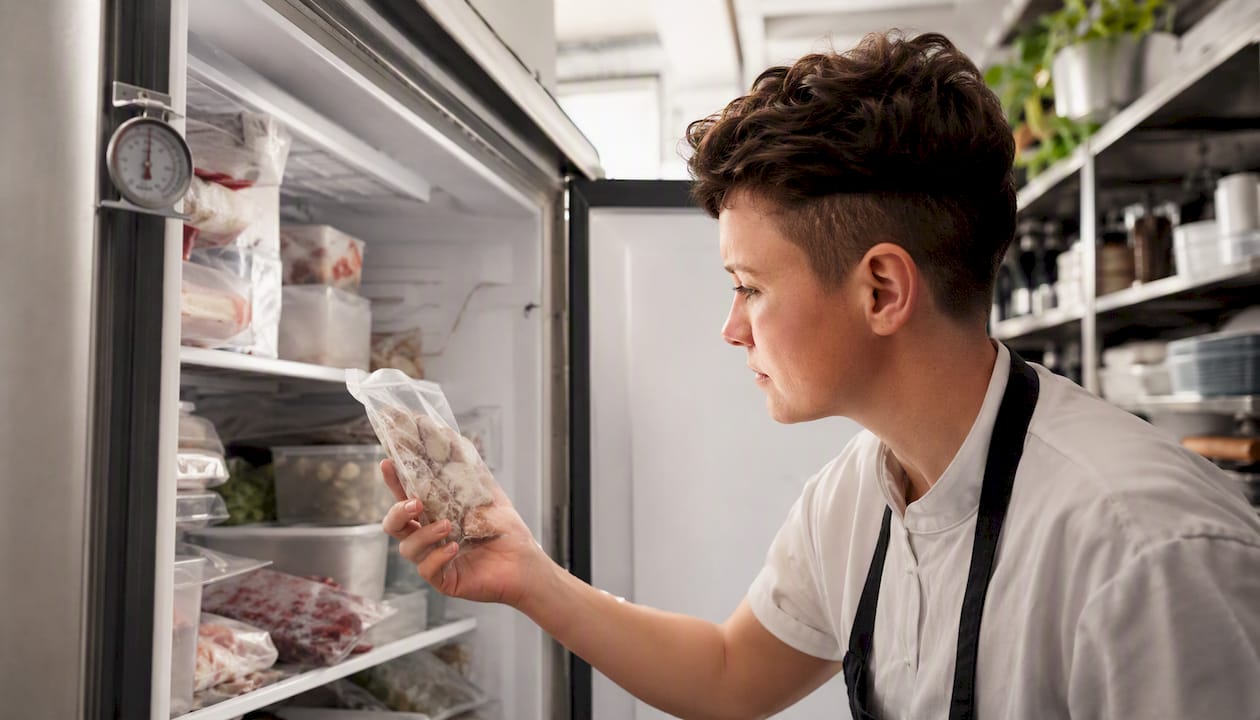
GOV.UK confirms that ‘best before’ applies to a wide range of foods including frozen, dried, and tinned goods. Think pasta, rice, breakfast cereals, frozen peas, tinned tomatoes, biscuits, and many hard cheeses. None of these become dangerous the morning after their ‘best before’ date passes.
How to judge food after its ‘best before’ date:
Look for visible mould, an unusual texture, or an off smell. Taste a small amount if the appearance and smell are fine. These sensory checks are appropriate here precisely because quality-related spoilage is detectable in a way that pathogen growth is not. A bag of oats that smells stale is unpleasant; it is not a food safety emergency.
Reducing waste around ‘best before’ dates:
- Freeze bread, meat, and dairy before the date if you will not use them in time.
- Use slightly past-date dried goods in soups, stews, or baking where texture matters less.
- Portion large packs and freeze what you will not use within a day or two.
- Follow the manufacturer’s “once opened, use within X days” instruction, which often overrides the printed date.
The FSA’s consumer insights research highlights that clearer understanding of date labels is one of the most direct levers for reducing household food waste while keeping people safe.
What do ‘display until’, ‘sell by’, and ‘best before end’ mean?
These are the labels that cause the most confusion, largely because they look official but serve very different purposes.
- ‘Display until’ and ‘sell by’ are stock-rotation tools for retailers, not safety or quality dates for shoppers. A supermarket uses them to manage shelf turnover. You can ignore them entirely when deciding whether to eat something. The date that matters is always the ‘use by’ or ‘best before’.
- ‘Best before end’ (BBE) is simply a format variant of ‘best before’. Under Regulation 21 of the Food Labelling Regulations, longer shelf-life products may show only a month and year (e.g. “Best before end: March 2027”) rather than a specific day. The meaning is identical to ‘best before’; only the precision of the date changes.
- ‘Date of freezing’ appears on some frozen products and tells you when the item was frozen, which helps you judge how long it has been in storage. It works alongside, not instead of, a ‘use by’ or ‘best before’ date.
- Multi-pack and composite products can carry mixed dates across individual components. The rule is straightforward: follow the earliest relevant date. If a meal kit contains a chicken portion with a ‘use by’ of tomorrow and a sauce with a ‘best before’ of next month, the chicken’s ‘use by’ governs when the whole dish must be prepared.
These products must still carry a lot number for traceability purposes.
What are the UK legal rules on date marking?
The legal framework is clear, and the consequences for getting it wrong are serious.
When each date type is required:
| Requirement | ‘Use by’ | ‘Best before’ |
|---|---|---|
| Applies to | Highly perishable foods posing an immediate health risk | Foods with a longer shelf life where quality declines over time |
| Legal obligation | Mandatory; must appear with any necessary storage conditions | Mandatory for most prepacked foods unless exempt |
| Selling past the date | Criminal offence | Not a criminal offence; quality may have declined |
| Consumer action | Do not eat after the date | Use sensory judgement; usually safe |
GOV.UK’s food labelling guidance confirms that most prepacked foods must show one of these two dates alongside any storage conditions required to maintain its validity. Selling food past a ‘use by’ date is a criminal offence under UK food safety legislation.
Seller and retailer obligations:
- Maintain accurate stock rotation and remove ‘use by’ products from sale before the date expires.
- Keep storage records and ensure cold chain integrity (refrigeration at 5°C or below where required).
- Label any repacked or portioned food with the correct date from the original packaging.
- Retailers buying for resale should verify date-marking compliance with their supplier. Woodford’s guidance on UK food compliance covers the traceability and labelling obligations that independent retailers need to meet.
Reporting a breach: if you believe a retailer is selling food past its ‘use by’ date, report it to your local authority’s environmental health team. The Food Standards Agency website lists contact routes for England, Wales, and Northern Ireland; Food Standards Scotland covers Scottish businesses.
How to store, handle, and freeze food safely
Good storage habits are what make date labels meaningful. A ‘use by’ date is only valid if the food has been kept correctly from the moment it left the factory.
Key storage rules:
- Keep your fridge at 5°C or below. Most domestic fridges run slightly warmer than their dial suggests; a fridge thermometer costs very little and removes the guesswork.
- Store raw meat on the bottom shelf, away from ready-to-eat foods.
- Follow any “once opened, use within” instruction on the pack, which often sets a shorter window than the printed date.
- Never refreeze food that has already been thawed, unless you cook it thoroughly first.
Freezing and cooking around dates:
- Freeze on or before the ‘use by’ date. Once frozen, the food is safe indefinitely, though quality degrades over time.
- Label everything you freeze with the date it went in and what it is. A freezer bag of unlabelled mince from three months ago is a practical problem even if it is technically safe.
- Batch-cook meals approaching their ‘use by’ date and freeze the cooked portions. Cooking kills most pathogens, and the cooked dish can then be frozen safely.
Pro Tip: Portion meat and fish into meal-sized amounts before freezing. It reduces waste, speeds up thawing, and means you only defrost what you actually need.
The FSA’s consumer insights work consistently shows that households which understand the difference between ‘use by’ and ‘best before’ make better decisions about both safety and waste. Knowing which label you are looking at is the single most useful habit to build.
One firm warning: never apply the sniff test to a ‘use by’ food and conclude it is safe. The bacteria that cause serious illness, including Listeria monocytogenes, grow without producing any detectable odour. Smell is a useful tool for ‘best before’ foods. For ‘use by’ foods, the date is the only reliable guide.
How do manufacturers decide which date to use?
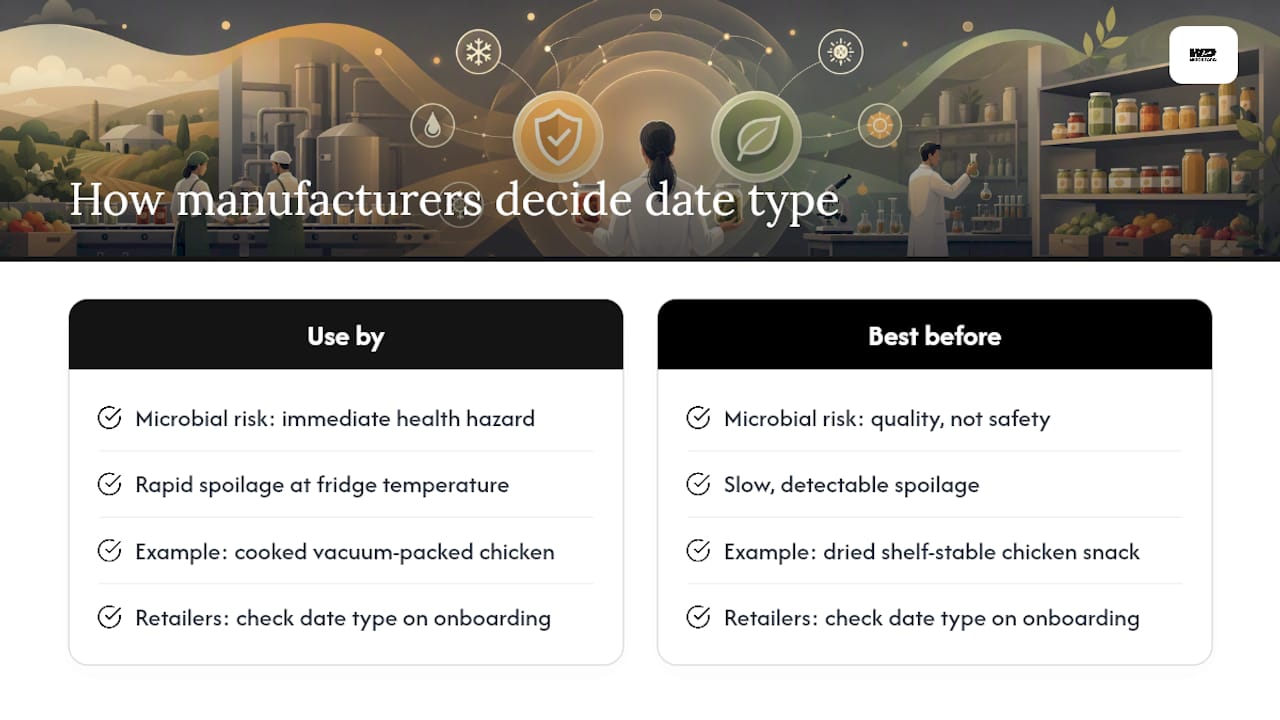
The choice between ‘use by’ and ‘best before’ is not arbitrary. Manufacturers carry out microbiological risk assessments that consider the food’s composition, water activity, pH, processing method, and packaging. A food that supports rapid bacterial growth at fridge temperature will receive a ‘use by’ date. A food where spoilage is slow, detectable, and not an immediate health risk gets a ‘best before’.
This is why two products that look similar on the shelf can carry different date types. A pasteurised, vacuum-packed cooked chicken slice and a shelf-stable dried chicken snack face entirely different microbial risk profiles. The FDF’s date-marking guidance confirms that ‘display until’ and ‘sell by’ marks are stock-management tools and carry no consumer safety meaning.
For retailers buying products for resale, this has a practical implication: check the date type on every new product line, not just the date itself. A product switching from one supplier to another may carry a different date type if the processing method differs. Woodford’s resources on food sector compliance offer further detail on what to verify when onboarding new product lines.
Small producers who apply date marks manually should use compliant labelling equipment. A date-marking stamp with the correct wording helps meet the format requirements set out in UK labelling regulations.
Sources
The guidance in this article draws on official UK sources. For consumers, the most accessible starting points are the GOV.UK food labelling pages and the FSA’s home food fact checker. For businesses and food handlers, the legislation pages and GOV.UK’s detailed labelling guidance set out the precise legal requirements.
This article is general information, not a substitute for advice from a qualified doctor. Consult a qualified healthcare professional about your own circumstances before acting on anything here.


