
UK Food Imports: 5 GOV.UK Checks with Woodford for Retailers
Yes, you can import food into the UK for resale, but three things need to happen first. Register as a Food Business Operator with your local authority, obtain a GB EORI number, and check whether your product falls into a risk category requiring an Export Health Certificate or IPAFFS notification. Get these wrong and your consignment sits at the border while you scramble.
TL;DR:Most food imports require a GB EORI number and premises registration before shipment to avoid delays or border holds.High-risk animal products need Export Health Certificates and IPAFFS notifications, with proper documentation submitted at least one day before arrival.Inspections vary by risk level, with high-risk foods facing more physical checks and sampling, so verifying port designations is crucial before booking shipments.Customs declarations are usually handled by agents due to complex tariff codes, but businesses can submit themselves using verified software if prepared properly.Maintaining detailed traceability records and pre-import testing reduces recall scope and accelerates clearance, especially for higher-risk or regulated products.
WoodfordSimplify Your Food Supply ChainWoodford connects independent UK retailers with curated food brands, exclusive distribution, and hassle-free logistics.Visit Woodford
Table of Contents
- What are the first steps to import food to UK premises?
- How does the food import process work from order to clearance?
- What food import regulations UK rules must you follow?
- What are Border Control Posts and how do inspections work?
- Who handles customs declarations and clearance for imported food?
- Do you need traceability records for imported food?
- How much does it cost and how long does it take to import food?
- VAT and tax implications for food imports into the UK
- How Woodford helps you skip the border-control learning curve
- Sources
- FAQ
What are the first steps to import food to UK premises?
Before you place a single order, work through these five checks. Skipping any one of them is how shipments get held at the port.
- Check the commodity risk category. Animal products and high-risk foods need extra paperwork; ambient dry goods usually don’t.
- Register your premises and get a GB EORI. Do this before goods move, not after.
- Agree paperwork and traceability fields with your exporter. Commercial invoices, batch codes and origin details all need to match.
- Identify the right Border Control Post or confirm your courier can handle the commodity. Not every port accepts every product type.
- Decide who submits your import declarations. Many independent retailers hand this to a customs agent or their transporter.
Miss step three and step five and you are living a fantasy. You cannot submit an accurate declaration without accurate paperwork from the person who packed the pallet.
How does the food import process work from order to clearance?
Importing food isn’t a single event. It’s a sequence, and each stage has its own paperwork and its own way of going wrong.
- Pre-shipment checks. Confirm your exporter is approved for UK trade, get the correct commodity code, and establish whether an Export Health Certificate applies. Medium-risk animal products normally need an Export Health Certificate issued in the country where the product was last processed.
- Prepare your documents. Commercial invoices, packing lists, and any labelling or marking files that prove the product meets UK standards, all before the goods leave the exporter’s warehouse.
- Submit an IPAFFS notification if required. Products of animal origin and certain high-risk foods need IPAFFS notification at least one working day before arrival, which generates a CHED reference number.
- Present the consignment at the correct Border Control Post. Officials may run documentary checks, identity checks, or physical inspection depending on risk category.
- Complete your import declaration and collect the goods once customs release them.
Pro Tip: Build a supplier onboarding template that captures commodity code, country of origin, and certification status before you ever agree a price. Chasing this information after the goods have shipped is where most delays start.
The whole sequence can run smoothly in a matter of days for low-risk goods. Add an animal product, a missing certificate, or a badly filled invoice, and you’re looking at a week or more.
What food import regulations UK rules must you follow?
Two registrations sit underneath everything else, and both have hard deadlines attached.
- Food business registration. You must register each premises as a Food Business Operator at least 28 days before trading, and that includes warehouses, mobile units, and even office-based distribution operations. Companies that broker or distribute food must register even if they never physically hold stock.
- GB EORI number. Every import declaration needs an EORI number starting with GB; if your existing number doesn’t start with those letters, apply for a new one before you ship anything.
- Export Health Certificates versus commercial documents. POAO consignments generally need a certificate signed by an official vet in the exporting country. Lower-risk goods usually travel on standard commercial paperwork alone.
- Labelling and marketing standards. Product name, ingredients, allergen information, and country of origin all need to meet UK labelling rules before the product reaches a shop shelf, regardless of how it was labelled for its home market.
Retailers who treat registration as a formality tend to discover the 28-day rule the hard way, usually when a new premises or distribution hub goes live a week before a big order arrives.
What are Border Control Posts and how do inspections work?
IPAFFS is the online system that tells the border authorities your consignment is coming. Submit your notification and you receive a CHED, or Common Health Entry Document, sometimes called a UNN. Miss the one-working-day window and your goods risk being turned away at the port rather than simply delayed.
Inspection rates aren’t uniform across every product type:
- Low-risk goods typically pass with minimal documentary checks.
- Medium-risk animal products usually need an Export Health Certificate and face identity and physical checks at a designated Border Control Post.
- High-risk foods attract the highest rate of physical inspection and lab sampling under the Border Target Operating Model.
Shipping to a BCP that isn’t designated for your commodity is one of the most common, and most avoidable, causes of border delay. Verify the designation for your specific product before you book the crossing, not after the lorry is loaded. Consignments that fail checks can be detained, and goods needing further testing may be stored under control at an Externally Trade-Approved Storage Facility (ETSF) while lab results come back, with the importer covering the storage and sampling costs.
Who handles customs declarations and clearance for imported food?
Your GB EORI number lets you submit import declarations yourself, but most independent retailers and smaller brand owners hand this to a customs agent because the software and tariff classifications are genuinely fiddly to get right without practice.
- Compatible declaration software is needed if you submit declarations in-house; most businesses use an agent instead.
- A customs agent or transporter should confirm commodity codes, duty liability, and any licensing requirements before the goods travel.
- GVMS (Goods Vehicle Movement Service) coordinates port and airport movements for roll-on roll-off crossings, linking your declaration references to the specific vehicle.
- Give your agent everything upfront: commercial invoice, packing list, certificates, and your EORI number, all before the goods reach the port.
Pro Tip: Send your agent the paperwork the moment the exporter confirms shipment, not when the lorry reaches Dover. A same-day document scramble is how correct paperwork ends up submitted late.
Do you need traceability records for imported food?
Wholesalers carry a legal traceability obligation, not just a good-practice recommendation.
- Keep supplier and customer records for every consignment, covering who you bought from and who you supplied onward, as required under GOV.UK traceability rules.
- Retain CHED and inspection records for at least one year at the first place of destination.
- Arrange pre-import testing for higher-risk commodities where contamination or mislabelling is a realistic risk.
- Tight traceability shortens recall scope. Knowing exactly which batches went to which retailer means you pull ten cases, not the whole month’s stock.
How much does it cost and how long does it take to import food?
Budget in stages, not as one lump figure. Registration and premises approval can take several weeks if your establishment needs formal authorisation before it can handle certain animal products. IPAFFS notifications need at least one working day’s notice, but inspections and lab results can add anywhere from a few days to a couple of weeks on top.
- BCP inspection charges for documentary, identity, or physical checks.
- Storage or ETSF fees if goods are held pending lab results.
- Testing costs for sampled consignments.
- Transporter and agent fees, which vary by shipment size and complexity.
The hidden cost is rejected paperwork: a wrong commodity code or a missing certificate can mean re-submission, storage charges, and a spoiled chilled product by the time it’s sorted.
VAT and tax implications for food imports into the UK
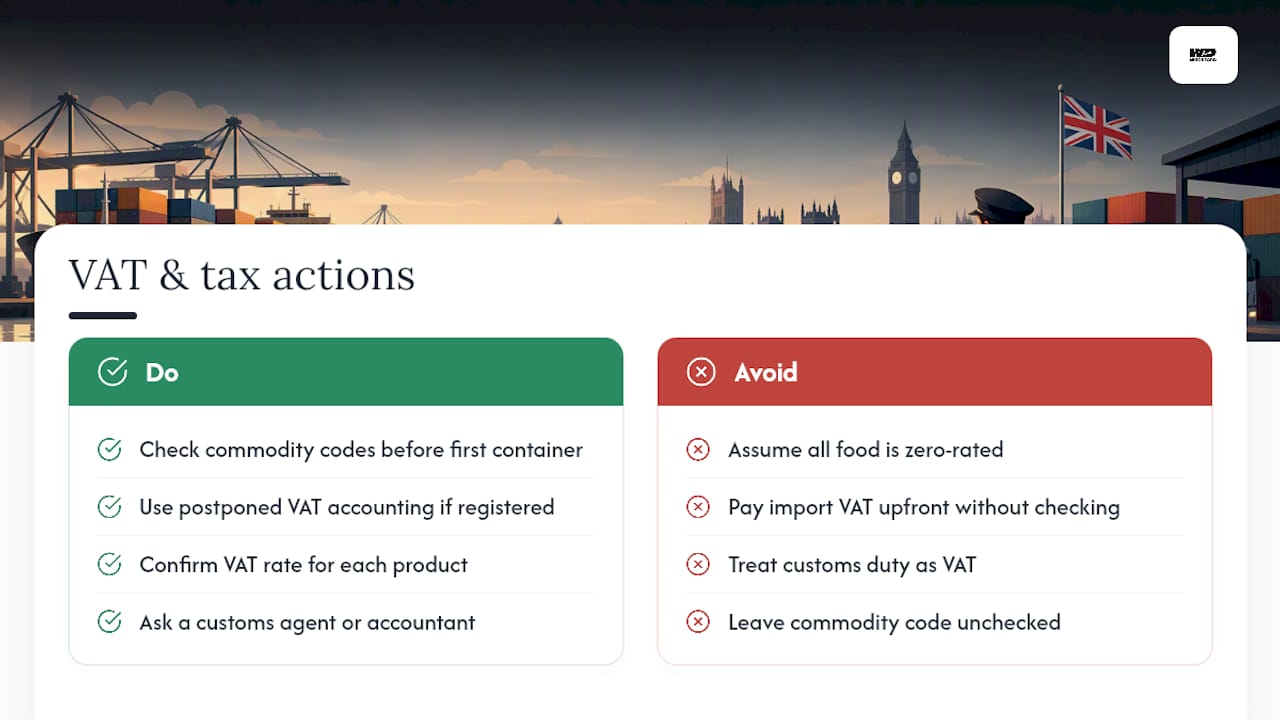
Most food imported for resale is subject to import VAT at the point of entry, though the rate depends on the product. Many staple foodstuffs qualify for the zero rate under UK VAT rules, while confectionery, crisps, and certain other categories are standard-rated. Getting the commodity code right matters here as much as it does for customs clearance, because the wrong code can mean paying VAT at the wrong rate or missing a relief you were entitled to.
If you’re VAT-registered, you can usually account for import VAT through your normal VAT return using postponed VAT accounting, rather than paying it upfront at the border and waiting to reclaim it. This makes a real difference to cash flow if you’re bringing in regular container loads rather than one-off pallets.
Customs duty is separate from VAT and depends on the tariff classification and country of origin. Some food categories benefit from preferential rates under UK trade agreements, and duty relief schemes exist for specific circumstances, such as goods that are re-exported or processed before resale. None of this is straightforward to work out from a spreadsheet alone. If you’re importing regularly, it’s worth getting your commodity codes checked by a customs agent or accountant familiar with food imports before your first container lands, rather than after HMRC queries a declaration.
How Woodford helps you skip the border-control learning curve
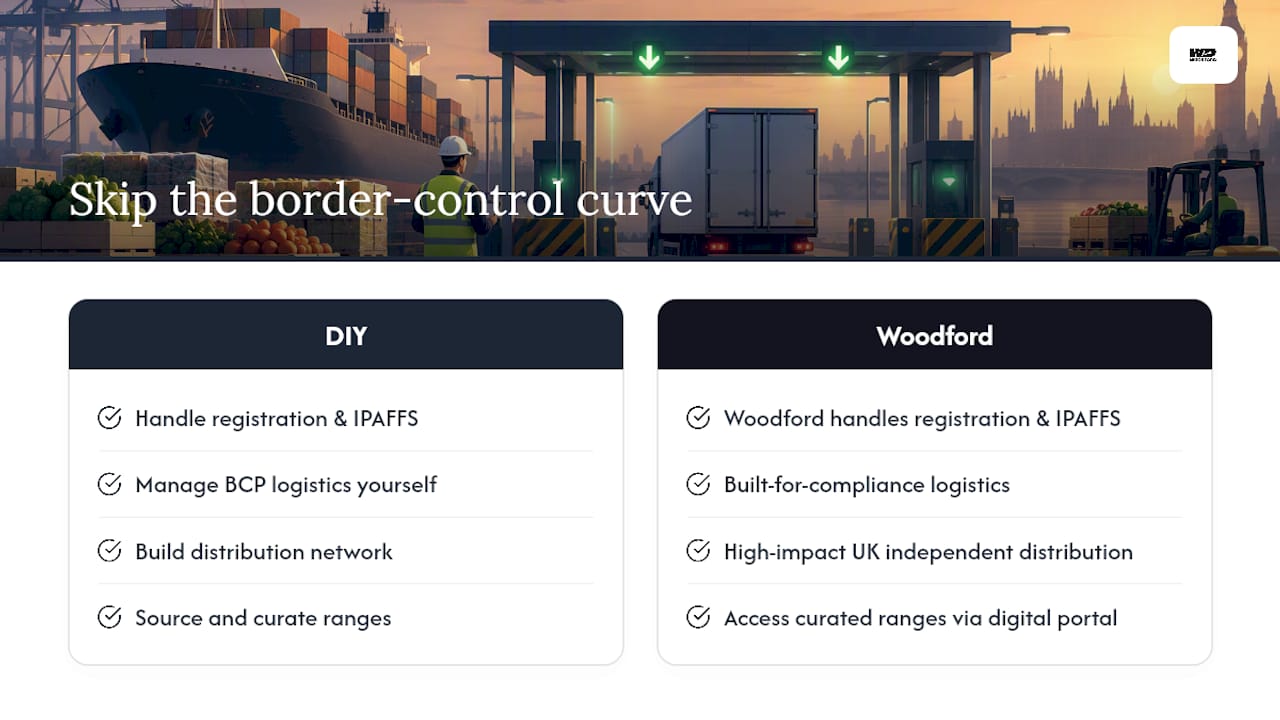
Handling registration, IPAFFS notifications, and BCP logistics yourself is entirely possible, but it’s also a part-time job on top of running a shop or growing a brand. A strategic food wholesaler exists to take operational weight off independent retailers and brand owners who’d rather spend their time on ranging and sales than customs codes, as explained by this example wholesale distributor workflow.
For brand owners, Woodford offers exclusive, high-impact distribution into the UK independent retail network, backed by logistics that are already built for compliance rather than bolted on afterwards. For retailers, the wholesale and logistics service gives you access to curated organic, drinks, dairy, chilled, speciality, vegan, and wellness ranges through a single digital ordering portal, without you needing to become an expert in Export Health Certificates. Woodford also publishes practical guides on wholesale logistics and UK food compliance for retailers who want to understand the mechanics behind the products on their shelves.
If you’re a brand owner weighing up whether to manage UK import and distribution alone or hand it to a partner who already has the infrastructure, Woodford’s brand owner page is the place to start that conversation.
Sources
Keep these pages saved. Rules on import restrictions and IPAFFS requirements change, sometimes with little warning.
FAQ
Do I need a licence to import food into the UK?
Most everyday food products don’t need a specific import licence, but high-risk categories and certain animal products do require additional certification, such as an Export Health Certificate. Check the GOV.UK list of foodstuffs with GB import restrictions before agreeing a supplier contract, since restrictions can apply to specific country and product combinations.
How long does it take to clear customs when importing food?
Low-risk goods with correct paperwork can clear within days. Products of animal origin needing IPAFFS notification must be flagged at least one working day before arrival, and physical inspection or lab testing can add several more days.
Do I need an EORI number to import food to the UK?
Yes. Every business importing goods into Great Britain needs an EORI number starting with GB to submit customs declarations, and this applies whether you file declarations yourself or through an agent.
Can Woodford help me distribute an imported food brand in the UK?
Yes. Woodford offers exclusive distribution services for brand owners looking to place imported products into the UK independent retail network, alongside logistics support and a digital ordering portal for retailers.
What happens if my food consignment fails a border inspection?
Failed consignments can be detained, retested, or refused entry depending on the nature of the failure. Goods awaiting lab results are often held at an approved storage facility, with the importer usually responsible for storage and testing costs.


