
New brand forecasting: 5 ways to make opening orders with Woodford
Yes, you can produce a defensible opening forecast for a new brand launch without a single day of sales history. The method combines analogue or attribute-based baselines with pre-launch signals and scenario buffers, not a crystal ball. Build conservative, base, and upside scenarios, set a review trigger at a fixed week number, and treat the pre-launch number as a working hypothesis rather than a final answer. Post-launch calibration is where the real accuracy shows up.
TL;DR:Reliable new brand forecasts rely heavily on analogue or attribute-based models combined with pre-launch signals like wholesale commitments and pre-orders.Pre-launch signals such as retailer commitments and search trends are more meaningful than vanity metrics like social media likes or newsletter sign-ups.Post-launch calibration within the first 12 to 16 weeks is essential, with weekly reviews early on, shifting to biweekly updates to refine the forecast.Building scenarios with buffers tailored to lead time and product novelty helps determine appropriate order quantities and replenishment triggers.Wholesale distribution partnerships significantly enhance forecast accuracy by converting pre-launch signals into confirmed sales commitments before launch.
WoodfordMake Your Launch Easier to ReachWoodford connects food brands with independent retailers through exclusive distribution, trend-led curation, and hassle-free logistics.Explore Woodford
Table of Contents
- Why forecasting for new brands is a different job
- Five practical forecasting methods and when to use each
- How to build a defensible pre-launch forecast and opening order
- Pre-launch signals worth collecting
- Post-launch calibration: the first 12 to 16 weeks
- Turning scenarios into buy quantities and reorder rules
- How Woodford applies these principles to food and drink launches
- Where a distribution partner fits into the picture
- Sources
- FAQ
Why forecasting for new brands is a different job
Established SKUs give you months or years of sell-through data to model. A new brand gives you nothing but assumptions, so the forecast is only as good as the inputs you feed it: category benchmarks, comparable launches, and buyer intuition. That’s the cold-start problem, and it changes everything about how you plan.
There are really two distinct jobs hiding inside “forecasting for new brands”:
- Pre-launch baseline: a best estimate built before a single unit has sold, used to size the opening order
- Post-launch calibration: a live recalculation using actual sell-through once stock hits shelves
The gap between these two matters for lead time and cash. Order too conservatively against a long supplier lead time and you miss the sales window entirely. Order too aggressively and you’re staring at a stockroom full of markdown risk. Buyer commitments and analogue forecasting fill the data gap that a lack of sales history leaves behind, and they’re the backbone of everything that follows.
Five practical forecasting methods and when to use each
No single method carries a new-brand forecast on its own. Layering two or three, and weighting them by confidence, gets you closer to a workable number than betting everything on one.
- Analogue forecasting — find three to five comparable products that launched recently, in a similar channel, and use their early sell-through curves as a template. Best for categories with recognisable comparables (a new oat drink versus existing oat drinks); weakest when the product genuinely creates its own category.
- Attribute-based forecasting — instead of one analogue, you build a synthetic comparison from shared attributes (price point, pack size, flavour profile, dietary claim) across many products. Attribute matching replaces missing SKU history by borrowing patterns rather than a single comparable product.
- Delphi/judgemental forecasting — structured input from buyers, category managers, and sales reps, aggregated and reconciled over two or three rounds. Useful when data is thin but expert intuition is strong; weak if your panel shares the same blind spots.
- Diffusion/Bass modelling — models adoption as a curve (slow start, acceleration, plateau), useful for genuinely novel products where “will this catch on” matters more than “how many units in week one.”
- Bayesian blending — combines a prior (your analogue or attribute baseline) with observed early sales, shifting weight towards real data as it accumulates.
Statistic to anchor expectations: new products typically account for a modest share of total category sales in any given period, a reminder that even a well-forecast launch is competing against an entrenched shelf. Hybrid approaches such as DemandForest, which pairs clustering with Random Forest and quantile regression, can automate analogue selection and quantify the uncertainty band around a forecast rather than just producing a single point estimate.
How to build a defensible pre-launch forecast and opening order
Turning assumptions into an actual purchase order takes a structured sequence, not a gut call.
- Set launch scope and metrics — define the channel, the geography, and whether you’re forecasting units, revenue, or both.
- Assemble attributes and analogues — pull three to five comparable launches and list shared attributes (price, format, claim).
- Generate baseline forecasts — run analogue and attribute-based models in parallel and compare outputs.
- Collect and weight pre-launch signals — layer in pre-orders, waitlists, and retailer feedback (covered below).
- Convert into scenarios and add a buffer — build conservative, base, and upside cases, then apply a stock buffer sized to lead time.
- Set review triggers and replenishment rules — fix the week number and sell-through threshold that force a recalculation.
Pro Tip: Choose analogues from the same channel and price band before you chase category similarity. A £3.50 oat drink launching into convenience stores behaves nothing like a £5.50 oat drink launching into premium delis, even if both are “oat drinks.”
Pre-launch signals worth collecting
Vanity metrics lie. Social media likes and newsletter sign-ups feel encouraging but rarely correlate with a shopper reaching for the product on shelf. What actually moves a forecast is behaviour that costs the customer something, even a small commitment.
- Pre-orders and waitlists with a deposit or card on file carry far more weight than free sign-ups
- Wholesale commitments — a retailer agreeing to stock a minimum quantity is the strongest signal you’ll get pre-launch
- Search and traffic trends for the category or a close competitor product
- Direct retail buyer feedback from category managers who’ve seen hundreds of launches
Wholesale commitments, waitlists, pre-orders, search volume, and direct buyer feedback each translate into a numeric adjustment. A retailer who commits to 200 units across five stores lets you scale that ratio across your full distribution footprint. Before you lean on analogue history, strip out promotional spikes and stockout gaps. A comparable product’s Christmas surge or a week where it sold out entirely will distort your baseline if you don’t clean it first.
Post-launch calibration: the first 12 to 16 weeks
The pre-launch forecast is a hypothesis. Real sell-through data is what tests it, and it starts arriving within days of hitting shelf.
- Weeks 1 to 4: review weekly. Early sell-through is noisy, but sharp deviations from the base case (either direction) need a fast response.
- Weeks 4 to 12: move to a biweekly cadence as the signal stabilises.
- Weeks 12 to 16: this is when planners typically retire the pre-launch prior and let observed sales carry the forecast on their own.
- Bayesian update: each week’s real sales shift weight away from the original analogue-based prior and towards the observed pattern.
Pro Tip: Cap how much a single volatile week can move your forecast. A Bayesian ramp model that lets one freak week override three stable ones will send you chasing noise instead of signal.
Turning scenarios into buy quantities and reorder rules
A forecast without a buying rule attached to it is just a spreadsheet. The conversion step is where risk gets managed.
- Map each scenario to an order size — the conservative case sets your minimum viable order, the base case sets your working plan, and the upside case tells you how fast you could scale if wholesale commitments outperform.
- Size the buffer to lead time and novelty — buffers generally ranging from a modest to substantial percentage depending on product novelty and supplier lead time are common, wider for genuinely novel products or long supplier lead times, tighter for close analogues with short lead times.
- Set a replenishment trigger — a fixed sell-through percentage or weeks-of-supply threshold that automatically prompts either a reorder or a pause.
- Build a downside plan before launch, not after — know in advance what a markdown or reallocation to another retailer looks like if sell-through stalls.
How Woodford applies these principles to food and drink launches
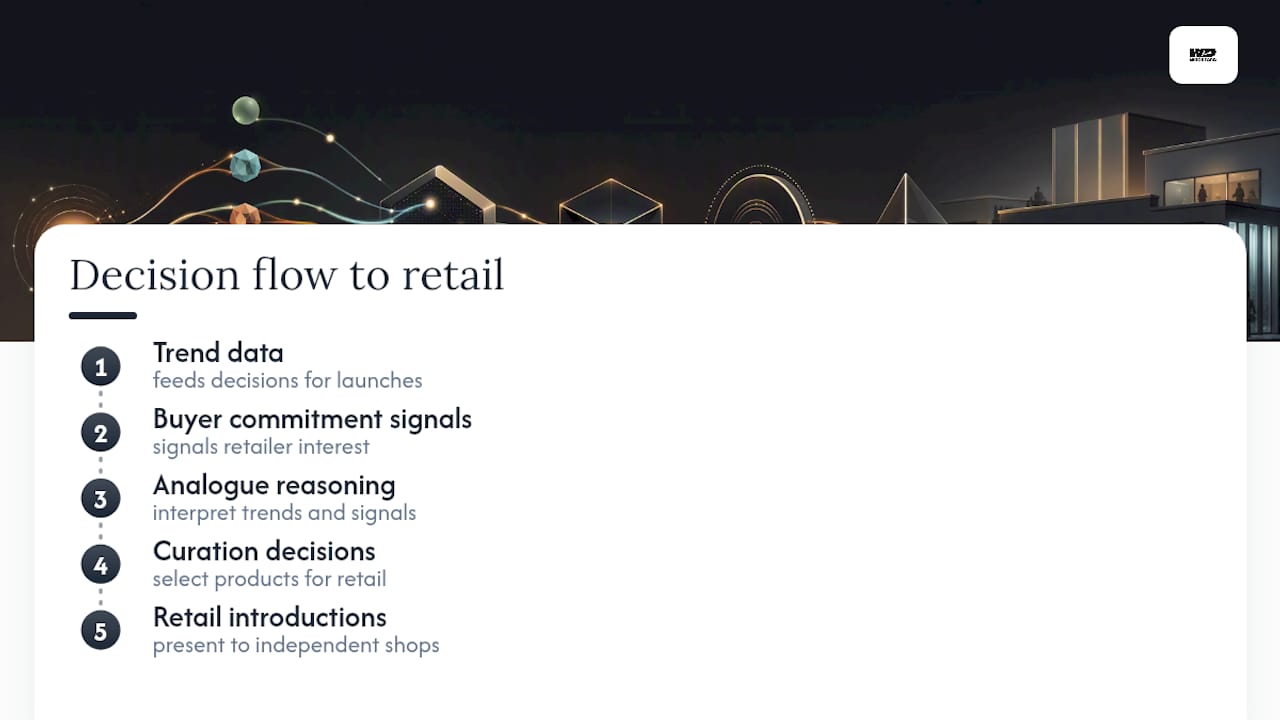
This process is applied daily in trend-led wholesale distribution to independent retailers, with curation decisions and retail introductions depending on analogue reasoning and buyer commitment signals similar to those covered above. For a deeper look at how trend data feeds those decisions, see Woodford’s guides on conducting trend analysis for UK food brands and the food trends shaping 2026.
Where a distribution partner fits into the picture
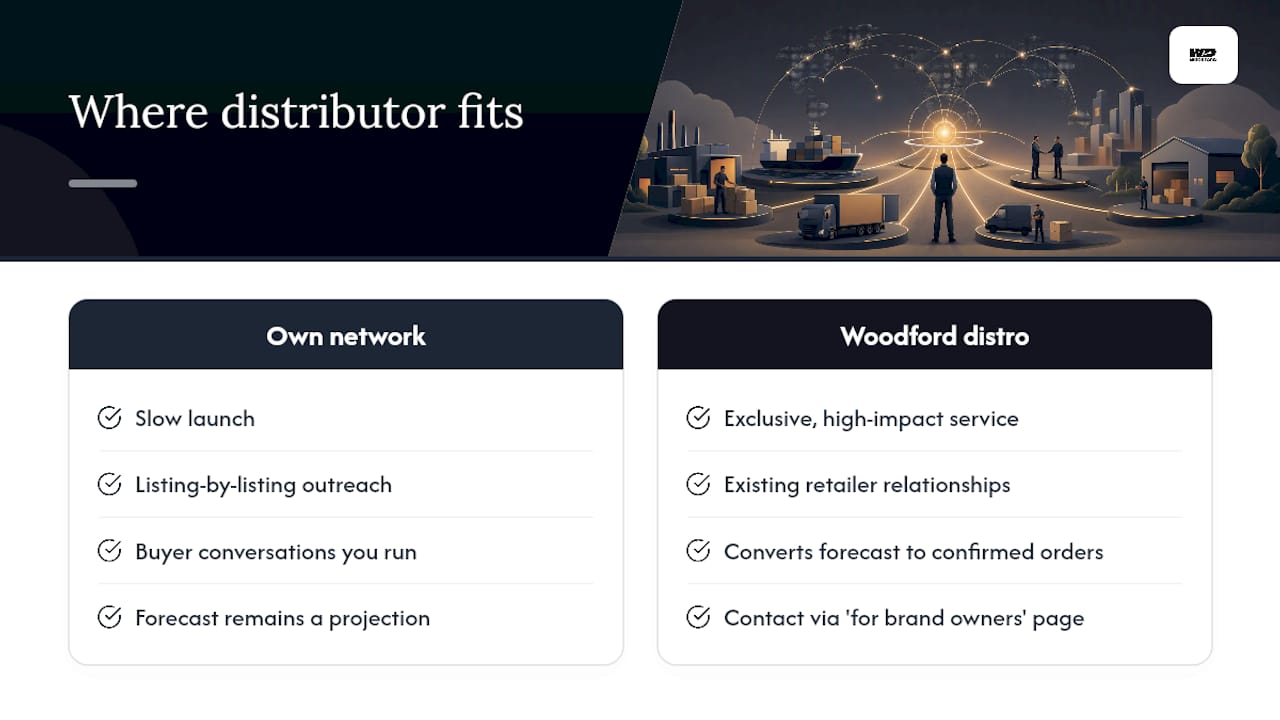
Running the workflow above still leaves you needing somewhere to sell what you’ve forecast. Building your own retailer network from scratch, listing by listing, is one route; it’s slow, and every buyer conversation you have yourself is one Woodford has already had at scale across its retailer base. Woodford’s exclusive, high-impact distribution service exists specifically for brand owners who’ve done the forecasting work and now need retail introductions and wholesale commitments to convert that number into real shelf presence. That’s the pre-launch signal your forecast was missing: a distributor’s existing retailer relationships turn a projected order into a confirmed one before launch day. If your brand fits the organic, drinks, dairy, chilled, speciality, vegan, or wellness categories Woodford curates for, the next step is straightforward: get in touch through the for brand owners page and talk through where your launch sits against current retail demand.
Sources
For deeper method detail, see TrueGradient on demand planning for new products, the DemandForest study on ScienceDirect, and AWS Prescriptive Guidance on forecasting best practices.
- Demand planning for new products in retail | TrueGradient
- Forecasting demand profiles of new products
- Share of sales from new products | Statista
FAQ
What Are the Seven Steps to Forecasting?
Most practical frameworks compress to: define scope, gather data, choose a method, build the baseline, collect live signals, generate scenarios, and set review triggers. The six-step workflow earlier in this guide covers the same ground in a launch-specific order.
How Do You Forecast Demand for New Products?
Combine an analogue or attribute-based baseline with pre-launch signals like wholesale commitments and pre-orders, then wrap the result in conservative, base, and upside scenarios. Attribute matching and analogue methods are the strongest starting point when no sales history exists.
What Are the Five Forecasting Methods?
Analogue, attribute-based, Delphi/judgemental, diffusion/Bass, and Bayesian blending each solve a different piece of the cold-start problem, and most defensible launch forecasts layer two or three together rather than relying on one.
What Is the Golden Rule of Forecasting?
There isn’t one universally agreed “golden rule,” but the closest practitioner consensus is to treat every new-brand forecast as a starting hypothesis, not a fixed number, and to recalibrate against real sell-through fast rather than defend the original estimate.
Does Woodford Help With Launch Forecasting Directly?
Woodford doesn’t build forecasts for brands, but its retail introductions and wholesale commitments supply exactly the kind of pre-launch signal that strengthens a forecast. Details on the distribution service sit on the for brand owners page.


