Food brand strategy drives UK retail success in 2026

Most food brand managers assume price is the single most important factor in consumer purchasing decisions. Yet evidence from leading UK retailers reveals that strategic branding shapes perceived value, drives customer loyalty and determines market share more powerfully than price alone. Waitrose, Tesco, Sainsbury’s and Aldi demonstrate how sophisticated brand positioning influences consumer behaviour and sustains competitive advantage. Understanding these dynamics equips food brand managers and independent retailers with the strategic tools to build lasting market success through authentic, emotionally resonant brand experiences that transcend simple price competition.
Table of Contents
- How UK Food Brands Balance Quality, Value And Customer Perception
- The Emotional Connection As A Central Pillar Of Food Brand Strategy
- Comparing UK Food Retailers: Pricing Perceptions, Branding Approaches And Market Implications
- Practical Steps For Food Brand Managers And Retailers To Harness Brand Strategy
- Explore Woodford’s Expertise In Quality Food Branding
- Frequently Asked Questions
Key takeaways
| Point | Details |
|---|---|
| Brand strategy shapes perceived value | Strategic positioning influences how customers evaluate quality relative to price, enabling premium positioning |
| Emotional connections foster loyalty | Campaigns that resonate with customer values build lasting relationships beyond transactional exchanges |
| Quality and value balance boosts share | Retailers balancing affordability with quality messaging gain competitive advantage and market growth |
| Long-term branding yields sustained results | Consistent multi-year campaigns build resilience and trust that withstand market volatility |
How UK food brands balance quality, value and customer perception
Major UK food retailers demonstrate that brand strategy fundamentally alters how consumers perceive quality versus price. Waitrose combined quality and value to deliver dramatic growth despite recession fears with its new ‘essential’ brand. This strategic extension maintained the retailer’s quality reputation whilst addressing price-conscious shoppers, proving that brand positioning can reconcile seemingly contradictory market demands.
Tesco and Sainsbury’s increased market share since 2022 by promoting perceived quality relative to price. Their success illustrates how strategic messaging influences consumer evaluations beyond actual pricing structures. Customers willing to pay premium prices for brands they perceive as offering superior quality create sustainable competitive advantages for retailers who master this balance.
Aldi presents a fascinating counterexample. Research reveals customers systematically overestimate Aldi’s prices, yet this perception actually benefits the retailer by attracting bargain-conscious consumers who discover lower actual prices than expected. This pricing perception gap demonstrates how brand positioning shapes purchasing behaviour independently of objective price points.
The following table compares perceived versus actual pricing strategies for major UK retailers:
| Retailer | Pricing Perception | Actual Positioning | Strategic Advantage | | — | — | — | | Waitrose | Premium quality | Value range added | Maintained loyalty whilst attracting new customers | | Tesco | Balanced value | Quality emphasis | Justified price premium through perceived quality | | Sainsbury’s | Quality focus | Premium positioning | Price less critical to customer decisions | | Aldi | Underestimated cost | Lowest prices | Positive surprise drives loyalty |
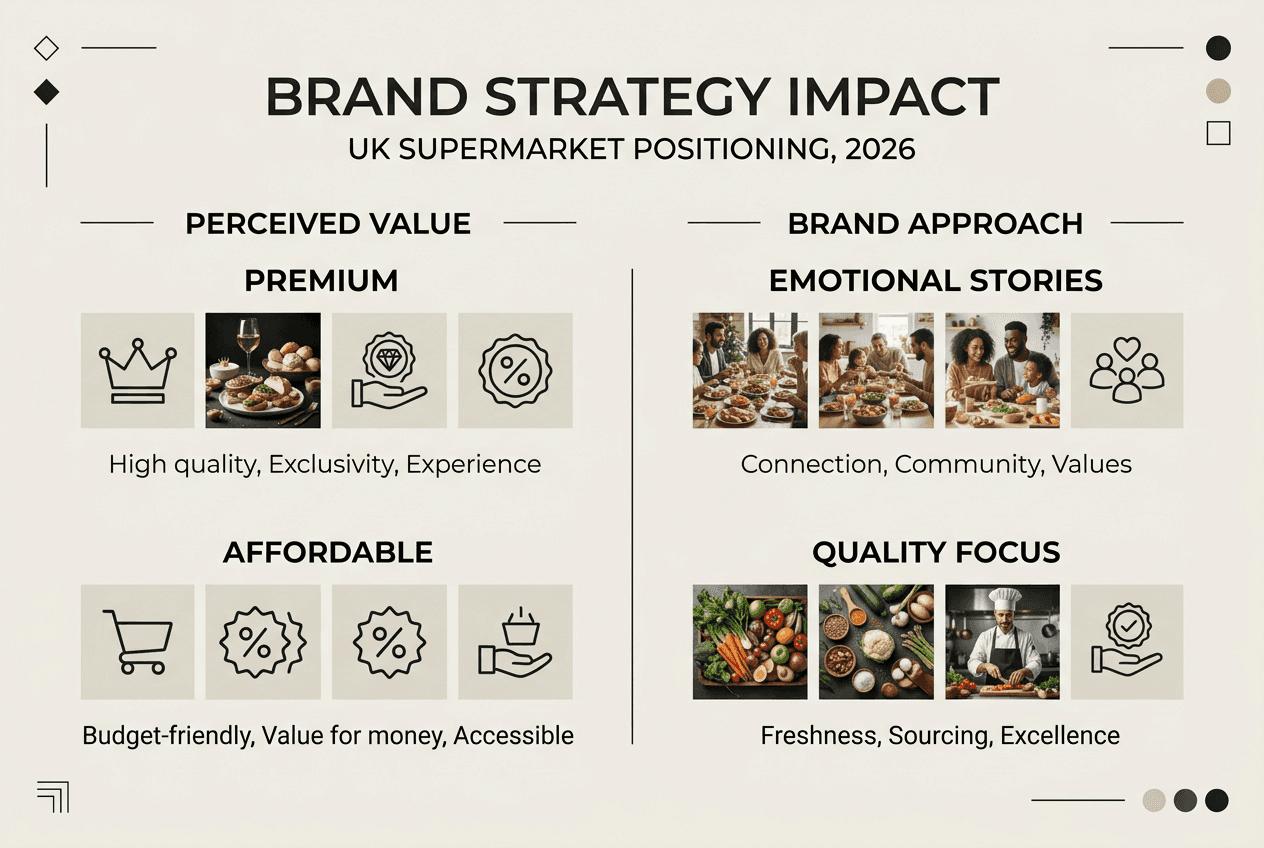
These examples reveal that coherent quality-value messaging maintains price justification whilst building customer trust. Retailers who articulate their brand positioning clearly enable customers to make purchasing decisions aligned with their values rather than price alone. Our food brands demonstrate this principle through curated selections that balance quality with accessibility for independent retailers.
Pro Tip: Prioritise coherent quality-value messaging across all customer touchpoints to maintain price justification and build lasting trust, avoiding mixed signals that confuse brand positioning.
The emotional connection as a central pillar of food brand strategy
Emotional branding extends far beyond visual identity to speak directly to customer values and lived experiences. Branding creates emotional connections with customers that transcend functional product attributes. Food retailers who master this dimension build resilient brands that withstand competitive pressure and economic uncertainty.
Tesco revitalised its brand and improved customer perceptions through its long-term ‘Food Love Stories’ campaign, focusing on emotional connections people have with food. This six-year commitment demonstrated that sustained emotional engagement builds brand resilience. The campaign proved particularly valuable during the pandemic, when established emotional bonds helped maintain customer loyalty through unprecedented disruption.

Long-term brand investments pay dividends, especially during challenges that test customer relationships. Retailers who invest consistently in emotional storytelling create deeper connections than competitors focused solely on transactional messaging. These bonds translate into measurable business outcomes through increased loyalty, enhanced quality perception and stronger differentiation.
Emotional connection benefits food brands through several mechanisms:
- Increased loyalty as customers identify personally with brand values and narratives
- Enhanced perception of quality through positive associations and memorable experiences
- Stronger differentiation in crowded markets where functional attributes become commoditised
- Repeat business driven by emotional satisfaction beyond product performance
Authentic emotional branding requires understanding what truly matters to your target customers. Generic appeals to family or tradition fall flat compared to specific, relatable stories that reflect genuine customer experiences. Branding strategies for food brand owners must prioritise authenticity over manufactured sentiment.
Branding is fundamentally about creating emotional bonds with customers, not merely designing attractive logos or packaging. These connections determine whether customers remain loyal during competitive pressure or economic uncertainty.
Emotional branding works because food carries inherent emotional significance. Meals connect to memories, celebrations, comfort and identity. Retailers who tap into these associations through thoughtful campaigns build lasting relationships that transcend price sensitivity. The most successful food brands recognise that customers buy experiences and meanings, not just products.
Comparing UK food retailers: Pricing perceptions, branding approaches and market implications
Different UK food retailers adopt distinct branding strategies that shape pricing perceptions and market positioning. Tesco invested over £20 million in multi-channel campaigns to rebuild its brand by growing quality, value and reputation with customers. This substantial investment demonstrates the strategic importance major retailers place on brand perception as a driver of footfall and spend.
Sainsbury’s customers perceive price as less critical, allowing premium brand positioning. This perception enables Sainsbury’s to justify significant price premiums through quality messaging. The retailer’s success illustrates how strategic branding creates space for premium pricing by shifting customer focus from cost to value.
Aldi presents an intriguing contrast. Customers overestimate Aldi’s prices yet remain attracted by the brand’s value positioning. Upon shopping, they discover lower actual prices than expected, creating positive surprise that reinforces loyalty. This perception gap works in Aldi’s favour by attracting bargain-conscious consumers whilst delivering better value than anticipated.
The following table summarises key brand strategy elements for major UK retailers:
| Retailer | Pricing Perception | Campaign Approach | Market Share Impact |
|---|---|---|---|
| Tesco | Quality justifies premium | Multi-channel, long-term investment | Increased share since 2022 |
| Sainsbury’s | Price less critical | Premium quality messaging | Sustained premium positioning |
| Aldi | Overestimated prices | Value focus with quality emphasis | Positive surprise drives growth |
| Waitrose | Premium with value options | Strategic range extension | Growth despite recession fears |
Retailers can leverage pricing perceptions strategically through systematic approaches:
- Conduct research to understand how customers perceive your pricing relative to competitors and actual costs
- Develop messaging that highlights quality and value dimensions beyond simple price comparisons
- Invest in multi-channel campaigns that consistently reinforce your chosen positioning over extended periods
- Monitor perception shifts through regular customer feedback and adjust messaging to maintain desired positioning
- Balance premium positioning with accessible entry points to broaden appeal without diluting brand equity
These strategies recognise that customer perceptions matter more than objective price points in driving purchasing decisions. Woodford quality foods supports retailers in navigating these dynamics through curated brand selections that balance quality with competitive positioning.
Successful retailers understand that brand strategy shapes the context within which customers evaluate prices. A premium brand justifies higher prices through perceived quality, whilst value brands attract customers through affordability messaging. The key lies in maintaining consistency between brand positioning, actual pricing and customer experience to avoid cognitive dissonance that erodes trust.
Practical steps for food brand managers and retailers to harness brand strategy
Translating strategic insights into actionable brand development requires systematic approaches that balance customer expectations with authentic brand values. Waitrose realised having its brand synonymous with quality food and ethical principles could drive price-conscious shoppers away during recession. This recognition prompted strategic brand extension that maintained core values whilst addressing affordability concerns.
Understanding your brand’s core values and customer expectations enables you to balance quality with affordability authentically. Generic positioning statements fail compared to specific value propositions rooted in genuine customer needs. Research what truly matters to your target customers, then align brand messaging with those priorities consistently.
Develop authentic emotional storytelling to deepen customer ties and differentiate from competitors. Unwavering belief in long-term brand building paid off for Tesco, even during a history-defining pandemic. This commitment demonstrates that sustained emotional engagement builds resilience against market disruptions. Stories that reflect genuine customer experiences resonate more powerfully than manufactured narratives.
Adopt a long-term view in brand building with consistent messaging across channels. Short-term tactical campaigns generate immediate sales but rarely build lasting brand equity. Multi-year commitments to coherent brand narratives create cumulative advantages that compound over time. This patience proves challenging but essential for sustainable market success.
Practical implementation follows structured steps:
- Conduct comprehensive brand audit to assess current positioning, customer perceptions and competitive differentiation
- Execute market research to understand customer values, purchasing drivers and emotional connections to food categories
- Develop messaging framework that articulates quality-value balance authentically aligned with brand values
- Plan multi-channel approach ensuring consistent brand experience across touchpoints from packaging to digital presence
- Execute campaigns with commitment to sustained investment over multiple years rather than short-term tactical bursts
- Track performance through customer perception metrics, loyalty indicators and market share trends to refine approach
Food brand strategy for retailers and brand strategy for food brand owners benefit from systematic approaches that prioritise authenticity and consistency. Rushing brand development or chasing trends undermines the long-term equity building that drives sustainable success.
Pro Tip: Avoid chasing short-term trends that dilute brand identity. Instead, nurture enduring brand ideas that resonate with customers over years, building cumulative equity that withstands competitive pressure and market volatility.
Successful brand strategy requires patience, consistency and authentic customer understanding. Retailers who invest systematically in these dimensions build competitive advantages that transcend price competition, creating loyal customer bases willing to pay premium prices for brands they trust and value.
Explore Woodford’s expertise in quality food branding
Transforming strategic insights into market success requires partners who understand both quality food brands and retail dynamics. Woodford offers a curated selection of quality food brands tailored for retailers seeking to differentiate through premium positioning and authentic value propositions. Our expertise bridges visionary food brands with ambitious independent retailers through exclusive distribution and trend-led curation.
Support and promotional services help food brands connect with customers effectively through strategic positioning that balances quality with accessibility. Whether you’re a retailer seeking distinctive brands or a food brand owner looking to expand distribution, Woodford provides the expertise and logistics to implement strategic brand approaches that drive market success. Partner with Woodford to access curated food brands, retail solutions and brand owner support that translate branding principles into tangible business growth.
Frequently asked questions
What is the role of food brand strategy in UK retail?
Food brand strategy shapes how customers perceive value beyond simple price comparisons, influencing purchasing decisions and loyalty. Strategic positioning enables retailers to justify premium pricing through quality messaging whilst building emotional connections that sustain customer relationships. Effective brand strategy differentiates retailers in crowded markets where functional product attributes become commoditised.
How can emotional branding improve consumer loyalty?
Emotional branding builds relatable stories that resonate with customer values and lived experiences, creating deeper connections than transactional messaging. These emotional bonds encourage loyalty by making customers feel personally invested in brand success. Premium brand positioning becomes sustainable when customers identify emotionally with brand narratives beyond functional product benefits.
What strategies help balance quality and price perception effectively?
Introduce value-focused product ranges without diluting core quality positioning, as Waitrose demonstrated with its essential range during recession concerns. Use multi-channel campaigns to reinforce both quality and affordability messaging consistently across customer touchpoints. Research customer perceptions regularly to ensure messaging aligns with actual experiences and maintains credibility.
Why is long-term brand building crucial for food retailers?
Long-term branding builds trust and resilience against market volatility by establishing deep customer relationships that withstand competitive pressure. Consistent messaging over multiple years creates cumulative brand equity that short-term campaigns cannot replicate. This sustained investment proves particularly valuable during crises, when established emotional bonds maintain customer loyalty through disruption.