
Fine food distribution for UK retailers and brands
Fine food distribution delivers a curated product range, trade pricing, reliable fulfilment, and compliance cover in a single supplier relationship. If you run an independent food retail business, manage procurement for a multi-site group, or own a food or beverage brand that needs trade distribution, this guide is written for you.
The core services you should expect from a quality gourmet food distributor:
- Curated product selection with trend-led ranges and exclusivity options
- Trade pricing and account terms including volume discounts and promotional support
- Delivery and cold-chain logistics covering ambient, chilled and frozen lines
- Stockholding and fulfilment so you are not carrying excess inventory
- Compliance cover including allergen matrices, HACCP documentation and recall procedures
- Digital ordering portal for real-time stock visibility and reordering
The single most important shift in UK specialty food supply is away from transactional wholesale towards strategic partnerships. Retailers that choose distributors offering curated ranges, transparent pricing and genuine account support consistently outperform those buying on price alone.
Recommended next step: use the evaluation checklist in Section 5 to score any distributor you are considering before requesting terms.
Table of Contents
- What does a fine food distributor actually offer you?
- How does delivery coverage and lead time work across the UK?
- What does fine food distribution actually cost?
- How do you choose the right fine-food distributor?
- What food safety and compliance standards should you require?
- Does your distributor’s technology actually reduce your workload?
- Why Woodford stands out against the evaluation checklist
- Key takeaways
- Woodford: trade distribution built for independent retailers
- Useful sources and further reading
What does a fine food distributor actually offer you?
The service offer goes well beyond moving pallets. A specialist in artisanal food distribution functions as a category partner, a logistics operator and a compliance resource simultaneously.
Service categories to map against your needs:
- Product curation: hand-picked ranges from verified producers, often with exclusivity agreements that protect your margin and differentiate your shelf
- Trade pricing and account terms: tiered volume discounts, 30–60 day payment terms and promotional contribution budgets
- Delivery and cold-chain handling: temperature-controlled transport for chilled and frozen lines, with documented chain-of-custody records
- Stockholding and fulfilment: the distributor holds buffer stock, reducing your working capital requirement
- Marketing and merchandising support: point-of-sale assets, shelf-ready packaging guidance and seasonal range planning
- Sample and promotional programmes: new-product samples, listing incentives and co-funded promotions
Product range examples across a well-stocked gourmet food distributor:
| Category | Example lines |
|---|---|
| Ambient specialist pantry | Single-origin olive oils, artisan preserves, rare vinegars |
| Chilled artisan dairy | Raw-milk cheeses, cultured butters, small-batch yoghurts |
| Cured meats | British charcuterie, continental salumi, smoked fish |
| Bakery | Sourdough loaves, patisserie, gluten-free artisan bakes |
| Premium drinks | Natural wines, craft spirits, botanical soft drinks |
| Specialist ingredients | Heritage grains, fermented condiments, truffle products |
UK food self-sufficiency has dropped to roughly 65%, which means retailers increasingly depend on curated, resilient supply partners rather than sourcing direct from producers who may face climate or policy disruption. A distributor with strong sourcing relationships and near-shoring strategies absorbs much of that risk before it reaches your shelf.

The value adds that separate good distributors from average ones are exclusivity agreements, seasonal range planning and a proper ordering portal. Without those three, you are essentially paying for a warehouse with a van.
How does delivery coverage and lead time work across the UK?
Geography and temperature class are the two variables that most affect your delivery SLA. Understanding both upfront prevents the frustration of discovering your rural Scottish branch sits outside a distributor’s chilled network.
Typical coverage tiers:
- Metropolitan same-day: available in London and a handful of major cities for ambient lines; rare for chilled
- Next-day national: the standard for most ambient and chilled orders placed before a cut-off (typically noon)
- Scheduled weekly: common for low-turn specialty lines, frozen products and remote postcodes
- Rural and remote exceptions: the Highlands, islands and parts of Wales often attract surcharges or longer lead times; confirm coverage explicitly before signing terms
Cold-chain requirements tighten the window considerably. Chilled products must stay within 2–8 °C throughout transit, and frozen lines below 0 °C. Any distributor handling artisan dairy or cured meats should be able to show you temperature logs from recent deliveries, not just a policy document.
Onboarding timeline to expect:Account application and trade verification: a few working daysSample order and range review: typically about one to two weeksFirst standing order placed: generally within the first monthPromotional lead times: several weeks ahead of campaign date
Connecting POS data to distributor portals enables predictive restocking cycles that reduce manual reordering and cut waste, which is particularly valuable for chilled lines with short shelf lives. Distributors investing in advanced analytics and automation are also better placed to flag routing risks before they become missed deliveries.
For imported lines, factor in additional lead time for customs documentation, especially post-Brexit. The UK–EU Sanitary and Phytosanitary agreement has eased some border friction, but implementation remains inconsistent, and even minor documentation gaps can delay perishable shipments. A distributor with UK food logistics expertise will manage that paperwork on your behalf.
What does fine food distribution actually cost?
Food inflation is forecast at 9–10% by end-2026, which makes understanding your total landed trade cost more urgent than ever. Distributors charge in several overlapping ways, and the headline unit price rarely tells the full story.
Primary charging models:
- Unit/line pricing: the base cost per SKU, usually expressed as a trade price with a recommended retail price alongside
- Tiered volume discounts: better unit rates once you hit case or pallet thresholds
- Delivery or pallet fees: a flat charge per drop or per pallet, sometimes waived above a minimum order value
- Account or service fees: less common but present in some managed-distribution contracts
- Chargebacks: fees applied for failed deliveries, short-picks or rejected substitutions
Common hidden costs to watch for:
- Minimum-order surcharges when your basket falls below the threshold
- Storage fees for slow-moving lines held in the distributor’s warehouse
- Promotional contribution expectations (sometimes mandatory, not optional)
- Returns and substitution charges when you reject a line
Example cost breakdown for a sample ambient order:
| Cost element | Amount |
|---|---|
| 12 units × £4.00 trade price | £48.00 |
| Delivery fee (below MOQ threshold) | £9.00 |
| Total landed cost | £65.00 |
Introductory deals often compress margins for the distributor in exchange for a listing commitment, so the pricing you see in month one may not reflect standard trade terms. Ask explicitly what the terms revert to after any introductory period, and get the answer in writing.
Contract length matters too. Shorter rolling agreements give you flexibility but may mean higher unit prices. Exclusive distribution contracts for brand owners typically run 12–24 months and include volume commitments on both sides.
How do you choose the right fine-food distributor?
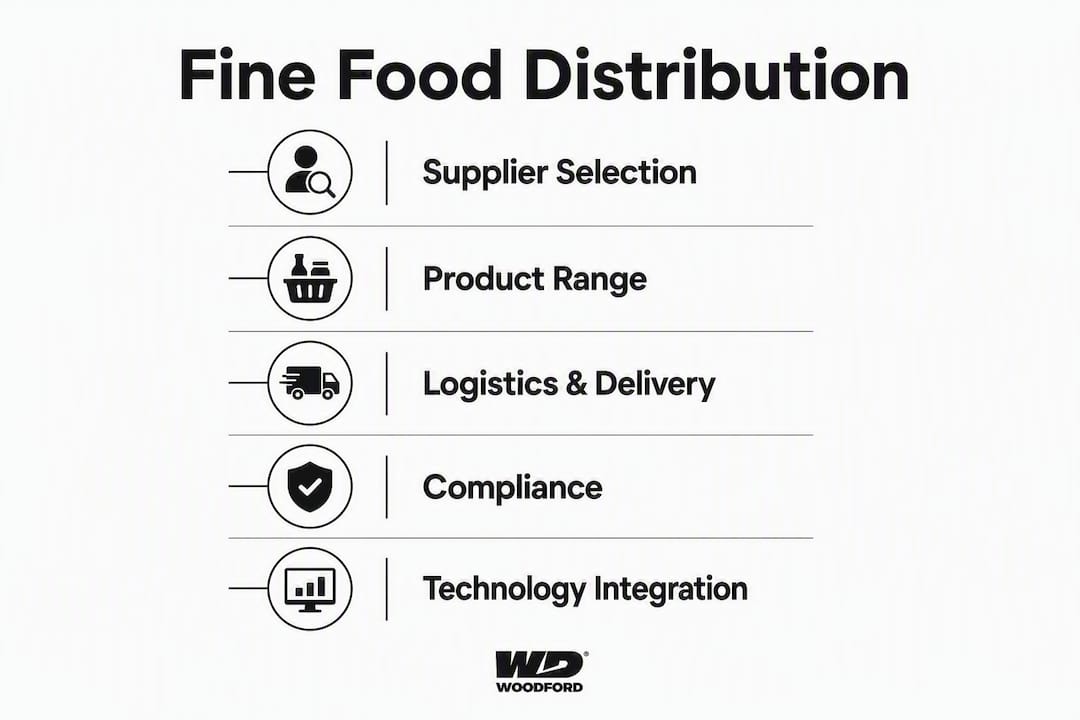
A structured evaluation process saves you from discovering problems after you have committed stock and margin. Work through this checklist before you request formal terms.
Step-by-step evaluation checklist:
- Product fit: does the range genuinely complement your existing offer, or does it duplicate what you already stock?
- Pricing transparency: can you see a full trade price list, including all fees and surcharges, before signing?
- Minimum order quantities: are the MOQs workable for your current volume, or will you be forced to over-order?
- Logistics SLAs: what are the confirmed delivery windows for your postcode, and are chilled lines covered?
- Technology: is there a digital ordering portal with real-time stock visibility, or are you ordering by email and spreadsheet?
- Account management: do you have a named contact, or does every query go to a generic inbox?
- Food safety certifications: can they provide current BRC/BRCGS, HACCP and SALSA documentation on request?
- Traceability: can they trace any SKU back to its producer within 24 hours?
Questions to ask in your first supplier meeting:
- What is your typical account onboarding time from application to first delivery?
- What is your substitution policy when a line is out of stock?
- How do you handle a product recall, and what documentation do you provide to retailers?
- Does your portal integrate with common POS or EPoS systems?
- What promotional margin support is available, and is it discretionary or contractual?
Red flags that should give you pause:
- Pricing presented verbally with no written schedule
- No digital ordering portal, or a portal that has not been updated recently
- Inability to provide cold-chain temperature logs on request
- Vague or absent allergen matrices for chilled and ambient lines
- Core lines with lead times exceeding five working days
Simple scoring rubric to compare distributors side by side:
| Dimension | Weight | Score (1–5) |
|---|---|---|
| Product fit and exclusivity | High | |
| Logistics capability and SLA | High | |
| Pricing transparency and total cost | High | |
| Technology and portal quality | Medium | |
| Account management quality | Medium | |
| Food safety certifications | High |
The wholesale procurement framework for UK independent retailers recommends reviewing supplier contracts at least annually, checking for changes to MOQs, payment terms and delivery charges. Build that review into your procurement calendar from day one.
What food safety and compliance standards should you require?
Regulatory compliance is not a one-time check. Effective distributors maintain dynamic documentation for allergens, traceability and recalls, which materially reduces legal and operational exposure for retailers. The distributor’s role as a regulatory shield means they handle product specifications, allergen declarations and recall paperwork on your behalf, but you remain legally responsible for what sits on your shelf.
Core certificates and standards to request at account setup:
- BRC/BRCGS: the British Retail Consortium Global Standard for food safety; the benchmark for UK retail supply
- HACCP plans: documented Hazard Analysis and Critical Control Points covering every product category
- SALSA: Safe and Local Supplier Approval, particularly relevant for smaller artisan producers in the range
- Supplier audit reports: third-party audits of the distributor’s own facilities and key upstream producers
- Allergen matrices: a complete, SKU-level document listing the 14 major allergens for every product
Essential documents to collect before placing your first order:
- Current certificates with expiry dates (not expired copies)
- Traceability logs demonstrating batch-level tracking from producer to delivery
- Recall procedure document, including your role as the retailer in a recall event
- Public liability and product liability insurance evidence
Set a calendar reminder to re-request certificates annually. A distributor that resists or delays providing updated documentation is a compliance risk, regardless of how good the product range looks.
Does your distributor’s technology actually reduce your workload?
The gap between a distributor with a proper ordering portal and one relying on email and PDF price lists is significant in practice. Distributors that ingest POS data and offer automated suggested ordering materially reduce waste and stockouts, particularly for chilled lines where over-ordering has a direct cost.
Common platform types to look for:
- Ordering portals: web-based catalogues with live stock levels, order history and account statements
- EDI integration: electronic data interchange for high-volume buyers or multi-site groups
- API links for POS: direct connection between your till system and the distributor’s inventory
- Forecasting and analytics add-ons: demand prediction tools that flag reorder points before you run out
Key features to require from any portal:
- Real-time stock visibility, not a static weekly update
- Automated suggested orders based on your purchase history
- Substitution rules you can configure (accept, reject or query)
- Audit trails for every order and delivery, accessible for compliance purposes
The UK wholesale sector is forecast to reach £42bn by 2030, with digital and service enhancements identified as the key differentiators. Distributors investing in portal technology now are building a capability that compounds over time; those still operating on spreadsheets are falling behind.
Pro Tip: Ask for a short live demo using real or anonymised POS data before you commit. A distributor confident in their integration will do this without hesitation. One that hedges or offers a scripted walkthrough instead is telling you something.

Why Woodford stands out against the evaluation checklist
Woodford is the UK’s leading strategic food wholesaler, working exclusively with independent retailers and food and beverage brand owners. Here is how Woodford maps against the evaluation dimensions from Section 5.
Capability checklist:
- Product range and exclusivity: curated, trend-led ranges with exclusive brand partnerships that protect your margin and differentiate your shelf from the multiples
- Logistics and delivery SLA: full logistics and fulfilment with cold-chain capability and documented delivery SLAs
- Minimum order and pricing: transparent trade pricing with no opaque fee structures; terms available on request
- Account management and ordering technology: dedicated account management and a digital ordering portal for real-time stock visibility and reordering
- Retail marketing support: merchandising assets, seasonal range planning and promotional support programmes
- Certifications and traceability: food safety compliance documentation available at account setup
Woodford’s approach reflects the structural shift analysts have identified: away from commodity wholesale towards collaborative, vertically integrated distribution that mitigates cost volatility and builds genuine resilience for retailers.
Independent retailers that partner with a distributor offering curated ranges, dedicated account support and a digital ordering portal consistently report fewer stockouts, better margin control and stronger customer loyalty than those managing fragmented supplier relationships alone.
A practical example of what this looks like: a multi-site independent grocer with six locations was managing 14 separate supplier relationships for its ambient specialty range. After consolidating through a single curated distributor, the buyer reduced ordering time by roughly half, cut short-pick incidents significantly, and gained access to exclusive lines unavailable through any other trade channel. The distributor handled all allergen documentation and recall procedures, removing a compliance burden the retailer had previously managed manually.
Woodford’s distributor model for independent retailers is built around exactly this kind of consolidation: fewer supplier relationships, better range coherence, and a single point of contact for logistics, compliance and marketing support.
Key takeaways
Choosing the right fine food distributor comes down to product fit, pricing transparency, logistics capability, technology quality, and compliance rigour — evaluated systematically before you commit.
| Point | Details |
|---|---|
| Evaluate before you commit | Use the eight-point checklist covering product fit, pricing, MOQs, SLAs, portal, account management, certifications and traceability. |
| Total landed cost matters | Add delivery fees, small-order surcharges and handling to the unit price; the headline trade price rarely reflects true cost. |
| Compliance is ongoing | Request BRC/BRCGS, HACCP and SALSA documents at setup and re-request annually; a distributor that delays is a liability. |
| Technology reduces waste | A portal with real-time stock visibility and automated suggested orders cuts stockouts and over-ordering on chilled lines. |
| Woodford as your partner | Woodford offers curated ranges, exclusive brand partnerships, full logistics, a digital ordering portal and dedicated account management for UK independent retailers and brand owners. |
Woodford: trade distribution built for independent retailers
Woodford works exclusively with UK independent retailers and food and beverage brand owners who want curated, trend-led ranges without the complexity of managing dozens of supplier relationships. The offer covers exclusive brand partnerships, full logistics and cold-chain fulfilment, a digital ordering portal with real-time stock visibility, and dedicated account management with merchandising support built in.
If you are ready to consolidate your specialty food supply, reduce compliance risk and access ranges your competitors cannot easily replicate, the next step is straightforward. Set up a trade account or request a portal demo to see how Woodford’s ordering technology integrates with your existing systems. Procurement teams can arrange a short onboarding call to discuss range fit, MOQs and delivery coverage for their specific locations.
Useful sources and further reading
The following sources informed this guide and are worth bookmarking for ongoing procurement planning:
- UK Food Supply Chain Challenges 2026 — Valiant CXO analysis of inflationary pressures, cost drivers and structural shifts in UK food distribution
- Serving Up 2026: Trends Shaping UK Foodservice, Retail, and Supply Chain — Orderly’s industry report on data integration, predictive forecasting and automation in distributor operations
- UK Food System Challenges: Climate, Policy and Profit — ESM Magazine coverage of Savills research on self-sufficiency, provenance and supply resilience
- UK Grocery, Foodservice and Wholesale Forecast to 2030 — IGD sector forecast including the £42bn wholesale growth projection and digital capability analysis
- Wholesale Procurement: a Guide for UK Independent Food Retailers — Woodford’s practical procurement framework covering supplier qualification, MOQs and logistics planning
- How to Choose Food Suppliers in the UK — Forkto guidance on supplier qualification, allergen compliance and the distributor’s role as a regulatory shield


